Friends

January 1, 2026

The Bootie Dilemma

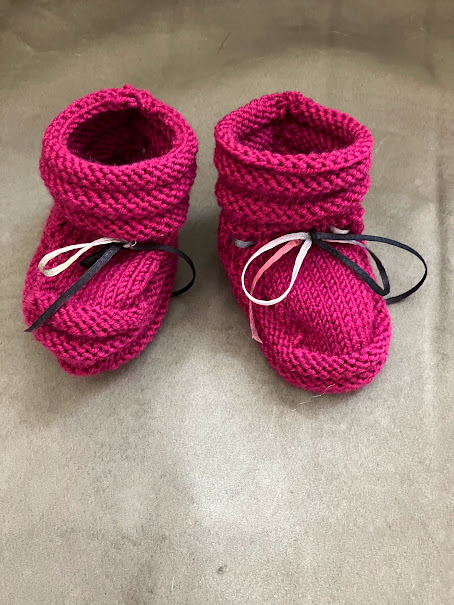
Anna, a former student of mine, is having a baby!  There hasn’t been a baby on my radar for a while so I am excited. I wanted to knit something for the new little person and give it to Anna at the baby shower.

Unfortunately, knitting has not been on my radar for a while either but I had made these particular little booties before and the instructions comes from a book called “Learn to Knit!” whose cover features a woman, smiling and relaxed with skeins of colorful wool under her arm and brandishing knitting needles.

The whole project felt jinxed from the beginning. I felt as though I was knitting with ten elbows instead of fingers. I lost track of where I was, in spite of noting the rounds with pen and paper. I pulled out rows, stich by stich, until I was sure of where I was. Passing my earlier stopping place, I noticed I had dropped a stitch five rounds earlier. In frustration, I pulled the whole thing out and began again. This happened two more times. I put the whole thing away and a week went by. The shower date was still three weeks away. I had plenty of time.

Did I mention that this was the month I was moving from my house of thirty years into a new living situation with my inamorato, Andrew? And a dog, Stella. I started the booties when the three of us were at the beach. They were supposed to be part of the relaxation of the week. Instead, they were part of what I went to the beach to relax from.

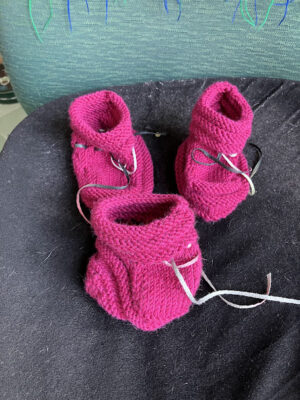
I brought the yarn and the needles and the happy woman on the cover of “Learn to Knit!” home from the beach. I was half moved into the new house, enough to be living there while I waited for the furniture move date. I settled in and started knitting while working my way through episodes of Matlock and Murder in Sandhamn. I finished the first bootie and started in on the second, feeling confidant. I knit happily away; you could have put me on the cover of “Learn to Knit!” I finished the second bootie. From a distance, they looked all tiny and cute like baby clothes look. Up close, one of them was quite a bit bigger and looser and seemed to have a few extra rows. It would have been perfect if there was a club foot involved. (I had recently re-read Of Human Bondage.)

I planned to give the booties to Anna as they were with no mention of a club foot, not to an expectant mother. I probably shouldn’t even have been thinking it. But the more I thought about it, the more I felt I was betraying my artistic/creative integrity. I didn’t have enough yarn left for another bootie and due to the obsessive way I weave the yarn in at the end, I didn’t think I could pull it out and re-use it and I was now out of yarn. The shower was two days away. I still had time. I bought another skein from The Tea Cozy.

On this third bootie, I was scrupulously careful to follow every line of the instructions. I wasn’t sure which of the first two booties correctly reflected the instructions but I was counting on the third one matching one of them. I knit all morning long the day before the shower. With 6 rounds to go, I fell asleep over Matlock.

Knitting the booties ought to have been straightforward. But there was this minor distraction that I was moving and my life was changing: I had been thrown into new routines, my belongings were scattered from one end of the zip code to the other and boxes were piling up in my new living space. I had limited range in one arm and pain in both arms from carrying boxes.

I finished Bootie number #3 the evening before the baby shower during an episode of Murder in Sandhamn. I could tell right away that something was wrong with it, something much worse than just being a little bigger than Bootie #1. It didn’t even look like a foot covering. More like a tiny football.


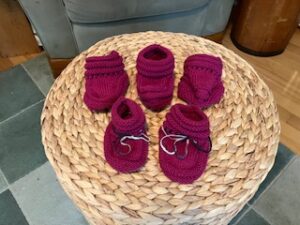
I put it all away, discouraged and went to the shower with a lame IOU. A few weeks passed, my furniture moved into the new house, boxes were unpacked. I set out to knit Bootie #4. It did not match any of the previously knitted booties. Neither did Bootie # 5. By then I was out of yarn. None of them were quite right. None of them. Though I followed the directions as exactly as I knew how. And I am not a beginner knitter. I have knit upwards of 50 pairs of socks. But these little baby booties have defeated me.

I am going to pack up all five of them and send them to Anna and John with a copy of this post. I might keep back the little deformed one. It would go perfectly on a golfing friend’s driver. I kind of looks like that’s what it’s for.

Epilogue: This post was written in October. Anna had her baby November 29

EnglandFriendsLiteratureShakespeareTravel

June 22, 2025

Bermuda For Two in Which Andrew Scores His Sandwich

After a hot weekend, Monday morning was cool and windy. Andrew and I visited St George, the oldest town on the island.  The bus carried us along the north shore of Bermuda and up into the hills where the houses became grander and the roads quieter. From the bus stop at the Swizzle Inn, we set off with a couple from Boston who I had pegged as Texans, on a lovely and clearly marked trail to the Crystal Cave.

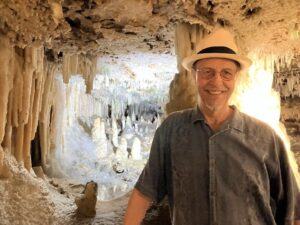
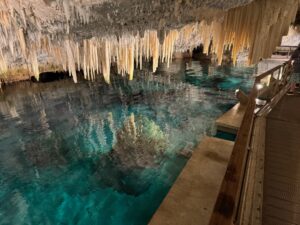
The Crystal Cave is 84 steps underground.  Limestone stalactites hang like drying candles and gnome-like stalagmites rise up from the ground. What a place of wonder it is: those strange sculptures creating themselves quietly over millions of years. We walked on a trail built on pontoons, which rise and fall with the tide.

Andrew in cave of gnomes

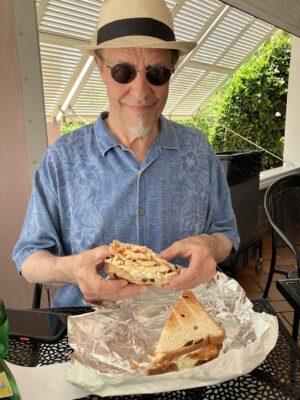
Andrew finally got his ultimate island specialty, the wahoo fish sandwich on raisin bread, at the Café Ole next to the caves. From where I sat, it looked like the goopiest, runniest, most luscious sandwich I’d ever watched someone eat.

Andrew scores his wahoo fish sandwich on raisin bread

Me, I had what I considered the best salad I had ever had in my life. Since I’ve been home, I’ve made it several times, dubbing it the Bermuda salad.

Kale and romaine formed the base. Then carrots strips, slices of avocado, hunks of tomato, pieces of mango, a handful of blueberries and raspberries and a honey-mustard dressing. The flavors mingled delightfully; I decided it was the mango that pulled it all together.

The café is family-owned by lifelong Bermudians. The young woman who took our order had been to school in the states.

“You don’t have an accent,” Andrew commented

“That’s why I work the front,” she laughed.

We walked back to the Swizzler Inn, stopping across the street at Bailey’s Ice Cream Parlour. We sat outside with our desserts and listened to a steel drum band thumping out of the Inn. They call it “Kettle Rock.” At the bus stop, we passed the time, rocking back and forth in the hot sun, singing “Ain’t Misbehaving” and “Across the Great Divide.” On the bus we chatted with another Bostonian couple. This time I thought they were Australians.

St George seemed to be still getting its clothes on for tourist season and wasn’t quite dressed yet. But there are always compensations for traveling off-season, principally the smaller crowds. St George had cobblestone streets and an ancient church; it looked much older than the rest of the island. Even the pastel colored buildings seemed faded and world-weary.

The town is named after the patron saint of England, not to be confused with the George Somers who founded the first British colony on Bermuda in 1609. In the main square stands a huge statue of George Somers reaching his hands to the sky with a ghastly smile on his face. Maybe he was drunk. In any case, the press around George Somers obscures the fact that the English may have colonized Bermuda but they weren’t the first to discover it.

Juan de Bermudez first found the islands in 1505. Apparently uninhabited by humans, the Spanish just moved on. As Andrew put it, there was no one there to massacre or exploit so they left. The British came along a century later.

In 1609, a ship called the Sea Venture was wrecked off the coast of what is now St George on Bermuda, Sir George Somers, being the captain. As I was reading this in the town square of St George, a penny dropped. Shipwreck, uninhabited island, 1609. Shakespeare wrote The Tempest in 1611; it was his last play. It begins with a shipwreck on an uninhabited island–except for a wizard, his daughter, and a slave. News of the Sea Venture wreck would have had time to reach England. I thought I had discovered something: Shakespeare based the island and the shipwreck in The Tempest on Bermuda. Later, I found about ten books and numerous articles about Bermuda being the location for The Tempest; that didn’t bleed me of my joy in having thought it out myself.

Some of my favorite lines from The Tempest are spoken by Caliban:

“Be not afeared; the isle is full of noises, sounds and sweet airs that give delight and hurt not.”

I grabbed Andrew’s arm, “Andrew, it’s the whistling tree frogs! Those are the strange noises!” I quoted the lines to him. I was thrilled!

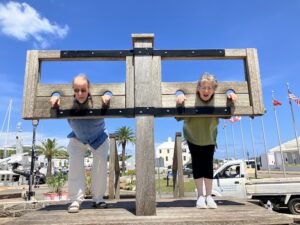
We had fun clowning around in the stocks and pillories, which looked pretty grim, in actual fact. As did the dunking stool, apparently reserved for women who talk too much. We met an entire family of Bostonians who I again thought were Australian. Andrew is clever with accents; he finally just laughed at my attempt to keep up. His accent wizardry is part of the entertainment of his company.

In the pillory

We poked around a bit. One tall, old, black guy behind a cash register responded deadpan to my announcement that we didn’t vote for Trump: “I’m glad we cleared that up.”


Travel

June 11, 2025

Bermuda for Two: The Beach!

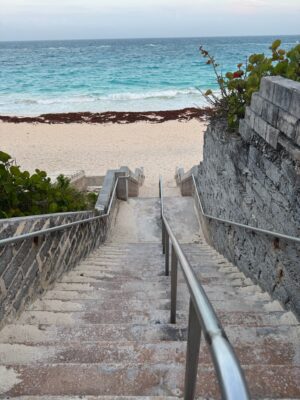
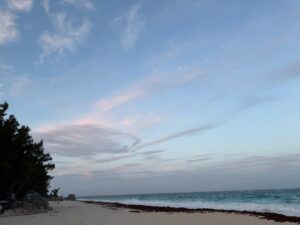
Mid-morning, we went to the beach slathered in half the tube of sunscreen. The Airbnb supplied two chairs, beach towels and a tiny, mostly useless umbrella, which we duly lugged around the corner and down the eighth of a mile to Elbow Beach.

Steps to Elbow Beach

Elbow Beach

The astonishing clear, turquoise water went from cold to tepid to bathwater in five minutes. The waves were high enough that for the first time in 25 years, I could throw myself in front of one and ride it towards shore. As a kid, I loved the Washington State waters because it was all I knew. I grew up swimming in Puget Sound and didn’t know it was cold. I lived for the times we went to the ocean and I could throw myself in front of the waves. In the Sargasso Sea that surrounds Bermuda, I was ecstatic, squealing with the pure pleasure of being thrown about.

Andrew swims like a fish. He has the broad shoulders and long body of a swimmer. I loved watching him dive into the waves head first like a dolphin, then loll on his back, toes in the air, waiting for the next one.

Several times, I threw myself into Andrew and we stood in the swirls, holding each other. We were in Bermuda. We were in the Gulf Stream, holding each other.

Sargasso seaweed floats in the shallow waters and washes up onto the shore where it creates hedges in the sand. Portuguese man o’ wars come riding in and nestle themselves into it on the beach. We encountered one such creature putzing along on a wave, supremely confident that no one would challenge it, even the seaweed giving it a wide berth.As a kid, we inspected the jellyfish on Puget Sound, unimpressive and harmless little blobs. Occasionally my brother would soberly inform me that he thought one of them might be a Portuguese man o’ war.

We came back for lunch and a long loll on the bed. I baked two potatoes, grated some cheese and cut up some butter. Andrew cuts his potato halves into a grid and lets the butter and cheese melt into the nooks and crannies. I smash mine all over the plate, melt the butter on it, eat the pulp, then roll up the skin—my favorite part—like a cigar and let the remaining butter drip all over my fingers as I eat.

Late afternoon, we were back on the beach for another hour of diving and squealing in the waves. Andrew said that after watching my joy in the water, he decided he had racked up a trillion honey-do points by bringing me to Bermuda. I had to have that explained to me, after which I washed all the day’s dishes.

In the evening, we piled clothes and towels into the washing machine, which was in a little cupboard on the outside of the cottage. After an hour in the dryer, the laundry still felt heavy and damp. Andrew inspected the filter and pulled out a pile of dryer lint the size of his head. We stayed up late playing cards until things finally dried. Meanwhile, the air was damp and soft, little patio lights came on and a bright moon rose over the sea.

We played gin rummy. (I won three games—unusual for me) Moving on to Casino, we discovered the three of clubs was missing from the deck. I made a note on the card box and threw it with disgust into the kitchen drawer.

I’d been telling myself that this was a Beach Cottage on an island. I expected casualness and lots of sand. But that lint trap in the dryer was rusty, the knives were dull (I rather expected that, too), the chain on the ceiling fan broke off every time I reached for it, there was next to no water pressure in the shower (this, we later learned, is a feature of Bermuda—low water pressure) and the traffic noise was constant. All of this accumulated and spilled over for me when we stayed up too late and the three of fucking clubs was missing from the card deck.

On the other hand, there was a lovely teapot in the Airbnb, which I used every morning.

Our third day was much like our second. We swam in the morning and pottered around until lunch at the Paraquet Restaurant down the road: the two-lane road with sometimes sidewalks. We crisscrossed the road to keep on the sidewalks, skirting the maniac drivers until we got to the restaurant. We both had fish chowder with rum, an island specialty. It wasn’t particularly special at the Paraquet. Andrew had the other island specialty: wahoo fish sandwich on raisin bread. He was now on a mission to find out why the wahoo fish sandwich on raisin bread was supposedly such a treat because it fell short of that at the Paraquet. I think that 65 per cent of traveling is finding food one can eat and ways one can be comfortable.

We continued down the road to explore what we could in the heat and humidity: the Paget Nature Reserve and the Railroad walking trail. We ended up back at the market where I bought more sunscreen and a deck of cards. We dozed and read and went for another swim. In the evening Andrew grilled chicken and we played cards with a full deck and the moon again rose over the sea..


AnglophiliaFamilyTravel

June 1, 2025

Bermuda For Two: The Saltus School

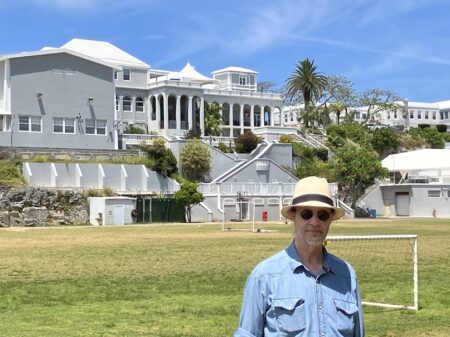
Bermuda for Two: Saltus Grammar School

On a background of deep green foliage, Bermuda is a watercolor of pastels beginning with the turquoise of the sea. The stucco of the cottages are painted shades of manganese and cerulean; rose madder and diluted pink opera, lemon yellow and new gamboge, topped off with bright, white limestone roofs. Except for our cottage, which was barn red.

Bus stops painted pink signal buses going toward Hamilton, the main town on the island. Bus stops painted blue signal going away from town. Our routine into town began on our first day: turn right on South Road, walk an eighth of a mile, cross at the zebra crossing, walk several yards and wait at the shelter of the pink bus stop. On that first foray into Hamilton, we met three Canadian sisters (not the nun kind) at the bus stop. I tried out what became my signature salutation: “Nice to meet you. We did not vote for him.” The five of us chatted until the bus came; the women had a pile of helpful information about Bermuda.

Now, in full tourist flow, we boarded the bus and I chatted with Shirley. A black woman with her head turbaned and dressed in gorgeous colors and with bracelets going up her arms, she was a native Bermudian. She told me that as a child, she hadn’t liked the water. She played marbles and jumped rope. She answered all my questions about grocery stores and the post office in a soft and lilting voice. A hospital administrator, she exited the bus when we did and pointed us toward the visitor center. I wondered if Bermudians like Shirley look at tourists like us with resignation and fatigue.

You have to be a resident of Bermuda to drive a car; the only rentals available to tourists are mopeds and bicycles. Bermuda is an archipelago although a lot of the tiny islands are connected by causeways and bridges into one large land mass shaped like a fish hook. It might have been fun to zip around on mopeds twenty-five years ago but it was more than our combined lives were worth to even step off the sidewalk now.

In the visitor center, we got ourselves oriented with the help of a young woman with elaborately painted and pointed gel nails, which made it easy to follow her directions as she ran one nail up the streets on a map. Up Queen Street, right on Reid to the Phoenix pharmacy and the Rock Island Café and up Woodlands to the Saltus School, our primary destination of the day.

But first, coffee (not great) and tea (excellent)at the café. A funky little place with a ceiling that looked part Tudor, part cathedral. A wren was dining in and eating very well indeed. A man in a long skirt with hair to the floor meditated outside the doors to the loo, which were covered in cartoon paintings so large, it was hard to find the door handles.

Lunch at Wild Greens: it was clear we had a found a place frequented by the locals. We had enormous salads created by a man with the deepest basso profundo I have ever heard. My “Greek” salad had everything imaginable on it: greens, micro-greens, olives, carrots, peppers, tomatoes, nuts, seeds, chicken chunks, feta. Plus, a fabulous dressing.

The temperature was not high and there was a cool breeze, otherwise, I think I would have fainted in the humidity. I felt dizzy much of the morning and particularly in the trudge up the hill to the Saltus School, an imposing white building atop a hill. Not knowing how to get to the entrance, we first circled most of the fenced-in playfield where uniformed students were at their games.

“I say!” declared Andrew.

This was Andrew’s thing. He had asked me if I thought we would hear British accents saying “I say!” on Bermuda. I said I didn’t think people talked that way anymore.

“Oh, I say!” he responded.

“Andrew. You are not going to walk around Bermuda saying ‘I say!’”

“I say!”

The uniformed guard at the gate told us that we had to have an appointment to enter. I was ready to tell him we hadn’t voted for Trump but Andrew explained that his father had been headmaster here during WW II. He called ahead and let us through.

We waited in the hall outside of reception. On a wall of photographs, Andrew spotted a small one of his father with a group of uniformed dignitaries.

By the time we entered the reception, every official in the school must have been informed that the “Booker family” was on campus because everywhere we went, they knew who we were and treated us like royalty. The director of enrollment, Amanda Skinner, met us at reception. A beautiful woman in her fifties in a comfortably fitted dress and sandals with glittery cabochons. Her handshake was firm and her smile lit up her face.

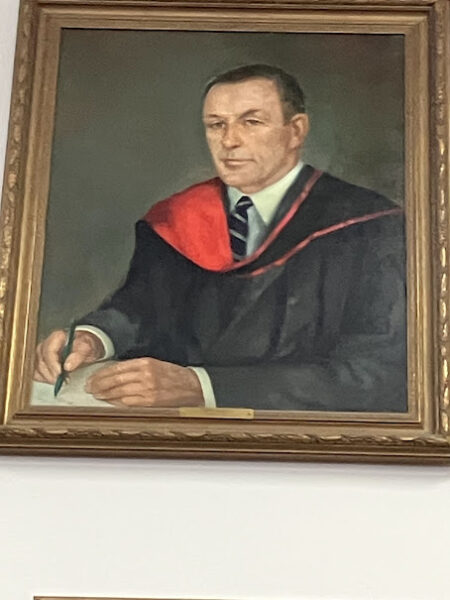
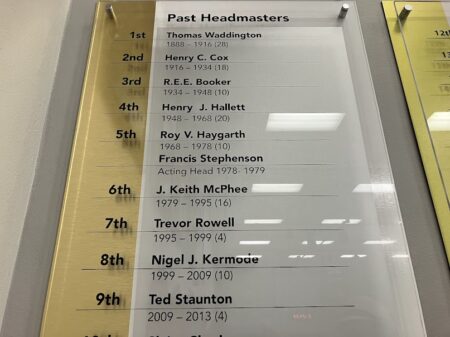
Amanda took us to the Alumni Room to see the portraits of all the former headmasters. Amanda’s grandfather was second-in-line, Andrew’s father was third. There was his name “Robert E. E. Booker” 1934-48. There was the portrait. Andrew looked up at it.

“That’s not my father,” he said.

So, there’s a mystery. Was it just a bad portrait? The eyes seemed right. The name was correct. Amanda and everyone thereafter was nonplussed. Andrew said he somehow remembered a portrait at his childhood home. Had his father taken his. in which case, who was this? He would see what he could find out.

The Booker That Wasn’t

Third in Line and note the arithmetical error

We were passed onto Katie Kostiuk, director of alumni, whose office was in the building where Robert Booker would have lived. Katie was enthusiastic about meeting us as she was in the process of organizing all the old records.

“We didn’t vote for him,” I said.

“Oh, that’s all right.” A pause. “But good to know.”

Andrew gave Katie information about his father and his three half brothers who had also attended the school.

We met the headmistress, Mme Julie Rousseau. Katie took a picture of us with Julie and another with Amanda. Amanda took pictures of us with Katie. I felt honored to be included. Andrew was pleased and, I think, a little overwhelmed.

Elena and Andrew, Saltus School, Bermuda

Katie called down to the student shop to ask the staff to let us in to buy some Saltus merch (my word.) Andrew bought a polo shirt for his daughter and I got a keychain with the Saltus logo.

After so much time spent in air-conditioned rooms, I was less dizzy. We walked down the hill to the market, which turned out to be a Waitrose, the swankiest of U.K. grocery chains. I filled the cart with fruit, vegies, eggs, chicken, cheese, milk, yoghurt, mayo, butter, bread, McVities digestives and mint humbugs. At the checkout, I asked how we could order a taxi and the checker called behind her:

“Hugh, could you get these lovely people a taxi?”

“Thank, you,” I said. “We didn’t vote for him.” Then to the man behind me in line. “We didn’t vote for him.”

We rested for a long time once we got home, made ham and cheese sandwiches, then rested some more. In the evening, we watched the moon rise on the beach. It had been a lovely day.

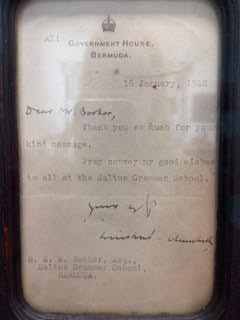
Letter from Winston Churchill to my boyfriend’s father


AnglophiliaFamilyFriendsPostsTravel

May 29, 2025

Bermuda For Two

A wee quiz:

1. Is Bermuda in the Caribbean?

2.Which state of the United States is Bermuda closest to?

3.Bermuda is a protectorate of what country?

4.Who discovered Bermuda and what country was he from?

5.Which Shakespeare play is set in Bermuda?

6.What are two signature sounds of Bermuda life?

Answers:

1.No
2.North Carolina
3.Great Britain
4.Juan de Bermudez from Spain
5.The Tempest
6.Honking horns and whistling tree frogs

The trip to Bermuda was Andrew’s idea. (In case you are new here, Andrew is my late-in-life inamorato.) His three-pronged reasoning went like this: We both love the ocean, Elena is an Anglophile and Andrew could get in some Ancestor Worship.

Andrew’s father, Robert, born in England, was a “classics man” at Oxford and headmaster of Saltus Grammar School in Hamilton, Bermuda from 1934-1948. Andrew’s mother, Lorna, moved with her two small sons—Andrew’s half-brothers–to Bermuda after the war where she met and married Andrew’s father. Hence, the “ancestor worship.”

Andrew, himself, was born in Charlotte, North Carolina. Bermuda sits in the middle of the Gulf Stream at the same latitude as Charlotte. A few days in Andrew’s hometown was a natural way to break up a seven-hour flight.  Not that I ever complained about the many nine-hour flights I have taken to England, ha ha.

Andrew arranged for us to go in style not counting having to get up at 3:00 in the morning. A town car picked us up, we had TSA pre-check and we flew First Class. I was made to understand that FC was not what it used to be but I had no complaints except for the lack of a blanket for my cold feet. Not that I ever complained about my travails in steerage on nine-hour trips to England, ha ha.

My immediate impression of Charlotte was of fragrance, green-ness, bird song and humidity. We stayed in an Airbnb in a lovely and peaceful setting with the occasional barking and mauling of two magnificent dogs, Lucy and Maisie.

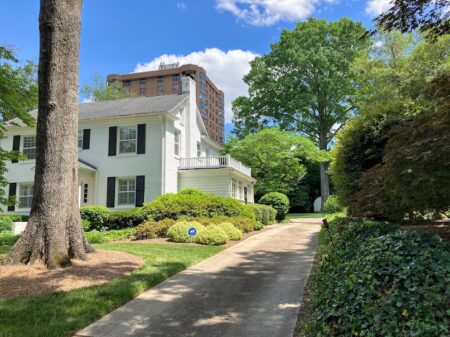
House where Andrew grew up, showing the room he set on fire

Andrew showed me the house on Brandon Road where he lived, age 5-20, minus the dreadful years in a boarding school. He pointed out his bedroom window and the porch he’d climb onto when he went out in the middle of the night to tear up the town. Also, the room he set on fire while making patterns with lighter fluid on a slate floor. I imagined him coming out the front door in the mornings, banging the screen door and coming down the walk to get into mischief with David and Preston. He showed me Myers Park elementary where Mrs. Creed taught him how to study and the playground where he and Preston set off a Molotov cocktail. And the dip in the road where, experimenting with various substances, he saw Jesus in a magnolia tree. Or something like that. Whatever it was, he decided afterwards to stop with the various substances.

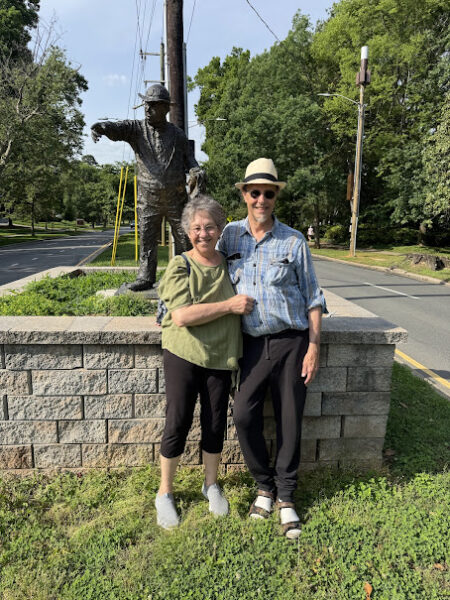
Hugh McManaway guards the entrance to Myers Park. He was an eccentric in the neighborhood when Andrew was a child. He played the organ at the Presbyterian church and the saw in the local drugstore, directed traffic (unofficially) at the corner of Queens Road and Providence Road, talked to himself and to everyone he met. No one had a name for what was going on in his head.  After his death, he was celebrated with a statue at the intersection where he directed traffic.

Hugh, Elena, Andrew in Charlotte. Photo by a neighbor who was out working in his yard.

I saw the Elizabeth neighborhood where Andrew lived with Sarah and Edgar. He kept his Harley in the dining room and revved it up and rode it right out the front door when he left the house. Sarah must have been an unusual woman to have put up with that.

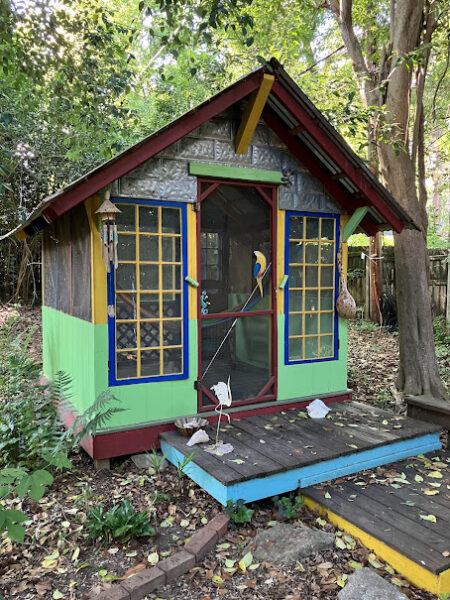
We spent our full day in Charlotte with Andrew’s music-making friends from days gone by: Chris, Buddy and Deborah. Chris, master of deadpan humor, I already knew. We started at his House of Whimsey in the Merry Oaks neighborhood with breakfast and a tour of his garden, also whimsical. Chris is a bit that way, too. His cat, Sweetie Pie, allowed me close enough to pet her once and spent the rest of our visit glaring at us.

Caribbean beach hut in Chris’s garden

We three went to see Deborah and Buddy. Briar Creek runs through Deborah’s wild and glorious garden. Deborah grew up near the patch of country where I spent my 18th summer: the intersection of Virginia, West Virgina, and Kentucky i.e. Hatfield/McCoy territory. I was thrilled to talk with her about the Appalachians, about gardening and her reading for four hours a day (oh bliss.) Buddy writes and we had a good long natter about that.

The five of us sat around most of the day, talking and laughing. I had been dreading this, thinking I would be bored listening to hours of reminiscences. They pulled me right in. I felt welcome and enjoyed and entertained. I laughed until I cried. With people I had just met.

The next morning, we were on the Billy Graham Parkway unnecessarily early, getting to the airport and breezing through TSA with two hours to spare.  Then I spotted the First Class lounge and was glad for the extra time.

“Oh, Andrew,” I gushed. “There’s all this free stuff!”

“You know it’s not free, right?”

“Yeah, yeah.”

There was a full breakfast available and a separate kiosk for Avocado Toast, something American Airlines seemed inordinately proud of. I had as much tea as I could put in me—because it was “free”– and helped myself to a dozen tea bags. The chairs were comfortable and I was able to write. Once a flight or two had left, it cleared out and was quiet.

Our plane was small, only four people in first class. I didn’t have time to sit down before the air hostess was asking me if I wanted something to drink.

“What do you have?”

“Anything you want?”

“A decaf tea?”

“Well, we don’t have that.”

Andrew ordered a “co’cola.” He really wanted to say that. Co’cola. I was pleased for him because he hadn’t shared my pleasure in the first-class lounge. To top it off, I was first off the plane. First among all the jaded individuals used to flying with benefits and “free” stuff.

Another first for me: our pre-ordered taxi driver was standing in a line of people holding up phones and tablets. There were our names on Shane’s tablets. He led us to his taxi and once again I was in England, trying to get in on the right side of the car. The roads are narrow and people drive like maniacs—also like England.

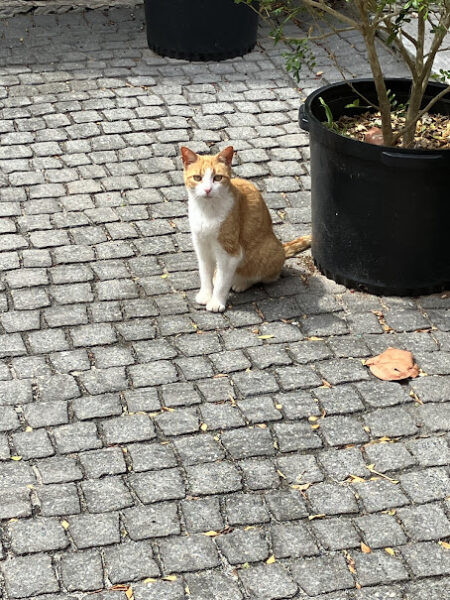
Tigger

Our Airbnb was a cottage on South Road in a section of the island called Paget. We were welcomed by Tigger, a young orange Tabby who came in and jumped first on my lap and then Andrew’s. Steve, our official host, ran us down to the market where we collected enough food for supper and breakfast. We walked backed in the hot, humid air, dodging the mopeds, cars and buses that whizzed by like vehicles in a video game.

The water is a brilliant turquoise, the foliage thick as a jungle. Birds, frogs and crickets make a wild orchestra that rehearse all day and night. We walked around the corner and down to Elbow Beach in the evening. The waves roared, around us and washed onto our feet. The moon rose and we took it all in, our arms around each other.


FriendsHolidaysTravel

January 7, 2025

How I Spent my December, 2024

You know how people (probably you) complain that Christmas music begins too early — like right after Halloween? If you’re a musician, by the time Halloween has reached its sugar-sated conclusion, you’ve been rehearsing Christmas music since the end of September. And you had to start thinking about it in August. That’s been my life since the 1980s. I don’t whine much about it anymore although when I had young piano students, I got heartily sick of some of the easier carols like We Three Kings and Good King Wenceslas.

Every fall I have two singing groups that I get ready for a big concert mid-December. I coach my private students to do a little holiday recital as well. That’s all in a day’s work; some years I love it more than others. But what’s the most fun for me in the holidays is the baking and gift wrapping and enjoying the lights. I get quite Grinchy when those activities are scuppered.

The end result of the holiday season is that I am usually so exhausted by Christmas Eve that I want to go to bed and not get up until the new year. If there’s a gift left to distribute, I want to throw it inside the door and say Merry Fucking Christmas.

And then I usually get sick.

I don’t know how I avoided all that this year because I was crazily preoccupied. Andrew and I made candy and packed it in boxes for friends: candied orange peel, peanut brittle, fudge, two kinds of divinity, pecan sandies and biscotti. We shopped for stocking stuffers, planned Christmas Eve Dinner and decorated trees for both our houses. The night of the biggest OK Chorale/All Present concert, a college friend I hadn’t seen in years spent a night with us.

Andrew and I left early the next morning to drive to Port Angeles for the Black Ball ferry to Victoria. We had reservations to stay for two nights at the Empress Hotel and were booked for high tea. By the time we bundled into the car, I had doubts about whether or not I would be able to relax enough to enjoy myself or if I would be a big crabby mess. The former prevailed.

The two of us travel easily; we enjoy just being together. Both of us would rather be hours early than to feel rushed and worried about say, making a ferry. We got to Port Angeles with time to scout out the famous Swains, an old fashioned mercantile/general store and a place to eat, Country Aire (providing Port Angeles with healthy choices since 1975!)

Victoria is a charming city and our two days were a recovery of calm in the riot that is the American December. At the Empress, they fell all over themselves to serve and pamper. We had a luxurious dinner at the Q Restaurant. Q stands for Queen and the walls are covered with portraits of Queen Victoria in all stages of her reign except the grumpy “We are not amused” pose.

Our waitperson, Maddy, looked about 25 years old. She reminded me of myself when I taught pre-school.

“Oh now THAT!” she cooed when I asked about Queen’s Delight mocktail.  “That’s one of my favorites!”

She enthused over every item we ordered – short ribs, risotto, creamed spinach, broccolini, fingerling potatoes and bread–like I would have a child’s story of a trip to Wild Waves. When the food appeared, we looked at the big platters in astonishment. We had ordered with the idea that in a classy restaurant like Q we might expect one spinach leaf and half a fingerling with a sprig of dill for fifty Canadian dollars.

We looked at each other. “Eat slow,” Andrew said. He repeated this several times as we tucked in.  Neither of us do this naturally.

Towards the end of the meal, Andrew asked Maddy for the restroom. She sized him up. “Can you do stairs?”

Taken aback, he laughed. “Do I look that old?”

Maddy recovered immediately, which is how we learned she was actually nearer 50 than 25.

Parliament Building

The restroom was up an old, wooden staircase that Fairmont Hotels hadn’t yet got its hands on. The steps were about four inches high, just right for women in corsets and long dresses. We revisited the staircase several times during our stay at the Empress because it was imposing and olde-worlde and more what one hoped the entire Empress would be like but wasn’t.

After our Q dinner, we walked up Government Street to what is still referred to as Chinatown and back down to the harbor, enjoying the clear night and the Christmas lights, especially those on the always imposing Parliament Building.

Chinatown Gate

Dazzled

Our room was small and did not have the city view we had signed up for but the bed was comfortable and we both slept well. After creeping around trying to find things in our suitcases, figuring out the shower, making hot drinks and scrabbling together some breakfast from all the snacks we had brought, we set out on a pilgrimage to Bows Coffee Roaster (formerly Bows and Arrows.)  Andrew orders their (single origin) coffee from Victoria where it seems to regularly get held up in customs. We went to pay homage, stock up and to get a cup of coffee to begin the rainy day.

We drove around James Bay and Oak Bay and stopped at a pharmacy to buy extra strength Voltaren and Tylenol with Codeine, everyone’s preferred Canadian contraband. It used to be tea and maple sugar products; this is the kind of wild travel acquisitions people make in their 70s.

Wandering around the hotel before our reservation for high tea, we somehow blundered into The Gold Area, that is to say, a section of the hotel reserved for its Gold members. Andrew—Mr. Ethics– was uncomfortable being in an unauthorized place but this is the bailiwick of the invisible, post-menopausal cat lady. I have learned that I can walk around and help myself to whatever is on offer in a place like the Gold area and no one will challenge me; certainly not in polite Canada. I took several handfuls of Smarties.

High tea was lovely. We were seated in a window overlooking the harbor. Our server was fun and had his patter down. When he took our picture, he instructed us to hold up our pinky fingers. We each had a pot a tea on a flame and tiered dishes of sandwiches (no crust) of cucumber, pate and lox; various small cakes, scones with clotted cream and jam and cherry jellies.

Tea with Pinkies


We walked back up Government Street to look for Canadian stocking stuffers. I took Andrew to Murchies (tea) and Rogers (chocolate), two places that were there long before I first visited Victoria in the 1960s. In one of the many souvenir places, I collected maple syrup products while Andrew was held captive by the owner, a French Canadian who insisted that Vancouver Island was larger than the state of Texas.

We found the Cuban cigar store.  Andrew wanted a Cuban cigar but we understood it to be illegal to bring them back to the states. We were disabused of this idea by the owner who, like our tea server and the French Canadian with his fixation on size, had his patter down. He also seemed a little sleazy to me but apparently the prohibition on Cuban cigars has lifted so Andrew bought two Romeo y Julietas.

Late in the afternoon, the rain still coming down hard, we propped up on the bed in the small hotel room with no view. As novel as it was for me to be in this lovely city at Christmas time with a man I loved, I think what I enjoyed most of all was sitting around the cramped hotel room on a rainy day, laughing and talking. I tell Andrew all the time that I am a cheap date; here was an instance of it.

Andrew took a call from someone who was trying to work out the mess that is the accountancy for his disabled daughter’s care—something that gets him quite exercised. I sat next to him reading. Later I marveled at how easy it felt to be with him. Me, who craves her privacy and needs quiet. I should point out that in my entire 70 years, I’ve never had this level of comfort with another person, and certainly not a man.

We patched together a meal of snacks and then did some laps around the hotel. We walked on all the floors and saw views of the city that should have been ours. We found old furniture that I wished had been in our room.  We looked at old photos of the hotel and found old menus from the 1920s when a rack of lamb was 80 cents. We tried out the exercise equipment and wished we had thought to use it sooner. We walked around the conference center and looked at the totem poles.


We left the next morning, a brilliant sunny day. I love the Port Angeles harbor. It feels real, gutsy. A functional, utilitarian non-touristy sort of place with the Coast Guard sitting there amidst the backdrop of the choppy straits of Juan de Fuca, which can be dangerous in the best of times.

We cruised through Customs. Elena: “Don’t mention the cigars, just in case. Let me do the talking.”  I said something similar when we came across the border two days earlier in regards to the CBD gummies we had for sleep. Andrew had to go and find out that it was illegal to take them into Canada. The article even threatened “sniffer dogs.”

I said, “Why do you even go looking for articles like that? Leave it to me. You don’t know anything.” I put the CBD gummies in an Altoid tin (curiously strong peppermints, you know) to throw off the sniffer dogs. “Just let me do the talking.”

Honestly, with a post menopausal cat lady in attendance, a person is safer than he realizes.

DogsFriendsTravel

October 9, 2024

Walla Walla Day 2

The puppies had me flying out of the Airbnb the next morning accompanied by Stella, barking her head off. Andrew followed with his coffee.

“Did you hear the owl this morning?” John asked.

Andrew raised his eyebrows. The genuine-ness of the owls not to mention the crickets was still in question.

We learned a little more about our hosts while I cuddled the puppies one after the other.  According to John, Amy was “athletic,” but he was a Mountain Man. As a kid he trapped muskrats, skinned them and sold the pelts. I left the two men talking about manly stuff and went back inside to get ready for Day 2 in Walla Walla.

We started by driving up and down the roads around the Airbnb, trying to find Castoldi’s Candy Sweet Onions. Even though they are available in Seattle, I like to buy a huge bag of Walla Walla sweets right from the source when I can. I bought 25 pounds in a little shed next to what was presumably Farmer Castoldi’s house, stuffing $17 into a little Honesty Slot. For the rest of the trip, I relished learning that they were much more expensive everywhere else.

“You’re my Walla Walla sweet,” Andrew said. I glowed.

Next stop was Fort Walla Walla, which I remember as green but late in the fall it is brown and yellow. We found a walking path and Disc Golf course with those baskets that look like they belong at the bottom of a guillotine. Andrew had two discs in the car. He showed me how to throw one –it’s all in the wrist– and I immediately threw my neck out instead. We walked along the path with Stella, occasionally throwing a disc; it was hot and a little dis-spiriting. The magpies were fun though. On my 1075 trips to Walla Walla, I always noted the first magpie once I crossed the mountains.

We went back to Pioneer Park with a picnic lunch, it being so much greener there. Andrew is a first-class picnic lunch maker. He’s also an amazing cook though he modestly says that he just follows the recipe. If you are new, he’ll tell you about America’s Test Kitchen, Cook’s Illustrated, Cook’s Country and Milk Street. I’m not complaining, I like it that I rarely have to cook.

We drove to a pottery place called Clay in Motion. I discovered it once when I drove down to Milton-Freewater in Oregon to get some Scotch without having to pay all the Washington state taxes. I bought a soup plate to compliment the one I had bought on the earlier occasion.

It was what Andrew calls “surgical strike” shopping, the only kind he likes. Go in, buy, get out. The only exception is Christmas stocking shopping when you have to graze a bit. We had fun doing that last Christmas. Otherwise, I prefer not to shop with Andrew. He hangs around behind me and I think he’s bored but he says he enjoys the people watching and objected to my use, in this blog post, of the word “skulk” so I took it out.

Coming back into Walla Walla on 9th Ave, we stopped at Melody Muffler Sculptures so Andrew could photograph some of Mike Hammond’s creatures and objects built from car parts.

Back at the Airbnb we had more discussions about where to go for dinner and whether or not the crickets and owls were real. Then a nap, ending with me leaping up: “Klickers!” I needed to show Klickers to Andrew. We drove up Issacs Ave, past the Community College with their renowned viticulture school, out toward the airport to family-owned Klickers where we used to get blueberries, watermelon, squash, honey and ice cream. We bought some Klicker’s  salad dressings, some carrots and apples and ice cream.

Like we needed more food. We always bring too much food on these excursions. Also too many clothes. We both wore the same thing for three days and packed about as much food home as we brought with us, not counting my 25-pound bag of Walla Walla sweets.

We resolved some of our excesses by deciding to have dinner at the Airbnb. Andrew grilled sausage, corn-on-the-cob and asparagus on the barbeque and toasted tater tots in the oven. I made a salad with everything that could possibly go into a salad. I put on a dress and lipstick and the sapphire earrings that my friend Kay gave me before she died. Andrew put on a tie. We had a lovely meal on the terrace next to the fountain with the lily pads.

Andrew said, “The food is always better at home.” When Andrew is the cook, I concur.

Another issue was resolved in the early evening when Stella who had been chasing something in the cabin for hours, finally bagged a cricket. I decided the owls were probably real as well.

The next morning as we packed the car, Stella insisted on sitting in my seat. She usually rides in complete comfort in the back but it took some coaxing to get her there. We visited the Walla Walla Saturday Market on our way out of town. A busker fulfilled all my requirements: good voice, accompanied by single guitar, well-played; old, well-loved songs and –crucially–not overly amplified. As we listened, a text came in from our Airbnb host: “You forgot Stella’s bed.”

Back we went for Stella’s bed. When she got settled, she looked as though to say, “See, I told you something wasn’t right.” Dogs know.

Andrew found the old highway out of Walla Walla. I don’t think I ever thought of it as Highway 12. It was the only way into town. We went by Waiilatpu (place of dry grass) where the Whitman massacre  took place. My freshman class at Whitman was the last one required to visit the site during orientation week.

Old Highway 12 goes through little old Lowden and Touchet, two communities where speeding is resented.  Lowden is the site of Woodward Canyon, the first winery in the valley and L’Ecole No 41, the winery with some of the best marketing merch. The two towns were always markers on the trip to Walla Walla.

We stayed on the old highway as much as we could, winding through the little farm towns.  In Zillah, we visited the oddity that is The Teapot Dome Gas Station and visited with the docent and his lovely dog, Ebony and puppy, Alfie. At Union Gap we finally found the Los Hernandez Andrew had seen on Evening Magazine –the best tamales in the valley, in Washington, maybe in the country, the world. We got four different kinds: pork, chicken, asparagus, and cactus, then wandered around looking for a place to eat them.

We ate them at a park on the edge of another gem: the Central Washington Agricultural Museum, which features a street to resemble an old western town, full of period pieces of carriages, mechanical potato planters, wringer washing machines and the like. The most interesting aspect was not on the curated street; it was behind it. There must have been acres of old equipment, cars, trucks, tractors, every piece of equipment you could imagine a farming couple wanting to get rid of when they down-sized their home so they could move to a condo in Yakima.

The tamales were ok.

Finally we made stops at the Selah and Thorp produce stands, which weren’t as wonderful as I remembered them to be, but then a lot of things are that way.

In any case, I could relax. Andrew pretty got much the full Walla Walla experience.

Melody Muffler musicians, Walla Walla
photo by AJB

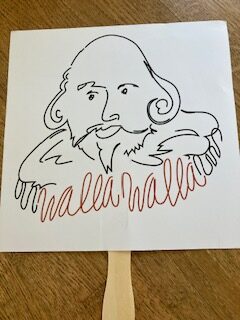
Shakespeare fan, Walla Walla Shakespeare Co. Observe the beard.

Teapot Dome Photo by AJB

Trucks, Central Washington Agricultural Museum Photo by AJB


Sugar Beet Lifter Central Washington Agricultural museum photo by AJB


Some of the Back Forty lot Central Washington Agricultural museum photo by AJB

DogsFamilyFriendsTravel

September 17, 2024

Walla Walla

Andrew and I (and Stella, the dog) traveled to Walla Walla last week. You might be forgiven for thinking we were going for the wineries but we were not. Neither of us are drinkers. We were there for the Walla Walla sweets and Ancestor Worship, as Andrew says. My father was born and grew up in Walla Walla. My family visited when I was a child and I went to college there. (That would be Whitman College, not The One in Spokane, Whitworth.)

There was so much I wanted Andrew to see beginning with the pilgrimage there. He likes the dramatic terrain of I-90 which takes you across the Columbia River at Vantage but I argued for the highway through Yakima which is prettier and because I have avoided the Vantage route ever since I got a speeding ticket in the Hanford nuclear site.

The Yakima route was not prettier because the roads have changed. I used to wind through Selah, Zillah, Sunnyside, Grandview and Prosser. The new 82 speeds past sagebrush and gasoline exits, which gets old pretty fast. Past the Tri-cities, I couldn’t find the old road that used to be the only road to Walla Walla.  I felt a bit bereft and with pressure (all my own making) to see that Andrew had a good time. But how could he when we hadn’t gone past the Whitman mission at Waiilatpu and through little old Lowden and Touchet? Andrew couldn’t know what he was missing!

“I thought you said you had been to Walla Walla a thousand times.”

“I said about 75 times but I meant 1075 times.”

We had made a detour in Yakima to find a place Andrew had seen on Evening Magazine, Los Hernandez, best tamales in the valley, on the road to Naches. We ate tamales that didn’t seem all that special and Andrew said the storefront wasn’t the one from Evening Magazine. That mystery as well as The Mystery of the Missing Waiilatpu hung in the air until the drive home.

Our Airbnb, Silver Maples Estate was four miles outside of town on a highway looking suspiciously like the old one I thought I had lost. We had a charming little cabin next to the house where the hosts, Amy and John, lived with two dogs and three Havanese puppies. Stella could run around leash free on soft grass and poke around a pond with lily pads and a fountain built from the pink bricks of the old Walla Walla post office.

We got Stella moved in—she travels in style– and ate an early dinner. I took her outside after dark and stood listening to the crickets that chirped away in the grape vine festooned with colored lights that shielded our cabin from Amy and John’s house.

Andrew came out and smiled. “Those aren’t real crickets,” he said. Do you hear how rhythmic they are? Crickets aren’t in rhythm like that. The sound is probably connected to the lights.”

Back inside he showed me lights that chirped liked crickets on Amazon.

We created the tundra-like sleeping conditions that Andrew likes with help from a ceiling fan and two open windows. The sound of fake crickets poured in. The next morning, Stella let out a volley of barks and I heard little yippy noises from the yard next door.

“Oooh, puppies!” I threw on my robe and we were out the door.

Murphy, a Parti Yorkie and Maple, the Havanese mother of the three puppies and Stella barked fit to lose their heads until we got Murphy and Stella calmed down and Amy took Maple inside. I went for the puppies, three little brown balls of squirming fur—Marley, MacKenzie and Maverick, 12 weeks old. The youngest, MacKenzie weighed three pounds and was the color of milk chocolate. They call him Big Mac.

I wish to comment here that Andrew’s preferred method of introducing dogs is to pick Stella up and hold her anus to the nose of the new dog. He says it saves time.

As we stood out in the fresh morning air with the puppies and our hosts, we asked about the crickets. They both assured us the crickets were real.

John said, “I used to have a bunch of frogs in the pond. They ate all the crickets over there so now they hang out in the grapevine. But the frogs are gone now, too.”

“They sound too rhythmic for crickets,” Andrew said.

“No, they’re real,” they both assured us. “Did you hear the owls last night, too?”

Back inside, I said, “They both had pretty straight faces.”

“They sure did. Do you think they’re messing with us city people? I bet the owls are fake, too.”

We spent all of the first day visiting campus and my old haunts. We parked in front of Sherwood Center and made the first of many trips into the student union building, which we used to call the Sub but which is now called the Pete Reid center. It’s built on the site of the old White Temple Baptist church, which my great grandfather helped build and where I occasionally played the piano for services when I was at school.

The point of the many visits to the Sub was for one or the other of us to use the toilet, the other to stay outside with Stella. I am used to sitting with Stella while Andrew goes into a toilet or convenience store. She sits like a pointer trained at the door, whines a little and cannot be distracted by anything. Andrew sat with her while I went into the bookstore to see if there was any interesting new college merch and we discovered that she does the same thing when I am missing. Apparently, she wants us together as much as we want to be together.

Stella waiting for Elena outside SUB. Photo by AJB

While in the bookstore where there were no interesting tchotchkes, I asked the young man at the counter where I could find a drug store. Thrifty Drugs on the corner of Main and Palouse is long gone and the young man who was sweet and looked about 14 years old, wasn’t the least bit interested in hearing how much we had liked Thrifty Drugs in the 70s. He didn’t know of any drug stores except Tallman on Main Street.

“But it’s really old,” he seemed apologetic, embarrassed to be suggesting that a human being would go into such a place.

Tallman is one of few stores left from the 1970s and it was exactly where an old person could find knee supports; I had forgotten mine at home.

We toured the campus beginning with what used to be the Music Building but is now used for various humanities classrooms. I stood in the doorway with Stella and suggested Andrew peek into MacDowell Hall, where I had sung in recitals. It was locked. I wanted to belly up to someone and demand to see the hall on the grounds that I was an alumna but Andrew suggested I not make a scene. The building is charming inside even without the hall.

We walked along the wooded path that used to be Lakem Duckum until they stretched it out into a stream that meanders through the parts of the campus that flank Boyer Avenue.

(used to be) Lakem Duckum, Whitman campus

The path took us to the amphitheater where my graduation ceremonies took place, back to Ankeny Field, looking green and luscious and alongside Lyman House, which is no longer the funky old building that went co-ed the year I matriculated as did Jewett Hall where I spent my freshman year and was next on the tour. We carried on past Olin Hall, the Science building and Penrose library, always coming back to the old Memorial Building, the first building on campus in 1859.

Memorial Building, Whitman College

The day was pleasant and the campus was calm with very few students walking around. I said rush hour would start when classes changed. But when classes changed, there was an influx about half a dozen more students. Whitman is a small school. The population when I was there was 1000 students. I seem to remember walking to the Sub every day for my mail (how quaint) and practically running into everyone on the entire campus either coming or going.

Finally, we circled back around to a few of my family’s homes. My grandparents and their four children lived one house down from the corner of Park and Alder next to a house that was a fire station and then a Red Cross station. I can’t quite figure out what it is now but it’s still there and always seems to be closed. My dad tells the story –something that became family lore– of something catching fire in their house and he running next door to yell, “Our house is on fire, our house is on fire!”

“Where do you live?”

Wildy excited, eyes spinning around in his head, he repeated “Our house is on fire, our house is on fire!”

Old firehouse, Park and Alder (photo by AJB)

My father lost both his parents early. My grandmother Louise died in 1918 of the flu when my father was eight. My grandfather died during a gall bladder surgery seven years later. Louise’s sister Ann, took the four boys, ages 4,6,8 and 10 to live with her at 623 Alder in a house that is still there.  Much later Ann moved to a home on Marcus Street where my family came when I was a child.

When we tried to get to the Marcus Street home, it was gone and the whole block was a construction site. The street has slowly been encroached upon and taken over by the college. We approached from the other side because I wanted Andrew to see the tiny footbridge across the canal that contains Mill Creek and that used to take you right to my Aunt Ann’s property at 325 Marcus.  By this time of the year, Mill Creek is a gentle trickle down the middle of the canal; at flood stage it can be terrifying, especially to a child.

We had a picnic lunch in Pioneer Park up the road a bit from campus by the bandstand where my father attended Sunday afternoon band concerts.  We walked a few blocks to 728 Whitman St. where my great grandfather, James Knott, built the family home in the late 1800s. My grandmother grew up in the house and my father spent a lot of time there. It’s been re-modeled to within an inch of its life but it’s still there.

My dad at 623 Alder,
c. 1925


Elena on Marcus St footbridge over Mill Creek (photo by AJB)


(used to be) 325 Marcus St, Walla Walla


The gazebo and my favorite tree, Pioneer Park, Walla Walla (photo by AJB)


We had a nap, then made dinner at the Airbnb while talking about where we might go out for dinner the next night. I said that Foraging i.e. talking about what and where one is going to eat is, like Ancestor Worship, integral to the traveling experience.  We had a number of recommendations and spent an inordinate amount of time looking at menus online.

Back into town in the evening, we walked up and down Main St. to see what we were missing what with not being drinkers and with having a dog on a leash. Main St used to be small-town funky. The money brought in by the wineries has changed it completely. But for the angle parking, it could be Kirkland. The last straw for me was the Marcus Whitman hotel, a venerable old western style hotel with high ceiling fans, cantilever lamps and plush chairs in the comfortable lobby. I’ve stayed there a few times and for all it’s dignity, it was a fun place to stay.

Marcus Whitman at sunset from Alder St
(photo by AJB)

Once I had my bicycle with me and they let me keep it in a room off the office. When I came back after tooling around town, I could ride right into the lobby and up to the front desk to smiles and applause. The lobby has now been expanded and tables for drinking, eating and playing cards have replaced the plush chairs. When I pushed open the door, I didn’t recognize the space. I wanted to show Andrew the gorgeous old lobby and it wasn’t there.

We had a number of conversations about expectations on this trip. It’s only been eight years since I was last in Walla Walla and the changes left me alternately sad, annoyed and reflective. Andrew said that for him, my reminiscences were all part of the show.

The first day ended with the genuineness of the crickets and owls as well the next evening’s restaurant still undetermined.


EnglandTravel

August 6, 2024

10. A Spring in Britain: Homecoming.

My favorite thing to do in a city like London is to have a small mission that allows for adventures along the way.  Tuesday’s mission was to explore Ealing because Andrew’s (The Sweetheart) father was born in Ealing and Andrew knows shockingly little about his father’s origins. I began the day by walking to Paddington and taking the Elizabeth line to Ealing Broadway.

Ealing Broadway is one of the last train stations coming from my cousins in Somerset and I always envisioned it like a backstage in a Broadway theater in New York. I expected to get off the train and see people in leg warmers doing stretches and actors in Shakespearean dress fencing in the intersections. It’s not like that. Broadway is the “broad way.” It’s like Main Street and a busy one it is.

It is also the home of Ealing Studios, which I wish I had had time to visit. But I was on a mission.

St John's Parish church, Ealing

St John’s Parish church, Ealing

I found my way to St John’s parish church a mile down the road that Andrew’s father attended as a boy. Some sort of community meeting was going on in the social hall and apparently that meant a visitor from Seattle, there for only one day, could not see the sanctuary or talk to the vicar, making this one of my more interesting stories.

But on the way I discovered Walpole Park, named after Sir Robert Walpole, Britain’s first prime minister, which opened in 1903. Andrew’s father was born in 1898 so it was easy to imagine that he would have played in the park. The 18th century villa, Pitzhanger Manor, built by Sir John Soane displays itself amongst gardens and green spaces. Sir John Soane, the architect who designed the Bank of England, called Ealing home for a time, amongst the green that became Walpole Park.

Walpole Park, Ealing

I found some lunch at Marks and Spencer. I’ve learned from my cousins that this is a reliable place for an old lady lunch. Decent tea, homemade soup, always something gluten free. I had a bowl of tomato basil soup and a bun.

At the library I learned how to get to where historical records were kept, a tube stop away in Southall. A friendly librarian gave me directions and made a map for me. Southall, where “Bend it Like Beckham” was filmed is called “Little Punjabi” these days. Finding an English cup of tea actually proved impossible but I had the most gorgeous cup of masala chai in a hot, noisy café with pastries in neon colors and women is lovely saris.

Fortified, I found the Dominion Center library where I met Dr. Oakes who I had been corresponding with about Andrew’s family. He had a pile of books and papers and photos for me to peruse and was an enthusiastic help. His other researchers told me they were regulars and he was bored with them. I looked through old town directories and found listings for Andrew’s grandfather at the various addresses he occupied. It wasn’t much but as this was all about the hunt, I was thrilled.

On the way home, I bought a chicken salad and salty popcorn (hard to find; Brits prefer sweet) at Waitrose, the supposedly upscale grocery store. I took a hot bath, ate my salad and popcorn, Face-timed with Andrew when it was morning in America and fell asleep by 9:00. I had walked seven miles in better shoes than the day before.

The new Vagina Museum

In the morning, Andrew and I Face-timed again when it was evening in America. Then I set out for the Vagina Museum. I had discovered this museum on my previous visit to the U.K. and loved everything about it. In the interim between my two visits, it had closed and re-opened in a new location. Still in Bethnal Green, a long tube ride across town, I wanted to go back purely to buy 20 pens in the gift shop. I was irked when I found there were, due to supply issues, no pens and I had to be content with buying a dozen plectrums i.e. guitar picks.

I spent the rest of the day collecting items I like to bring home with me: paracetamol (British tylenol), Astral, a rich, old-fashioned hand cream and plasters (band-aids) from Boots. I took a final walk in Kensington Gardens and flew home the next day.

Andrew was waiting at International Arrivals when I got spit through customs and immigration. He went into a little dance step when he saw me and I nearly toppled my luggage in my hurry to get to him. A welcome like no other.

The other being who was happy to see me was more circumspect. She appeared disinterested when I walked in the house but for the next three days her favorite place was next to my face.

Artemis


Choir SingingEnglandSongsTravel

May 31, 2024

9. A Spring in Britain: A Concert and A Cemetery

When we were last together, I had said farewell to Lindisfarne after being in the unlikely position of reassuring native Britons at the bus stop that there was indeed a real bus that arrived on Holy Island regularly, if not often.

Once back in Berwick, I checked into the Castle Hotel, not the Castle Vale House, which I had enjoyed so thoroughly a week earlier. It should be said at once that there is no castle. There used to be a castle but apparently the train station was built on its former location and everything within spitting distance is now named Castle Something.

The Castle Hotel was serviceable and the staff was lovely. I was only there because I decided at my advanced age that I had had enough of hurling myself from one destination to another, at the mercy of late trains, flash floods, train strikes and being fatigued. So I gave myself an extra day in Berwick to walk in some of the glorious parks and to go to an evening concert I had seen advertised on a poster.

The concert was called “All in the April Evening,” a reference to a weird poem by Katharine Tynon set to music by Hugh Roberton and well known in the church choir set a generation ago. Marion Scammell directed a community choir and orchestra in Vivaldi’s Gloria, Schubert’s Mass in G and Elgar’s “Songs from the Bavarian Highlands” in the Berwick Parish Church, the Cromwellian building where I had, a week prior, asked to use the toilet and then felt obliged to attend mass because the vicar was so nice.

Berwick town walls

I arrived at the concert, having walked over on the old town walls, and found that I needed cash, which I did not have. There was a time when I bought pound sterling before I got on the plane in Seattle and then got more at an ATM in Heathrow. Now everything is contactless. Except amateur musical societies.

British to the core, Reception was apologetic for asking a fee at all and outraged at their own thoughtlessness in not being able to accommodate credit cards.

“We really need to pull ourselves into the 21st century. But do come in. We are not going to turn you away!”

(I sent a donation when I got home and Andrew doubled it. I love having a boyfriend.)

I sat in the balcony until the intermission –when we all repaired across the way to a social hall for wine– and then moved down to the front, near enough to see the drama behind the performance. I thoroughly enjoyed the concert. I like a well-rehearsed professional choir as much as anyone but there is nothing quite so magical and refreshing than listening to regular people making music for the pure joy of it.  I enjoyed not being responsible for any of it.

Concert, Berwick Parish Church

And then it was the next day and I was on the train to London where it was warm and summery. I got in a taxi queue and then sank back for the ride to Queensway where I had booked a room at Hyde Park International Hotel, two blocks from the park. Not an expensive hotel, there still was a smiling doorman and wonderful staff and lovely rooms with a view of a quintessential London street with two story white rowhouses, quaint iron gates and big leafy trees. I went for a long walk in Kensington Gardens and then to bed early.

Monday the rain and cold was back. I went to Kensal Green Cemetery, my mission the grave of one Krystyna Skarbeck aka Christine Granville, Polish-British spy.  A rain squall drove me into a Costas where I dried out with a cappuccino and wrote four postcards I had been carrying around from Holy Island.

entrance to Kensal Green cemetery

When the rain let up, I started walking, looking at my map and asking questions until I got on the correct bus. The driver put me down at a wall on the Harrow Road and told me the cemetery was on the other side.

Kensal Green is an enormous cemetery crammed with monuments and headstones bending every which way, long grass dressing everything up. It would be a nightmare to trim, which is probably why they don’t. I walked along one of the main roads for what felt like miles, following signs to the chapel and crematorium, figuring that would be the most likely place to get some directions to the St Mary’s section of the cemetery I was looking for. I finally found a foreman who told me I was in the wrong cemetery!  St Mary’s used to be part of Kensal Green but now has a separate entrance. So I went out and the far end and around a corner to get into St Mary’s.

There wasn’t a soul (least not a live one) in sight but fortunately I had done enough homework that I knew the quadrant and number of the grave. But the quadrant was enormous and it’s not like the grave numbers are prominently displayed like house numbers. I wandered around and backtracked, musing that I had worn the wrong shoes and how on earth did I expect to find this grave and what was wrong with me that I even wanted to. Couldn’t I just go to the Tower of London or Madame Tussauds like everyone else?

Picking my way through grass and graves, I suddenly just saw it. It was like when Sue and Wendy and I were wandering the harbour of Tobermory, hoping to see the cat, Ledaig and Sue suddenly crying “There it is!”

Clearly, I was not the only pilgrim to this grave. Krystyna has not been forgotten. There was a sash –maybe a French resistance thing—flowers, rocks, a photo, a candle. I stood for a long time, got tears in eyes and finally turned to backtrack all the way to the bus.


Krystyna Skarbeck


On my way, I saw a man about my age at a small grave.

“I never bring the right tools,” he commented when he saw me.

“You’re tending a grave. Is it a parent?”

“No, it’s my son.”

Simon, aged 8, had died in 1981 of leukemia on that day, April 15.

“I’m so sorry,” I said

“You never get over the guilt of being left alive.”

I started to choke up.

“Never mind,” he said. “That’s life. Who are you visiting?”

“A spy.”

We had a nice chat about spies, World War II, American sports (briefly as I know nothing about them. He liked the Dallas cowboys, yawn) and our political scene.

“Bless your little boy,” I said– I don’t know why; I wanted to say something—and continued on.

By the time I was getting some fish and chips in Notting Hill, I couldn’t feel my feet. I had walked six miles in the wrong shoes. It had been a strange but lovely day.