Friends

September 26, 2016

Walla Walla Begin Again

Tags: ,

(This is the first in a series.)

This past weekend was the 40th reunion of the class of 76 at Whitman College.  All my favorite people minus one were going to be there so it was shaping up to be something special.  Walla Walla has always been a magical place to me, going back to my childhood when we visited my great Aunt Ann in the house on the corner of Shady Rill and Marcus Street, now owned by the college.

Walla Walla is a beautiful old town on the way to nowhere else.  It’s its own destination.  Whitman is a charming campus, which these days reeks of money.  You could eat off the steps of the classroom buildings they are so well maintained.  A private liberal arts college is essentially a four year summer camp for (very) young adults and in many ways we were cossetted at Whitman.  Still our minds were valued by our professors and so we learned to value our minds and the process of learning.  Everyone in my favored group has continued to learn and in various ways to give ourselves back to the world.

It was a mixed experience for me, being a college student.  The further away I get from my college days, the more rhapsodic I feel about it.  I was excited about the reunion but as date approached, regression sucked at me. I had a dream that everyone was mean to me and I went home early.  In waking life, I closed off all means to a fast getaway by making plans to ride across state with one of my beloved group.

John’s (poly-sci major but he acted like an English major) plane from Boston landed late morning and we were on the road by early afternoon.  A cross country (and assorted running events) coach, John was, is and always shall be a long-distance runner.  Physically he is a piece of sinew with a head.  Every inch is lean muscle.  I fully expect he will one day be featured on the cover of a magazine I hope classier than Time as a 95 year old marathon runner with better time than say, the 70 year olds.  He’s qualified twice for the Olympic trials in the marathon.

“So,” I, the artiste, cast around for how to phrase it.  “The groups you work with: do the players already know the game and you work on training and technique?”

There was a change of atmosphere in the car: a mix of patience, exasperation and amusement.  “Well, first of all they’re athletes, not players. And they run in an event.  It’s not a damn game.”

“Oops.

“Don’t worry.  I get that a lot.”

We drove across state via Yakima.  It’s the loveliest way to go, especially now that you don’t actually have to go through Yakima. We never ran out of things to say.  We were still talking happily when we crossed into Oregon.  For those of you who don’t know the geography, the drive from Seattle to Walla Walla via Yakima does not involve crossing into Oregon.  I have driven across state probably 100 times and I have never once strayed into Oregon, the border of which is seven miles south of Walla Walla.

“We shouldn’t be in Oregon,” I said. “How did this happen?  Weren’t you watching the signs?”

“I was following you.  I thought you were navigating.”

“I didn’t know there was even a highway to turn onto,” I said. “Everything always seemed to flow towards Walla Walla.”

We pulled over at the 395/730 junction to look at the map.  A proper Rand McNally paper map.  That’s who we are.  Somewhere outside the Tri-Cities we missed a sign that would have taken us to Walla Walla and now we were south of Columbia River.  But you know what?  Next time I go to Walla Walla I am going to make this detour on purpose.  I had no idea how beautiful was the approach from Oregon.  We drove along the Columbia River through basalt monuments that are the Wallula Gap, the light causing the water to shimmer and now I wish I hadn’t talked so much as we came through.  Words are for later—like what I’m doing now.
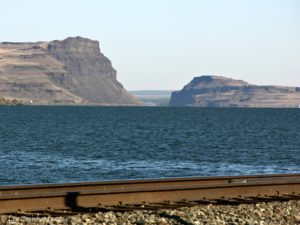
Wallula Gap

Wallula Gap

Once we were underway again I remembered that I had told Debi I would text her when we left Seattle.

“We’re an hour away,” I texted laboriously. I’m not good at texting.  I have my father’s big thumbs.

“I’ll pick up your registration packets,” she wrote back.

“Get me one of everything’s that free.” That text took me five minutes.

“Will do.”

Finally we were there at the home of Debi (English major) and Jim (Biology).  There was funny, kind Bruce (German major) and his wife Helen (French but at UCLA).  The only one missing was Mary-Ellis (English) and her husband Phil (I don’t know where he went to school but he is an attorney) who I was soon to see at the Green Lantern, a tavern famous among Whitties of our generation although we had never frequented it or in most cases, even been to it.  At the Green they set us up outside where it was cold and dark but there was a fire pit and it was good to be together.

And the evening and the morning were the first day.



Ah, HumanityCatsFriends

September 21, 2016

Season of Rats and/or Mellow Fruitfulness

Tags: ,

When I was up on Whidbey, one of the wildlife issues was field mice.  In the city we deal with rats.  I know they are everywhere and lord knows I’ve had my adventures with them but I hated those adventures.

On Sunday I went up to my local Fed-Ex to do some printing.  I like to go when Vince is there because he is a sweet, helpful guy with a charming smile who does a beautiful job with my cards and never gets impatient when I ask him to fix punctuation or tighten a crop.

One of the doors was propped open on Sunday but I think (I hope) I came through the other one.  Vince was at the front desk looking his usual calm self but before I could get in a word he asked me, “Do you want to see something gross?”

“Sure,” I said.  I thought it was going to be something funny.

“Look over at the door,” he said.  “There’s a rat caught in it.”

I walked towards the door and immediately reeled back. There was indeed an animal caught in the hinge side of the door.

“Are you sure it’s not a squirrel?”

I walked all the way to the far wall to come around to the other side of the door just to look out the window and see from that vantage point a rat’s tail.  The rat had tried to slip in when the door opened and was almost but not quite bisected.

“When did it happen?”  I asked.

“Just now,” Vince said.

“Damn,” I thought. “I meant to come an hour ago.”

“What are you going to do,” I asked Vince.

“I’m not sure.  They don’t pay me enough to touch a dead rat,” he said.  “I’ve been trying to get a hold of the store manager and Animal Control.”  He took a deep breath and folded his hands on the counter.

“What can I do for you?” he asked politely.

“Oh no,” I said.  “I’ll help you figure this out first.  Animal Control is not going to do anything.  Did you try a pest control service?”

Someone came in wanting help using the copy machine at the same time Vince’s manager called back.

“I’ve got to take this,” he said.

“That’s okay,” I said.  “I’ll help her.”

It was a woman with two small girls in tow.  “Hi,” I said.  “I live here.”  Sometimes I think I do.

I got the woman with the two girls set up in time to help the next customer who came in.  The third person to walk in was none other than my good friend Kay.  She, like me, comes to this Fed-Ex when she knows Vince is working.

Kay did a thorough inspection of the rat, complete with appreciative comments about his size.  “We’ll help you get it out,” she said.

I didn’t like the sound of that “we.”  Still I volunteered to hold the door open if I didn’t have to look down.

Vince got off the phone and reported that someone would be there in the next four hours.

“Never mind your facilities person,” Kay said. “Do you have something we can poke it out with?  When the door is open, there’s room to push it through.”

A man marched in, his arms full of a project and immediately began to tell Vince what he wanted done.  Kay and I looked at him speculatively.

When he finally noticed us, he said, “Oh, I’m sorry.  I interrupted.”

“We were waiting for you,” I said.  “We were waiting for a nice man to come in and help us with something.”

He grinned.  “What do you need?”

We introduced him to the dead rat and I will say this for him: he was a good sport about it.  Vince tied some discard-able paper around a yardstick and the man held the door.  Kay pushed the rat out with the yardstick and then kicked it into the street next to where her car was parked while I stood in the store and shrieked.

She came back in, smiling.  “Sissies,” she remarked.

That was Sunday.

Tuesday morning I found Artemis in the cabin off my sunroom, presiding over a rat.  She and I stood and looked at each other for a long time.  I don’t know what she was thinking, but I was thinking, “Oh no. It’s started.”

I got close enough to see that the rat was twitching a little bit.  It was also quite small.  A baby.  That squeezed a little compassion out of me.

It was still breathing when I popped a box over it and weighted the box with a flowerpot.  When my friend Madelaine showed up for Tuesday morning watercolors, I said I had a huge favor to ask.

All I wanted was for her to be with me while I did whatever it was I decided to do. The little guy was in distress and it would have been merciful to kill it but I can only deal with rats if I don’t have to look at them.  And I don’t like to do things that put in my mind images that will disturb my sleep.  The world has enough on its plate without me serving it a sleep-deprived self.

In the end I slid a piece of cardboard under the box the way I would slide a piece of paper behind a glass in which I had trapped a bee.  I took it outside and managed to toss the whole thing on a pile of garden refuse without actually looking at it.

Sigh.  There are so many beautiful aspects of the fall.  My apple tree is leaning low.  The apples are growing in bunches like grapes.  Even though I didn’t thin them this year, they are larger than they have ever been with less scab and fewer worms.  It’s a great time to be alive.  It’s always a good time of year to be a cat in my household.  A rat not so much.


TeachingTravelWriting

September 8, 2016

Letter From Whidbey

Tags: , ,

Last May when I was two weeks away from my trip to England, I started a folder called “Stuff to Do When I Get Back” and began tossing notes quite liberally into it.  After spending an idyllic June in England, I came home to my life, which includes wonderful friends and neighbors, my two cats and the spillage of all my interests into my work life.  My private students showed up for their lessons.  My watercolor class, All Present and the OK Chorale began .  .   . and ended.  At the other end of the summer, I still hadn’t opened the folder labelled “Stuff to Do When I Get Back.”

“When I Get Back” has taken on new meaning because I am now on Whidbey Island, trying for the fourth time to work on a novel I keep telling myself I’m writing. As a last resort, I am doing an outline. I’ve resisted this because my mind doesn’t function in a linear way and outlines have never been much use to me.  In fact I don’t think I ever actually made one. Ever. Even in school. I decided that since this novel has stalled four times already, I would try an outline. Then I could work on the story in chunks to match the way time parcels itself out in my life.

I’m up at my usual idyllic locale on the island, the Buddhist meditation retreat owned by my voice teacher, Tommie and her husband.  I usually come up for a long weekend, intending to write, but I spend the first two days watching for deer, walking in the woods and reading poetry.  Then it’s nearly time to go home.

I have been here a week. With one day to spare I have succeeded in creating a decent outline for a novel. My big break came on Day #2 when I was thinking how easy it had been to write a memoir: 99 Girdles on the Wall. I already knew what had happened; I only had to tell the story in an entertaining way.  In trying to write fiction I got stuck over and over thinking that nothing had happened that I could re-call and write about.  As my friend Debi (Putzer, the Attorney) elegantly put it, “It’s a lot harder to make things up from scratch than to lie about what happened in the first place.”

I had characters I liked: my neighbor Gwen who knows something about just about everything dressed them and gave them all cars. I had a plot I could live with and several optional endings.  I had been studying the structure of plays, novels and TV shows for the past two years.  Finally I asked myself, “well, could such and so happen?” Then it was a short trip to “Well of course, it could. Make anything happen that you want to.  Just enjoy the process of writing it.”

This is exactly what I tell all my students: The whole point is the process. Don’t ask yourself if you have talent or if you’re as good as someone else or if something could happen.  Just wallow in the experience and see what happens.  So I’ve wallowed in my outline.

This is what no TV, no phone and no Internet access can do for a person. Actually all three are available—case in point the posting of this blog entry– it’s just that I have to pack my computer and phone in a bag and go down the hill to Tommie’s studio.  I’ve been down there every day to use the piano but I’ve mostly left technology behind in Seattle.

I’ve never been here in the fall.  (Correct me if I’m wrong but it seems to me that we changed from summer to fall in one day and that day was Friday, Sept 2, the day I came up here.)  I’ve been entertained by a slightly different cast of wildlife than in the spring.  For one, I smell skunk.  I haven’t seen any and Tommie doesn’t know anything about them but I swear I smell skunk and I am not without some experience of skunk.

There are twin fawns scampering around the retreat center.  They appear to be motherless children taking care of each other.  I’ve figured out a few of their habits.  When it’s clear in the late afternoon, they sun themselves like a couple of cats near an old tree that I can see from the east facing windows in the Buddha House. At dusk they tend to hang out around the main house down the hill.  In the morning I hear them up the hill near the meditation cabins.  I especially like coming upon them unexpectedly as I leave Tommie’s studio or head to the woods for a walk.  Their heads come up and they stare at me.

“Whatcha doin’?” I ask.

“Nothin’,” they say defensively as kids all over the world do.

I sing to them and watch their ears go up.

“Could you be any cuter?” I ask.the-twothe-one

I’ve seen more rabbits than I usually do.  One bright little guy hangs out under my car every morning, nibbling the grass.  I think a whole rabbit clan has a hole in that tree where the fawns sun themselves because I see them leaping around, disappearing and re-appearing there in the mornings. Except for their bright, white tails, the rabbits are the color of the foliage. When the scamper and jump, their cotton ball tails scribble in the air like sparklers on the Fourth of July.

In the woods I’ve found snakes either slithering out of my way or refusing to. One rather large garter snake (which I know can’t hurt me, yeah, yeah, yeah) stretched his full length across my path in the woods, leaned on his elbow and taunted me.

“Ok, move now,” I said. “Not funny.  Move.”

I waved a stick at it.  It stuck its tongue out.

“You’re scary. Go away.”

I picked up a branch the size of the proverbial ten foot-long barge pole, flicked him to the side, and hurried past.  I’m pathetic, I know.

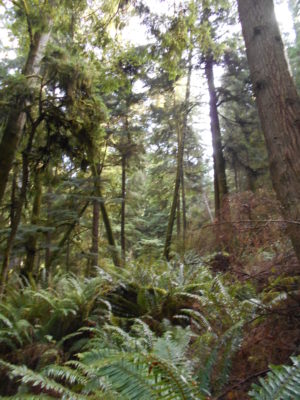
I’ve learned how to get from the retreat into South Whidbey State Park via the Fern Gully and Wilbert trails and had many adventures in my daily visits.  I met a family of chipmunks where the Wilbert trail crosses the highway to the main entrance of the park.  I saw numerous woodpeckers and met Dave, a birder who told me their official name: dryocopus pileatus. I wished he was as shy as his dog, Sephera, but I guess birders spend so much time being quiet that when they get the opportunity to talk, they never shut up. He was a cheerful guy, though and I liked knowing he was in the woods.

I learned that a fastidious, life-long city dweller could crap in the woods and survive.  Of that episode I will say no more.

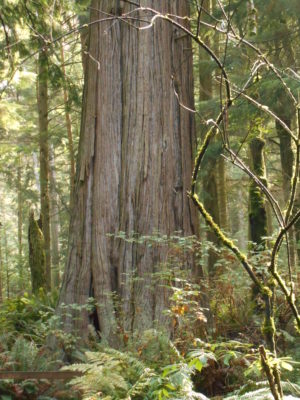
At a diversion along the Wilbert trail is a sign next to a cedar that says “Ancient Cedar.”  I had passed the sign many times, always thinking to myself that the cedar didn’t look all that old to me.  One day it occurred to me to look beyond the sign and sure enough, down the little diversion was as massive a tree trunk as I have ever seen except maybe that redwood in California you can drive your car through.  It looked twelve feet across.

Ancient Cedar

Ancient Cedar

On the Fern Gully Trail

On the Fern Gully Trail

It’s been fenced in and a sign says that the tree is over 500 years old.  Back in the 70s the Wilberts, among others, had thrown their arms around it to prevent its being felled. I stood for a long time, staring at it, and weeping.  This tree was here when Shakespeare was staging Hamlet.  It would be nothing out of the ordinary in say, England, but here in the Pacific Northwest, it feels, well, holy.

Tomorrow I head back to Seattle.  With any luck all that “Stuff to Do When I Get Back” will be past its due date.


AnglophiliaCharles DickensEnglandTravel

July 13, 2016

My Brexit

Tags: , , , , ,

(This is the final entry in a series that begins with A Night in Steerage.)

The third week of June was a strange time to be in London.  Brexit was approaching its vote.  A beloved MP, Jo Cox, a strong advocate of immigration, had been assassinated outside her constituency office in Yorkshire.  The country was stunned for two days and then went back to political crapola as usual.  It was hideously humid and thundery showers were in the forecast.  I bought papers, listened to the news, and kept an eye on the weather.

During the night before the Brexit vote, great cracking thunder disturbed my sleep.  All night long persistent rain plopped on the porch outside my hotel door. In the morning I learned there had been flash floods all over the south of England and as a result some trains were not running, including the trains from London to Canterbury.  What luck that I had made the decision to go yesterday.

The rain let up around 9:00 and looked like it would hold off until late afternoon so I set off for my be-heading at the Tower.  I took the 23 bus to Trafalgar and spent some time walking around looking at the lions and the pigeons and the famous buildings.  It’s as majestic a place as Piccadilly is seedy.

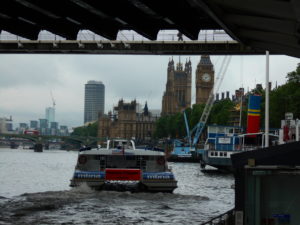
I walked down Northumberland Ave and found the Clipper River Bus at the Embankment Pier.  Once on the boat I struck up a conversation with a man who was on his commute to work.    After we passed under Westminster Bridge I looked back and saw Big Ben and the Parliament buildings framed by the bridge.  I jumped up to take a photo. Coming back, I gave my companion a sheepish shrug as though to say, “I’m a tourist, after all.”

“It had to be done,” he said cheerfully.

Had to be done

Had to be done

So, apparently, did the Tower “have to be done.”  Now that I’ve seen it, I know that I didn’t have to.  I’m glad I did but it’s just a check off the list.  Too many people, too many supercilious staff persons, too much stimulation.  What made it most interesting was the gloomy sky and the threat of rain.  The closeness was nearly unbearable.  I have never sweat like that in my life!

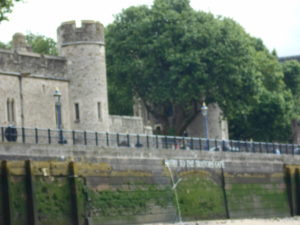
Traitors Gate is all cemented up but you can see where it was, the entrance for those unfortunates who were not going to be leaving the Tower alive or at all.  I looked at it for a long time, standing on the Clipper dock in the shadow of the Tower Bridge.

Traitor's Gate--the green bit right of center under lettering that says "Entrance to the Traitor's Gate"

Traitor’s Gate–the green bit right of center under lettering that says “Entrance to the Traitor’s Gate”

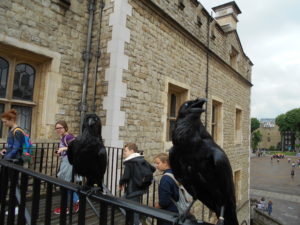
The ravens.  What wonderful birds!  They were obviously smart and used to people.  One could get within a foot of them and they posed, and then changed poses over and over. With no hint of superciliousness.   I started thinking of them as Henry VIII’s ravens.Ravens

There are lots of steps at the tower and for the past few days my left knee had been complaining about going down steps so I decided to just cut to the chase.  I felt like a ghoul for asking but I approached one of the supercilious.

“Where is the Anne Boleyn .  .  . um.  .  . place?”

“The place of execution?” asked a raised eyebrow.

“Yeah, and the–” I swallowed. “Torture chamber?”

With directions I saw what I came to see, sometimes over the ear of the person in front of me and then found myself another Salad Niçoise and got back on the Clipper.  I had expected to spend more of the day at the Tower but it was checked off by noon.  The rest of the day was to be devoted to used book stores but I knew I didn’t have the room to pack books home unless I checked my luggage, which I didn’t want to do. Another consideration was to stay ahead of the rain.  I wanted to be at a bus stop or on a bus when the predicted downpour began.

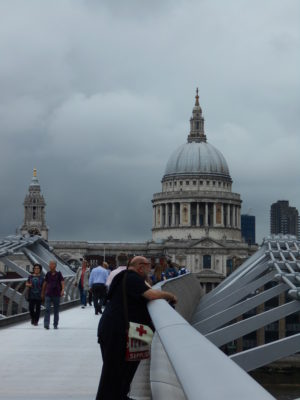
I ended up getting off the Clipper at Bankside, connecting another dot of the London-in-my-head map.  There was The Globe and the Tate Modern.   On Tuesday it would have been easy to have walked across the millennium foot bridge—the wobbly bridge they call it—and find a bus on the other side.  But then I wouldn’t have met the French couple, found a bus map and had “a lovely tea at The Delaunay.”

St Paul's from the wobbly bridge

St Paul’s from the wobbly bridge

Walking across the Thames on the wobbly bridge provides a progressive view of St Paul’s Cathedral.   It walked me right up to the reception where I paid $25 to go into the cathedral and watch a lot of people sitting around looking at their cell phones. I’ve said that walking into a cathedral takes my breath away and usually makes me cry.  Not so the Italianate St Paul’s.  I walked in and thought, “OK , You’re grand.  I get it.”  The most interesting part of my tour of the cathedral was to note that Thomas Morley, Jeremiah Clarke, and John Stainer were all organists at one time.

I went to a service at St Paul’s in 1977 during my first visit to London.  We sang the hymn that repeats “Rejoice, again I say rejoice.” Behind me was a young, clear, effortless soprano voice.  I have never forgotten the way her voice sounded like clear, running spring water.

One of the day’s more tedious features was that in the morning, while still on the Clipper, my handbag strap gave way right off the bag.  I had brought my raincoat in a garish orange plastic bag because I had forgotten its very tasteful carrier in Wendy’s car.  Now I had to cram my handbag in there as well.  It got heavier and heavier what with water bottles and the small items I picked up at gift shops along the way.  My back and neck didn’t like the weight so I had to lodge it against my hip like a baby and walk around London that way.

I found a bus going to Trafalgar where I had tea at St Martin’s in the Field and tried to decide what to do next.  A whole afternoon in London for the picking.  I was worried about how much was left on my Oyster card.  I was completely in the dark about how much the bus had been costing.  The boat had taken off £13 and I knew I was down to £5.  A group of Transport men on a break were cheerfully elucidating.  The bus was costing me £1.40 a ride.

“Well,” I said. “With £5 I could ride all over London.”

“Cheers!” they said, laughing.

I decided I would go to the Dickens Museum.  I had been there in 1977; it was time to re-visit again, especially since last summer I had read all 14 novels. I walked up Charing Cross Road and found all the used book shops.  It nearly killed me to walk by them.  Inside were hundreds of old interesting smelling books with inscriptions like “Simon de Monfort, Cambridge, 1956” printed inside the cover in an exotic British font.

I got on a 38 with a bus driver who said, “Show me your map and I’ll tell you the closest stop.”

Bless him!  People were so good to me.  I know I must have brought something to it, though, something along the line of finding the England I was looking for.  When I asked for help or directions and got not only the information I required but that lovely accent falling all over me like a fine spray on a hot day, I was so sincerely delighted and grateful that I pressed my hand on arms and said “Thank you so much.”

I loved the museum just as I expected to except that it was so close and muggy, I could hardly bear myself.   I keep bringing up the humidity because there is a connection to and an epilogue with something I mentioned in an earlier post: The Astral Cream.  I had bought a big jar of it, knowing that I wouldn’t be able to take it home with me so I was using it freely.  In fact I was coating myself with it. It’s a rich, thick hand cream but I was using it morning and evening like body lotion.  I could feel it practically hanging onto my body as I walked all over London in the humid air.

At one point I thought, “Gee I wonder if all this perspiration should be mixing with the Astral cream.”  I got my answer my first day back in Seattle and found welts on my arms and a galaxy of red dots on my legs. Prickly heat rash. Nice.  But I will say this: it wasn’t as bad as the sciatica I brought home last time I went to England.

But I am getting ahead of myself.  Back at the Dickens Museum, I alternately longed for the rain and was concerned about where I would be when it finally came.  It came as I walked up Grays Inn Road toward Euston and St Pancras where I had been the day before.  Another city connection fell into place.  The rain was light at first and so cooling that I enjoyed it falling on me.  Just as I got to a bus stop, I turned around to see a 205 approach at the same time the skies opened up.  From the top of the bus I looked through the spattered windows at two motorcyclists with helmets that said “Fuck the rain” on the back.  In the end I only needed that frigging raincoat for a block and a half to the hotel.

As I approached the hotel a van drove by with a horn atop like the political campaigners in the old movies.  It was blaring Vera Lynn singing “There’ll always be an England.”

“Oh, the Brexit vote,” I thought as I stared after it. “Today is the day.”

When I awoke the next morning, I reached for the remote and turned on the television.  “Leave” was splashed across the screen and the newscasters were looking a bit uncertain, I thought.  I heard the phrase “an historic occasion” more than once.  I was shocked.

I hadn’t paid a great deal of attention to Brexit during my three weeks in England, busy as I was with village fetes and all.  I did notice that out in the country I saw a lot of “Leave” signs but once in London they were mostly “Remain.” The few people I talked with—like the man on the Clipper river bus—told me they would be glad when Friday came and they could stop hearing about Brexit.  He must have assumed that the “Remain” vote would win out and nothing much would change.  As things stand now, we are all going to be hearing about Brexit for a long time to come.  I understand that as soon as the results came out a new group began forming that called itself “Regrets-it.” That is pretty much all I have to say about Brexit.

I was making my own Brexit that very day and felt empathy for the “Regrets-its.”  I didn’t want to leave.  The last thing I did was go for a walk in Kensington Gardens along The Long Water that turns into the Serpentine once the gardens become Hyde Park.  I listened to the bird song and watched the swans, so lovely on the water and so undignified grooming themselves while sitting in their own poo.

I pushed my suitcase to Paddington, walking slowly like a dog with its tail between its legs.  I was sure I’d be back.  There will always be an England and I expect I will always find the England I am looking for.


AnglophiliaBooksCharles DickensEnglandLiteratureTravel

July 9, 2016

A Day of Pilgrimages

Tags: ,

(This is the twelfth in a series that begins with A Night in Steerage.)

I’ve wanted to see Canterbury Cathedral for as long as I can remember.  Never more so than after I read The Canterbury Tales a few summers’ ago.  It was on the itinerary for Wednesday but I almost didn’t go.   There were “thundery showers” in the forecast for Thursday and I couldn’t decide if “thundery showers” were more suited to a pilgrimage or a trip to the Tower of London.

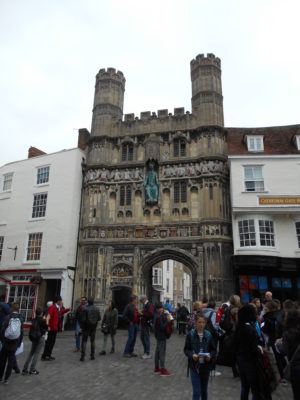
I decided when I walked out the door that I would save the Tower of London for Thursday.  I got on the 205 bus to St Pancras and then a high speed train, which deposited me at Canterbury West in an hour.  From the station I couldn’t see the cathedral so I didn’t know how easy a walk it would be.  A taxi set me down in Sun Street so I approached the cathedral from the west.  Suddenly there was the Christchurch Gate.  I can’t think how many times in England I have said “There it is!” when I’ve come upon some place that has been in residence in my imagination for years, if not a lifetime.

Christchurch Gate, Canterbury

Christchurch Gate, Canterbury

I walked through the gate and there stood the old girl, worn and dusty as a pilgrim. I cried as I always do when I enter a cathedral. They take my breath away.

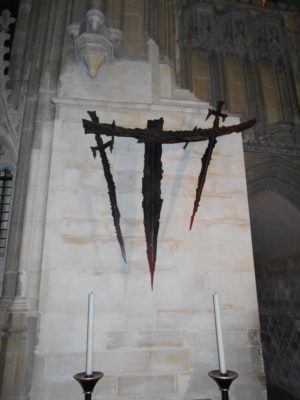
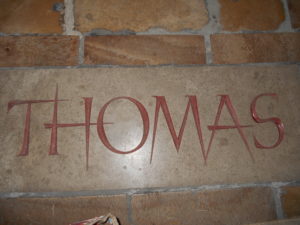
I followed the little guidebook to the site of the murder of Thomas à Becket. Hanging above the site is a dark, ominous looking metal sculpture of knives and swords.  At the kneeler, I looked down the way I do when I’m studying my cuticles instead of praying. Carved into the floor is the name Thomas.  It’s a powerful exhibit.

Sculpture above the site of the murder of Thomas à Becket

Sculpture above the site of the murder of Thomas à Becket

Thomas

At the site of the murder of Thomas à Becket, looking down from the kneeler.

I went to two services at the Cathedral.  At 11:00 AM on the second, every day since the end of World War I, the bell from HMS Canterbury, disabled in the battle of Jutland, is rung and a page is turned over in the book that lists the dead from all wars since.

As soon as this was over, I went to the crypt where we were told to not take photos and people were taking photos. There I participated in another communion service, this time on the site of the original burial of Thomas à Becket. My communal partners included sixty school-children from Germany, ages 12 -14.  They were pretty cute and probably fairly bored.

Canterbury Cathedral doesn’t sparkle like Wells Cathedral does, but somehow that seems appropriate to its history and its significance.

The Canterbury Tales is a museum of sorts.  You go on a little pilgrimage though the sights and smells of the 14th century, watching tableaux and listening to the characters from The Canterbury Tales tell their stories.  It’s staffed by people in old costumes, talking in a sort of bastardized Shakespearean English. I got no end of respect after they found I had read The Canterbury Tales in Middle English.

After buying fudge from the Fudge Kitchen, I was ready to go back to London. I asked at the Tourist Info center how much trouble I might get into trying to walk to Canterbury West train station.

“Oh, no trouble at all,” they assured me.

“Please don’t tell me I can’t miss it!” I said.

It turns out that all I had to do was carry on down the High Street, called at various stages the Parade or Peters Road, and turn right at Station Road.  It was barely a quarter of a mile and I didn’t miss it.

I got back to London late afternoon.  I knew there was a church in back of St. Pancras Station that was worth seeing.  I couldn’t remember why it was worth seeing but I was glad I persevered in finding it.  Naturally I thought that if it was in back of St. Pancras station, it would be in back of St. Pancras station. So I looked out the enormous window of the enormous station.  There was nothing back there except busy streets and boring buildings.  But I spotted an arrowed sign that said “To St. Pancras Old Church.”  When the trail went cold, I asked someone in an official-looking uniform and he told me exactly how to get there.

“And remember,” he twinkled. “It’s not pancreas!”

“And not kidney or gall bladder either,” I agreed.

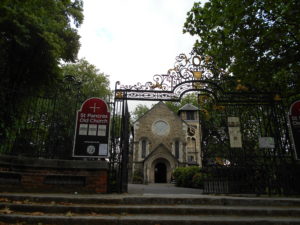
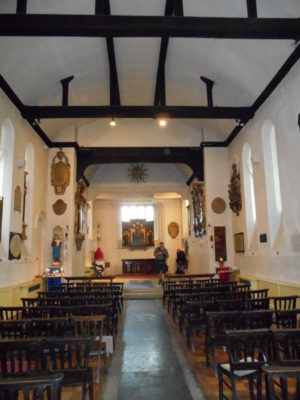
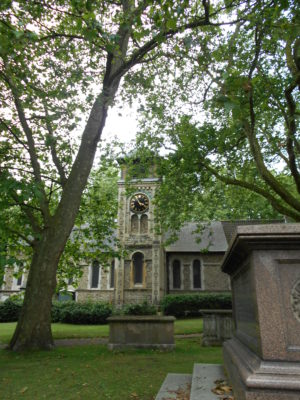
Talk about taking my breath away: St. Pancras Old Church transported me right into the 19th century as sure as any time machine could. It was straight out of Dickens with the tall iron gates to the churchyard and the old headstones in disrepair.  The tiny church doesn’t just smell of damp; it smells of old damp. On a close, overcast afternoon with a storm threatening, the atmosphere was perfect.

Gate, St Pancras Old Church

Gate, St Pancras Old Church

I remembered what I knew about this place: This was where Jerry Cruncher and his son went body- snatching in A Tale of Two Cities!  Yes, I know he was a fictional character but the point is, this was a place Dickens knew well.

Interior, St Pancras Old Church

Interior, St Pancras Old Church

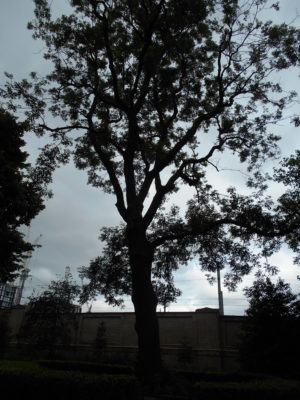
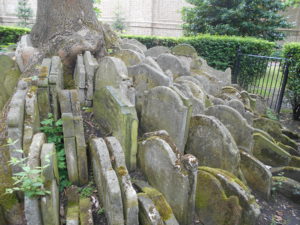
Thomas Hardy was once employed to work in the churchyard.  To note his opposition to the encroachment of the railways, a living tree in the cemetery that is fused with old headstones is called The Hardy Tree.

The Hardy Tree, St Pancras Old Church

The Hardy Tree, St Pancras Old Church

under the Hardy Tree, St Pancras

Under The Hardy Tree, St Pancras Old Church

I stayed at St. Pancras Old Church for a long time.  I could hear the city roaring in the background but inside the gates, life was protected, sacred and full of spirits of the past.

St Pancras Old Church

St Pancras Old Church

I worked my way back to Euston Road by walking through St. Pancras station. In the morning I had noticed there were pianos every 25 yards or so. In the late afternoon, people were playing them.  A young woman was playing Mozart.  Someone else was playing jazz and at the far end a man was playing a ragtime of “Buffalo Gals.”

After a bit of a hotel rest, I walked back up to the Edgware Road to Marks and Spencers to buy some of that Luxury Gold tea that had won the taste test in The Guardian.  They were all out of Salad Niçoise at Pret à Manger but I got a chicken salad that was just as good.  I fell asleep over an episode of Foyles War.


AnglophiliaCharles DickensEnglandFamilyFriendsLiteratureShakespeareTravelWorld War II

July 7, 2016

Finding London

Tags: , , , , , ,

(This the eleventh in a series that begins with A Night in Steerage.)

London is my favorite city in the whole world but I ached on the way to the train station.  I had loved not feeling (completely) like a tourist.  Wendy, Sue and I had gotten on well together and I felt a lot of affection for them.

For these reasons the train ride to Paddington was dreary and sad. I cheered myself up by helping myself to everything I could off the tea trolley.  And again at the lounge in Paddington where I had a cappuccino and tried to think what I should do first.  I decided the first order of business would be to see if I could get into my hotel early.   Since there were no public phones to be had, not even in the First Class Lounge, I sized up the room of folks waiting for trains and chose a couple to hit up for a local call on their cell phone.

Success! My room was ready.

When I handed the phone back to the couple, the woman asked, “Did I hear you say your name was Richmond?”

“Yes, that’s right.”

“That was my maiden name!”

There followed a genealogical conversation wherein we decided we must be related and I left the lounge smiling and thinking, “This trip feels charmed.”

My hotel was one of a village of hotels around Paddington station, cheap, clean and convenient to everything.  I dumped my stuff , got myself an oyster card, and with the help of Pedro at reception, got on a 205 bus going along Marylebone (pronounced Mar le bun) Road to Baker St.

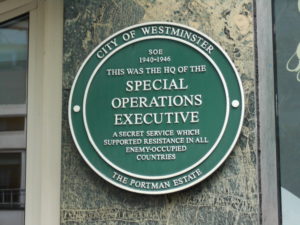
I was on the spy trail again.  I wanted 64 Baker St, former S.O.E. headquarters.   I knew that all I was looking for was one of those plaques. I had seen it dozens of times in documentaries but the point is I wanted to see it in situ.

“There it is!” I spotted it and crossed the street to stand under it and let my imagination loose.DSCN0276

Just before Marylebone High Street turns into Marylebone Road was the Garden of Rest, a sweet, quiet little park.  Charles Wesley is buried there.

When I came out of the park, an old woman with calm eyes said to me, “It’s a lovely park.”

“Yes, it is.”

“So many places to explore in London,” she looked at me as though she pegged me for the pilgrim I am.

“Do you know if Charles Wesley was the hymn writer or the preacher?” I asked.

“The hymn writer, I think,” she said. “I get them mixed up, too.”

And she was gone. (To all the things that will not notice when we die yet lend the passing moment words and wings.)

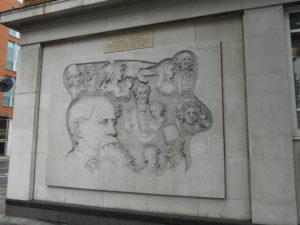
A notation on my map said there was a Dickens plaque on the corner of the two Marylebones.  I was on the corner.  I had to find it. I looked around.

“Oh god,” I thought. “I’ve got a blister on my toe and I don’t even know what I’m looking for. I’m never going to find this plaque.”

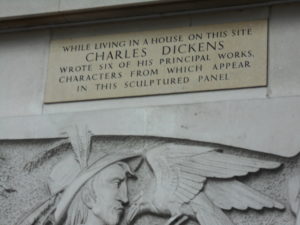
I was standing right under it. Charles Dickens wrote six of his novels in a house on that site.DSCN0278 I tried to decipher the novels from the sculptures on the plaque but all I could think about was my toe.  I went back to the hotel, put a blister band-aid on my toe, changed shoes, ate something from the mini-bar I had assembled from Wendy, Sue and the tea trolley on the train, rested up and was out the door in the opposite direction.DSCN0279

I walked the length of Kensington Gardens and Hyde Park from the Marlborough Gate to the laughably gaudy Albert Memorial and the venerable old Albert Hall and finally brought my dogs home for the night.  I fell asleep during “Went the Day Well?”

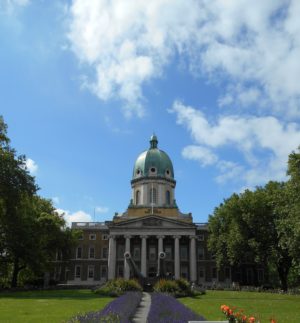
The next morning I was up early and out with the commuters. I will remember for as long as memory serves that the 148 in London terminates at Camberwell Green.  Every time the bus resumes after a stop, a voice says so.  Since I saw and heard nothing to indicate the stop at which to disembark for the Imperial War Museum, I rode the 148 all the way it its terminus south of Elephant and Castle.  It was hot and I had to pee as I waited for a bus back to town.  When I disembarked from the ingoing bus, the driver made made sure I was facing the right direction toward the impressive edifice that is the Imperial War Museum, IWM London, and I spent the morning there. The Imperial War Museum

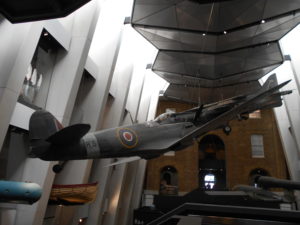
Spitfire

Spitfire

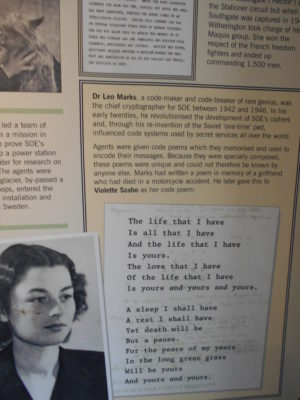
Violette Sazbo's code poem by Leo Marx

Violette Sazbo’s code poem by Leo Marx

Again I headed for the S.O.E. exhibit and this is the last time it figured on my To Do list.  There was way too much information to take in.  Much of what I wanted was filed away in the education and research rooms and I didn’t have the energy to pursue it so all in all I think I enjoyed the little museum at Beaulieu better.

I wandered around Elephant and Castle, trying to figure out how to get to the next thing on my itinerary, the Globe Theatre.  Without my earlier research I would be wandering there still.  Eventually I ended up at Bankside, the area along the Thames just up from the Southwark Bridge.  Let’s all say Southwark.  Wrong.  It’s pronounced “Su-thick.” What American would ever have guessed?

Hordes of schoolchildren swarmed the area, making it seem hotter and stickier than it was.  I drank a lemonade practically in one swallow and bought a ticket for a tour of the Globe.  When my tour started, Tony, the guide began collecting tickets:

“Thank you, lovely, thank you, cheers, thank you, brilliant, lovely, brilliant, cheers, thank you.”

I’m not sure but I think I stare when someone launches into a patter like that. And then I write it down.

There was a rehearsal going on for Macbeth that very afternoon, a piece of which we got to watch.  It wasn’t the play per se but the jig that’s done at the end.  I wouldn’t have thought a production of Macbeth would end with a jig but I learned that plays ended with a song or dance so everyone would know it was time to go home.  There were no curtains to come down.  The theater is open air, but is built so that in the event of rain, audience and players don’t get wet.  The thatched roof hanging over the stage and stalls is the only thatched roof allowed in London.  They don’t want a repeat of 1666.

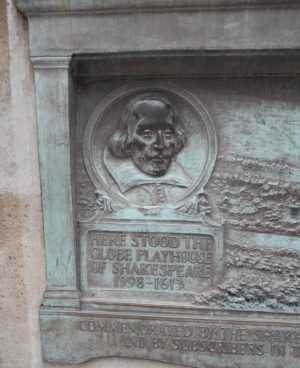
After the tour I had to find the plaque that indicated the exact location of the theater.  Found it. Breathed the air.  Took the snap.  I have a strong sense of the jolly old genius loci.Site of the Globe

Then I had to figure out how to get back to Paddington.  I had become good at working without a map.  I looked for a double decker bus, any bus, and stepped on to ask what bus I wanted for wherever I was going.  That usually got me started.  Or I asked people on the street.

I hailed a man in a T-shirt that read “Something wicked this way comes.”

“Hallo, Macbeth person!”

He looked down at his t-shirt.

“Can you point me in the right direction for a bus to Paddington?”

See, this is the problem with always having used the subway.  You get places faster but you have no idea about how the city connects to itself.  There were any number of easy ways to get to Paddington but I didn’t know any of them at that point.  Actually neither did the Macbeth person but he said if I caught an RV-1 two streets over, it would get me across the river.

“Are you an actor?” I asked.

“Yeah.”

“Your voice.” I indicated my throat.  “You sound hoarse.”

“Yeah, I did some children’s performances over the weekend. Cheers!”

(To all the things we are not remember by, which we remember and bless.)

I caught up with a French couple who were waiting for the RV-1 and we rode together across Waterloo Bridge.  She had a bus route—she got it in the subway, who would have guessed?—and helped me figure out which buses would get me to Paddington from Aldwych.

Before I started for home I went into The Delaunay, a restaurant and attached Konditorei.  It was a beautiful and restful old place with classical music playing.  I had a splendid (GF) raspberry poppy seed cake and an enormous pot of tea.

I remembered Chris of the Wookey Hole bus ride telling me about the coffee she had in the Conservative Club in Wells.

“I had a lovely coffee there.  I’m not a conservative and you don’t have to be to go in.  I always call there.  I had a lovely coffee.”

I had been wondering what constituted a “lovely coffee.”  Was it that the coffee was good or the cake or the atmosphere or all of the above?  When I came out of the Delaunay, I thought, “I just had a lovely tea.”  It also occurred to me that I always seem to find the England I am looking for even if it involves a certain amount of disassociation.  The Delaunay might be a place for Austrian expats but I had a lovely tea there.

I was happy to be on the top of a double-decker, far from the madding crowds of Piccadilly Circus, Regents and Oxford Streets.  At Paddington I popped into the subway and got a bus route map.  That evening I fell asleep over a “Midsomer Murder.”


AnglophiliaEnglandFamilyLiteraturePoemsThe Norton AnthologyTravel

July 5, 2016

A Rainy Weekend in Somerset

Tags: , , , , , , , , ,

(This the tenth in a series that begins with A Night in Steerage.)

The day after my birthday, Sue and Wendy had appointments in Wells but I opted to stay home.  I was intent on finding a footpath, if I was lucky, to Street.  Or barring that, just a footpath to walk.  They are everywhere in England but so far I had mostly only been down The Drain. I only got as far as a little short one off the Drain.  It took me onto the main highway -two narrow lanes, no shoulders, fast cars.  Across the road was a break in a hedgerow where I glimpsed sheep.

I’d been trying to get close to some sheep for two weeks.  They had mostly been whizzed past me from the train or the car.  I ran back home for my camera.  Five minutes later and the sheep had gone.  I tried to peer around the hedgerow.  I wondered, how do sheep disappear in five minutes?

I carried on to the Post Office Shop where I knew that Sally, the baker of my birthday cakes, was working the morning shift and I wanted to thank her.  I picked up Sue’s bread order and bought a Daily Telegraph.  Back home I hunted high and low for the tin I knew the birthday cakes were in and finally found it in Sue’s bathroom.

I cut two thick slices of coffee walnut cake and put them on the Union Jack napkins that had been part of neighbor’s Marian and David’s Happy Birthday in England package.  I put on the apron they had given me and went next door with the cake.  I expected this would get me an invitation to tea and I wasn’t disappointed.  We had a fun conversation; they both made me laugh.  David said he would run me up to Castle Cary to the train when I left in two days’ time and I felt relieved to think I wouldn’t have to rely on the Nippy bus.

I wrote down their address so I could write to them and in the process I found that I had been muddling the Butleigh postal code for, I don’t know, ten years!  I had always written BA6855 when it was BA68SS.  Those European fives look like ss’s to me!

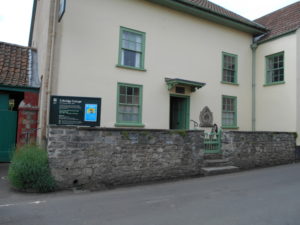
I got to go to Nether Stowey after all.  Sue had to work in the afternoon but Wendy and I could do some touring.  Sue read a description of the Coleridge Cottage out of her National Trust guide: “award winning former home of Samuel Taylor Coleridge.  .  .light refreshments in the tea room–”

“Tea room?” Wendy popped her head out of the kitchen.

“Tea room?” I said from the couch where I was teasing Tabsy. “Let’s go to Nether Stowey.

Sue put her National Trust card on the table by my purse. “You can use this, but you probably should say as little as possible until you get past the door because the cards aren’t transferable.”

It was a beautiful drive into the Quantock Hills.  At the door I stayed behind Wendy, the headmistress, and let her do the talking.  I handed over my card with my lips tightly closed.  Since the ticket taker then became our guide, I was afraid to open my mouth.  I could lie in my own world but not in an English one.

Coleridge Cottage, Nether Stowey

Coleridge Cottage, Nether Stowey

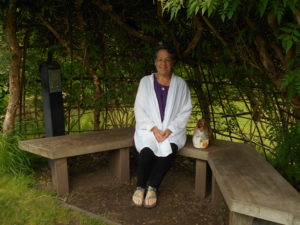
It turned out to be a magical experience for me. Here was the room where Coleridge wrote “Frost at Midnight” with his baby in a cradle next to him  .  .  .  probably.  And in the garden was a lime tree bower.  Not The Lime Tree Bower and not in the exact spot, but close enough for my imagination to go wild.  In case you have no idea what I am on about, “The Lime Tree Bower My Prison” is one of my favorite Coleridge poems.  It’s a poem only an English major can love but worth a look.

‘Tis well to be bereft of promis’d good,
That we may lift the soul, and contemplate
With lively joy the joys we cannot share.  .   .

No sound is dissonant which tells of Life.

The Lime Tree Bower

The Lime Tree Bower

The National Trust is tending to create hands on exhibits, which I think are marvelous.  We were encouraged to touch everything, sit on chairs, and try on clothes.  The only thing we weren’t allowed to do is break the glass cases and play with the authentic artifacts.


They made much of the fact that Coleridge had in a letter described the cottage as “mouse infested.”  There were fabric mice, knitted mice and plastic mice in every room of the house.  I began counting them for fun but stopped at 17 by the time I hit the second parlour.  Children (of all ages) would love it.  That’s the thinking behind the trend: to get younger people interested in the National Trust properties.

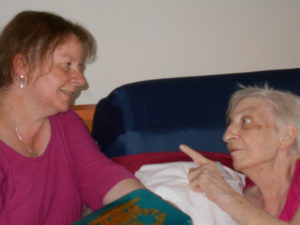
Wendy and I stopped in Glastonbury to see Pam and take her some birthday cake.  This was the most lucid I had seen her.  She had complete sentences and she clearly connected me with photos of Seattle and of my house.

She drank from a cup for the first time since her stroke. She held on to the cup, raised it to her mouth, sipped, and set it down shakily onto the tray-table.  She did it again.  The second time it was executed much more steadily.  By the fourth sip, she was executing the movement and hitting the targets smoothly.  It was fascinating: witnessing a brain connection leading to a new skill.   I’ve gotten to see Pam four times since I’ve been here and I am so glad it worked out that way.

Wendy and Pam

Wendy and Pam

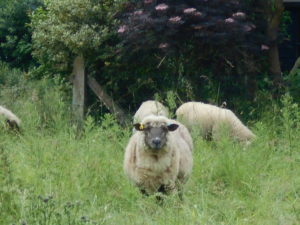
Sunday morning–the next day– was a wet one and it began for me when I walked up the path to see if the sheep were visible.  They were.  As I stood watching them the church bells began to peal.  They rang and clanged and did that falling down a ladder thing they do.  I stood in the wet with the sheep and the bells and thought, “Could anything be more English?!”

“You thought you were in the middle of a John Betjeman poem,” Sue said when I told her.  Sue gave me the best birthday gift I could have gotten when she said, “Elena, you have an English soul.”

DSCN0255

Sheep of my English soul

The three of us set off at noon for the coast of Dorset, destination West Bay and Lyme Regis.  The rain wasn’t supposed to have started until 7:00 in the evening but it rained and fogged up the windows right from the start.  I opined that it might be clear on the coast.  Sue looked at me piteously and said, “Bless.”

When we got to West Bay, Wendy asked, “Do you want to drive through the town or get out?”

I knew in my heart what the correct answer was but I said, “Oh I want to get out.  I want to see the big rock.”

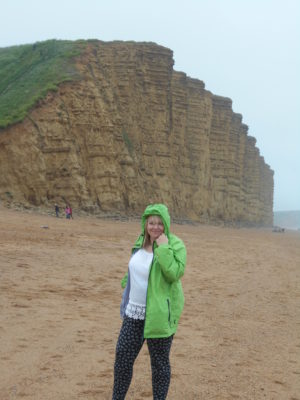
The “big rock” is the Golden Cap made famous in the mini-series Broadchurch.  We parked, put on our rain coats and hoods and made our way through the puddles to the harbor.  The wind was fierce.  I could hardly believe how good natured Sue and Wendy were.  As we picked our way along Sue bumped up against me.

“You don’t have to shove me into a puddle,” I said. “It’s raining. I get it.”

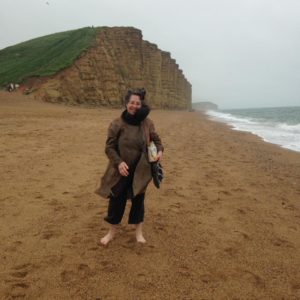
The beach is made up of tiny smooth pebbles, which stings on bare feet.  But the pebbles get into shoes and hurt in a different way.  I went barefoot because I wanted to paddle or as Americans say, wade.   My feet sank six inches into the pebbles, making movement forward a struggle.  I struggled to the water’s edge.

Sue and I took photos and laughed at each other while Wendy waited at the top of the hill.  Back at the car park, Sue and I made for the toilets.  “I can always cock an eye–or a leg– for a place to wee,” Sue said.

At West Bay, Dorset

At West Bay, Dorset

We drove the ten miles west to Lyme Regis, a Georgian town often visited by Jane Austen, her characters, and Sue and Wendy.  They come down for a day away quite often to go round the shops and walk the footpaths and have tea in a Wendy approved tearoom.  On this Sunday it was raining so the best we could do was a restaurant called “By the Bay” with a view of the Cobb featured in The French Lieutenant’s Woman.

Sue, West Bay, Dorset

Sue, West Bay, Dorset


Back home I said a difficult goodbye to Wendy before she set off to Burnham for the night and work as usual in the morning.  Sue and I stayed up talking books and literature. Tomorrow I was going to London for three days and my trip was nearing its end.


AnglophiliaCatsEnglandFamilyFriendsGardenPoemsTravel

July 3, 2016

Clouds of Witnesses

Tags: , , , , , , , ,

(This is 9th in a series that begin with A Night in Steerage.)

After my experience in Wells, I wasn’t eager to try new bus adventures.  I wanted to go to Nether Stowey to see the Coleridge Cottage.  Sue looked into it for me and said that the bus would only get me to within 20 miles of the cottage and the rest of the journey would involve a taxi and some very careful planning if I was going to make that all important last bus of the day. The internet makes it sound like a bus drops you off at the front door of the Coleridge Cottage twice an hour.
Instead I stayed in town and went to Holy Communion at St Andrews.  I don’t know why I like doing this.  To me it’s not a religious experience so much as I feel like I’m in  Masterpiece Theater.  The service was from the 1662 Book of Common Prayer, which both attracted and repelled me with its cannibalistic imagery and masochistic sentiments.

What I found moving was the parade of old age pensioners who limped, wheeled and stumped with canes and sticks to the altar.  Bent with scoliosis, osteoporosis and arthritis, they come every Thursday morning for this.  The elements were taken down to an old nun who sat silent and sour in a pew.  A man in the back was trying to hack up such a plug that I hoped he didn’t get in line ahead of me. There’s something wonderful about a ritual that brings people into meaningful connection with each other regardless of whether I or anyone else happens to believe the liturgy.

The smell of coffee wafted through the hall.  I took mine to the sour old nun who brightened into a beautiful smile. I said hello.

“Who am I speaking to?” she asked.  “I’m blind, you see.”

“Are you completely blind?” I asked. “Or can you see shapes?”

“No, completely blind, only impressions of light and shade.”

We talked for quite a while.  Her name was Sister Ruth and her order was in Portsmouth but she lived in Burnham in a home for the blind.  Calm contentment emanated from her. I was glad I had come if for no other reason than to sit for a few minutes and have coffee with her. When I left I put my arm around her and she leaned into me with a force more powerful than a bear hug.

It had been trying to rain all day but the when the sun finally won out, I elected to go for a walk on Burnham’s fine beach. I took off my shoes and walked barefoot for miles out past the lighthouse, repeating the poem that had been in my head during the communion service.  It has become a prayer and a mantra to me when I travel alone.  It’s part of a canto from Louis MacNeice’s “Autumn Sequel:”


A cloud of witnesses. To who? To what?
To the small fire that never leaves the sky.
To the great fire that boils the daily pot.

To all the things we are not remembered by,
Which we remember and bless.
To all the things that will not notice when we die,
Yet lend the passing moment words and wings.


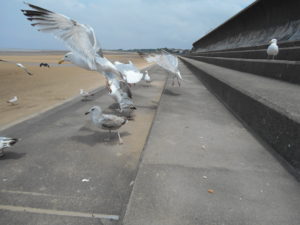
DSCN0183On the steps below the esplanade I cleaned my feet and encouraged the seagulls with the end of a loaf of bread. They are so used to being fed, they come very close.  I got them hovering, flapping and fighting and took photo after photo, hoping to get some good action shots.

DSCN0234 I came back through the shops on the High Street and bought a Guardian at the Post Office Shop.  I’ve been buying a different paper every day: The London Times, The Daily Mail, The Daily Telegraph, The Guardian.  Back home I curled up on the couch, tried to understand Brexit and fell asleep.

A cat came to visit: a sleek Siamese. He appeared and was watching me when I spotted his face.  He didn’t respond when I schmoozed and after a while went on with his ablutions.  “To all the things that will not notice when we die, yet lend the passing moment words and wings.”

According to The Guardian, after holding a taste test, the best tea is

1) Marks and Spencer Luxury Gold
2) Clippers organic
3)Morrison’s English Breakfast
4)Co-op Loved By Us 99 blend.

Good to know.  And if you are in the market for an electric teakettle, get a Russell Hobbs.  It’s so efficient, all you do is look at it in the morning, say “Tea” and it fills itself up and boils in 30 seconds.

On June 17, it took me a while to remember it was my 62nd birthday.  I was up at 5:30, looking out over Mervyn’s dear old garden, now overgrown and unkempt, but still beautiful to me.  I’d been watching all week for foxes because I’d been told they have a den somewhere at the bottom of the garden. So far only the Siamese cat had shown up.  And birds: chickadees, sparrows, the great whacking pigeons, magpies, gulls, crows and an assortment of other black colored birds: blackbirds, I guess.  I liked the way the crows held their own with the seagulls.
I did laundry and tried to clear up and put the house back the way I had found it.  I had taken it over: I dressed in one room, slept in another.  I bathed in the big tub in the downstairs bathroom and made all my other ablutions in the upstairs one. I wrote in the breakfast nook and read and ate in the conservatory because it opened into the garden where the birds, squirrels one cat, and no foxes come.

Janet took me for shepherd’s pie and lemon posset at Saunders Garden Center.  Back at her house, I fed Penny the last of the dog biscuits and happened to notice that Janet had some of my china pattern that I inherited from my Aunt Ann.  Mason’s Regency. Impossible to get any longer, Janet gave me a small dish that would pack easily, a birthday surprise.

Wendy fetched me when her school day ended.  On the way back to Butleigh, we stopped in Glastonbury to see Pam.  I told Wendy that talking to Pam was like standing in front of a locked door with hundreds of keys, trying out one after another to see which would unlock it.

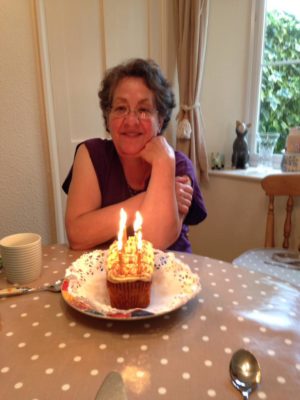
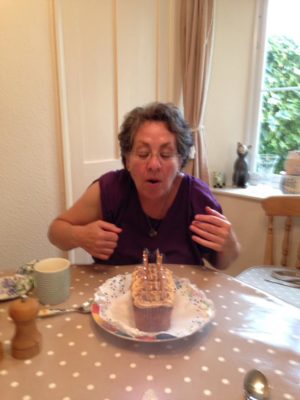
It was nice to be back in Butleigh.  Sue and Wendy had asked me what I wanted to do for my birthday and I said that principally I wanted to be with them.  And I wanted cake.  That was enough. There were two kinds of cake: the gluten free coffee walnut one I had requested and a lemon cake because neither of them fancied coffee walnut.  I had a slice of both.

David and Marian (neighbors) had put together a birthday package of Things British, including a candle for the Queen’s 90th. Sue and Wendy gave me a gift certificate, light and easy to pack.  Eight hours later came the Facebook blizzard of greetings, making me feeling like I had had two birthdays but only got one year older.  Sue and I stayed up talking books and literature. It was one of the happiest birthdays I’ve ever had.

Birthday Happy, England 2016

Happy English Birthday (photo by Sue Cooke)


Coffee Walnut

Coffee Walnut (photo by Sue Cooke)


AnglophiliaCatsEnglandFamilyFriendsTravel

July 2, 2016

Wells to Wookey and Back Again

Tags: , , , , , , , , ,

(This is 8th in a series that begin with A Night in Steerage.)

On my way to the Old Pier to catch the bus to Wells I chatted with a man who ascertained for what felt like the hundredth time which side of the street I wanted.  It’s funny: there aren’t that many buses in and out of Burnham and there are only two sides of the street; I don’t know why it’s so difficult.

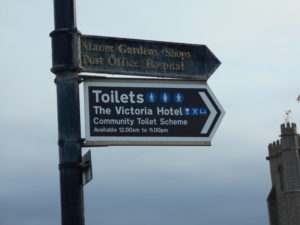
Directions in general are difficult. I wish I had a pound for every time someone who gave me directions ended with “You can’t miss it.” As in: “Right. You carry on down to the bottom of the High Street, veer off onto the wonky road and turn right at the sign for Community Toilet Scheme.  You can’t miss it.”  As in: “Yes, I can.”

When I got on the Bakers Dolphin 67, I asked the bus driver, “How much is a Wells return?”

“It’s free.”

“What does that mean?”

“It means it won’t cost you anything.”

“Why is that?”

There followed an explanation that referred to the Webber bus that I had expected to catch, the phrases “belly-up overnight” and “keep the route going” and traffic commissioner.  I didn’t quite understand because his accent was hard to follow and I was fascinated with the way three of his lower teeth stuck out like a gangplank.

My free ride to Wells was an hour of sheep, cows, villages and people walking their dogs.  A Cathedral Lady got on: beautiful face, her grey hair pinned back in a top-knot with wispy curls around the forehead and neck.  She wore a printed skirt, blue jacket and sensible shoes.  When we got to Wells, she and I both made for the bus station toilets, in which a recording of a cathedral choir plays while you wee.

I hoofed it all the way past the front of the cathedral to the Tourist Information to find out where the library was because I wanted to e-mail a Happy Birthday to someone.  Naturally the library was back the way I came and I found it tucked away in Union Street.  That errand called for a cup of tea.  I always try to channel Wendy when I am looking for a tea place as she has a sixth sense for the best ones.  I ended up at the Swan Hotel, certainly not a place Wendy would choose, but quiet and empty was good enough.  I had my cup and surreptitiously nibbled a gluten free coffee walnut muffin I had bought at Burns the Bread.

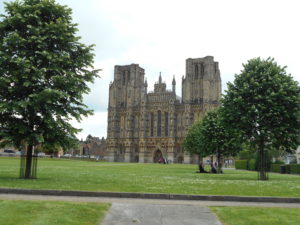
Wells Cathedral

Wells Cathedral

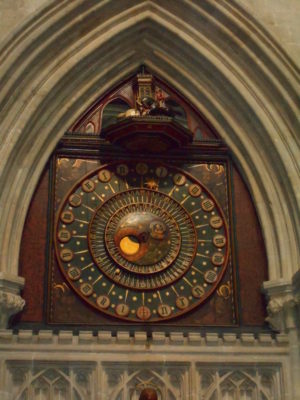
When I felt ready to go on, I entered the cathedral.  This would be my third visit to Wells so when I saw that it was ten minutes of twelve, I knew to beetle over to the clock for its biggest performance of the day.  On the hour, the knights of this medieval clock come out and joust before the bell tolls.  I joined the elderly sitting on benches in back of the hordes of school children sitting on the floor.
Wells Cathedral Clock

Wells Cathedral Clock


The cathedral is really an enchanted place.  The nave takes my breath away and this time I got tears when I entered the Quire.  It’s a wondrous thing to have such a majestic and magical place feel familiar!

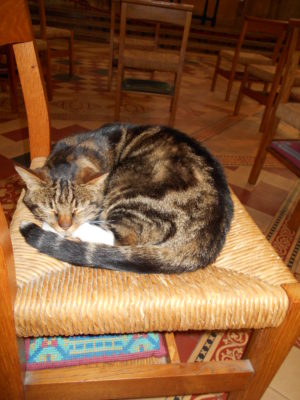
I was actually intent on finding a different kind of majesty:  The Cathedral Cat.  Since I was here last, a cat named Louis has made this his home.  I had gone up past the Quire, idly looking for the Jesse Window.  When I didn’t spot it up in the front (or is it the bottom, which means the end?) When I turned to go back, I saw a cat asleep on a chair. He endured being awakened, turned around the other way and fell back asleep.  This turned out to be Pangur, Louis’ competition.  The cathedral was apparently crawling with cats, much like Sue and Wendy’s cottage.  I never did see Louis.


Louie, the Cathedral Cat

Cathedral Cat: Pangur, the competition to Louis

Neither did two other Louis Spotters who photographed Pangur and went with me to find the Jesse Window, which had been in the Quire all along.

“Cracked that one!” the man said.

“By jove!” I said.

I went to the Bishop’s Palace to see if I could find Maisie, the Bishop’s Palace cat I met seven years ago. I spotted her across the croquet lawn while I was eating my pea and charel soup at the Bishop’s Table café.  I kept an eye on her until I finished my lunch and could go over and say hello. She wasn’t nearly as friendly as the day seven years ago when she shared my tea with me.  She grabbed my hands with her paws and bit. But then she posed so I could take a photo.

Maisie in 2009

Maisie, 2009

I walked across the drawbridge onto the grounds of the Bishop’s Palace, surely the epicenter of the enchantment.  If I lived here, I would have a membership and visit once a month to restore myself. I love the rampart walk where you can see the countryside and feel safe and protected and be enveloped by the quiet.

Maisie, 2016

Maisie, 2016

As I walked around the wells, the sky darkened and I heard thunder. I hurried to see the reflection of the cathedral in the wells before the rain came.  Which it did and I finally needed the raincoat I had been lugging around for a week and a half.  “Thundery showers” is what they call these weather conditions.

There was an open air market outside the cathedral at the top of the High Street.  I stayed under its canopies as I walked toward the bus. In the process I bought a hat and a carpet bag.  When I lost the protection of the canopies, I looked for a place to have tea.  There is a wide gutter between the sidewalk and the High Street in Wells and it was already nearly overflowing.

I ducked into Coffee #1, another place Wendy would have passed up.  They had The Most Luscious orange cake I have ever eaten—gluten free. I wrote for an hour, keeping my eye on the rain and a big school clock.  I needed to pee and to pick up a loaf of bread I had bought earlier at Burns the Bread before catching the bus home.

The 3:40 bus I meant to take was sitting in its dock with a sign saying “Not in Service.” I joined the people milling around.  Information began to trickle in: the bus wouldn’t start, there were only two buses running this route, the drivers were Romanian and ours didn’t understand English very well, he also seemed frightened and not sure what to do, they were sending a relief bus in ten minutes, they were sending a relief bus within the hour, the 3:40 wouldn’t run at all, the only bus left that day was the 5:40.

A small woman in her early seventies hitched up beside me on the misericords they give you to sit on at the bus stops. When she heard my voice, she asked me where I was from.

“Seattle.”

“Oh, Seattle.  Frasier.  I love Niles. He’s a pantomime with words.”

This exchange made us instant mates.

“Would you like a doughnut, love?” she asked pulling two long packages out of her bag.

“Oh, no thanks,” I said. “I just had a piece of cake.”

She offered the doughnuts to the rest of the people at the stop.

“Here,” she said. “I’ve got custard and raspberry.  Which would you like?”
“Why did you buy so many?” I asked.
“I couldn’t decide which I wanted so I got both but I was only ever going to eat one of each.”

Chris led the charge for us all to sit in the broken bus while we waited for Bakers Dolphin to rescue us.

“Sit with me, love,” she said, patting the seat next to her.

We were joined by a young man who looked like a young Alec Baldwin and I told him so.

“Ooh, I didn’t like him when he was young,” Chris said. “But now that he’s old and fat and gray, he’s lovely!”

Our companion was named Sam. It turned out that both he and Chris were out-of-work actors.  They talked about Equity and I decided it was Rupert Graves that he looked like. Then we moved on to Brexit.

“It’s already over,” Sam said. “The politicians are just making noise now.  We all know how it’s going to come out.”

“How is that?” I asked

“Remain,” said Chris.

“Leave,” said Sam at the same time.

The second Bakers Dolphin 67 showed up at 4:40 and the three of us boarded it even though it wasn’t due to head toward Burnham until 5:40.  Here’s what I learned about the 67 route lately run by Webber bus and now by Bakers Dolphin: For every trip it makes from Wells to Burnham-on-Sea, it makes two trips to Wookey Village and back to Wells and two trips to Wookey Hole and back to Wells. The last time it goes back to Wells it becomes the 5:40 to Burnham-on-Sea.  And not before.  No matter that they hadn’t run the scheduled 3:40.  The bus driver was beside himself trying to explain this to us.

It was pouring rain.  Our options were to stand in the rain and wait until 5:40 or go back into town and sit somewhere dry. No one wanted to get out of sight of the bus station just in case a relief bus showed up. So we rode back and forth from the two Wookeys to Wells for two hours having a grand old time.

Finally we were headed home.  Chris got off a few villages before Burnham at East Huntspill.

“I’m going to give our driver a doughnut,” she said as she packed up.

“Whether he wants one or not,” I said.

“Whether he wants one or not,” she laughed.

We kissed goodbye and I watched her insist the driver take a dough-nut.

“There’s raspberry and custard.  Which do you want? No, take one. They’re lovely.  Here. Here’s a raspberry one, sweetheart!”

She got off the bus, leaving the driver with a drippy dough-nut and waved to me until I could see her no more. I walked in the door of the house on Love Lane at 7:00 and went straight for the Talisker.

Entrance to the Quire

Entrance to the Quire

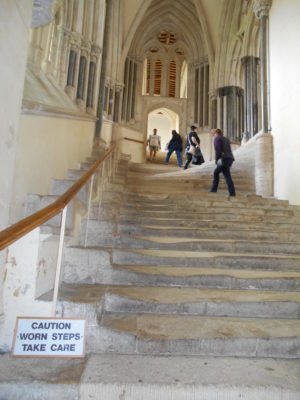
Chapter House steps, worn with use

Chapter House steps, worn with use

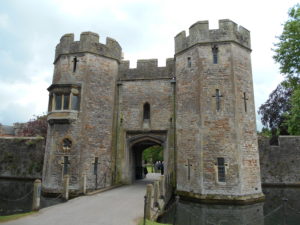
Entrance to the Bishop's Palace

Entrance to the Bishop’s Palace

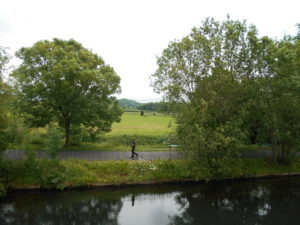
View from the Ramparts Walk

View from the Ramparts Walk


DogsEnglandFamilyTeachingTravel

July 1, 2016

Burnham-0n-Sea Revisited

Tags: , , , ,

(This is 7th in a series that begins with A Night in Steerage)

Burnham-on-Sea is a small resort town on Bridgewater Bay, which is itself a dip in the Bristol Channel.  I was here in 2009 when Mervyn was alive and Pam was herself.  I stayed with them in their semi-detached house on Love Lane.  From my big upstairs bedroom I could look out onto the garden and see Mervyn pottering around overseen by what he called the “whacking great pigeons.”  The pigeons are still there. Pam and Mervyn were only there by association and imagination this time.

Mervyn in the garden from my bedroom window, 2009

Mervyn in the garden from my bedroom window, 2009

My first order of business after a lazy morning was to go around the corner to Tesco and get something with fat in it.  I can’t bear this semi-skimmed milk and faux butter spread Sue and Wendy use.  I got some “single cream,” which turned out to be like our whipping cream (yum) and real British butter.

I pushed the cart backwards around the store wondering why it was so difficult to maneuver.   It was funny how everything was the same as what I was used to but just slightly different enough to throw me off.  There was no earthly explanation for why a cart shaped the way that one was should be pushed from the other side. I couldn’t figure out the stove or the dishwasher.  Showers were hand held.  Keys in doors didn’t turn the way I expected them to.  Once I tried to get into the house next door because it looked like Pam’s house.

I spent a long time in Tesco trying to find some hand cream.  I hadn’t brought nearly enough. I expected Pam would have dozens of bottles and tubs of cream falling out of cupboards.  The elderly always do. The only bottle of cream she had was ancient and when I squeezed it, the bottom exploded and old, runny stuff came out all over me.  I wanted something I couldn’t get at home.  I settled on a big tub of something called Astral.

Later I showed it to Sue. “What can you tell me about this?”

“Astral? Oh, my mother used to use that.”

“Oh, great. I’ve bought Ponds cold cream.”

“Joanna Lumley uses it and she looks fabulous.”

Sue and I looked at each other, a beat went by and we said simultaneously, “Absolutely fabulous!”

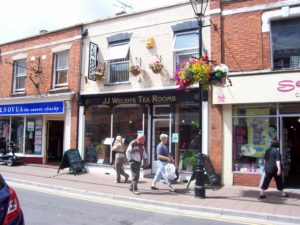
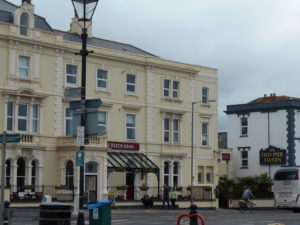
I walked the half a mile into town and made for the esplanade and the beach. The tide was out so I walked on the beach all the way down to the Old Pier on the far side of town. There used to be a train station across the street but it’s gone now.  So is Jackie Welch’s tea shop.  Most of the shops are thrift shops and 99p shops (Dollar stores).  The Home Hardware and DIY is still there and the proprietor I chatted with seven years’ ago was as jolly as ever.  When I was here before we talked about different meanings of the word “solicitor.”  This time we talked about Brexit and Donald Trump.

Welch's Tea Room on the High Street, 2009

Welch’s Tea Room on the High Street, 2009

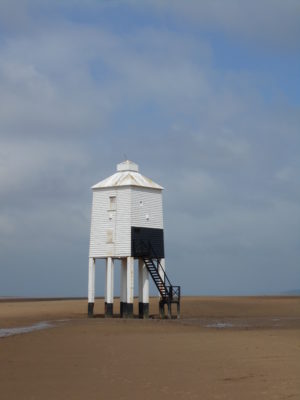
Back on the beach, I walked along looking toward the funny little lighthouse and thinking, “I’m really here.  I never thought I’d be here again.”

It’s a funny little place, really.  It’s small and middle-class and not posh at all, which is one of the things I like about it.  There’s not much to do and I like that, too.  There’s a sign on the esplanade that points to a “Community Toilet Scheme” that sounds a little alarming.

Funny little lighthouse of Burnam-on-Sea, otherwise called "iconic."

Funny little lighthouse of Burnam-on-Sea, otherwise called “iconic.”


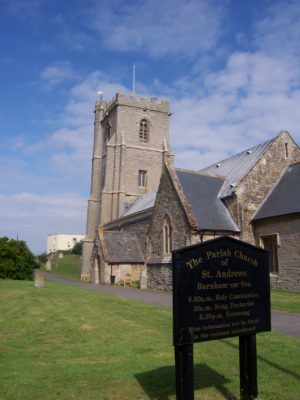
The next day I went to meet my friend Janet.  When I was here before, I went to services at St Andrews Church because there were bells.  They actually rang the bells fifteen minutes before the service started so you’d know it was time to join the stream of people issuing from the their homes. There I met Janet, an older woman who clearly was one of the energizing members of the church.  She took charge of me, took me to the coffee, bought me a biscuit, and introduced me to everyone.  We have been exchanging Christmas cards ever since.

St Andrew's Church, Burnam-on-Sea

St Andrew’s Church, Burnam-on-Sea

Last fall I wrote to tell her I was coming in June.  In her Christmas card, she acknowledged my visit.  I wrote again in the spring to tell her the exact dates I would be in Burnham and where I would be staying.  No response.

Once when I was staying in Rye in Sussex I met a couple who told me they lived down the road from Charles Darwin’s house and that I should go see it and then come knock on their door.  I asked Mervyn if he thought they meant what they said.  Because when you say something like that to an American, they’ll take you at your word.

“I think if you knocked on their door, they’d be shocked,” he said.

When I didn’t hear from Janet, I began to doubt the existence of seven years of Christmas letters.  But the night Wendy and Sue left me at the house I found that Wendy and Joy (sister) had stocked the place with fruit and vegetables, Mary Beary dressing and a sampling of every gluten free cake, cracker and biscuit in Tesco.  In the midst of this plenty was a note in Janet’s familiar handwriting.  She suggested I pop into the church the next morning because she would be there and we could make some plans.

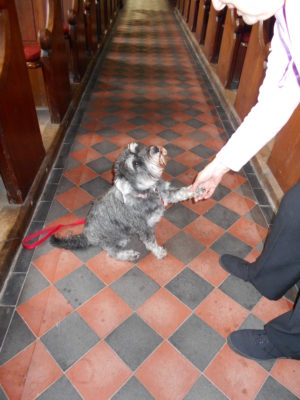
At 11:00 the next morning I popped.  I was greeted by Penny, the Schnauzer, and the newest member of Janet’s household.  I was ready for her with dog treats.  Janet and three other women were seated around a table.  They were there to pray and Janet invited me to stay.  I was horrified.  But it turned out to be very C. of E., that is to say civilized and short.

Penny

Penny

I went home with Janet, saw her garden, and her house, Field’s End, overflowing with correspondence and church business affairs and knickknacks in an owl motif.  The bags of woolies in the living room will be given to a teen shelter in Weston Super Mare, but the paper clutter and the 10,000 owls are, I fear, there to stay.

We made a lunch together and ate in what Janet called her conservatory and I called a sunroom.  Then she took me to Church Field, the school where Wendy is the headmistress, in the town of Highbridge, two miles from Burnham.

It was a good day to visit.  Wendy and her deputy head were touring all the classrooms to help judge the best poster, card and crown made in honor of Queen Elizabeth’s 90th birthday.  My favorite card was one a boy had made from a box.  Open the lid, and it said “Dear Queen, Happy Birthday.”  Wendy calls this “teaching British values” with more than a raised eyebrow of irony.

Janet picked me up later for supper at a pub called The Dunstan Arms. We had fish and chips and a blackcurrant sorbet so sweetly tart it made my eyes water. Later, feeling very full, I went round to the Tescos to see what they had to say for themselves in the way of spirits.  I found a bottle of Talisker just the right size to last me the rest of my stay in England and I went to bed happy.

The next day was set aside to go to one of my favorite places: Wells.

DSCN0185

signpost, Burnam-on-Sea

Old Pier, Burnam-on-Sea

Old Pier, Burnam-on-Sea