
FriendsTeaching

April 30, 2016

The Duck Pond

Tags: , ,

On the corner of NW 95th and 6th NW in Seattle is a duck pond. I’ve known about it since 1987 when I bought my first house in the Greenwood area of Seattle, not too far from where I live now. Back in the 80s, three of my piano students –known by the child whose lesson came after them as The Three–rode their bikes past the pond on their way to lessons. In the spring the day always came when The Three trooped into my house, dropped their jackets and music on the floor, and announced, “There are baby ducks!” Later in the evening, I’d make a pilgrimage to the pond to see the ducklings.

The Three consisted of two sisters, Alix and Robin, and their friend, Jocelyn. Jocelyn is now 38 years old and has a baby boy. I have known her since she was two years old. When I taught music at the Perkins School, Jocelyn was in the Pinkers, the two year olds and then graduated to the Orange Group when she turned three.

She was an intense child. She took the singing of silly pre-school songs seriously. When we made our fingers and noses be a stringed instrument and sang “Vio,vio,viola,” she made sure she did it correctly. But she enjoyed herself intensely, too. That was so interesting to see in such a small child.

Every afternoon Jocelyn’s mother fetched her daughter. She arrived in what I can only describe as A Determination. She came through the door onto the playground like a force of nature and then abruptly stopped, rocking back slightly in her Birkenstocks and looked for her child. This mode of bodily conveyance has become familiar to me because Jocelyn’s mother is now my dear friend, Nina–rhymes with Dinah. But that was years in the future. I still try to not mix Parents with my relationships with students. At that stage in my life, I wanted nothing to do with anyone’s parent full stop.

When I went into teaching private music lessons, Jocelyn was the only student I solicited. She was in grade school by then but I had never forgotten her. Nina started her in lessons with me and we stayed together for ten years until Jocelyn graduated from high school. She did her senior project on Piano from the Romantic period and played a recital she had put together herself. Home from her first year of college, Jocelyn and I did a summer of voice lessons.

I’ve followed Jocelyn’s career as an actor. I went with Nina to see all the plays in which Jocelyn participated at Franklin High School and to all the summers of Shakespeare in Seattle. My first visit to New York City was made in order to see Jocelyn’s senior performance when she graduated from New York University School of Drama. I’ve seen her in a few independent films and in one exciting part in The Middle, which I made Nina play 15 times, rewinding it over and over to see Jocelyn’s part and then to see her name in the credits.

Jocelyn witnessed me singing “Lasciatemi morire!” (Let me die!) in my room at the Waldorf Astoria at the beginning a long trip through upstate New York and a crossing on the Queen Mary II to England. I had sold my mother’s house and was feeling flush. Singing “Let Me Die” at the Waldorf Astoria was my idea of a funny thing to do.

I sang at Jocelyn and Abe’s wedding. I flew home from my extended trip just in time to get over the jet lag and get my voice warmed up. And—here’s my favorite part—I got to sing a classical piece! True, I did it with guitar accompaniment because we were outdoors in the Woodland Park Rose Garden, but I sang Handel’s “Alma Mia” as well as Andrew Lloyd Webber’s “Love Changes Everything.” I was so pleased that two of my favorite songs also appealed to Jocelyn.

Jocelyn and Abe now live in Los Angeles. In addition to her acting jobs, and being a mom, Jocelyn tutors students in math in preparation for their SATs. And she has started a business, Home Place Beef, with the tenant and caretaker of the family ranch in Montana. You can order beef from grass fed cattle here:

Now instead of a singing with a Pinker with her fingers in her nose, I watch videos of the exceptional antics of baby Hugo. Of course there’s never been as wonderful a baby as Hugo and everyone knows it. Still I limit Nina to showing me only one video per week and no more than five photos in any one day.

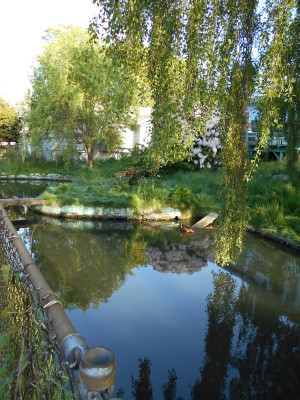
These memories come back to me because it’s April and there are ducklings at the duck pond. My daily constitutional is currently routed past the pond. I stand at the fence and talk to the ducks. There’s mama and papa and the eight ducklings. When I first started greeting them, the mama was protective of her brood and herded them to the other side of the pond. (Query: Do ducks herd and brood?) Yesterday she paraded them out of the drain pipe where they had apparently been playing when I came to the fence.

One day they were all in a pile under the mama and remained in place when she stood up: a little mat of down with the odd beak or eye showing. The papa climbed up the bank and picked at the ducklings for no reason that I could see except it caused all of them to get up and move en masse two feet away where they rearranged their beaks and eyes and matted up again.

There was some agitation the other morning that seemed connected to the presence of two extra male ducks. I always think of the male ducks that cluster around in a group as The Uncles. They are like the uncles at Christmas who sit in the front room and observe the goings-on but do nothing to help. One of the males at the pond had a dark green, almost black, velvety head. He seemed a little menacing, not like anyone’s uncle. I called him the Black Prince. The other was an everyday green mallard who seemed to not quite know what to do with himself. I called him Uncle Vanya because I have been reading Chekov.

This morning I took my camera because I wanted to take a picture of the ducklings before they got much bigger. There was only Uncle Vanya, preening.

“What have you done with the ducklings?” I asked.

He looked at me contemptuously and swanned (Query: do ducks swan?) to the far end of the pond.

The duck pond is empty now except for Uncle Vanya. When there are babies, it always reminds me of The Three, especially The One, Jocelyn, the beautiful little girl with the intense intelligence and sensitivity. I would never want to be 40 again but I do miss a time when kids rode their bicycles to piano lessons and ducklings were an event. Tomorrow is May Day. It’s early yet. There’s still time for more ducklings.
The Duck Pond
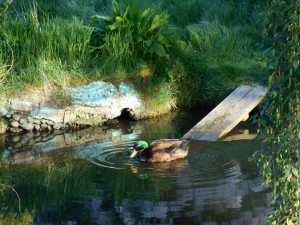
The Duck Pond

Uncle Vanya
Uncle Vanya

FriendsGardenSongs

April 20, 2016

Garden Compost

Tags: , , , , ,

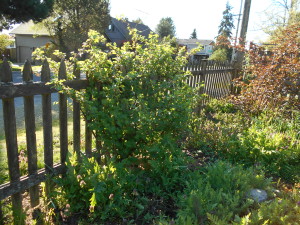
Eighty eight degrees in Seattle in mid April.  This is an unremembered occurrence, if not unheard of.  I was out wallowing in the earth during the weekend, trying to get ahead of weeding the garden outside the front fence and tending to the peas that I am training up the fence.  It took me years to get it through my head that peas won’t vine up the fence with the unerring migration of salmon swimming upstream to spawn.  Peas don’t have even very little brains let along GPSs.

Too much time goes by between my visits to the garden thus far in the season.  I get out there just in time to have to weed the same area I worked on two weeks prior.  I put in quite a few hours this weekend just to get ahead of the peas.

Tim and I have a compost bin this year.

“Put all your kitchen scraps in it,” he told me. “Everything except meat products.”

So I did.

Then it was, “Our compost isn’t going to get hot enough to break down citrus peels.”

I started sorting out the peels of heirloom oranges that I eat like candy this time of year.

Then I was told, “It’s best to break things into smaller pieces so everything composts evenly.”

I started chopping the wilted celery stalks.

Then, “I’ve never seen marshmallows in a compost bin.”

“You said everything except meat products and the marshmallows are just the right size,” I said.  “I also feel the need to say they are left over from Pajama Week.  I got them for my students.  I only eat artisanal marshmallows.”

It’s weird having someone comment on my garbage.

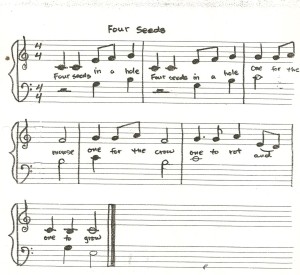
There’s a mental composting that goes on when I weed.  It’s one of the things I love about it—following the thoughts that go through my mind.  For example I was planting more peas and I remembered the little song I used to teach my preschoolers when I worked in Head Start:

Four seeds in a hole,
Four seeds in a hole;
One for the mouse,
One for the crow,
One to rot
And one to grow.

We sang it while dropping four pinto beans in a little ceramic pot.  They could sing it all day.  Everyone had to have a turn with the pinto beans and then they wanted to do it again.

Memory is like an eye floater.  Memories float to the front and continue on their rounds.  I have a shady woodland area to the north of the house that’s full of violets, lily of the valley and oxalis.  I gave a flat of oxalis to my analyst once.  His office had a sliding French door opening to a little garden, which to my mind needed more plants.

“These are oxalis,” I told him. They are invasive and you’ll never get rid of them.  I thought they would remind you of me.”

On the other side of the house my raspberries live in danger of being choked to death by Bindweed, more elegantly called Morning Glory.  I spent an hour grinding my teeth while I went for their extensive root system.  Fortunately the roots are easy to find.  They are big fat white things, no nuance whatsoever.  It’s either stupidity or arrogance on their part.  On the other hand it takes a long time to finally choke the bindweed to death.  They’ve got tenacity.  So do I though my aforementioned analyst called it stubbornness.

“You’re no one to talk,” I said.

He once told me that he was trying to garden at his home and he kept looking in magazines and talking to people and he didn’t know how to proceed.

“Why don’t you just get in there and try things?” I asked

“Why can’t you do that with your life?” he shot back.

I planted carrots last spring.  I planted them all over the garden to see where they grew best.  They mostly didn’t grow at all.  I got several the size of a thumb that were tasty nonetheless.  There is nothing like the sweetness of a carrot pulled out of the earth on a warm day, rinsed off with the hose and eaten with a little dirt still on it. As I went around the garden last weekend I found big, sweet carrots in all the locations I had planted them.  They had come through the winter . They had flourished.  I ate every last one.

When I’m out in the garden, I like it when I have a cat for company.  I like to look up and share their contentment or see what they are sniffing or batting at.  Cats never oblige. Still I have found a way to get Artemis to at least come for a visit.  I call her sworn enemy Suli, the cat across the street. In fact any time I need Artemis I call for Suli and within a few minutes Artemis has shown up.  Suli never does.

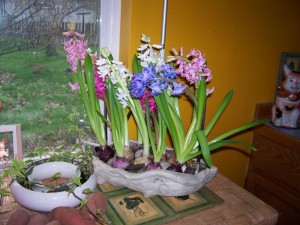
The last thing I did in the garden was to put the forced hyacinth bulbs in the ground.  Round about October I set hyacinth bulbs in an elegant ceramic trough my mother made.  I anchor them with rocks, pour in a half inch of water and put them in a cold dark place.  This tricks them into thinking it’s winter a few months before it actually is.

I water them periodically until January when actual hyacinths start to appear.  At this point they look pretty jaundiced.  After few days in a warm, lighted area, they get color in their cheeks and scent in their bloom and are cheerful and fun to have in the house. I cut the hyacinths down to the bulb when they come to the end of their cycle.

The bulbs will never bloom again after they’ve once been forced but I still put them in the ground as a kind of burial.  It’s a bittersweet habit, forcing bulbs.  They are lovely but they also remind me that when people, especially children, are forced to do something they aren’t ready for, it can mean they will never do it again.

“Why don’t you just get in there and try things?”

“Why can’t you do that with your life?”

That’s compost for us all.

The bittersweet forced hyacinths,

The bittersweet forced hyacinths


Four Seeds 001


FriendsGardenPosts

April 8, 2016

The Lovesome Garden

Tags: , , , , , ,

“The garden is a lovesome thing, God wot.”
Thomas Edward Brown

As I walk around my own garden in early April, I feel like I do when I unpack the Christmas tree ornaments and see my old friends:

Sweet violets in the spring.  I have a lot of them this year: patches of sweetness all over the garden.  I see them every morning when I go through the gate into the cemetery, which is how I begin my morning constitutional.   Soon that morning walk will be one of the few times I have shoes on my feet as I am mostly barefoot from May to October.  My feet turn green from the grass stains and I go to bed happy.

On the other side of my path to the cemetery the kerria japonica waves its unruly orange stems.  I don’t know what happened to the kerria except that my gardening companion, Tim, pruned it to the ground two years ago very nearly over my dead body and it’s taken it that long for it to stagger back to its feet.

Tim is a baritone in the OK Chorale who moved to my neighborhood five or so years ago.  For the first time in his adult life, he did not have a garden.  He asked me one day if I had any large gardening projects I wanted done; he missed the garden.  Take a minute to digest the wonder of this request: he missed having a garden to muck in.  He wasn’t asking for work.

My situation was that what used to be a lovely garden had become overgrown and unhappy as I got older.  Arthritis has made it impossible for me to spend eight hours a day in the garden, something I used to do regularly.  I was thrilled with Tim’s request.  He and I embarked on a collaboration that’s been working –mostly smoothly– for three years.  And the garden is not just lovely, it’s magnificent.

We’ve planted fruit trees (Santa Rosa plum, Italian prune, cherry) to keep company with my fig and my old Spartan apple tree.  The fig tree is a revenge plant.  It and a Japanese maple were given to me ten years ago by a friend who was going through a rancorous divorce.  She had no place for the trees herself but she didn’t want her ex-husband to get them so she gave them to me.  The maple is supremely happy, the fig is still having a little trouble recovering from the divorce.

Tim and I have planted blueberries, blackberries, currents, gooseberries and strawberries.  There were raspberry bushes when I moved into this house in 1997.  Every year I strip the bushes three or four times and put the berries in vodka to be made into a liqueur in the fall.  This is the extent of my “canning.”

Many of the garden’s plants have come to me by way of the Garden Fairy down the street, another windfall I don’t know how I was so lucky to acquire.  Annette works at a local nursery, which shall go nameless.   Plants that lose their cultivar tags or start looking puny get marked down and put on the Table of Shame in back of the flourishing plants.  Soon they are moved into a free pile for employees only.  Annette loads her car.  Flats of vegetables, vines, perennials—anything I ask for really—appear like magic on my front steps once a week for the entire growing season.

I planted the yosta berry –gift from a student—years ago.  Yosta berries are a cross of gooseberry and current and they give my raspberry liqueur a zip and a tingle.  I have had one too many squirmishes with sawflies, which devour the yosta’s leaves.  I refer you to this:After the Tilth, the Deluge.  I told Tim—in full presence of the yosta –that I had had enough and I wasn’t going to spray, dust or squish ever again.  If the yosta wanted to live, it could do so without me.  I think I scared it into participating in its own life because it’s flourishing joyfully right now.

Today I weeded the herb garden while chicken bones simmered their way into a broth.  I’ll use the broth in sorrel soup.  My three sorrel plants are big, fluffy and just about to bolt.  I learned about sorrel when I spent a weekend at a friend’s summer home on Camano Island.  She sent me into the garden to get sorrel to make the soup.  I loved tramping in the wet grass with Gus the terrier to cut the sorrel and I loved the soup. I learned that people call it Weed Soup because sorrel is indestructible and grows in vacant lots and on parking strips.

And so begins the gardening year: seeds to plant, grass to mow, weeds to pull, flowers to deadhead, trees to prune.  But this year no squishing of sawflies.

sorrel

sorrel


yosta berry

yosta berry

sweet violets in the spring

sweet violets in the spring


BooksCatsFriendsLiterature

March 24, 2016

Deer Watch

Tags: , , , , , ,

I’m on Whidbey Island for four days at Windhorse, the retreat center I visit every year when the Buddha House is available because the meditation cabins don’t have toilets and I’m sorry, I don’t leave the house to use the toilet. I need a modicum of comfort and the cabins, though lovely inside, don’t leave room for a lawn chair, which I have learned to bring with me. I can open it on the balcony outside the meditation hall or put it on the front porch depending on the situation with wind, rain, and sun.

Also depending on where I am most likely to see the deer. Tommie (who owns the retreat, and is also my beloved voice teacher) told me there were “deer everywhere,” but I think that when a property owner says there are deer everywhere, hers is a different perspective than that of a city girl who hopes she’ll have to thread her way through a herd just to get to the front door.

As far as I can make out, there are exactly two deer here. I think of them as “that lovely couple from Burien” as one of the caregivers from All Present once called my assistants –and friends– Susan and Mike. At first light and at dusk, I am either out walking (stalking really) or stationed at one of my vantage points to get a sighting of the lovely couple from Burien.

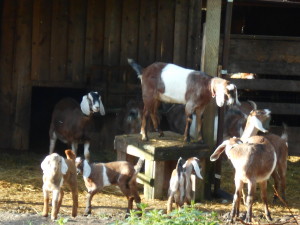
Last June there were twin fawns running around with a harassed doe barely able to contain their exuberance and I saw a lot of them. This year there are three baby goats at the farm across the road. I stand at the fence several times a day and wait for them to get curious enough to come over. So far they are being very cautious so yesterday I used my close-up lens to get some photos. In doing so I discovered which part of the fence was electric. There’s an enormous white dog the size of a cow with enough drool coming out of him to water a small garden. He barks and wags his tail and backs up when I reach through the un-electric part of the fence with a dog biscuit.

An insistent meow made me turn to find a black cat about the size of Suli the cat across the street in Seattle who knocks on my door when she’s bored and comes in to sit on top of my refrigerator and incense my cat Artemis. She was friendly, rubbing against me and letting me pick her up, purring her profound feelings, whatever they were—one learns to not speculate about these things with cats.

There’s now a path from Windhorse into South Whidbey Island State Park. There have been some terrific windstorms lately that have toppled at lot of trees in the area. There’s a notice in the Buddha House to not walk in the woods if it’s windy. During my first venture into the park, I followed a trail until it felt unsurpassable due to the trees, branches, puddles and mud in the way. The second time I walked in the woods, the sun shone through the trees even in the deepest part of the woods. When the sky is cloudy the woods feel safe and womblike; the sun illuminating this but not that is an enticing invitation into another world. Out of the corner of my eye I see a structure—a fairy house?—but when I turn to view it straight on, it slips into the other world. The same thing happens with a little foot—a wood nymph maybe?

At the bottom of the bowl of the retreat center is a little pond populated by frogs who have regular choir practice. Every time I visit, though, they are on a break, and I have yet to see one. I haven’t seen a frog since I was a child. We caught them in Lake Washington and took them home in shoe boxes. We tried to make them be pets. We freed them into the fish pond outside our house and never saw them again.

Every day I walk the mile and a half out to the highway. Yesterday I saw one rabbit. On the walk back I saw at the top of a pine tree an eagle so enormous I spontaneously sang “Oh, beautiful for spacious skies” but stopped because it immediately felt a little weird. That’s where all the rabbits have gone—into that gargantuan sitting atop the tree.

I brought a ridiculous amount of things to do during my few days here: three books of poetry, two novels, one book on tape, a history and a book about Buddhism. I brought painting and drawing supplies, several notebooks, and the computer though there’s no internet service at the Buddha House. I almost brought music because Tommie has a studio here, but I knew I could find anything I wanted to sing or play amongst her stacks. As a child I wanted to pack half my bedroom into the car for a car trip. How did I know what I was going to want to do? Last June the car was full but I ended up doing nothing but read two novels and watch for the twin fawns.

It’s colder now than it was in June so when I sit outside with a book, I wear two shirts and a windbreaker. With my lined-with-fleece wool jacket tucked around me and my feet in the hood, I can stay comfortable for about an hour. I’ve been reading The Magic Mountain because it had been recommended to me twice in the same week, one person telling me he thought it was the greatest novel of the 20th century. It’s 850 pages and I am up to 260, reading a little bit every day. I was afraid if I stopped for four days I would lose the momentum; it is so slow-going that it could take an entire century to read. Which reminds me that I really want to finish the last hundred pages of Ulysses.

I brought Christopher Buckley’s The Relic Master because it came in at the library the day before I left town. I read that in the afternoon when I can’t concentrate on anything heavy; it’s very funny and I snort tea out my nose at unexpected asides. I’ve got poems by Stephen Dunn and Fernando Pessoa and a notebook of poems I’ve collected. I read those in the morning after Thomas Mann and before Keeping the Faith Without a Religion, by Roger Housden, which I highly recommend, by the way. I highly recommend the poetry books, too but hardly anyone reads poetry anymore. We’re a strange little coterie, those of us who love poetry.

At night I put on The Phantom Tollbooth which I have listened to before but now I am also reading along. I marvel that I never read this book that was published in 1961 and must have been an offering of the Scholastic Book Services, which my mother was glad to shell out money to. On the other hand I don’t know that I could have appreciated a fraction of its cleverness when I was a child. For example: a car that goes without saying. Meaning everyone has to stop talking to get it started. One of my favorite characters is the Spelling Bee who spells the occasional word in all his sentences. S-e-n-t-e-n-c-e-s. “Years ago I was just an ordinary bee minding my own business, smelling flowers all day, and occasionally picking up part-time work in people’s bonnets.”

It’s been a week of walking, reading, reflecting, and watching for deer. It’s hard to think about leaving but as the time gets closer I feel pulled toward home knowing that I always take some of Windhorse with me until I need to come back for more.

DSCN0011

DSCN0013

DSCN0020

DSCN0025

Alzheimer's diseaseFriendsSongs

March 12, 2016

Doris in Wonderland

Tags: ,

Doris is moving but I don’t think she’s going to notice. Doris is my friend with Alzheimer’s disease.

Over the years I have spent many Friday evenings with Doris.  My first visit set up a pattern: I walk in and introduce myself. She graciously responds. We chat about singing, music, and teaching. We watch MSNBC until the news shows end and the weird Lockdown part of their programming begins. I fix her a peanut butter and banana sandwich and a bowl of ice cream. We begin at the beginning of the Schirmer edition of 24 Italian Songs and Arias of the Sixteenth and Seventeenth Century and work our way through to the end. She plays the accompaniments and I sing the arias. I do a little water painting and she watches. She doesn’t want to try it herself. We watch the KCTS Arts channel until time for me to leave.  I make sure she gets her evening medications before I go.

“Doris, will you know who I am when I come back?” I asked at the end of that first visit.

“I don’t know who you are now,” she said.

Every time I visit, Doris claims to remember me but I can see in her eyes that she doesn’t. She searches my face. There’s a glimmer of panic that goes away as soon as I smile and tell her how good it is to see her. I like to think that something in her heart recognizes me, but I don’t know if it does. That’s really not what these visits are about. We aren’t building a relationship.

Doris is the mother of Tommie, my (beloved) voice teacher. She lives with her son, Rich who is a hospice nurse. I started visiting when Doris’ husband died and her dementia was progressing. I didn’t know much about Alzheimer’s disease, but I grew up with a mother who was mentally ill and I know how to roll with unexpected behavior and disconnected thinking. I just wanted to help. I didn’t expect to come to love Doris.

Doris is delightful. She’s funny, out-spoken and kind. There was no odd behavior or disconnected thinking in the beginning, except that her memory loss meant I had to answer the same question 15 times in an hour. I don’t mind that except when the question is “Do you have a family?” That feels a little brutal. I mean I do have a family, but it’s of my own making, not one I was born into or that came out of my body. When I explain this to Doris, she understands (and often has a few choice comments about the drudgery of husbands and families) but then I have to keep explaining it.

Conversations now are like being in Wonderland. Sometimes her husband is alive, sometimes he is dead. Sometimes we are in her home, sometimes we aren’t. Sometimes she is living with her youngest son, sometimes with the oldest. Sometimes she isn’t living with anyone.

One December I exclaimed, “Oh Doris, you got a Christmas tree!”

“Oh, no” she said. “That’s not mine.  I don’t live here.”

“This is only where you spent the last 150 nights, right Mom?” Rich asked.

“Where do you live?” I asked.

She thought for a while. “Someplace else.”

We always travel through the various places Doris has lived: Born in Prince Rupert, she grew up in Fremont, Nebraska, and as an adult and mother lived in Franklin Lakes, New Jersey, and Iowa City. She lived in Seattle once but she’s not sure when that was.

We talk about her career in music: singing, teaching singing, teaching public school music, being a church organist. I tell her about my teaching and performing experiences. She enjoys and sympathizes and comments with astuteness.

We sing a song she used to teach in the classroom: “Singing is fun, singing is fun, let’s all sing together each and ev-er-y-one.” I feel for Rich and Tommie; I am truly sick of that song.

She’s tells me about her parents, brothers and sisters. We go over the names of her children. Looking at a collage of photos one day, I remarked at how pretty Tommie was.

“She’s not pretty,” Doris said. “She’s cute.”

“And your son here—he’s quite handsome.”

“No, he’s not. That’s just a good picture.”

“Doris!” I laugh.

“Well, I do love them,” she said.

She’s never sure what I am doing there. Am I one of the aides? Am I her guest? She should be serving me a banana and peanut butter sandwich.

“I’m your friend, Doris,” I say. “I’m here because I like being with you and I don’t care for peanut butter and banana sandwiches! But I’ll eat the last half of that banana.”

I really do enjoy the time with her. It’s an alternate reality that I find restful and occasionally fascinating.

But the last visit was different. It started out as it always did and we went along for a few hours before it turned a corner. It bothered her that I was in the kitchen. What was I doing in there? It bothered her so much I had to hurry things along and left a mess. Then she objected to my cleaning it up.

She didn’t want me to paint. She was adamant about that. Why was I in her house?

Finally she said, “I am tired and want to go to bed. I am going to excuse you now.”

I looked at her for a long time, trying to decide what to do. Finally I said, “Doris, I understand ‘I’m excused,’ but Rich wants me to stay here until he gets home. If you want to go to bed, I can just read a book until he gets back.”

“I can’t do that. You’re my guest.” She looked at me as though she wasn’t
at all happy that I was her guest and composed herself to be a martyr.

“Where is Rich?”

“He went to the movies. He’ll be back soon.”

Doris became agitated. “No one discussed this with me. They shouldn’t make plans without talking to me.”

“Oh look,” I said picking up a box of photos. “I can’t leave before we look at these.”

It took about ten seconds to distract Doris from whatever suspicions were cycling through her mind, and we spent the rest of the evening in a détente. I felt sad on the drive home. Doris’ condition is always changing but this was the first time I had seen such a departure from what I was used to. To me it signaled the end of our fun evenings together.

“Don’t worry about it,” my friend Susan (and author of Old is Not a Four Letter Word) told me. “It’ll be different next time. She won’t remember.  Nothing will carry over.”

Susan was right. I saw Doris last week. I walked in and introduced myself. I kissed her cheek. She graciously responded. We chatted about singing, music, and teaching, and all the places she has lived. I made her a peanut butter and banana sandwich. She asked me if I had a family.

Doris is soon to be moved into an adult family home.

“All the other people are practically comatose,” Tommie told me. “She’ll be the life of the party.”

Oh Doris, you are already the life of the party.

Ah, HumanityCurmudgeonFriends

January 14, 2016

Grievances

Tags: , , , ,

Three weeks ago I set out to write another blog post about grief. It was going to be a calm, wise little reflection on a remark my (beloved) voice teacher Tommie had made. We were talking about the abysmal technical support that’s available for anyone over the age of 40 who is trying to cope with computers.

She said, “Teachers and tech support people need to understand that they are talking to people who are grieving.”

I didn’t understand what she meant until I emerged from what I am about to relate. I was already grieving other things. I was sad from the deaths in the OK Chorale, from the death of the cat of my heart last summer, from the frightening near death of my college friend in November. My world felt precarious.

Christmas week I finished with choirs and teaching and was looking ahead to ten days of doing nothing except what felt good at the time. Then Christmas Eve I broke my partial. It snapped in two like a cracker, denying me a quarter of my teeth. It was five days before I could get an old partial adjusted. I was philosophical about it. It’s not like I hadn’t eaten enough all month long; a friend and I had been talking about doing more juicing so here was a good time to start.

Three days after Christmas, I dropped my laptop and cracked the screen. Insert one day of hysteria. I took it to Seattle Laptop and borrowed an old Dell from my friend Mike who made me a document folder and helped me access the internet and my email so I could do some of the things that used to require stamps and phone calls but now I do exclusively on the computer.

Seattle Laptop reported that it would cost as much to fix the laptop as it would to buy a new one. Insert another day of hysteria plus hyperventilation. This was my vacation. The idea was to relax and not have to think. I was mad at the world when I marched into Best Buy. I stood sulking at customer service until someone summoned the courage to approach me. I had on a piece of paper the name and model number of a Toshiba Satellite laptop. Gwen had suggested I look at it, that it might be what I wanted. I handed the model number to the agent.

“I want this computer,” I said.

“Do you want to know anything about it?” he asked.

“Nope,” I said.

“Do you want to see one? It’s set up over here.”

I hesitated.

“I’ll get you one while you play with the display model,” he said.

I pushed a few keys listlessly. I was hard pressed to describe how much I didn’t care.

He was back with my computer and a gleam of excitement in his eyes.

“Let me show you the touch screen,” he enthused. “This will be ten times faster than what you’re used to.”

Oh god, I thought, please don’t show me anything. It never occurred to me to say I didn’t want a touch screen. I just assumed this was the new technology being foisted upon us all whether we wanted it or not.

“Listen, does this computer have USB ports and a CD drive and can I stream Netflix and do email? Can I use Word? Because that’s all I care about.”

“But just look. . “

“I’ll take it,” I said.

Then came the warranty pitch. This is what I heard:

“Blah, blah, blah, blah, 6 months, blah blah blah, protection, blah blah, blah geek squad, blah blah blah.”

“How much?” I asked

He started circling things on a sheet of paper. “Blah blah blah, two years, blah blah, blah, comes with blah blah. . .”

“I don’t want the warranty,” I said.

I took the computer home, set it up—that’s one thing that has gotten less complicated—and then took it straight over to Seattle Laptop where My Life on a Hard Drive sat in a Samsung laptop with a cracked screen. I left the Toshiba with them to transfer everything from one computer to the other. Then it was New Years and I was able to forget about it for about 24 hours—not because I was drunk although that might have been a good strategy for the entire holiday season but because the shop was closed.

I got the Toshiba back with my files and a third of my email addresses intact. I moved in, deleted everything on the Start Page that didn’t look familiar, began to personalize and set preferences. I started the blog post about grieving. That’s when I realized there was something wrong with the space key. It stuck. Sometimes it stuck and wouldn’t make a space. Sometimes it stuck on space and ran down four lines before I could get it unstuck by pressing down on the keyboard frame at different points. I shut the computer and thought seriously about just going off the grid. I was about to anyway, in a manner of speaking.

A student emailed me to ask to change her lesson time. I had to start teaching in one more day. Everyone who walked into the house would need something from me and I would have to be able to think straight and be fucking gracious to them. I immediately burst into tears. I decided to take another week off to recover from the week that just was. I calculated that I could still get a good five days of rest.

I am old enough to remember when we thought it was clever to say that the light at the end of the tunnel turned out to be the headlight on the locomotion. On the first morning of my fresh new week off I called Best Buy to inquire about getting the space bar fixed.

“Just bring it in and swap it out for a different one.”

“But I’ve already moved all my stuff into this one. Can’t someone fix it?”

“You can bring it to the Geek Squad.”

“Can you transfer me over there?”

“They don’t use the phone. You have to bring it in. They’d have to check it and see if the bar is sticking because of food caught in it or something.”

“This is a computer you sold me and fresh out of the box, the space bar sticks,” the pitch of my voice was creeping ominously higher, if the poor sales person only knew.

“I’ll run over and ask them,” she said. This wasn’t part of her job. She was being helpful and nice.

Back on the phone this was her report: “They say they won’t fix it here. They’ll send it to Toshiba who also won’t fix it but will advise you to swap it out. It’ll take a month.”

I swamped up with panic. Ahead of me stretched my second week of intended rest and it, too, was going to be eaten up by goddamn technology.

“Are you fucking kidding me? This is your customer service? You people. . listen . . . I hate computers, I hate Best Buy!” I hung up.

I paced the floor and heaved anxiety around the house for a while. The cats disappeared. By the time I had ratcheted myself down to mere hysterical sobbing, I called my neighbor Gwen who knows something about just about everything. Gwen came over and reset the computer back to its original settings.

Meantime, my friend Nina (rhymes with Dinah) had gotten the voice lesson cancellation email and had inquired twice as to what was going on. “Don’t make me come up there!” she said in her second message.

Nina drove me and the stupid Toshiba to Best Buy the next day.

“I may embarrass you,” I said on the way over.

“I doubt it,” she said. She’s a good friend.

We got a very calm and reasonable sales person who listened to my story, helped me pick a computer –an Asus– better suited to me. There was no talk of touch screens or warranties.

I set up the Asus and took it over the Seattle Laptop. When Alex at Laptop heard my story he said, “Oh, I am so sorry!”

“You’re not half as sorry as that woman at Best Buy,” I said.

Alex transferred all my stuff a second time. He also spent an hour and half with me making sure I could get to everything I needed. He didn’t charge me anything. So there’s one good thing that came out of this. Seattle Laptop is now where I will go for everything computer related, including my next computer should I live so long as to need another.

I think computers are marvelous in some ways, but I am not interested in them as things in themselves. To me the computer is a means to an end and I just want it to work. I don’t enjoy spending day after day reveling in its latest dazzle. I would rather do almost anything else. When everything is working reasonably well, it’s great.

When Tommie said that tech support people need to understand that they are talking to people who are grieving I thought she was putting it a little dramatically, but I have changed my mind. Every time I open the computer I am actually grieving for a world that is gone, the world I grew up in, and knew how to navigate. There are still pieces of that world lying around to enjoy. I’m going to do just that as soon as I post this.

Choir SingingCurmudgeonHolidaysSingingTeaching

December 20, 2015

A Holiday Whine

Tags: ,

I yelled at the Chorale. In 23 years of directing the Chorale I never remember yelling at them. I am often irritated by them but I don’t let that show. I’m a singer and I know how to take a deep breath. I often raise my voice over them to get their attention, but that’s not done with irritation. The combination of irritation and a raised voice equals yelling at and I simply do not do that.

Afterwards everyone said it wasn’t that bad but I felt like I had turned into my mother at her most abrasive. I was embarrassed and it took me a while (two days) to get over it. So I had to ask myself, “How on earth did you get to this point?”

It’s been a demanding quarter. It began with more new people than we usually get and many of them were bewildered and disoriented. New people often think they are the only ones who don’t know what’s going on. One of them clearly blamed me for the fact that he was new and that bothered me for weeks.

Then the wife of one of our baritones died. It wasn’t unexpected but it was heart-wrenching for those of us who knew them. She was a lovely person and a sensitive photographer. Over the years she had taken many photos of the Chorale in action.

I had a period of domestic difficulties. I hurt my back while heaving wood around. Rats got into the ceiling one stormy night and sounded like they were setting up a bowling alley in which they proceeded to bowl. A trapper who looked like NRA Man and his assistant, a tall skinny guy who could have been one of the Darryls from the Bob Newhart Show rescued me.

Then Hal, our beloved bass, unexpectedly died. He went to sleep one night and didn’t wake up. I was stunned by the news. I went into a crazed period that reminded me of the months around my mother’s death—also in November—eight years ago. I organized the Chorale to sing at the memorial service with an obsession that worried me when I occasionally breathed the air of self-awareness.

I started waking up in the middle of the night, sobbing. This was not just about Hal and my mother. This was about my cat Freudy who also died unexpectedly last May in bed, in the middle of night. I went into that surreal grief place where I feel like I am trying to run underwater. Everyday life became slow and difficult.

I chose this particularly hectic period to finally purchase a cell phone. After it came a friend pointed out I could have gotten a Smart Phone for the same price. It seemed as though my life depended on getting an upgrade immediately and that demanded a second session of customer service calls.

I now have the phone and I am committed to spending half an hour a day or until I start crying –whichever comes first– learning how to use it. Don’t call me yet and for god’s sake, no texts.

A good college friend had a surgical procedure that developed complications. Instead of one week in the hospital, he was there for two. When he finally went home, it was only for two days before he had to be air lifted from Walla Walla back to the hospital in Everett where, as of this writing, he remains. For days I expected to hear that he had died, but he is very much alive and looks cheerful.

The OK Chorale usually has two performances at the end of a quarter, occasionally three if two are on the same day. With expansive optimism I had scheduled six (6!) this year. Hal’s memorial service made for a somber seventh.

Nina (rhymes with Dinah) drove us to the second of the six performances. A good friend had confided that he was being tested for cancer and it didn’t look good. I didn’t think I could hear any more from anyone about anything. As we pulled into the lot of Columbia Lutheran Home Nina told me she had double-booked into something she couldn’t get out of and she’d have to miss the third performance.

And that was the last I saw of my equilibrium.

Our third performance was to be at Fred Lind Manor on Capitol Hill and the only thing keeping me upright was the thought that at the very least I wouldn’t have to drive to Capitol Hill and park and show up all merry and bright. I was so tired of being merry and bright.

“Oh, that’s okay,” I said. “I’ll manage.”

In the Luther Room (great acoustics, fabulous piano) of Columbia Lutheran Home someone fussed up to me, “You didn’t tell us when to get here. This was the only performance where you didn’t tell us when to get here.”

I looked at him. I looked at the clock. 6:30. I looked at the OK Chorale milling around like a bunch of fifth graders. Excitement leaped from them and from my inquisitor, whirling and spinning and turning into anxiety where it settled in me. Did this matter now?

I sang some high notes to get their attention. Some of them stopped talking.

Then as I recall, events went something like this:

“Let’s get warmed up.”

We ran through some scales and the beginnings of the songs in the order I had them in my notebook. Chatter, rattling of pages, and comparing notebooks broke out between songs.

“There’s some anxiety about the order of songs,” Susan said.

(Oh good god, how many times have I gone over the order of songs, how many e-mails, how many hard copies, how many oral walks through the fucking order of songs?)

“The order of songs is what it has always been.”

“When did you move “Feast of Lights” to be second?” Britt asked

“It’s always been where it is.”

“No it hasn’t.”

(Shut up, shut up, SHUT UP!) “Did you read the e-mail?”

“Which one?”

While everyone who was actually listening began re-arranging their music, I rummaged for a hard copy of the order of songs and in restraining myself from crumpling it in a ball and throwing it at her, I happened to notice that “Feast of Lights” was not second. It was fifth. It had been fifth except for the Monkey Lighting the week before when we did a shortened program.

Oh god, it was my mistake. I apologized and tried to laugh at myself. Merily came up and put her hand on my arm.

“Don’t worry, you just call them and we’ll sing them!” she said cheerfully.

I wanted to throw her gracious hand off me. I didn’t want anyone to be nice to me. I wanted to go home.

Jessica swooped in with some urgency, “Are we singing the German first on Silent Night even though it’s last on the audience song sheet?”

That was when I heard a shriek, “STOP TALKING!!” It was my mother’s voice but it was coming out of my mouth.

Everyone stopped talking just the way they did when my mother entered a room at full force. Just what I wanted for Christmas: to turn into my mother.

We carried on and eventually I got over myself. Our seven performances went beautifully. What stands out in my mind now is Merily’s graciousness and everyone’s generosity. I wouldn’t say I feel merry and bright and it will a long time before I want to hear another fa la la. This is the time to breathe in the line from “O Little Town of Bethlehem:

“Silently, how silently the wondrous gift is given.”

Choir SingingFriendsHolidaysSingingSongsTeaching

November 24, 2015

Goodbye to Good King Hal

Tags: , , ,

The OK Chorale lost one of our long time singers three days ago. Quite unexpectedly, Hal, our resident funnyman, died in his sleep. He was cheeky, irreverent, and a reliable bass with a lovely voice. When I got the news, I went trawling through my blog posts to find the ones he had starred in. It took me 24 hours to start sobbing. Now I’m on the other side of that.

Hal’s life intersected with members of the OK Chorale at the opera, the symphony, the ballet, and at baseball games. In fact he was recruited into the Chorale from a baseball game many years ago. The following vignettes are drawn from past posts:

The Chorale quarter begins with everyone introducing themselves and answering a question that I put to them.

One January the question was “Tell us your name and something you got for Christmas. My name is Elena and I got these earrings.”

We went around the room:
“I’m Jim and I got a lovely case of Syrah.”

“My name is Ruthie and I got some expensive dog biscuits.” And after a brief silence: “They were for my dog.”

Mel’s ear was prominently bandaged. “I had surgery for skin cancer,” he informed us.

When we came round to Nina (rhymes with Dinah), she said, “I got skin cancer for Christmas, too.” She had had a small patch removed above one eye.

Hal in the bass section—our inimitable Hal—turned around in his chair and said “Where do the two of you shop?!”

Let’s take a little break and review all the reasons “Good King Wenceslas” is a great carol. From a piano teacher’s point of view, it’s an easy one for beginners, especially small children who have just started learning piano in September. That’s about it. Or that’s what I thought when I asked The OK Chorale which traditional carols they wanted to sing this quarter and Hal suggested “Good King Wenceslas.”

I couldn’t imagine anything more boring. Melodically two of the lines in each of the five verses are exactly the same. Rhythmically the song is nearly all quarter notes, which means it yaps along like an annoying little dog.

“It’s boring,” I said

“It’s a dialogue,” he said

I looked at it again. I read the verses. “It’s a little play,” I thought, “Hmmm.”

Still I was only willing to do the carol on condition that we come up with a way to break the musical monotony. I made a list of all the nouns in the song and put out a request for props. I asked Hal if his granddaughters who have yearly enjoyed the OK Chorale Christmas concerts would want to participate.

He reported back the next week. “They’re in,” he said. “We’re arguing over who gets to be king.”

Hal was crowned king.

Wenceslas was not actually a king. He was just a duke. Still the carol says that the Good King looks out his window at the moonlit snow on St Stephen’s Day. He sees a Poor Man gathering wood for a fire. He gets the neighborhood scuttlebutt on the Poor Man from his Page. The two of them set out with bread, wine, and meat, plodding through the wind and snow to the Poor Man’s dwelling. By verse four the Rude Wind has kicked up and the Page says he can’t continue. The Good King tells him to walk in his footsteps and so they continue. The song ends with the mild suggestion that when we bless the poor, we ourselves are blessed.

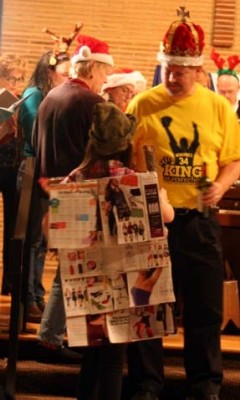
By mid-quarter we had assembled our props and the Dramatis Personae had been decided. Hal was the King, Kelsey would play The Poor Man, and Brianna would be The Page. Good King Wenceslas turned out to be my favorite part of the OK Chorale show that quarter:

Good King Wenceslas, a Treatment:

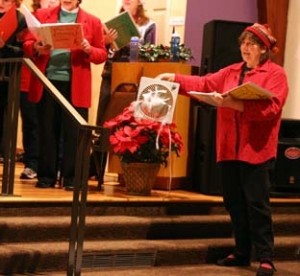
Five white sheets cover an area in front of the stage, not deep and crisp, just white. Strewn about are sticks and small logs from this year’s supply of wood for my wood stove. Anne (alto) holds a fan with crepe paper streaming from it in the direction of the audience so they can appreciate the ambiance. Nina (soprano) cuts most of the hall lights.

The rude wind

The rude wind

Verse One: At first mention of the moon, a powerful flashlight from Hal’s glove compartment is turned upon the side wall by Kathleen in the soprano section. The Good King sees The Poor Man gathering up sticks.

Verse Two: The Page appears dressed in a Robin Hood hat supplied by Chris (tenor) and wearing an outfit made of magazine pages (pages, get it?) designed by the girls’ mother, Monika.

Verse Three: The Page and the Good King get together a wine bottle supplied by Anne, and the rubber chicken supplied by Sandi (alto) that doubles as one of the French hens for “The Twelve Days After Christmas.” At first mention of the wind, Jody (soprano) Eileen and Chris ( tenors) and Kristin ( alto) fan the air (mostly in the direction of the director at the piano.)

Verse Four: The Wind becomes Rude. Jody, Eileen, Chris and Kristin fan more furiously.

Verse Five: The Page clomps across the snow in a pair of Hal’s shoes, trodding in The Master’s footsteps.

Jody, Chris, Eileen, and Kristin, having transubstantiated the fans into instruments of blessing, pronounce one.

The page and Good King Wenceslas

The page and Good King Wenceslas

I told Hal that Kelsey and Brianna were welcome to do something with us every Christmas until they start adolescing. I love this group. Something wonderful always happens and I always feel blessed with them. The transubstantiated fans just put the crown on it.

Last Christmas we did “A Holiday Feast for a Hungry Choir” (by Lee G. Barrow) The Treatment was choreographed, cast, and directed by Hal. It opens with a poem explaining that the choir has been so busy performing that it hasn’t had time to eat. Weak with hunger, the choir free associates food into the carols.
Instead of the “ding dong, ding dong” in “Carol of the Bells,” the choir sings about Hostess Ding-Dongs. Instead of “Bring a Torch, Jeannette Isabella,” they sing “Bring a torte, Annette Isabella.” “O come let us adore Him” became “O come let us all gorge then.”

Throughout the medley of Christmas songs was a recurring theme of figgy pudding, which necessitated a magnificent prop: a 12-pound non-edible figgy pudding, looking every ounce like the real thing. It cost $75. We took up a collection to defray the expense and I am now the custodian of it along with the OK Chorale’s boar’s head.

Kelsey and Brianna played the parts of Annette Isabella and Not Annette Isabella. They produced the figgy pudding on cue and salted the audience with Hostess ding dongs at the end of the song.

“Next year, I want to do songs from the Grinch, Hal can be the Grinch and one of you can be Cindy Lou Who and we’ll mousse your hair straight up.”

“No one’s touching my hair,” Brianna said.

In the spring of last year, one of Hal’s cohorts in the bass section prodded me to do “The Lumberjack Song” starring—of course—Hal. I didn’t write a post about it but I remember there was a beard and a bra involved and some confused senior citizens in our audiences. However we did an impromptu visit to a skilled nursing facility and sang it for a woman with Parkinson’s who was mostly confined to a bed.

Hal sat down alongside of her and began conversationally, “You know, I never wanted to be a singer.”

And so we began. When we got to the line “I cut down trees, I eat my lunch, I go to the lavat’ry,” Hal matter-of-factly gestured to the little potty chair next to the bed. Leone gazed at him, rapt. It was magic.

This quarter we have been rehearsing “You’re a Mean One, Mr Grinch,” and had put out a call for props. We planned to get wigs for the girls so no one would have to touch Brianna’s hair. We will put the song to rest. I don’t want to do it now.

The OK Chorale has a potluck rehearsal every quarter. It’s a chance to get better acquainted with the people we sing with. Years ago in a misguided effort to foster comradery, I said, “If there’s someone in the Chorale who annoys you, you might use the potluck to get better acquainted with him or her. Sometimes that helps reduce. . .”

I was drowned out by the explosion of laughter. So I did what I often do when I’m too much in earnest. I started re-explain myself and ended up saying exactly the same thing which resulted in another assault of laughter while a few people –tenors, I think– began acting out the parts of Annoyed and Annoying Person.

At the potluck, Terry (alto) sat down next to Chris (tenor) and said, “I’m supposed to sit next to an annoying person and Hal isn’t here.”

When I reported this last comment to Hal, he grinned, gave me a thumbs up and said “I still got it!”

Wherever Hal is now, whoever he is annoying, amusing, wherever he is being irreverent, I have no doubt he’s still got it even yet.

Our Hal

Our Hal

CatsFriends

November 8, 2015

Lucy, I’m Home

Tags: , , ,

Gwen, my neighbor who knows something about just about everything is home after what felt like six weeks but was only half that long. She was doing the European thing while I was home on Lucy duty. Lucy is her 15 year old gray and white with smudged-nosed cat.

When Gwen goes away, she sets Le Bistro to dispense a measured amount of cat food at the same time every morning so a person doesn’t need to actually feed Lucy on a daily basis. But I’m a person who works at home; I am besieged by my cats all day long so I have perhaps a jaundiced view of how much interaction a cat actually needs. I try to at least get a sighting of Lucy every day.

When I visit Lucy she always comes out to say either ‘hello’ or ‘why the hell are you interrupting me,’ plays keep-away around the legs of the butcher block table, watches me change her water, waits to see if I have a treat and then disappears. If she’s feeling particularly fetching, she rolls on her back on the rug. This could be misconstrued as a social invitation but if I attempt to engage her when she’s rolling on her back, it only offends her.

Gwen had gotten her suitcase out a week and half before she left. Some of the experts tell you to do this. Cats get alarmed when they see the suitcase but if it’s sitting there for a week and half, the thinking is that it becomes part of the landscape and it loses its charge. Don’t you believe it. Cats are not that stupid. Gwen reported that Lucy got clingier at the run-up to departure. Gwen usually keeps intimate rituals with her cat private so I deduced from this outpouring that Lucy was in a bad way and that tugged at my heart.

The first morning I went over I couldn’t find Lucy for a good ten minutes. Finally I spotted a lump under a blanket move ever so slightly. There she was huddled into her barren and loveless life. I cooed and petted her but she turned away. The second morning was much like the first.

The third morning I took my computer with me, settled into a window armchair, and accessed Gwen’s superior wireless network. I checked my email, wrote a few notes, deleted a lot of stuff, looked at my bank balance, and played a few moves of Scrabble on Facebook. When I got up to leave I saw that Lucy had been sitting in back of me, watching.

The fourth morning I took my computer and a thermos of tea. As I went about my business, Lucy walked past me. I heard her go out the cat flap that takes her from the kitchen to the basement stairs. I heard a meow. Quite an indignant one. As I was leaving I opened the door to the basement. There was Lucy sitting four steps down in a patch of sunlight. She meowed at me and I said Goodbye.

The fifth morning I had my computer, my tea and The Adventures of Sherlock Holmes. As I was reading and sipping, two little feet appeared on the blanket beside me. I watched Lucy as she sniffed the air, the blanket, and the edge of the book. I went back to my story. The sixth morning, Lucy curled up by my knee and pretended to not notice me. I pretended to not notice her.

Finally the day came when Lucy dislodged Sherlock Holmes and fell asleep in my lap. I stayed especially long that morning. Thereafter she was waiting for me on the chair when I came in the door. She would leap down so I could settle in, then leap back up and take over my life. I did a lot of reading, thinking and emailing last month with Lucy in my lap. And playing Scrabble. And Yahtzee. And one of those Jacqui Lawson games where you explode balls. The morning of the day Gwen came home, after Lucy fell asleep on me I watched three episodes of Frasier on Netflix.

The mornings with Lucy had become a cherished routine. The only part of this intimate ritual I am keeping private is how many salmon treats I gave Lucy. Gwen reads my blog posts.

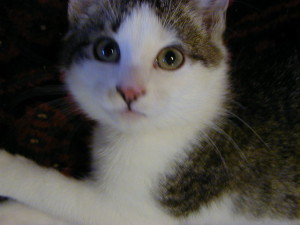
Lucy as a kitten before she got the smudged nose

Lucy as a kitten before she got the smudged nose

Ah, HumanityAlzheimer's diseaseChoir SingingTeaching

October 18, 2015

Choir Season

Tags: ,

My two choirs began last week. I’m not sure what prescience caused me to be more than usually prepared with the music, the schedule and the quarter routine but I shudder to think what the first rehearsals would have been like if I hadn’t been.

The OK Chorale has been singing for 23 years. It’s still a University of Washington Experimental College class but there is a core of 20-25 people who come back quarter after quarter so that it functions more like a community choir. However to keep my catalog listing, not to mention my monopoly on 4-part choirs in the Experimental College, everyone has to register with the University every quarter. Two weeks before the beginning of the quarter I send out emails begging everyone to register early so that I will know how many copies of the music we’ll need.

It used to be that the location of classes was a dark secret. You found out where the class was held after your registration fee had been paid. The internet makes that impossible now. As a result, there were fifteen more people than I expected at the first rehearsal, most of them first timers. One man who didn’t read music was clearly worried that I wouldn’t be able to accommodate him. Several women said they had never sung in a choir before. Someone else wasn’t sure whether he sang high or low. I directed traffic like an old fashioned cop, a smile pasted on my face, sweat forming at my hairline.

When we got everyone settled down, I abandoned my original plan to start with an unknown piece—so that everyone would get hopelessly lost together instead of the recidivists out-singing the new people and the new people having flashbacks to when they weren’t in the most popular clique at school. Instead we started with an arrangement of “God Rest Ye Merry, Gentlemen” which involved a lot of unison singing.

I thought this would be easy. But first I found I had to make sure that the non-music readers knew they were not alone and that many in the group learn their part by hearing it since I go over things –god help me-what feels like a hundred times a week. Then I had to explain to people who weren’t used to choir music which line was their line. Then I made my little joke about not assuming anyone, including me, actually knew what we were doing. (I think only other teachers in the Chorale realize how much I fly by the seat of my pants.)

This particular arrangement of “God Rest Ye Merry, Gentlemen” begins with typed music but then morphs into handwritten music. I do this a lot. I know what my group (and I) can manage and what we can’t so I am forever truncating and re-writing things. One gentleman was completely thrown when the visual look of the music changed from typed to printed music. When we finished reading through the piece he was turning his pages over and over and looking not at all merry. He looked overwhelmed and well, angry. When I tried to smooth things over he more or less barked at me.

That was the point I stopped babying people and decided that for the rest of the rehearsal—ah geez, 45 minutes left—everyone would have to cope on his own. My clothes were almost soaked through.

I went home that night and had a Scotch. The next morning something told me to take it easy and not do anything taxing—like calling Comcast or Premera–before leaving for All Present, my song circle for people with ESML (early stage memory loss) which began at 10:30. I made a cup of coffee and watched a couple of episodes of Frasier.

I arrived early at the Greenwood Senior Center. Copies of new songs had been printed and punched and were waiting to be inserted into the songbooks. There were six new standards and four new musical comedy songs. (I add new songs mostly for myself and my assistants. The people in All Present could sing “You are my Sunshine” and “Goodnight, Irene” over and over for an hour and half every week and be perfectly happy.) The sheets had mostly been printed correctly, but I had gotten something wrong so now we had “14.Mr.Sandman” after “13.Anything Goes” in Standards and after and “27. Doin’ What Comes Naturally” in Musicals.

My lovely assistants, Susan and Mike were stuck in traffic. Susan is the brains behind the notebooks. She can figure out how to fix any glitch. She can organize anything. She could organize a 1200 page manuscript underwater if she had to. She’d use clams as paper clips. But she was stuck in traffic.

My other lovely assistants, The Other Susan and Linda with her dog Lucy were also there early. We folded up tables, set out chairs, moved the piano, and got water pitchers. The Other Susan started in trying to figure out where to insert the new song pages. “Mr.Sandman” seemed to be on the back of every page.

Our singers started arriving and it was peculiar feature of the morning that they continued to arrive as late as 45 minutes into the session. Every time someone new showed up, we had to re-arrange the circle to accommodate them: Vivian with her lovely smile that we hadn’t seen since the spring, Jane, the wanderer who always tries to walk off with my tote bag, Jim with the golden voice, Bill who in his younger days as a night club singer opened for Tony Bennett, Violet who at age 90 went to Croatia over the summer and saw her family for the last time, John whose harmonizing tenor wafts over the top of so many of our songs.

There were lots of familiar faces, but there were a lot I had never seen before. And still they kept coming, all with entourages of spouses, caregivers, walkers, and wheelchairs. Susan and Mike finally arrived just in time for Mike to move Violet over three feet because she had sat down just before we needed to expand the circle. Once we get Violet settled no one wants to disturb her.

The group had doubled. There 17 singers and seven caregivers and three spouses that had to stay either next to or close to their charges. There were three wheelchairs and five walkers. There was an extra dog. There was chaos. The room was shrinking. The room was growing hotter and hotter. Someone farted. A big one. We ran out of song sheets. Jane started to wander and had to be seduced back to her chair. During “Easter Parade” someone danced with her. Bob, a center volunteer, came in to ask how many were staying for lunch. When I said I didn’t know, he asked if he could go around and asked everyone.

I wanted to scream, “Can’t you see what I’m dealing with here?”

But I said, “Oh what the hell, sure, go ahead.”

He clearly could see what I was dealing with because he called out,

“Anyone staying for lunch?”

“No,” everyone chorused whether they were or not.

“That’s all I needed to know,” he said cheerfully and exited.

When I went to bed that night I felt like I had been put through the washing machine and the dryer and even then had hung on the line for a time. But two large groups with more singers than I expected: that’s a nice problem to have. It’s good to be back.