Alzheimer's diseaseChoir SingingFriendsHolidaysSingingSongsTeaching

December 24, 2014

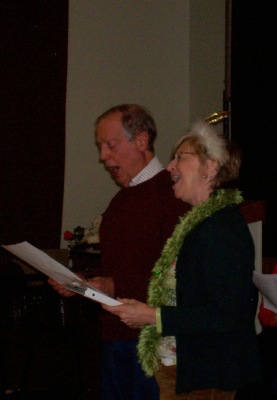
Sing We Now of Christmas

Tags: , , , , , , , ,

The All Present/OK Chorale Holiday Concert and Cookie Exchange took place over the weekend.  The actual Cookie Exchange was demoted to Cookie Potluck as in the end no one had the stomach for the politics of a formal cookie exchange.

“Whose idea was this cookie exchange anyway?” asked Susan, my lovely assistant with All Present and my copy editor for all writing endeavors except my blog which she stays away from unless my punctuation wakes her up in the middle of the night.

“Mine,” I said.

“Are you crazy?”

Earlier I had gotten a call from Carin, the social worker at the Greenwood Senior Center asking me how the cookie exchange was going to work.

“I’ve never done one before,” she said.

Not only had I, too, never done a cookie exchange, I had only attended one in my life and that was years ago.  But as a student of mine once said as she set out to arrange a piece of music into four part harmony, “How hard can it be?”

I put Nina (rhymes with Dinah) in charge of it.

“Just have one table where people can eat all they want while they are here and one where they can fill a plate to take home,” I said.

Nina gave it some thought and declared that there would be no cookie exchange.  “I don’t want to have to cope with two tables,” she said.

“Fine,” I said.

Whose idea was this Cookie Exchange thing anyway?

That settled, All Present went through their dress rehearsal, which was mainly a planning period for me, my assistants Susan, Mike and The Other Susan, and a handful of OK Chorale members.  The twelve singers in All Present were not going to remember what they did or why.  For them it was just another chance to sing. We tried out “Jingle Bells” with jingle bells and “Deck the Hall” with “fa, la, la” signs which I made for the OK Chorale many years ago.  I picked out four carols that we could do in the key of C so our harmonica virtuosos, Jim O. and Dennis could play the introductions on their harmonicas.

“We’ve got C and G harmonicas,” they told me.

“We only need the C.” I said

“Ok, but we’ve got both.”

I had had a brainwave that morning that Jim M. might be willing to sing “O Holy Night.”  Everyone in All Present sings well but Jim M. has a golden, magnificent voice and a breath capacity that seems to have no end.  He also seems to know every word to every song ever written so I had no doubt he knew “O Holy Night.”  He was a little hesitant to sing it alone but he said he’d give it a try.

Then I thought of The Other Susan.  (I’m calling her that because if I used the first letter of their last names to distinguish them, they would be Susan A and Susan F, which looked like they were being graded for existing.) The Other Susan, one of my voice students, is a lovely lyric soprano as well as both a terrified adult and a spotlight whore.  Susan and Jim were just what each other needed.  We ran through “O Holy Night” and they sounded splendid together.

Now that I am writing this down, I am amassing the many highlights of the Cookie Concert:  The Chorale opened with my arrangement of “Winter Wonderland,” which I am proud of.  The rhythm of the bass and tenor and the harmonies in the soprano and alto make me smile.  I thank the muses that visited me the day I wrote it.

Eileen, tenor, bought eight candles for “Ocho Candelikas.”  Her idea was for designated people to hold up their candles as we sang “una candelika,” then “dos candelikas” etc. until eight candles were held high.

“I don’t know how to assign the candles,” she said

I tried to hide my pity. It was such a lovely idea.

“Here’s how,” I said. “You there—you’re one. You’re two, three, four, five six, seven, eight. Now write down your number and if you’re going to miss a performance, find a substitute.  If you tell me you’ve forgotten which number you are, I’ll slap you.”

“Ocho Candelikas” was a hit every time we sang it this year.

We sang the Bach chorale “Break Forth, O Beauteous Heavenly Light,” “Gaudete,” and ended with “A Holiday Feast for a Hungry Choir” (by Lee G. Barrow, music professor at the University of North Georgia.) This final piece was choreographed, cast, and directed by Hal, bass. It opens with a poem explaining that the choir has been so busy performing that it hasn’t had time to eat.  Weak with hunger, the choir free associates food into the carols.

Instead of the “ding dong, ding dong” in “Carol of the Bells,” the choir sings about Hostess Ding-Dongs.  Instead of “Bring a Torch, Jeannette Isabella,” they sing “Bring a torte, Annette Isabella.”  “O come let us adore Him” became “O come let us all gorge then.”  Through-out the medley of Christmas songs was a recurring theme of figgy pudding, which necessitated a magnificent prop: a 12-pound non-edible figgy pudding, looking every ounce like the real thing.  It cost $75.  We took up a collection to defray the expense and I am now the custodian of it along with the OK Chorale’s boar’s head.  And this is the year I was hoping to realize my goal of packing Christmas all into one box.

Hal’s two granddaughters played the parts of Annette Isabella and Not Annette Isabella.  They produced the figgy pudding on cue and salted the audience with Hostess ding dongs at the end of the song.  Two years ago, Hal Played “Good King Wenceslas” and the girls enacted the page and the poor man gathering winter fuel.  Next year I want to do songs from the Grinch.  But Kelsey and Brianna might have outgrown the fun by then:

“One of you can be Cindy Lou Who and we’ll mousse your hair straight up.”

“No one’s touching my hair,” Brianna said.

After the “Holiday Feast for a Hungry Choir” we got All Present up on the stage.  Some of the Chorale arranged chairs for them and some helped them negotiate the step onto the stage.  The stage at the Greenwood Senior Center is much shorter than the one at the Phinney Community Hall where Jim O. almost pitched over the edge last summer.

I asked Jim O. and Dennis if they had their harmonicas ready.

“We’ve got C and G,” they said.  “Which one do you want?”

“Let’s use the C,” I said.

“OK, what for?”

“Can you play “Jingle Bells?” I asked

“We can play it in C or G.”

“Let’s go with C,” I said.

“Right now?”

“Yep.”

After “Jingle Bells” The Other Susan helped Jim M. up.

“What am I singing?” he asked

“We’re singing this.” She pointed to the song sheet he was holding.

Susan told me afterwards that she had a moment of anxiety.  But as soon as Jim heard the introduction to “O Holy Night,” he touched her hand and said, “OK, let’s go!”

They sang “O Holy Night” and half the room cried, including me.

We started the audience sing-a-long.  When we got to “Deck the Hall,” I went up to Dennis and Jim O.

“Can you play “Deck the Hall” now?”

“You want us to play?”

“Yeah.”

“We can play it in C or G.”

“Let’s go with C.”

We had the same exchange for “Silent Night” and “White Christmas.”

We ended the show with “Auld Lang Syne.”  It’s a fascinating phenomenon, short term memory loss.  All Present comprises a group of people who can’t remember what they had for breakfast and aren’t always sure who I am or what they are doing in a room at the Greenwood Senior Center.  Until we start to sing.  Then they remember every word from every song from days gone by.  From old long time. From Auld Lang Syne.

All Present and The OK Chorale

All Present and The OK Chorale

O Holy Night

O Holy Night


Choir SingingCurmudgeonFriendsHolidaysPianoSingingSongs

December 16, 2014

Christmas Lights and Glitches

Tags: , ,

It’s been two weeks since I’ve written.  If you follow my blog, I bet you thought I was reading David Copperfield all this time. Not even close. I haven’t begun to look for my copy of it yet.

No, I’ve been Doing Christmas.  I tried making divinity and ended up with vanilla soup.  Only then did I buy a candy thermometer.  I don’t have enough experience to be able to judge hard ball stage the way my mother did.  Still, even she had soupy divinity years accompanied by her classic stage line, “Oh no, I did a dumb thing.”

I wrapped presents the day after Thanksgiving.  I love wrapping gifts but I usually put it off to the final hour, the idea being to save the best for last.  But by the final hour I am usually so tired of everything that I want to just throw unwrapped gifts at people, turn and run away.  So this year I did it first thing and that put me in a good mood.

Then there were the holiday sales: the now infamous one that was annexed by a funeral, and then the Dibble House bazaar.  I played the piano for the opening preview at Dibble House and checked in every day because it was hard to stay away.  It’s a fun tradition and I like seeing everyone year after year.

And now the performances have begun.  The OK Chorale had a really splendid last rehearsal and a first performance fraught with unexpected glitches.  In a tradition that began years ago we sang at University House Wallingford prior to singing at the Green Lake Pathway of Lights.  Everyone dresses in layers.  Closest to the skin are the party clothes, as thin as possible because it’s hot at the retirement home.  Then come the sweaters, hats, gloves, and down coats because it’s usually freezing cold at the lake.

University House has a baby grand electric piano which is easy to maneuver and fun to play, and means I don’t have to bring my keyboard.  We launched into our first song, “Winter Wonderland,” after which the tenors and sopranos murmured that it seemed awfully low.  Jessi, soprano had a pitch pipe with her.  (I have no idea why she travels with a pitch pipe but maybe it has something to do with being a regular of the Gilbert and Sullivan Society.)  We checked the tuning and discovered the piano had been cranked down a minor third.  I scrutinized the buttons on the piano.  Some keyboards are easy to tune up or down.  Others need tools and the instruction manual.  This was one of the latter.

I wish now we had sung everything a cappella using the pitch pipe to get us started.  It’s not what we do best but we aren’t called The OK Chorale for nothing.  Instead we burrowed down into the music and I think some of the women tenors scraped their voices raw by the end.  On the plus side, two of the songs are unusually high for all the parts so this made for an easy warm up to when we had to sing them in the cold night air.  But I didn’t think fast enough to change course and I think it threw everyone.

So I was primed for everything to get either worse or better.  Nina—my dear friend Nina—is the most cheerful of chauffeurs.  I do know how to drive and though the keyboard is heavy and cumbersome, I can get it in and out of my car.  But Nina picks me up for rehearsals and performances and we have a chance to catch up with each other on the drive.  Nina picked up me and Ruthie, another soprano, at my house and was the chauffeur for the evening.  Green Lake is only about a quarter of a mile away from University House but on this particular night it took us nearly fifteen minutes to get from one to the other because the Green Lake Pathway of Lights has become so popular that traffic clogs every street emanating from the lake.

Nina dropped us, the keyboard, and the OK Chorale sign at a load zone and drove off to park the car.  We made our way through the crowd to the stage at the Aqua Theater where the superb “Five O’ Clock Shadows” were performing ahead of us.  A cold crisp night, it was more importantly dry.  That meant the 3000 candles that ring the lake are real candles, not LED lights.

The “Five O’ Clock Shadows” finished their set and the Chorale got into place.  Nina hadn’t yet arrived. We sang “Winter Wonderland.”  No Nina. I looked for her after every song.  Halfway through the show I knew she had been in an accident.  Then I calmed myself by imagining that she had arrived but for some reason–that she never would have credited– had decided to stand back and listen. I had to keep calling my mind back to what I doing: directing, playing the keyboard, looking intelligent.  The Chorale sang beautifully.  Their faces–-the ones not buried in the music—are so dear to me.  I love watching this group sing.  But I missed Nina.

At the end of our set, Nickie, soprano, said to me.  “Nina texted me.  She had parked and was on her way here when she realized she wasn’t going to make it so she turned around and went back for the car.”

I almost burst into tears. “Oh god, I use her like a commodity.  And for god’s sake, isn’t it time I got a cell phone!”

Ruthie and I waited in the load zone with the keyboard and sign while revelers streamed passed us and parking places opened up before our very eyes. I asked Nickie and her niece Marie to stay with us because neither Ruthie or I had a cell phone.  Ruthie hadn’t brought hers but when Marie understood me to say I didn’t own one, she looked at me like I was some kind of relic.  I was feeling like one.

Nina was only a few blocks away but she was stuck in traffic and pointing away from the lake. When I talked to her on Nickie’s phone she sounded about as harassed as I have ever heard her sound.

“I’m never doing this again!” she said.

I told her to go home and have an Old Fashioned and we’d get Nickie to take us to my house.

“But you have stuff in my car.”

“I can get it tomorrow.”

“No, I’ll wait for you at your house.  It’ll give me a chance to calm down.”

And so ended our 18th year singing at the Green Lake Pathway of Lights.  Oh, the internal drama of performing.  Everyone has such a different internal experience.  Ruthie who was experiencing the Pathway of Lights for the first time declared it magical.  I felt distracted.  The audience was big and enthusiastic.

Performing is like sex.  Sometimes the performer works hard and the audience has an ecstatic experience.  Sometimes the performer gets lost in her own bliss and the audience is unmoved.  Sometimes it’s a rush for everyone.   They also serve in absentia who are parking the goddamn car.

BooksCharles DickensLiterature

November 30, 2014

Dombey and Son

Tags: , , ,

I am almost finished with my Dickens Project.  Fourteen novels down and one more to go. I stalled a little at the prospect of Dombey and Son because no one seems to like it or to think it’s much good.  Surprise!  It was a sleeper.  I loved it.  It’s a glorious gush of a soap opera, and almost embarrassing in its domesticity.

It’s actually a book about daughters since the titular son dies a quarter of the way through the novel.  The father, Paul Dombey is a man of great fortune, great standing in society and great arrogance.  He ignores and neglects his first child, Florence, who spends her entire life trying to earn her father’s affection, even in the face of his hostility and spite.

Florence is still a young girl when little Paul, the son, is born.  The two children love each other, a situation which irritates the father who apparently wants to excise Florence from his awareness. Dickens doesn’t say why her father is so cold to Florence. I was left with the impression that it was merely because she was female.  When little Paul dies, the father commissions a headstone to read that he mourns the loss of his only child.  It falls to the stonecutter to suggest that the stone should read “his only son,” not “his only child.”

Along with all his other superficial qualities, Paul Dombey is a bad judge of other people’s worth primarily because his pride clouds any clear assessment of his own character.  After the death of his son he goes off with a blowhard named Joseph Bagstock to spend some time at Leamington Spa.  There he meets another interesting daughter.

Edith Granger, the widowed daughter of Mrs. Skewton, has been groomed by her mother to attract men with the hope that she marry a rich man.  Edith has apparently done this once and then had the ill luck to lose him.  So mother and daughter are on the circuit again.

Mrs. Skewton is a thoroughly ridiculous character.  Probably in her 60s, she dresses like a girl, flirts like a teenager, and calls herself “Cleopatra.”  All to the disgust of her daughter.  Edith is cold and disdainful but she knows her job.  She makes the acquaintance of Paul Dombey and endures his company until he proposes marriage without the slightest understanding that Edith despises him.

In this cesspool of human relations, Edith finds not just someone to love, but someone who gives meaning to her life: Florence Dombey.  Mrs. Skewton invites Florence to stay with her when Edith and Paul go on their honeymoon.  Edith interposes and threatens her mother.  She must drop the idea or Edith will call off the wedding.  Mrs. Skewton is not going to skew Florence the way she has Edith:

“I am a woman who from childhood has been shamed and steeled.  I have been offered and rejected, put up and appraised, until my very soul has sickened.  I have not had an accomplishment or grace that might have been a resource to me, but it has been paraded and vended to enhance my value, as if the common crier had called it through the streets.  .  .”

When Edith and Paul take up housekeeping back in London, Paul is disturbed by the unmistakable love and friendship that Edith and Florence develop.  He orders Edith to stop showing such affection to the girl.  She refuses.  He threatens to exile Florence.  At this Edith balks.  She tells Florence they must not spend so much time together but she cannot tell her why.  She does this to protect Florence from her father’s hatred as much as to keep her in the same house with her, Edith.

But the tension is unbearable and Edith snaps.  She runs away to France with Dombey’s slimy business manager, James Carker who, like Paul Dombey, completely misunderstands her.  Carker thinks the two of them are going to live together in Italy, but Edith dumps him as soon as she safely can.  Carker dies one of those fantastic Dickens’ deaths: he falls into the track of an oncoming train.

Back in London, a sub-plot that I haven’t mentioned has its denouement.  Early in the novel Florence has been friends with a young man, Walter Gay, in the Dombey office.  Because of this friendship, Paul sends Walter to an outpost of the business in the West Indies, an act understood to be an early death sentence.  Yet Walter returns.  He and Florence marry and Florence finds lasting love at last.

References to Dombey and Son often comment on the door-mattedness of Florence Dombey.  Much as I don’t care for human door-mats, the truth is that I was one in my early adult life and I found Florence’s behavior psychologically credible.  All of us who suffered a lack of parental empathy have large deficits to make up.  Some adult children move away to either lick their wounds or try to start over–I’m actually not sure what they do because I wasn’t one of those children.

I stayed close to unhappy family relations for the same reason that cats hang around watching the vacuum rather than just go outside to play until the noise is over.  Since I couldn’t figure out how to break my attachment to toxic family relations, I kept vigilant to make sure they didn’t erode me any further.  Though the attachment hurt me, I felt my parents had something I needed.  If I hung around them, I would be there if a drop of it squeezed out.  This is how I read Florence Dombey.

Paul Dombey loses his business and his health; he ends up being cared for by the daughter he despised and mistreated.  He learns to love his grandchildren, especially the child he calls “Little Florence.”  So there’s that in the end.

And now to David Copperfield!


Ah, HumanityFriends

November 23, 2014

Eight Artists and a Funeral

Tags:

Let me tell you about my bizarre weekend.  It’s one of those occasions you think you may laugh about in a year’s time but for now, all bets are off.

This was my second year as part of an artist’s sale called Northwest Holiday Handmade.  When I was invited to join last year I was flattered. I felt like the Big Girls had asked me to play with them. My watercolors joined up with Molly Hashimoto’s (my first teacher) paintings and blockprints, Linnea Donnen’s handwoven textiles, Barbara Clark’s ceramic tiles, and Marin Curry’s vintage inspired jewelry.   This year included Beth Hall’s beadwork, Virginia Hungate-Hawk’s etchings, and Paula Gill’s ceramic tiles.

For seven years this sale has taken place in a rented space at a Scandinavian Lutheran Church.  I believe that for seven years the church has had a pastor and an administrator, but just now they are lay led.  So it was perhaps understandable that we got double-booked with a funeral.  That’s human error.  It could happen anywhere in the environs of Lake Woebegone.  Linnea saw the announcement in the paper two days after our publicity had all gone out and immediately called her contacts at the church.

They were oh so apologetic.  There was actually plenty of time for them to have shifted the funeral to the day after the sale when everyone would be in church anyway, but they didn’t.  They decided the two events would go on simultaneously.  My first thought was, fair enough.  Death happens.  Life goes on. They are upstairs, we are downstairs.  They come down for coffee and cookies after the service and buy our art.  Where’s the downside?

But when I got to the church to set up my watercolors, I learned that the deceased had been a very old and much-loved man.  At 11:00 the next morning, the church expected at least 150 funeral guests in a sanctuary that only held 100.  They expected the overflow would watch a streaming video right in the middle of our sale.  I couldn’t believe it.  It was a solution bound to offend just about everyone. Certainly it was an act of bad faith towards us who had booked the hall well in advance of the death, which itself had been a month earlier.  But you don’t argue with Scandinavians.  You learn that when you live in Seattle.

The first day of our sale was a Friday.  The day was rainy, windy and gloomy.  Virginia and I drove around the neighborhood putting up ten signs.  I bought two colorful Mylar balloons to attach to the signs outside the church.  They immediately went flaccid, hovering dispiritedly inches from the ground.  Sales were slow and discouraging.

I wasn’t looking forward to Saturday.  I hoped there wouldn’t be an overflow of funeral guests at all. But when I got there, Virginia’s and my displays had been pushed disrespectfully out of the way and a huge screen sat in their place.  Video equipment and chairs pushed our entire sale into a corner.  Church ladies were everywhere setting tables, making coffee, unpacking boxes of sandwiches and cookies, and looking repressively at us.  I almost burst into tears.  Then I almost threw a fit.

“This is a disaster,” I blurted out.

“Not yet,” Beth said quickly.  She has a calm demeanor.

We tried to keep an aisle clear for folks who started wandering in around 10:00 for our sale.  Rather than singlehandedly dismantling the video equipment and stacking chairs, I volunteered to stand outside and try to separate the shoppers from the bereaved.  This was perhaps the best place for me.

It was easy enough to tell which was which.  Anyone elderly and any man under the age of 50 with a tie on was a funeral guest.  Any woman with a fanny pack had come for the sale.  I developed a patter with which I way-laid the shoppers.

“Are you here for the sale?  Well this is going to be a unique experience.  The church has double-booked us with a funeral.  .  .  so there will be entertainment as well.”

Many of them laughed.  “Oh that sounds just like the Lutherans!”

If I got a shocked look, I switched to a minor key and assured them that the family was fine with the sale going on.  That much was true as far as I could tell.   A son of the deceased had laughed with me about the situation.  Someone told me that the man would have loved the idea of a holiday sale being double-booked with his funeral.  Later when I spoke with the widow, she concurred.  But families live in a surreal place after a death.  The whole business was, to put it mildly, less than optimal.

Because I was wearing a black coat that matched everyone’s funeral attire, I cut loose one of the Mylar balloons in order to look more festive.  There I stood, a lone sentinel flogging the air with a dispirited balloon.  I stood there from 10 in the morning until after noon.  My wonderful friend Susan who I have painted with every Tuesday morning for the past six years sat at my table while I was on sentry duty.  She needn’t have bothered.  Once the service started the sanctuary and the hall were packed.  People were standing in the corridors and the hallways.  You couldn’t get near the sale. Worse, my fellow compatriots were trapped inside a Lutheran funeral.  Susan managed to dig herself out towards the end.

“This was appalling,” she said to me.

“You think?”

When the outside door opened the crowds became unglued and people started to leave.  There was still a crush in the hall where food was being served but we pushed our tables toward them and the funeral guests who didn’t hate us too much eventually came shopping.  By 1:30 the place had quieted down allowing for a steady stream of people who had seen our publicity. I actually had a very good day after that.  But I think we were all still a little stunned as we packed everything up and locked the church at the end of the sale.

Listen, do something, will you?  I won’t be there but go see my fellow artists on Dec 5 and 6 at Pioneer Hall, 1642 43rd Ave E in Seattle.  Look for Northwest Holiday Handmade. Tell them you read my blog post.  Then give me a year and if I write about this again, I’ll make it funny.


Ah, HumanityFamily

November 21, 2014

Remembering My Mother: Final Chapter, The Estate

Tags:

The day after my mother’s burial, I moved the junk sitting on one half of the dining room table so that it sat precariously on the junk sitting on the other half of the dining room table,  the big table had held so many dinners that so many people remembered more fondly than I did.  Alex and I sat down with a bunch of paperwork and tried to figure out what we needed to do about the annuities, the pension, social security, and insurance policies.  We made lists of calls to make, letters to write and forms to fill out.  We divvied up the work.

A little problem had been worrying me for two months: Its inception lay in one of my final encounters with the chaplain at the care center.  He had waylaid me in the hall one day to say that the priest wanted to know about the terms of my mother’s will. Was there no place these two men didn’t feel entitled to stick their noses?

“What business is that of his or yours?”

“Your mother has left a bequest to the church,” the chaplain said.

“My mother has no estate,” I said.

“She has the house,” he said.

“She doesn’t own the house,” I snapped. “And this is none of your business!”

He stepped back with his hands up. “Okay, I just thought I could help.”

I knew immediately what had happened.  My mother had made statements to the priest about leaving money to the church or possibly giving them her house without any understanding of the legal process required or of the legal processes that had already been implemented.   She had made such promises to every church she had dragged her family through since I could remember.  Bequests on the backs of envelopes– dating back to the 1960s– to people she later crossed off her Christmas card list nestled in her underwear drawer.

There was a will that was part of my parents’ trust but we assumed something new had been written after my father’s death.  If it had, I couldn’t find it.  I had looked in all my mother’s usual places for squirreling things away—the freezer, her buttonholer, wrapped in a girdle in her underwear drawer, sandwiched in between stacks of sermon notes and an 8×10 glossy of Nancy and Ronald Reagan.  I had taken her bedroom apart, lifted up rugs, pulled out drawers, and looked behind pictures. Nothing.

Alex was afraid of what my mother and Mrs. Pilson had concocted in their secret meetings.  I said that it didn’t matter what they had concocted because our mother didn’t have an estate.  Alex thought that if her intention had been to leave the church something, we were obligated to honor it.  Twenty-five years’ of therapy had relieved me of that kind of thinking.

We decided we had to contact Mrs. Pilson.  Alex made the call.  I listened to him chat with her, telling her what I considered to be needless details.  I waved my arms in his face to get him off the phone.  He took it into the other room.  I followed him, making slicing motions against my throat.  Finally he hung up the phone, thoroughly irritated.

“What is wrong with you?  It was only five minutes.”

“Yes, and she is going to bill us for 15.  She’s not our friend.  If it had been me, I would have said, “Hello, Mary died, we can’t find the will and wondered if you have a copy.  If so can we pick it up today.”

“Why did you tell everyone they can have whatever they want?”  Alex asked me.  “When Radcliffe was over here to get the bed for his grandson, he wanted the night stand that went with it.”

“So?”  I said. “He can have the night stand.”

“He was looking at everything.  What, are we letting everyone take everything they want for themselves and their families, too?”

“The idea is get stuff out of the house.  It doesn’t matter how it goes.”

“But if we could make some money off the stuff–”

“That nightstand would probably go for $3.50 at a sale,” I said.  “Besides, I think we can afford to be generous with the few people who haven’t written us off as the spawn of Satan.  We need their help.”

“What if they take thousands of dollars’ worth of stuff we could sell?”

“Oh. My. God.  Have you ever been to an Estate sale?”

“I am sick of you telling me what to do and what not to do and how long I can talk on the phone and how I’m not doing anything right!”

I stared at him.  We needed to be able to work together for at least a few more months.

“Look, I’m sorry.  It’s just that your paranoia interferes with my hysteria.”

This made us both laugh and we relaxed a bit.  We sat at the dining room table and started to do what historically had helped us feel connected: imitations of our parents.

I told the story of our mother piping up, as the chaplain was turning away from her, saying, “I’d like a small service.” By the time I had repeated the line half a dozen times, I couldn’t get it out for laughing so hard. I repeated the conversation I had so many times with my mother:

“The priest wants to talk to you about the funeral.”

“Do you want a funeral?”

“No.”

We howled until we doubled over the dining room chairs, our sides ached, and our cheeks hurt.

We made a trip to Mrs. Pilson’s office where she handed over everything she had of our mother’s, including the original trust and will.  Nothing had been changed.   The Trust over-rode any will even if a robe and a suit had made our mother sign a new will in hospice. In any case my mother had nothing to bequeath.  Mrs. Pilson offered to file the will.  I said I would walk it into court myself.  I wanted to be done with her.  Before too long a bill came for $100 for the phone call and the time it took Mrs. Pilson to dig out my mother’s stuff and give it to us.  I told Alex I wouldn’t pay it.  He said he would.  I told him not to.  He paid it.

I wrote a letter to my mother’s church:

My brother and I wanted to thank the members of your congregation for the care and friendship you gave our mother in the last years of her life.  When my father died, there were only 2 things my mother felt strongly about: one was that she wanted to remain in her home until she died.  The family appreciates the help you gave her: house cleaning, yard work, taxi services.  But for your help, she probably would have opted to go into assisted living.

The other thing she felt strongly about was that she wanted no funeral.

If anyone in your congregation had any compassion or depth of understanding for my brother and me, we were not aware of it. Any effects would not have been felt in connection with you and we could not thank you so I do that now.

Sincerely,

“It’s way too subtle,” my brother said.

Reader, I didn’t not mail this one.  My brother was probably right.  It was way too subtle.

*        *        *        *        *        *        *        *

My mother died seven years ago today on Nov 21, 2007.   I wrote my memoir 99 Girdles on the Wall in 2009 and it was published the following year.  The “Remembering My Mother” posts are all material that was cut.

I toyed with several different endings to my memoir.  I had visited my mother’s grave several times in the year after her death. On one of those visits I told her, “I’m writing a Tell-All about you.”

I got two distinct responses from her and thought about using one or the other as an ending.  One was: “Oh dear, I hope you don’t say anything about my messy house.” The other was: “Elena, don’t mention menstruation.”


Ah, HumanityFamilyFriendsSongs

November 16, 2014

Remembering My Mother, Part Seven: The Burial

Tags: , ,

My mother died the day before Thanksgiving in 2007 and was buried a week later. My brother came for the burial. I wanted to do the service myself and I didn’t want anyone there who hadn’t been supportive of him and me.  Four people made the cut: Lisa, my mother’s next door neighbor, Kathie, my mother’s angel down the street, and Radcliffe and Marie.

I had written two poems I wanted to read and I had a funny song to sing.  It was important to me to see the casket go into the ground.  I wanted to toss the ceremonial handful of dirt and we wanted to put the last of our father’s ashes in the grave. I told Alex that anything he wanted to say would be part of the service.  But Alex was having his own experiences around the death and wasn’t expressing any desires or returning any phone calls or e-mails. Since I was of the opinion that no one but the two of us mattered, I felt free to arrange things the way I wanted them.

I drove to Olympia the day after Thanksgiving to go over The Arrangements.  Mills and Mills funeral home was a warm, comforting place. There was always coffee or tea available and usually some cookies.  At reception were little promotional packets of Kleenexes and of forget-me-not seeds.   Everywhere I turned there was another bowl of candy.   I met Christi, who had spent hours on the phone re-assuring me that no one could over-ride my mother’s contract with them and that they were prepared to call the police if there were problems with the priest, hell bent on his orthodox funeral.

I looked at headstone designs, by-passing all the praying hands and crosses, and chose a design of roses.  My mother was Bulgarian and Bulgaria is famous for its attar of rose.

Back at the house, I called Taz, the neighbor’s dog, and let him come inside and run around, sniffing and exploring.  My mother had never let an animal inside her house and my parents had a love-hate relationship with Taz.  He was at first reluctant to come inside.  I pulled him in with dog biscuits.  It was a new regime.  No religion at the grave.   Dogs in the house.  It felt wonderful.

Somewhere, both out there and inside me, I felt my mother’s understanding, approval, and gladness for me.  I sensed that she understood what it had been like for me to be her daughter.  Anyone who had a problem with that, I didn’t care to be around.  That included almost all my mother’s friends.

I got a call from Winifred, someone I had heard my mother talk about.   I assumed it was a condolence call, but thirty seconds into it she said, “You know, we were all upset that you changed your mother’s phone number.  And you took all her mail.  She didn’t like that at all.”

I was stunned.  My mother had just died. I had unlisted her phone number three years ago.  It was as though this woman had been holding it in, biding her time until she could give me a piece of her mind.  Or maybe, in the same way the priest was a receptacle for my anger, I was a receptacle for various people’s anger toward their own children.

“We couldn’t get a hold of her,” Winifred went on.  “I was one of her best friends and I didn’t know how to get a hold of her.”

I stammered, “Well she could dial a phone.  I don’t know why she didn’t give you her new number.”  I wish I had added, “since you were such good friends” but as I said, I was stunned.  “My mother was secretive.  She didn’t talk about her church friends with me.”

“I am completely open with my children.  I tell them everything.”

I felt some sympathy for her children just before my mind began whiting out the way it does when I feel very anxious.  I fell back on canned thoughts.

I said, “You knew she was mentally ill?”

Short pause.  “What was her diagnosis?”

“Diagnoses are for the convenience of drug companies,” I said.  “She was one of the hundreds of thousands of undiagnosed mentally ill in this country and no one knew it better than her family.”  The speech came easily as I had said it so many times at the care center.

“Well,” Winifred huffed.  “She was a lovely person and a wonderful cook and we had good times at her dinners.  That’s how I want to remember her.”

“Well,” I had finally found myself.  I imitated her huffiness. “That’s why you’re not invited to the burial.”

And I hung up.

Our small burial procession trooped out to the canopy on a cold morning in early December, me chattering about Six Feet Under which I think amused the funeral directors.  I read my poems, tearing up at the end. Alex made some comments, and then we all talked.  Everyone had funny stories about Mary.  Miss Mary, as Kathie called her.  The time Miss Mary’s pants and underwear just dropped off her shrunken body to the floor in a Safeway store.  Mary and her dinners.  The time Mary picked all Radcliffe and Marie’s plums while they were on vacation so they wouldn’t rot and made preserves.

Mary and the afghans. My mother was famous for making large afghans with a loose crochet stitch and giving them to just about everyone that walked in the door.  She passed them out like other people might pass around candy from a bowl.

“Did you get one of my afghans?  I have a blue and a purple one here.  Which one would you like?”

All the neighbors, all her friends, and their children and grandchildren had one each.  The priest and his family each had one.  So did the priest before him, the man who was now the appropriate hierarchical entity to tell my mother’s priest to leave me alone, the one who intervened so graciously about the funeral.  Former friends who now Wiggled Their Bottoms in an Ungodly Manner in church, and their families had several.  Any of my friends who had gone with me to Olympia in the past 25 years had one.  Certainly everyone at the burial had received several.  My mother kept trying to give them to me.  Half a dozen had passed through my hands over the years.  I never wanted them but my policy was to take them and give them away.  It was easier than fighting with her about why I didn’t want another or why I didn’t want that one.

“What’s wrong with it?  You said green.  It’s green”

“That’s not my idea of green.  I said forest green.  Oh never mind, give it here.”

I think about my mother’s afghans sometimes when I have 15 bottles of homemade framboise that I think will delight everyone on my Christmas list for the third year in a row.

I prefaced my song “Ain’t It the Truth” by Harold Arlen by saying that my father would have loved this but not my mother, at least not while she was alive. However, wherever she was on the day of her burial, I heard her laughing.

Life is short, short, brother, ain’t it the truth?
And there is no other, ain’t it the truth?
You gotta grab that rainbow while you’ve still got your youth,
Oh ain’t it the solemn truth?

You know that long as there’s wine and gin
To drown your troubles in,
What’s all this talk of sin?  (I winked at my brother)
Rise and shine, and fall in line.

Get that new religion, ain’t it the truth?
For you is dead pigeon, ain’t it the truth?
Cause when you’re laid horizontal in that telephone booth

(the funeral home staff snickered appreciatively)

There’ll be no breathin’ spell, that’s only natural
Ain’t it the gospel truth?

We watched the casket being lowered into the ground. Everyone had flowers or mementos to toss in.  Alex and I scattered my father’s ashes.  We trooped back to the hospitality room at the funeral home and warmed up with coffee and cookies.  We chatted about the house and the massive job the clean-up would be.  I told everyone they could have a good browse through the house and were welcome to anything they wanted.

I looked at Alex, “That’s okay with you, isn’t it?”  He nodded but he looked like the lost child he had always been.  He hardly knew what he was agreeing to and probably was uncertain he had the right to disagree.  He found he had that right once we tackled the mess that was my mother’s paperwork.

Next Installment: The Estate


Ah, HumanityFamily

November 11, 2014

Remembering My Mother, Part Six: Hospice

Tags: ,

Mid November my mother was moved into a private room, which to me heralded the immediacy of her death. One morning I found her dozing in a patch of sunshine.  I put my face close to hers.  When she opened her eyes, her face lit up with a beautiful smile.  She said my name and I started to cry.  She was shrunken and wrinkled and glowing an unearthly yellow, but she looked happy and beautiful.  She had the face of a ten year old.  A ten year old who had already been damaged by life but had not yet had the chance to damage me.  For the first time that I could remember, I wanted to look at her face because it was lovely.

“I am used to your face being angry and unhappy,” I said. “I always wanted you to be happy and now you seem to be.”

She seemed surprised to hear that. But all she said was, “How are you?”

I said, “Oh, you know. I’m just living my life.”

“That’s a good thing to do.”

This did not sound at all like the mother I knew.

I showed her a picture of her family, her parents and her seven siblings. She named them all.  I told her that she was going to see them, along with all of us in the family.  I didn’t believe this but that was hardly the point.

She perked up, “Are you going to be there?”

I said, “Well, not right away. I have to die first.”

She laughed. “You’ve been so good to me,” she said.

Did she believe that or was it hardly the point?

Her hands were cold so I held them and sang “Amazing Grace, how sweet the sound,” “Shall We Gather at the River?” and “This World is not my home, I’m just a passing through.” When her eyes were opened, we looked at each other while I sang.  I felt an almost unbearable tenderness for her.

Then she looked at my low cut T-shirt and said, “Why do you have to show your breasts like that?”

That made it easier to leave.

My friend, Nina, had driven me to Olympia for this particular visit. I asked her to come because of all my friends, she was the one most able to face down a priest.  I didn’t want to run into him.  The chaplain didn’t want me to run into him either.   He lived in a perpetual state of alarm that the two of us might make an ugly scene in his care center.  I had already been briefed that if the priest ever bothered me when I was visiting my mother, I was to call security.

Nina sat in the waiting room and intercepted anyone in a robe to ask them if they were visiting Mary Richmond. She was prepared to tell them to come another time.  The priest didn’t show up, but I loved Nina’s willingness to indulge me.  The faces of many of my friends were taking on a patient, possibly pitying look whenever I started a new rant about the priest.

I learned from the nurses that the priest, having lost his funeral rites, was now demanding the last ones. He had informed them that he needed to be called when my mother was dying.  This just infuriated me. Him and his ancient rituals that needed to be performed exactly as proscribed. I was utterly unimpressed. I also knew that my mother didn’t care about last rites except to the extent that the priest might be offended if she refused them, which struck me as comical.   However much she might idealize the “devout” priests of her childhood, my mother did not believe she needed a priest between herself and her God.

Washington State law gives preeminence to the grieving family. If I wanted to, I could sit with my dying mother and make the priest fume outside the door for days.  I was fully capable of that, such was my crazed state of mind.  A week before my mother died, I found a hospice in Tacoma that had an available bed.  I toyed with the idea of having her moved.  She’d be closer to Seattle, so conceivably I could see her several times a week instead of just once.  But the real satisfaction was in the thought of snatching her body away from the priest.  As long as I was thinking like this, the chaplain had reason to worry about an ugly scene.

The only scene that took place was reported to me by the nurses. When the priest learned I had taken him off the call list, he reportedly became bellicose and demanding.  The nurses were fantastic.  They went about their work with patience and calm.  They had seen plenty of arrogant clergy and hysterical daughters.  They were unendingly kind to me and they seemed to genuinely like my mother.

“She announces to everyone that she’s dying,” they told me. “She seems proud of it.”

My memoir 99 Girdles on the Wall opens with the death of my mother.  I describe the walk I took after getting the phone call from Hospice, how my mother found me a few blocks from my home and how love saturated I felt by her presence.

I came home from this mystical experience to get right on the horn and call the funeral home: I wanted the body picked up immediately.   I was convinced the priest had a mole at the care center who would call him in for the last rites.   Scoring over the priest had become an obsession with me.  He was a useful object, a repository of my rage, something I could hardly have directed at that shrunken, frail creature I last saw propped up in a wheelchair.

Next: The Burial


Ah, HumanityFamilyFriends

November 7, 2014

Remembering My Mother, Part Five: Fighting Over the Body

Tags:

In the last few episodes you met my mother’s new priest who had decided I was the spawn of Satan.  He (the priest, not Satan or the spawn) was determined to protect my mother from me.  I was just as determined to limit his influence. Read on:

The day after my mother and I received the news that she had about three weeks left to live, she was moved to a care center. I canceled my students and drove to Olympia to see her settled.   When I arrived I found that the priest had checked my mother in and had given his name as the only person to call in an emergency and at death.  I nearly fainted.

“My god,” I thought. “This is a battle of powers and principalities.”

After a long talk with the social worker, the priest’s name came off every form.

“He can visit her all he wants,” I said. “Bring her the Eucharist, pin crucifixes to her pillow, hang garlic around her neck. But he cannot be in the loop.  He intrudes and interferes.”

When I visited my mother in her new room, she said, “The priest wants to talk to you about the funeral.”

“Do you want a funeral?” I asked.

“No,” she said.

I wrote a letter to the priest:

*        *        *        *        *        *        *

Father—

Stop calling me.

Stop ordering me and my family around.

Stop bulldozing your values and opinions into a family you do not understand.

You are making an already intractable situation more painful by your interference and stunning obtuseness to the fact that the relationships within this family do not include you.

My brother and I will not attend and will not pay for any service you put together.

And now I want no further contact with you.


*        *        *        *        *        *        *

Reader, I mailed it.

“Anyone who needs a letter like that is probably not going to understand it,” Alex said.

“Do you think he knows what obtuseness means?”  my friend Nina asked.  “You are my favorite confrontational letter writer,” she added

My brother’s assessment was correct. Before long the chaplain at the care center was telling me that the priest wanted to do my mother’s funeral.

“She doesn’t want a service.” I said to him.

“That’s what she told me but she seems to be telling the priest something else.”

“Well, THAT’S BECAUSE .  .  . that’s because.  .  . he is pressuring her and she is anxious and inclined to say whatever will make her less anxious.  She’s mentally ill.”

There. I had said it.  It was the first time I had put it that way.  It seemed the most efficient way to maneuver through the complications.

I thought the chaplain was a bit of a nincompoop but he did have some familiarity with the behavior of the mentally ill. At first I mistakenly assessed him as having actual power in the care facility when in reality he was an overly earnest fusspot.  Still it was a good exercise for me to have one person to not antagonize.

Really, the only clergy I could talk with during this entire episode was the hospice chaplain who was a Unitarian.

“And that’s because you’re not a real minister,” I told him.

He laughed.

What I thought of the care center chaplain paled beside what he must have thought of me after getting an earful from the priest. I knew he was trying to make a decision about where to place his interference units: in my path or the priest’s.  To that end, he asked for a meeting with me and my mother, which I immediately characterized as a trial.

So I brought my counsel, my friend Terry and the most diplomatic person I know. I sat on the bed next to my mother.  Some exceedingly weird young man from my mother’s church and Lisa, my mother’s next door neighbor were visiting.   They remained as witnesses.   The chaplain in his new role as district attorney quizzed me about things the priest had told him: had I actually said to leave my mother in a house with no electricity in the middle of a winter storm?  Had I allowed her to stay alone in her house after coming home from the hospital?

I was uncharacteristically calm as I tried to widen the picture for him: the priest had never asked how he could help with our complicated family situation.  He gave orders to my brother and me with no interest in our limitations as people or of the relational land mines that exist in a family where the mother is mentally ill and the father was an alcoholic.  Neither he nor his wife had accepted my offers to interpret my mother’s behavior or to explain the choices Alex and I had made.  He had bulldozed his way into our family as though he belonged there.

I looked at Terry, the most diplomatic person I know. She knows how to say just about anything without resorting to insult or sarcasm.  She smoothly re-phrased what I had said, making me sound more sane and reasonable than I felt.  She also pointed out that it did not matter what the priest thought or said about me or what stories he may have told about me.  He was not family and he had no authority with which to be interfering.

The chaplain, switching to the role of judge, asked my mother did she want a funeral?

“No,” she said clearly. “I have already arranged everything with Mills and Mills.  I don’t want any fuss.  I just don’t want to be cremated.  I want to be buried.”

“So ordered” said the judge. He looked at me.  “I will tell Father.”

My mother had sat through the entire trial nodding like a Kewpie doll. Finally she asked what we were talking about.

“We’re fighting over your body,” I said.

The weird young man looked askance, but Terry, who knew me and Lisa, who knew my mother didn’t bat an eye.

My mother laughed, “I’m not going to care.”

The chaplain was gathering himself to leave when my mother said softly, “I’d like a small service.”

I almost choked on the hysterical laughter galloping up my throat. I looked at the chaplain and took a deep breath through my nose.  “I told you she would do this.  Just leave it,” I said.

To his credit, he did. I was acquitted.  However, it still was not the end of it. The following week my brother called to tell me that he had just talked with the priest who was still beating his drum about the funeral, hoping to wear down a family member.   He had outlined to my brother what an orthodox funeral entailed– as if this was somehow going to be an enticement. First, the priest expected to be at the bedside when our mother died. He would take possession of the body, and take it to the church where there would be an open casket viewing.  The congregation accompanied the body to the cemetery to say eulogies, throw flowers and dirt, wail and carry on like a bunch of moirologists.  It was an ancient ceremony that must be performed exactly as specified; there could be no deviation.

“Is the family even invited?” I asked Alex.

“If there are people who want to have a service for her, I would like to accommodate them if we can,” he said.

“No one is stopping anyone from having a service. They can do anything they want.  They just can’t have her body to do it with.  What part of No Fuss doesn’t he understand?  I mean, geez, if he talks Mom into this, I wouldn’t go.  Would you?”

“No,” Alex said.

While in theory I wasn’t against such an extravagant ceremony and being a death junkie, I was interested in ancient rituals. I objected to the way the priest was coldly trying to impose it on Alex and me who, to understate it, needed special handling.   At the very least we needed to be consulted.  More pertinently, it was exactly what my mother said she did not want. Privately I thought that my mother would have enjoyed the idea of the fuss, no matter what she said.  It was the expense she objected to.  She wasn’t to know that I wouldn’t have paid the priest a cent.

“I wish he wouldn’t come around so much,” she said to me.  I knew she enjoyed the attention so I interpreted this to mean that she wanted him to stop pestering her.  My mother was too weak and doped up to be any clearer than that.

Under Washington State law, no outside individual can override a person’s end- of-life wishes. But I was afraid the priest, with his constant badgering, would succeed in getting what I was now calling his freak show by wearing down my mother and ambushing her with a notary.   I knew she might okay the funeral just to get the priest to leave her alone.

I was hysterical the afternoon I called Joan, my friend with the theological chops (and sister of Terry, the diplomat.) While I was sobbing over the phone, she looked something up on her computer.

“Write this down,” she said.

“What is it?”

“It’s the name and number of the Bishop of the Eastern Orthodox Church in the U.S.”

I sobered up. This was impressive stuff.

I caught the bishop going into a dinner in Dallas, Texas. He was annoyed at being bothered but he gave me the name of the appropriate hierarchical entity to appeal to.  Within 24 hours I had the most gracious of letters from said hierarchical entity.  He had reigned in my mother’s priest; there would be no further talk of a funeral.  The congregation would have a Panikhida for my mother at a later date.

I was so relieved that I sobbed spontaneously for the rest of the day and all of the next. It was important to me to have won this last competition.  I wanted my mother’s body.  A burial meant something to me and I wanted the ritual.  More than that, I wanted a ritual I designed, not one imposed on me with words that meant nothing to me.

Next: Hospice


Ah, HumanityFamily

November 4, 2014

Remembering My Mother, Part Four: The Hospital

Tags: ,

The last time I saw my mother in my childhood home, she looked pale and shriveled. When she leaned back and closed her eyes, she looked dead.  She had lost a lot of weight.  Far from being problematic to her, she thought it made her look young and sexy.  She kept saying she felt better because of it. I felt a tenderness; I hated to leave her.

Two weeks later, the voice, loaded with accusation, of the orthodox priest announced on my answering machine that my mother had appeared jaundiced in church that morning and one of his parishioners, a nurse, had diagnosed her with only a few days to live.

“She needs to be taken care of,” he said officiously. It briefly went through my mind to ask him if he was suggesting a hit man.

I found it curious that the priest treated my mother as though she had no will of her own.   When he inevitably found she was inhospitable to his orders, he pressured me to make her do what he wanted.  I alternately felt sorry for him and despised him for this.  I knew he was trying to help and I knew the church was concerned about my mother.  But he had alienated me and I was the only one currently alive who knew how to negotiate the terrain of my mother’s mind.

I called my friend, Nina, and left a message that the priest was on the rampage and I needed some advice.

I called my mother. She sounded frail, but still had her usual belligerency.  I got nothing from her except the acknowledgment that she knew how to dial 911 should she think she needed to, whatever that meant.  Alex did a little better: He talked her into seeing a doctor the next day.

I was dialing Nina again when her car pulled up in front of my house. Nina has a great expression: “No one should be alone at a time like this.”  I played her the answering machine message and we talked about what to do.

I spent the next morning–Monday– monitoring by telephone my mother’s progress from her doctor to the hospital, getting the news along the way that her next stop would most likely be hospice. I knew it was serious when actual doctors began calling me.  I made arrangements to go to Olympia the next day, ignoring the half dozen calls from the priest.  In his last message, he said in dramatic tones that my mother was on her Death Bed and she deserved an orthodox funeral.

“So that’s what’s driving him,” I thought.

My mother had prepaid her own death arrangements: no funeral, no fuss, a simple burial, no expense other than what she had already put out. She had worn me out with reminders.  It had taken the place of her usual repertoire of lectures: don’t talk about menstruation in front of boys and look-at-how-you’re-sitting-keep-your-knees-together.   In the past few years when her memory loss was more acute, I had talked seriously with her about her death and burial as though we hadn’t already been over the material 341 times.

On Tuesday I found my mother in a hospital bed glowing iridescent yellow. She looked like a cartoon character.  She seemed a little dazed, but otherwise perky.  We were chatting when a doctor, a social worker and a hospice worker all walked in and shut the door.  I watched this serious procession and thought, “Wow, this is really it.”

The doctor began by telling my mother she had a cancerous mass that had started in her pancreas but had metastasized all over her body. She had about 3 weeks to live. He fumbled around the actual statement that there was “nothing we can do.”

“You can’t, huh?” my mother said as though we were discussing the possibility of a ride home.

The hospice worker cleared her throat. She opened her notebook and handed me a pile of brochures.  With much rattling of papers, she mumbled to my mother that hospice was there to help her Meet Her Goals.  I was amazed at her display of discomfort, not to mention the absurdity of the language.  I wanted to ask, “Is the goal to die or did you have something else in mind?”

I looked at my mother who was smiling at everyone. I leaned into her.  “Mom, do you understand what they are talking about?”

“No,” she said pleasantly.

I leaned in closer and said, “You’re dying. But it’s going to be like we’ve talked about—fast and easy and so you–” here I started to cry– “won’t feel pain.”

“Oh,” she said. “That’s nice.”  I knew she understood.  She was ready to die.

I looked at the three of them. I wanted to say, “You can go now” but it was their show so I just held my mother’s hand and waited.  They talked to me about hospice.  It seemed that she could go home and hospice would come to her or there was an available bed at a care center down the road.  I told them I thought the care center was the best idea.  I didn’t want to subject normal human beings to my mother’s house.   Also, I couldn’t stand the idea of her being alone in that house, no matter how familiar, while she was so close to death.

She looked a little frightened at the idea that she would not be going home. I told her there would be people who could play Scrabble with her all day if she wanted.

She perked up. “Can we play now?” she asked.

The lab coats left.

My mother gestured around the room and asked, “Now why am I here?”

“You’re dying.” I said

She sat back, smiling, “Oh, that’s right.”

I had spent 53 years trying to make my mother happy. If she died happily while playing Scrabble in the last month of her life, it would do wonders for me as well.

Next installment: Fighting the Priest.


Ah, HumanityFamilyHolidays

October 31, 2014

Remembering My Mother, Part Three: The Priest

Tags: ,

If you’ve been reading these pieces–cut from my memoir 99 Girdles on the Wall— in order, you’ll recall the 450 organizations my mother was leaking her pension to (The Mail) and the two attorneys my brother and I went through (The Attorney). Never a dull moment:

On another front, my mother’s church was getting involved in her affairs. She was ensconced in an Eastern Orthodox Church, having left the Baptist church where the women were Wiggling Their Bottoms in an Ungodly Manner during the singing of certain peppy religious songs.  The new priest had only been in the parish a short time, and more to the point, had only known my mother for a year.   He seemed remote but I liked him and his wife in the beginning.  I even visited a Good Friday service during one orthodox holy week.

“Is that what you’re wearing?” my mother asked when I arrived to pick her up.

“No.” I said. “You ready? Let’s go.”

“Elena, you can’t wear pants to church.”

“Well, too bad, it’s all I have. You don’t have to sit with me or act like you know me.”

“I have a skirt you can wear.” At that point in her life, my mother always wore the same thing to church:  a polyester navy blue jacket and skirt she had made a lifetime ago and an old veiled pillbox hat which sat on her head like a crumpled piece of newspaper.

“Did you want to go to church with me or with someone else? Because I’m wearing what I’m wearing.”

“Well, it’s not right.”

The small congregation gathered in the dreary upper room of a Lutheran church. The icons were colorful and exotic like the box of Kellogg’s cornflakes in my Bulgarian grandmother’s dark, sod house in eastern Montana.  When I tried to get close enough to inspect the icons, I was politely told I couldn’t be in the Priest’s space.  I sat down.  I enjoyed the service, more for its novelty than anything else.  I had never known anyone to kiss pictures since my junior high years when I kissed photos of the Monkees.  I had never seen people kiss the floor for any reason.

The priest’s wife brought my mother to Seattle to have lunch with me. They were making an effort to get acquainted with Mary.  I felt for them.

“How long do you give them?” my brother asked me.

“Six months,” I said.

I was close. Relations began to disintegrate nine months later and after my mother hemorrhaged a lot of blood and ended up in the hospital.  The priest e-mailed me to say he had visited her and they had decided she would move out of her house into assisted living.  I told him that she’d been a tease about assisted living since before my father died; we were used to her false alarms.  He didn’t respond.

Alex said, “Give her a few days. When she’s feeling better, she’s going to get tired of the priest’s attention and decide she wants to go home.”

That’s what happened. She got a little stronger, the docs said there was nothing conclusive from the blood work, and my mother went home. The priest and his wife were scandalized that we, well, principally I didn’t come down to Olympia and Put Her Someplace.

“Have you even met my mother?” I asked. “You can’t make her do something she doesn’t want to do.”

The priest began a campaign to get her to move. At the same time the church initiated helpful services that kept her more comfortably in her home.  They did yard work and little house repairs.  There was a man on call as her private taxi service to and from church, the grocery store, the bank.  Someone cleaned once a week.

I told my mother she had to pay whoever came in to clean. There was food rotting on the kitchen counter and the house smelled bad.  I had grown up with food rotting on the kitchen counter and I knew that wasn’t going to change.   The cleaner would have to get used to cleaning around it because she would be fired if she threw it out.  I offered to act as interpreter for my mother’s idiosyncrasies and to make sure the house cleaner got paid.

The woman from the church said she’d rather approach my mother on her own without my help. The unchristian, ungrateful daughter. The infidel.  So a perfectly nice woman named Rachel took her five year old child with her when she cleaned my mother’s house for $15 an hour.

“That seems really steep,” my mother told me.

“It’s not,” I said. “I wouldn’t do it for less than $50.”

There were problems from the start and before too long, Rachel was checking in with me.

“She has been questioning me about how much I am charging. She insists I am charging from the time I leave my home, not from the time I start work.  She thinks I am taking advantage of her.”

“It doesn’t mean you are,” I said.

Rachel seemed inordinately concerned about this. She was either taking my mother or her own image way too seriously.

The five year old child sometimes helped his mother with small things and sometimes played with a toy or looked at a book. The day came when my mother only paid Rachel for half her time because her son had not done any work.

“He can’t just sit there. He has to work, too.”  My mother was indignant when she related this to me.

“He’s a kindergartener! There are child labor laws, Mom,” I said. “You don’t want to be hauled down in front of a judge, do you?”

I learned that Rachel was so upset she had fallen to pieces in the priest’s office. The result of this ugly affair was to step up the pressure on me To Do Something.

The priest’s wife wrote to me, “I am getting red flags. Mary doesn’t seem like herself.  You need to be pro-active and decide as a family what you are going to do.”

I read this with amazement. I wondered first about her idea of family and the assumptions that went along with it.  Did she think a family was a standard issue item and all families operated similarly?  I wondered what she imagined we could do.  These people scarcely knew my mother.  She was behaving as she had for the 52 years I had known her. I didn’t see any red flags.  She seemed exactly like herself.

“Why don’t you tell her that it’s God’s will that she move out of her house?” I asked.  I was serious.  I thought that ploy might actually stand a chance at working.

“We can’t make up God’s Will!”

“Of course you can.  You do it all the time.”  This earned me no points.

I mused over the idea that we own our own lives. We make them what they are.  My mother was 88 years old.    There she sat, alone in a gigantic house full of junk, three refrigerators stuffed with food, some of it there since I had lived in the house.  She walked with a cane.  She was losing weight, looked frail, and seemed woolly-headed.    Aside from the aging, she was no different from the woman I had grown up with.  She was out-spoken and demanding, but also generous and kind to people who weren’t family.   I had come to think of her as disturbed, yes, but also a wily survivor; skillful at manipulating people, and capable of making life hellacious for everyone within 50 miles of her until she got exactly what she wanted.

My mother wanted the life she had. How prone people were to imposing their own notions about what would be a better life for her.  However an assisted living facility might have improved her life –and there’s no guarantee it would have– the discomforts and hazards of her home were preferable to the terror and disruption of going someplace new.  I was her only champion in this and I came to see it as a way of being respectful of her as a human being, something she had never been of me.  It was a way to love that I had not learned from her.

There were also practical considerations: Undoubtedly her living at home was more convenient for me.  All the work and responsibility of a move and subsequent interventions on her behalf would have fallen on me.  I was already exhausted and had my own health concerns and limitations.  And it meant money stayed put for the time being.  I was all for that as well.

Alex had a different set of worries. “What if she gets her meds all mixed up or stops taking them?  What if she falls?”

“Well, what if she does?” I said. “She is going to die one way or another. Maybe she’ll die from a fall while living exactly how she wants to live.  She could fall in a nursing home, too.”

For a while we ticked along. The priest and his wife pressured my mother to move. Their church made it possible for her to stay in her home.

My mother demonstrated her mettle when she told the priest, “Leave me alone. You are treating me like I don’t know anything.”

At least this is what she reported to me.   She also told me that the priest’s wife was stealing money out of her purse when she went up for Communion.  I listened without commenting.

My mother’s last Christmas came early when she got to pull her church, her neighbors, her children and what friends she had left into a turmoil over what to do when the electricity went out in her house during a regional storm on the Thursday before the holiday. On Saturday, my brother got a call from the priest’s wife saying they had Mary with them but could not keep her after Tuesday as they had family coming in.  What should they do?  I got a similar call on Monday.  I called back and left a message that I had choir performances all week, my mother was allergic to my cats, my back was going out (pretty much as I was speaking) and there wasn’t anything I could do.  Weren’t there other parishioners who could spell them?

This was so unacceptable that the Big Guy, the Priest Himself called with the same question: What should they do?

I found this odd. Why weren’t they asking Mary what she wanted to do? Why wasn’t my mother doing the calling? Either she had gone into her Helpless Act and they were falling for it or she had said what she wanted to do and they were trying to over-rule her.

Since I had made the mistake of answering the phone when the priest called, I said, “There’s nothing I can do.”

“Well, I understand that there’s nothing your brother can do, he lives so far away, but you .   .   . You know we’ve had her for 5 days”

I wanted to scream, “I’ve had her for 52 years!” but all I said was “There’s nothing I can do.” This was what they taught you to do in assertiveness training.  Keep repeating the same phrase even though you are about to crumple onto the floor with muscle spasms and anxiety.

“The thing is, she is your mother.”

I nearly turned inside out with rage. I wanted to say, “Hey, buddy, don’t even try that manipulative guilt shit with me.  I was raised by the Master and you aren’t in her league.”

What I did say proved to be problematic for me down the road, “Take her home, light a fire and call social services.” And to redeem myself for the sarcasm, I added helpfully, “Or a hotel.  That’s what a lot of people are doing here.”

He hung up on me.

I was shaking. Then I thought of her friends, Marie and Radcliffe. I called them, explained the situation and miraculously, they said she could stay with them.  They said they would arrange it.

Radcliffe said, “I don’t think it’s safe for her to be living alone.”

Sweat was pouring down me. I could feel it in every crevice of my body.  Was there no one who didn’t think it was all up to me to do something?  But I didn’t want to alienate anyone who might help.

“Probably,” I said as evenly as I could.   “But my mother is going to do exactly what she wants no matter what anyone thinks.”

“We know that,” Radcliffe said quietly.

I was so encouraged by his tone that stuff started spilling out of me, “She has her Helpless Face that she puts on when she wants someone to do something for her; she is capable of making everyone miserable until she gets her own way and she has undone everything Alex and I have done to help her be safe.”

“We know that, too.” His quiet voice on the other end of the line sounded like God.

I started to cry. “Thank you for saying that.”

“We feel badly that you and your brother are going through this.”

By the next morning, electricity had been restored to most of the city. Instead of going to Marie and Radcliffe’s, my mother went back to her home.

Alex called me that night to fill me in on a telephone conversation he had just finished having with our mother: She had wanted to go home after 24 hours of being at the priest’s house.  She had been bored at first, then furious because she felt trapped.  There was more:  His home doesn’t look like a priest’s home.  He doesn’t act like a priest.  He goes around in his socks.  When she was growing up, the priests were devout.

I started to laugh. So now the priest was on her shit list.

A few months later, Alex called me from California to say that our mother had been visited by social services. He was using his fussy-wussy voice and I thought, “Oh god, what now?”  I thought that at least once a week.

“The priest reported her.”

“Are you sure?”

“Who else could it have been?”

“Well,” I thought. “The priest finally listened to me. He called social services.”

“So now she’s in The System,” Alex fussed. “And there’s this thing where They can go in without telling us and do things for her and then They get paid out of her estate after she dies and They don’t tell us.”

“Ah, geez. What’s the number?”  I had no idea what he was going on about.

The next day I had a very nice chat with Hilda who explained the federal COPES program for which my mother did not qualify. She then went through her visit with my mother point by point, and finishing by saying that Mary was far from being incompetent or unable to live alone in her own home if that was what she wanted.

Hilda recommended trying to introduce some help with cleaning, maybe a panic button, and some support in the bathtub. We talked about ways of making these ideas palatable, even attractive, to someone as stubborn as my mother.   It was a relief to talk to someone who did not advocate bull-dozing the elderly For Their Own Good.

I asked Hilda if she was going to pass this information on to the person who reported my mother, and she said no. And that was the last we ever heard of social services.

My brother had actually called social services once while my father was still alive and my parents had a rodent infestation. My father had insisted on trying to trap the vermin but he was losing the war.  The basement smelled foul, the rest of the house almost as bad.  My parents had told us to mind our own business when we tried to help.

“They have RATS in their basement,” Alex said, wanting to impress on the government worker that it was scandalous to live this way.

“Really?” was the reply. “How big are they?”

I took my friend Joan to Olympia with me one day. Actually, she asked to come. I call Joan my friend with the Theological Chops.  She has a master of religious education from Loyola University.  Her thesis was in Geriatric Spirituality.

She and my mother took a shine to each other and by the time we left, they had arranged for Joan to go back and do what no man or woman had ever been allowed to do, not even my father: clean out the upstairs refrigerator. After this job was completed a few weeks later, there was mending and other small things.  I couldn’t have been more pleased.  And with my new access to the family revenue, I could pay my friend for the work.

Unfortunately it was not the last of the priest. I recognized that for the priest to have called a government agency, the entire church was probably no longer coping with my mother’s situation. It’s a pity that he couldn’t have extrapolated enough to find some empathy for my brother and me who had been trying to cope with her for over half a century.  I would have given anything to have had more support but the priest was in the business of giving orders, not listening to the concerns of someone who actually understood the situation.  In his intrusion into our family, he was in over his head and hadn’t the humility to recognize it.

Unfortunately it was not the last of the priest. Stay tuned.