

Alzheimer's diseaseChoir SingingFriendsSingingTeaching

August 9, 2014

The Gift of All Present

Tags: , , , , ,

All Present, a song circle for people living with ESML (Early Stage Memory Loss) is in its second quarter. Almost everyone from the spring returned. It’s a peculiar feature of this group that if I hadn’t been told every one of these singers had some form of dementia, I wouldn’t have known. Some of them drive themselves to class at the Greenwood Senior Center. It’s true that some of them need their care-giver to sit next to them to keep them oriented but there are days when I could use someone like that. Once the class starts, however, I don’t imagine we look different from any group of adults doing something as quaint as sitting around with song sheets instead of cell phones in our hands, and singing. Even people in The OK Chorale drop their music from time to time.

All Present has a formidable amount of music to drop. We have built up a repertoire that requires 50 –and growing–pages of song sheets. This bunch can’t learn anything new but there seems to be no end to the songs they remember. I have tried to create song sheets that are easy to read and can be added to; this has proven to be more complicated than I would have thought. I had re-written them twice when Susan, the wittiest woman I know got involved.

Susan copy-edited my memoir. She is the reason I even know what a copy-editor is. After I wrote my book, several English major friends proofed it. Then I published it. Then Susan read it.

“You didn’t have it copy-edited,” she said

After some hesitation on her part she gave me her copy of my book with corrections. Every page looked like a crime scene. There were mistakes on every single page. I was horrified. I felt like I had been walking around without underwear and with my skirt tucked into its waistband. I couldn’t fathom the number of inconsistencies, spacing and punctuation errors, and misspellings I had not only just missed but hadn’t even dreamed existed.

“Don’t worry too much about it,” she soothed. “Probably no one but another copy editor would notice most of these.”

I corrected everything, paid a fee and had the book re-published.

I have an idea that copy-editors are unable to read anything without a red pen in their hands. When Susan got a look at my song sheets, she asked me if she could streamline them a little bit—or something that sounded innocuous. They came back to me with Track Changes streaked across them. I shuddered in remembrance.  Susan and her husband Mike come every week to help with the song circle and we are still finding lines that aren’t scanning.  The song sheets are, like all of us, a work in progress.

I was flustered during the first class. There’s always confusion at first. Added to this, the sponsoring organization (Visiting Angels) who provides the money that pays me was hovering around filming us. I had forgotten to tune my guitar and had a hard time doing it front of 15 pairs of very interested eyes and 15 pairs of ears, many of which are more acutely aware of intonation than I am. I looked at Jim who gave me thumbs up and down. When I finally got it in tune, Roger said, “You could have taken in in the next room where it was quiet.”

I met the half dozen new people.

“Elena,” said Midge. ‘That’s a beautiful name.”

“So’s yours,” I said.

“No, it’s not.”

Busted while trying to be nice. I sometimes forget that while these people may have dementia, there’s nothing wrong with their minds.

“OK,” I conceded. “Midge is a cute name.”

She smirked. I’ve gotten used to that smirk with Midge.

We sang “Chattanooga Choo Choo” one day. On a whim I asked the group if there was a song they hated.

“Chattanooga Choo Choo,” Midge declared.

“You mean the one we just sang?”

“Did we?”

The next week I told Midge we wouldn’t sing “Chattanooga Choo Choo” since she hated it.

“Did I say I hated it?” she laughed

Vivian, with the beautiful, cheerful face and the sweet smile, has no idea who I am week after week though she greets me like I’m her daughter. Dennis seems uncertain of who I am until we start singing, then something in him remembers.

They all are so familiar to me and their faces are so dear and so expressive. I have to remind myself that their minds or parts of their minds are in a dimension I can’t access. They can’t remember what they did an hour earlier. They can’t learn anything new. But their ability to be present to the moment is richer than mine. That’s their great gift to me.

All Present and The OK Chorale are presenting

A Summer Musicale
3:00 PM, Saturday, August 23
Community Hall, Phinney Neighborhood Center
6532 Phinney Ave N, Seattle.
By donation for ESML programs at the Greenwood Senior Center.

Everyone is welcome. Prepare to be surprised at how rich the present can be.
BooksCharles DickensDogsLiteratureTravel

August 3, 2014

Little Dorrit

Tags: , , ,

My Little Dorrit story begins months before I ever launched myself on my current Summer of Dickens project. I was browsing in the library to see if there was a book on tape not by an author whose paperbacks could insulate a McMansion. I saw Little Dorrit.

“Oh. Little Dorrit. I’ll try that.”

There were five discs. I put in disc one.

“The watch,” an accented voice gasped.

Huh? I checked to make sure I was at the beginning of the disc. Again with the watch. Odd. I put in disc two. It appeared to be en medias res someplace else in the story. On disc three I heard about the watch again. Same with discs four and five.

I made a little note that disc one was not the beginning of the novel and that discs one, three, four and five were identical. I took it back to the library. They routed a different copy of the book-on-tape to me. But the different copy had the same errors.

“Look,” I said. “Can you send me all the copies in the system to me? I’ll check them all and report back.”

I love my library.

There were five copies in the system, all exactly alike. The librarian at my branch looked up their history.

“Here’s the really odd part,” she told me. “This book-on-tape has been checked out 40 times. Did anyone listen to it?”

Hmm. Hard to say.

As a result of this experience I knew that a *watch* figured in the story. The watch was part of a mystery that along with a few odd characters and minor story lines kept me reading. On the whole, though, the novel didn’t appeal to me. I am tired of Dickens’ angelic females who sacrifice their lives to care for men who haven’t bothered to grow up. I went through this with Nell and her grandfather in The Old Curiosity Shop. Hell, I went through it in my own life, which is partly the source of the irritation with reading about it. But rather than going into a diatribe about the patriarchy, I’ll note a few of the things that intrigued me in Little Dorrit as I meander through a synopsis.

The Marshalsea Debtors’ Prison. Up until about 1860 when a man became insolvent and couldn’t pay his creditors, he could be arrested and imprisoned. It left his family hostage to pay the outstanding bills and secure his release. The family could live in the prison and they could come and go as they liked. Only the debtor himself could not leave. Dickens had a lifelong preoccupation with debtors’ prisons. His own father had been sent to the Marshalsea Prison during Dickens’ boyhood and Dickens would breakfast with his family there before he went off to work (at age 12) in a blackening factory.

“Little Dorrit” (her given name is Amy and I found the appellation of “Little Dorrit” irritating to the nth degree although clearly it was meant to be endearing) is called the Child of the Marshalsea because she was born in the prison, her father, William, having been there for some 20 plus years. A grown woman when the story opens, Amy thinks of the prison as home. She lives with her father and goes out every day to work.

It’s supposed to be the great irony of the novel that Amy is the only character who is not imprisoned in some way. In the 19th century it hadn’t occurred to enough people that women were imprisoned by Western culture from the moment of their birth. Don’t get me started. I will concede that Amy is the only character who appears to be content with her life. On the other hand, the novel was written by a 19th century male. Don’t get me started.

William Dorrit’s freedom is secured and he is let out into Society as typified by the Merdles. Now Mrs. Merdle is an old friend—so to speak– of mine because Lord Peter Wimsey called all his many Daimlers “Mrs. Merdle” and I have read all of Dorothy Sayers’ novels. Mrs. Merdle is a formidable, haughty woman. I don’t remember that Lord Peter’s Daimlers shared those qualities but I’ve about exhausted all there is to say about his Daimlers so I’ll leave them and Mrs. Merdle aside.

When William Dorrit quits the Marshalsea Prison he opts to take his family abroad and leave his shame behind in London. To get to Italy where the Dorrits eventually take up residence, they traverse St Bernard Pass from Switzerland and stay in the alpine hostel originally founded by Augustine monks in the middle ages. The St Bernard breed of dog used to be bred right there by the monks. The dogs really did save people lost in the snow but I think the little canteen of brandy around their neck was a Walt Disney invention. All this time I had the St Bernard vaguely mixed up with Heidi so it figures that I thought the barrels on the dogs’ necks contained chicken soup.

William’s freedom is secured by the efforts of Arthur Clenham and Pancks, one of the novel’s most colorful supernumeraries who, by badgering the Circumlocution Office, finds the error that caused Dorrit’s original insolvency. William cuts himself and his family off from Arthur as too painful a reminder of his old Marshalsea life and of course Amy as the dutiful, 19th century, angelic Dickens’ heroine tries to comply. Arthur and Amy become star-crossed and tongue-tied; neither is able to express feelings of love for the other.

English society, headed by Mrs. Merdle, decamps to Venice where William finds it a different sort of prison. Amy spends much of her time alone, looking at Venice from a window or alone in a gondola. Although not happy in Venice she was at least doing what she wanted to do even though people noticed and people talked.

While Mrs. Merdle holds court and sway in Venice, Mr. Merdle stays quietly behind in London making himself rich by investing other people’s money– including Arthur Clenham’s– rather in the style of Bernie Madoff. When his bubble bursts and financial ruin overtakes everyone he has ever breathed upon, Mr. Merdle commits suicide in what was the most shocking surprise–to me–in the story.

In a final, rather delicious irony, Arthur Clenham ends up in Marshalsea Debtors’ Prison. Amy, with money she received because Arthur traces a clue from a *watch* belonging to his father, pays his creditors and gets him out. The two of them are married in St George’s Church right next to the prison.


BooksCharles DickensLiterature

July 18, 2014

Nicholas Nickleby

Tags: , , , , ,

Readers are advised that this post makes the detail of the plot explicit. But you probably weren’t planning on reading the book anyway.

My only recollection from reading Nicholas Nickleby in high school is that I liked it. Forty-five years later I understand why I liked it but I don’t see how I got through it. It’s picaresque—the full title is The Life and Adventures of Nicholas Nickleby— with the usual unmanageable cast of characters and is exceptionally rambling. Dickens’ third novel, it was written in monthly installments that carried on for nearly two years, which meant that on any given month he could go off onto some kind of tangent. He does this a lot. One bought the paper installments much like one now buy serialized e-books and for the same reason: to find out what happens. It would have annoyed me no end to have the main tale interrupted for two months while I had to read about the “gentleman in small clothes” who threw root vegetables over the wall to Mrs Nickleby as an apparent overture of affection.

I’ll be as succinct as I can with the main tale: when Nicholas, his mother, and his sister Kate are left without money at his father’s death, they apply to their father’s rich brother, Ralph to help them out. Ralph, a villain I loved to hate, gives the two women a small allowance and a nasty little house and sends Nicholas to teach at a boarding school in Yorkshire. Now I have been to Yorkshire and have familial connections with the North Riding. It’s beautiful and the people are lovely and they say “aye” instead of “yes.” But I gather that in Dickens’ time sending someone to Yorkshire was like sending him to Siberia. (It should now be understood that I’m not being succinct any longer). In the 1800s there were a bunch of boarding schools in Yorkshire where unwanted children were starved and beaten in exchange for generous guilt tuition. Dickens visited some of these schools before writing his scathing descriptions in Nicholas Nickleby and it seems that within ten years of the book’s publication and because of its influence, all of them had closed down.

Back to the novel: One of the residents of Dotheboys School is Smike, a young man of 19 who was first dropped off at the school at the age of about five and who has been so mistreated and malnourished that he has grown up unable to talk clearly, stand up straight or walk without strange limps and contortions. Nicholas who has observed the abuse handed out to his charges by Wackford Squeers, the one-eyed owner of the school feels helpless to interfere until a day that Mr. Squeers prepares to beat Smike particularly severely. Nicholas intercepts the whip and goes after Mr. Squeers himself, after which he packs himself off, intending to walk to London.

Once on the road, he discovers that Smike has followed him and the two become fellow travelers.  They become involved with a provincial acting company of generous artists, over-sized egos, sullen performers and The Infant Phenomenon, a female billed as age 10 but who looks twice that age. There are some touching scenes with Nicholas helping Smike learn the lines for the apothecary in Romeo and Juliet. With warmhearted support from the entire acting troupe, Smike delivers in the performance.

Back in London, Ralph is infuriated by the news from Yorkshire even as he goes about his many exploitative schemes to make money. He develops an intense hatred of Nicholas, seemingly for his idealism and youth, even as he tries to insinuate himself into the lives of Mrs. Nickleby and Kate and tries to marry Kate off to a predatory but rich man.

There’s a mole in Ralph’s office: his secretary, Newman Noggs, a man with ticks and quirks, “shrugging his shoulders and cracking his finger-joints, smiling horribly all the time, and looking steadfastly at nothing, out of the tops of his eyes, in a most ghastly manner.” Throughout the novel Newman goes about quietly undermining Ralph while looking after the interests of Kate and Mrs. Nickleby. He was the connecting thread that held the novel together for me; he was liable to show up anywhere weaving a web around Ralph while serving him without the “smallest speculation” in his face. “If it be possible to imagine a man, with two eyes in his head, and both wide open, looking in no direction whatever, and seeing nothing, Newman appeared to be that man while Ralph Nickleby regarded him.”

When Nicholas gets word of how Kate is being exploited, he and Smike leave the acting troupe and go to London. Nicholas removes his family from Ralph’s machinations. He finds a job and falls in love, but the woman is at the crux of one of Ralph’s schemes. Nicholas marries her and as a result Ralph loses a great deal of money. The wheel of fortune has turned.  But there’s more.

Smike dies of tuberculosis. Through a tale of past and present as twisted as London’s streets and involving numerous characters old and newly introduced, Ralph and the reader learn simultaneously that Smike was his son. Chapter 62 is titled “Ralph makes one last Appointment—and keeps it.” The next day he is found by his neighbors hanging from a beam in the attic room of his home where Smike spent the first five years of his life. So—if you’re following this—Nicholas and Smike were cousins. It made me think back over all the scenes of the two of them and burst into tears.

Finally here is a marvelous description of the London that Nicholas and Smike entered when they came home to save the day for the Nickleby family:

“Emporiums of splendid dresses, the materials brought from every quarter of the world; tempting stores of everything to stimulate and pamper the sated appetite . . . screws and irons for the crooked, clothes for the newly-born, drugs for the sick, coffins for the dead, and churchyards for the buried–all these jumbled each with the other and flocking side by side, seemed to flit by in motley dance like the fantastic groups of the old Dutch painter, and with the same stern moral for the unheeding restless crowd.

. . . There was a christening party at the largest coffin-maker’s and a funeral hatchment had stopped some great improvements in the bravest mansion. Life and death went hand in hand; wealth and poverty stood side by side; repletion and starvation laid them down together.

But it was London; and the old country lady inside, who had put her head out of the coach-window a mile or two this side Kingston, and cried out to the driver that she was sure he must have passed it and forgotten to set her down, was satisfied at last.”


Ah, HumanityChoir SingingPoliticsSingingSongsTeaching

July 7, 2014

The Ladies in the Lavat’ry

Tags: , , , , , ,

About 15 years ago there was a massive controversy in The OK Chorale involving a camp song called “The Titanic.” Something similar has come up and again it involves camp songs. Who would have thought that camp songs– camp songs!—would exercise so many people? I have finally realized that what most people call camp songs are “Home on the Range” and “Red River Valley” and all their friends. I call those folk songs. Camp songs are those satires and re-writes that kids do in order to upset the adults. They’re supposed to be puerile. That’s their charm—to me, evidently not to everybody.

For the Chorale’s summer quarter we are singing a set of standards (“It Had to Be You,” “Under the Boardwalk,” “Isn’t It Romantic?”) We were to sing a bunch of camp songs, but I am amending them to folk songs as a result of the uproar, which I admit is probably going on more inside me than anyone else. In any case, the offending songs were “My Gal’s a Corker,” “Oh dear what can the matter be, seven old ladies got locked in the lavat’ry,” “Clementine,” and “As Time Goes By.” Yes, you read that last one correctly.

We had several new people sign up for the quarter and they all brought their Presences with them. That’s fine. I like people who are direct and comfortable with themselves. But I noticed some smirks, and raised eyebrows on their faces and heard some snarky comments during the course of the rehearsal and I didn’t like that. As we were packing up I asked them how they were doing after an hour and half of The Chorale Experience.

“Well, it’s a fun, welcoming group,” one woman said, “but I had some trouble with the content.”

I immediately thought of a particularly crude verse depicting the experience of one old lady who was locked in the lavat’ry from Monday to Saturday, and for a second saw it through the eyes of someone who was young, earnest and idealistic. But no, the first “content” she sited was a line in “As Time Goes By:

“Woman needs man and man must have his mate/that no one can deny.”

“Oh!” I was completely nonplussed. “But that’s just one line. Have you seen Casablanca?”

“What’s that?”

I was speechless.

She went on to the “exploitation of children” in the song “Clementine.”

I had always assumed that Clementine was a grown woman. I don’t know what else to say.

I passed out temporarily and didn’t take in her comments on the seven old ladies locked in the lavat’ry from Monday to Saturday. The song does make the females in question look ridiculous, but why do I need to re-iterate that that is the whole point? I’ll also add that I can be considered an “old lady” by over half the population and I think the song is hilarious, especially since I grew up singing the sweet little song “Oh dear, what can the matter be, Johnny’s so long at the fair.” Besides that, it scans and I enjoy pretty much any song that scans. Just so you understand the indecency that’s being referred to, here is not the nastiest verse:

The next to come in was dear Mrs. Mason,
The stalls were all full so she peed in the basin;
And that is the water that I washed my face in,
And nobody knew she was there.

By the time I got home that night I was stewing with ingredients that all belonged in different dishes. When I deconstruct the text of some of the songs, of course I can see the images of “male domination over women.” If I were to strip my library of songs to reflect that single thought state, there would be nothing left to sing except a mind-numbing song someone sent me with a single rhythm pattern, five notes, and the same four words “Do the right thing,” repeated over and over and over and over and over. I’d rather be locked in the lavat’ry from Monday to Saturday.

Beyond that, though, was this question: who walks into a choir rehearsal for the first time with little or no experience of music or singing or songs (or Casablanca) and appoints herself supervisor of the teacher, someone who has been making music for 56 years. I felt patronized—anyone torturing me for information who knew about that vulnerability would find me spilling my guts in three minutes. Maybe if I were a parent I would be used to having my inconsistencies and failings pointed out to me by someone half my age, but I’m not so I ain’t.

My question remains: who does that? Well, on second thought, I have done it. I suppose a lot of us have, hopefully when we were much younger although that isn’t the case with me. It’s tacky behavior no matter the perpetrator or at what time of their life. However the incident in the Chorale rehearsal does bring up some thoughts about the disparate generations that inhabit the earth at the same time and their differing associations with music.

The older we get the more layers of memory are embedded in songs that connect our pasts and presents. I was raised in a fundamentalist church and grew up singing about grotesque religious images of death and lamb’s blood. Today I am not connected to any church or religion but there are things about those old songs—a stray phase and certainly the tunes—that I love. I would even sing one again in a group such as mine because the song is a connecting thread, not because I subscribe to any of the content. As for male-domination, if it wasn’t my generation’s facing down condescension and fighting back discrimination the young women in that rehearsal wouldn’t have, at their birth, been handed a world that contains the consciousness to deconstruct the songs let alone the nerve to comment on them.

The three new women are not coming back, and in fairness to one of them, she wrote me a thoughtful note. I’m sorry they couldn’t have given us more of a chance. However, in my (temporary) questioning of my own competence, I polled some of my regulars and found out that I am pretty much the only woman who likes the camp(y) songs. Maybe it’s because I was a Sunday School child and never got to be bad. I’ve decided to drop the Ladies who were stuck in the lavat’ry from the Chorale’s program but I am going to sing it to myself from Monday to Saturday. So there.

BooksCharles DickensLiterature

July 5, 2014

Martin Chuzzlewit

Tags: , ,

Charles Dickens is often criticized for creating characters that don’t grow and mature. There are days I might add that in that case, art is merely reflecting life. In any case, in Martin Chuzzlewit the maturation of the eponymous Martin as a plot line is nearly obliterated by the presence of a grandiose fellow who took over the book much as he took over the air space in every room he entered and sucked up the energy of every scene in which he figured: Seth Pecksniff:

“He was a most exemplary man: fuller of virtuous precept than a copy book. Some people likened him to a direction-post, which is always telling the way to a place, and never goes there: but these were his enemies; the shadows cast by his brightness; that was all. His very throat was moral. . .”
(Chapter 2)

“It was a special quality, among the many admirable qualities possessed by Mr. Pecksniff that the more he was found out, the more hypocrisy he practiced. Let him be discomfited in one quarter, and he refreshed and recompensed himself by carrying the war into another.” (Chapter 44)

We first meet Pecksniff when he is blown onto his butt by a windstorm as he attempts to open his own front door so my first impression of him was of a harmless galoot. But it was on account of Mr. Pecksniff that it took me nearly 400 pages to decide I liked this novel. After his first buffoonish appearance I found him nearly intolerable; he reminded me of someone I was recently entangled with, someone whose arrogance, sense of entitlement and lack of self-awareness was breathtaking. Since I have totally recovered from My Personality Disordered Entanglement, it seems odd that Pecksniff felt so concrete. He didn’t become funny until I was halfway through the book and he was getting his come-uppance.

In contrast to Pecksniff being a vacuous direction post, a recurring reference to a fingerpost helped orient not just the characters in the book, but me as a reader. On the road from Pecksniff’s small village to the cathedral town of Salisbury is the turn off to London and there stands the fingerpost that points in three directions. I could locate the comings and goings of the many characters whenever Dickens referenced the fingerpost, and I got quite fond of it, watching for references as though I were looking for Waldo.

My trajectory with this narrative followed the character of Tom Pinch, an open-hearted young man with a great dollop of naïveté, who had a huge fund of good will for Pecksniff, which the Great Man squandered as carelessly and thoughtlessly as My Personality Disordered Entanglement did mine—but I am completely and utterly over all that. It no longer bothers me. I don’t speak of it. Forget I said anything just now or a few paragraphs backs or that I might refer to it again.

I felt endeared to Tom right away because he played the church organ for his own enjoyment on his own time; in the 19th century that can only mean one thing: he played Bach. He and I realized together that Pecksniff, because he had risen to power in spite of his incompetence, could do a great deal of harm to people who strayed into his many blind spots.

Pecksniff, in spite of having no ability of his own, runs a small school for architects. He accepts large tuitions and provides room, board and the opportunity to bask in his grandiosity. Martin Chuzzlewit, a distant cousin, is a talented young man who comes as a student and whose family connections Pecksmith hopes will redound to him. When Pecksniff realizes there is more fortune to be made by toadying up to Martin’s grandfather with whom Martin is on the outs, he finds a way to diddle Martin out of both his inheritance and his fiancée. Tom Pinch is a casualty in the diddling of Martin, but Tom grows wiser and more content after he leaves Pecksniff’s orbit.

I identify with Tom Pinch, I have not a vestige of feeling left in regards to the arrested adolescent Pecksniffian who ate away at my sense of worth for too long (the jerk), and I tend to run as fast as I can from my third featured character when I meet her in Life, but who nevertheless is very funny on paper:

Her role serves a structural purpose and her personality explodes over the entire narrative, shoving even Mr. Pecksniff into a corner.  Mrs. Gamp, a nurse and mid-wife both to birth and death, her professional services are needed because an extraordinary number of people get sick or die during the course of the story. We first meet her when she is called to a death. “Mrs. Gamp, who had a face for all occasions, looked out of her window with her mourning countenance. . .”(Chapter 19)

Today we might characterize Mrs. Gamp as a networker –“Gamp is my name, Gamp my nater,”—“a lady of that happy temperament which can be ecstatic without any other stimulating cause than a general desire to establish a large and profitable connection. She added daily so many strings to her bow, that she made a perfect harp of it. . .” (Chapter 46)

Always promoting herself, her verbal resume is announced through the intermediary of a mysterious friend by the name of Mrs. Harris to whom Mrs. Gamp is “as gold as has passed through the furnace:”

“‘only t’other day; the last Monday evening fortnight as ever dawned upon this Piljian’s Projiss of a mortal wale; I says to Mrs. Harris when she says to me, ‘Years and our trials, Mrs. Gamp, sets marks upon us all.’—‘Say not the words Mrs.Harris, if you and me is to be continual friends, for sech is not the case.

At this point she was fain to stop for breath; and advantage may be taken of the circumstance, to state that a fearful mystery surrounded this lady of the name of Harris, whom no one in the circle of Mrs. Gamp’s acquaintance had ever seen; neither did any human being know her place of residence, though Mrs. Gamp appeared on her own showing to be in constant communication with her. There were conflicting rumors on the subject; but the prevalent opinion was that she was a phantom of Mrs. Gamp’s brain. . . created for the express purpose of holding visionary dialogues with her on all manner of subjects, and invariably winding up with a compliment to the excellence of her nature.” (Chapter 25)

Living in such “a wale” as she does, Mrs. Gamp fortifies and contents herself at all times with brandy, which she keeps in a teapot. She takes night duty when she has a patient so she’s free to have her “tea” and her “cowcumbers.” Here’s Mrs. Gamp when a mourner has the audacity to hang around the death bed to grieve during her watch:

“I have seen a great deal of trouble my own self,” said Mrs. Gamp, laying greater and greater stress upon her words, “and I can feel for them as has their feelings tried, but I am not a Rooshan or a Prooshan, and consequently cannot suffer spies to be set over me.” (Chapter 19)

Here’s a few more Gamp morsels:

*“Rich folks may ride on camels, but it ain’t so easy for ‘em to see out of a needle’s eye.” (Chapter 25)

*“Your countenance is quite an angel’s! Which but for pimples it would be.” (Chapter 46)

And here are a few more bits from the novel that I especially enjoyed:

*. . . this horse and the hooded vehicle, whatever its proper name might be. . . it was more like a gig with a tumour than anything else. . .
(a note for this line says that a gig did not normally have a hood–Chapter 5)

*An ancient proverb warns us that we should not expect to find young heads upon old shoulders; to which is may be added that we seldom meet with that unnatural combination, but we feel a strong desire to knock them off. (Chapter 11)

*. . . Nadgett. . . was born to be a secret. He was a short dried-up withered old man, who seemed to have secreted his very blood; for nobody would have given him credit for possession of six ounces of it in his whole body. (Chapter 27)

*Change begets change. Nothing propagates so fast. (Chapter 18)


Ah, HumanityCatsFriends

June 29, 2014

The Things She Carried

Tags: , ,

Putzer the Attorney and I were sitting in my sun room this morning drinking coffee when she got a text from her husband James in Walla Walla.

“Don’t forget your wallet,” it read.

“Do you get tired of hearing that?” I asked her.

“Yeah, it’s gotten annoying.”

Of course you’ll all want to know what that’s about. It makes reference to a time several years ago when Putzer came to Seattle fairly often in connection with the corneal transplant surgery she had in both her eyes. Since I live a few miles from where the surgical rehearsals, drama and cast parties took place, she often stayed with me before her appointments.

After one of these visits, I put her on the bus to the airport, and skipped off to meet my friend Nancy for our weekly walk around Green Lake.  Putzer got to the airport and discovered she did not have her wallet with her. She couldn’t get a hold of me because I was blithe-ing my way around the lake. When I got home from the walk, the wallet was sitting on my dining room table and my answering machine was blinking.

Putzer was on the flight to Walla Walla when I left her the message that I had her wallet. By the end of the day we had established that Jim who was visiting his father in Abbotsford, British Columbia could pick it up at my house on his way back to Walla Walla. And I heard all about the pat down and interrogation at the airport.

So that’s what that was about. I can see where it would be annoying. If it were me and people were still teasing me about two years later, I’d be crying.

It’s interesting that this has become the story about how Putzer left her wallet at my house with the entirely unfair suggestion that if she isn’t teased about it several times per visit to Seattle she might do it again.  It hasn’t, for example, become a story about how she got through airport security without I.D. because she doesn’t look like a terrorist or how fortunate she was that Jim was to be in Seattle within a day and could pick up the wallet. It’s not about what a Luddite I am that I didn’t even own a cell phone, let alone own one but not turn it on, which is the case with me now.

This week Putzer was here for A Situation and once again I was being blithe. I was visiting a friend on Camano Island, and staying in a very comfortable beach house, eating good food and romping with dogs on the beach.  Putzer had been given a key to and the run of my house.

I had made my usual arrangements to have my neighbors feed my cats. Gwen, who knows something about just about everything takes the morning shift and Bill comes over around 5:00. The cats go without their Peking duck meal for elevenses when I’m gone. It’s really too much to expect neighbors to understand, let alone indulge them three times a day. I asked Bill and Gwen to carry on as usual or at the very least, check to see if Putzer, the attorney-at-law, mother and grandmother was managing okay.

The truth is I didn’t think she had the proper attitude about my cats. In the first place she tends to treat them like animals as opposed to Fur Persons. Secondly she likes to tell a story about a time she stayed with her daughter and heard the cats scratching on the door of the master bedroom door at 4 in the morning. Her son-in-law got up, staggered into the kitchen and fed the cats. At 4:30 they scratched on the bedroom door again. Her daughter got up, staggered into the kitchen and fed the cats.

“What’s your point?” I ask, stony-faced.

Putzer emailed me before this visit to comment that she had never actually been apprised of the cats’ eating schedule. She’s right. She hadn’t been. The reason for this dates back to a sarcastic question she once asked me, something along the line of “Do you just feed them continually?”

I wrote back and said that they each get one scoop of dry food at 6 AM and one at 5 PM. For their elevenses they get one can of BFF Tuna and Shrimp in gravy, and one packet of BFF Tuna and Duck (hence the Peking duck reference) split three ways. Give or take the odd dribble of kibble when their whining gets to me. But she wasn’t to worry. Gwen and Bill would manage all that. And I would be home sometime on Saturday to resuscitate them if they were anywhere near starvation. She didn’t need to do anything. She could just have her sarcastic comments and smirking stories to keep her company.

Putzer wasted no time expanding to fill my house with her stuff on Friday afternoon.  She was so relieved after untangling The Situation that she foraged until she found the really expensive Scotch and had two drinks. She fed the cats. Bill came over and was told everything was under control. I assume it all happened in that order.

When I came home on Saturday afternoon, Putzer told me she had had a time finding the cat food. I pointed to the huge jar of kibble that juts into the passage between the living room and the kitchen.

“This?” I kicked at it. “You couldn’t find this?”

“No, I found that,” she said. “It was their elevenses. I didn’t know where the Peking duck was. And Gwen didn’t know either. But I finally found it.”

“You gave them their elevenses? You didn’t have to do that!”

“You know I can feed cats?”

Gwen came over later and the three of us made further inroads into the Scotch while hearing about the cats and the Peking duck and the further adventures of Putzer, the Attorney.  She left this morning. The house looks empty after she clears out and it’s quiet except for the cats whining at me to feed them. Putzer leaves me little reminders of her visits. I find her eye drop single-use vials all over the house. It was just the one time that I found her wallet.


BooksCharles DickensLiterature

June 27, 2014

Oliver Twist

Tags: , , , , ,

The very least you need to know about Oliver Twist for when you want to sound like you know lots of other things is that it’s the one about the pickpockets. (“Oh yes, that’s the one about the pickpockets.”) Beyond that some of the characters are among the most famous in Dickens: Fagin, a creepy old miser who nevertheless strikes me as a sad character, keeps a ragged little gang of orphans whom he has taught to rob the rich of London. The Artful Dodger, his star pupil, recruits Oliver, who has run away from his employment as a “mute,” a pathetic-looking person who trails along behind the coffin in a burial procession to encourage weeping, gnashing of teeth, and more business for the undertaker. Finally, there’s Bill Sykes, one of literature’s most famous sociopaths, his bull terrier, and Nancy, the prostitute who loves Bill and whom he murders.

Oliver began life as an “item of mortality” in a workhouse under the supervision of a beadle (a minor parish official) named Mr. Bumble. Dickens is relentless detailing how Oliver, is “cuffed and buffeted through the world—despised by all and pitied by none,” and left at the workhouse where “twenty or thirty other juvenile offender against the poor laws, rolled about the floor all day, without the inconvenience of too much food or too much clothing. . .”

His original readers couldn’t get enough of the descriptions of workhouse abuse and filthy slums much like those who can’t wait for another episode of Breaking Bad. It doesn’t really matter what century or decade, it’s all the same phenomenon. More than the just the sensationalism, it’s about being told a story. Oliver Twist is one of Dickens’ early novels and the first one to be carefully planned and plotted before it came out in monthly serialized episodes.

Reading Oliver Twist this time, I skipped over the details of beatings and of the sadism. I’m not sure how I ever got through it when I read in junior high school. The musical Oliver! had just been launched and that must have helped me with the plot and the setting. But all those happy homeless children, chimney sweeps, and wretched poor dancing through the London slums to upbeat, choreographed music frothed over the darkness and the pain in the novel. The movie was like a Disneyworld’s Adventure in Seven Dials.

Here’s a quotation from Chapter XVII: “It is the custom on the stage: in all good, murderous melodramas: to present the tragic and the comic scenes, in as regular alteration, as the layers of red and white in a side of streaky, well-cured bacon.”

It seemed to me there was precious little comedy in Oliver Twist. Mr. Bumble is sometimes funny, the Artful Dodger is entertaining, and there’s a fellow who is always threatening to eat his head. But there’s also streaky bacon in the alteration of goodness with evil. Oliver is rescued from Fagin’s gang by benevolent old Mr. Brownlow. Just when it looks as though all will be well, but since you’re not a third of the way through the book, you know it won’t be, Oliver is re-kidnapped by Nancy and Bill Sykes who are associates of Fagin. Nancy develops a soft spot for Oliver. She protects him from Bill and lays plans to help him escape.

Meantime Bill takes Oliver on a housebreaking expedition in south London. Their raid on the Maylie home fails and Bill gets away but Oliver is shot by the butler. (“The two women-servants ran upstairs to carry the intelligence that Mr. Giles had captured a robber; and the tinker busied himself in endeavouring to restore Oliver, lest he should die before he could be hanged.” Chapter XXVIII) Instead of twisting in the wind—now halfway through the story—Oliver is taken into the Maylie home, nursed back to health, and befriended by the (adopted)daughter, Rose.

The bacon tacks back. Fagin re-kidnaps Oliver yet again. A shadowy figure named Monk who turns out to be Oliver’s half-brother lays the infrastructure to diddle Oliver out of any –heretofore unsuspected–family money and connections. Nancy visits Rose and makes arrangements to restore Oliver to the Maylie’s. Bill Sykes gets wind of Nancy’s scheme. In a dark, horrendous scene, he bludgeons her to death.

By the time the story is fully cooked, we learn that Rose Maylie is Oliver’s long-lost aunt, and that Mr. Brownlow is an old friend of Oliver’s deceased father. Fagin is hanged, Bill Sykes commits suicide and the Artful Dodger is sent to a penal colony, grinning and mugging all the way.

Here are a few lines I enjoyed:

* “You shall read them. . . and you will like that, better than looking at the outsides, that is, in some cases; because there are books of which the backs and covers are by far the best parts.” Chapter XIV

* “A field-marshal has his uniform; a bishop his silk apron; a counselor his silk gown; a beadle his cocked hat. Strip the bishop of his apron, or the beadle of his hat and lace; what are they? Men. Mere men. Dignity, and even holiness too, sometimes, are more questions of coat and waistcoat than some people imagine.” Chapter XXXVII

* And the most famous quotation of them all:

“‘. . .the law supposes that your wife acts under your discretion.’

‘If the law supposes that,’ said Mr. Bumble, squeezing his hat emphatically in both hands, ‘the law is a ass—a idiot. . .’” Chapter LI


Ah, HumanityFriendsTravel

June 18, 2014

On Turning 60

Tags: , , , , ,

I’ve noticed that lots of writers do poems or prose pieces when they come upon significant birthdays and since I hope to be a writer if I grow up, I thought I’d mention that I turned 60 this month. A herd of my compatriots, all born in the Year of the Horse, 1954, have done or are doing the same. It’s both exhilarating and excruciating to be the center of attention so that it will be with both regret and relief that I watch time gallop on until I am the one picking up duty-free whisky for someone else (Eileen), or practicing making penuche frosting for a birthday cake request (Nina), catering a weekend at the ocean (Susan), popping by with flowers (Anna), making me some gorgeous earrings (Madelaine),treating me to a mani-pedi (Chris, the unclassifable), or contributing to the whole Facebook blizzard thing.

Festivities began early in the month with a small group of us who rented my two favorite cabins at my favorite ocean resort, The Sandpiper at Pacific Beach. What with five women, I knew there would be too much food but we had a professional caterer (Susan, wittiest woman I know and my copy editor)to organize everything. In the car on the ride down, we had A Conversation about Bacon that went, to the best of my recollection, like this:

Susan: I thought about getting a pound of bacon but then thought better of it.

Elena: I love bacon, especially at the ocean on a cold morning.

Gwen: I get Hempler.

Susan: Thick cut cooks up the best and did you know bacon should be baked in the oven, not fried on the stove?

Elena: I don’t eat enough bacon.

Gwen: A pound of bacon is a good thing to share with a group. Else one might eat the whole thing alone.   .    .  in a locked room.

A shout of laughter was followed by a silence in which I, at least, recalled times I had closed myself into a room to eat something I did not want to share.

Our first morning at the ocean, Gwen disappeared early in her Murano and returned with a stack of newspapers (Susan needed crossword puzzles) and a pound of bacon. My wish was someone’s command, I guess. Being the center of attention has its rewards but it can be excruciating for a reasonably healthy human being. I enjoyed not having KP duties or having to cook, but I dealt with the near constant deference to The Birthday Princess by getting the giggles a number of times, usually over things that were not inherently funny at all. If I think about it I can still laugh til I cry over the following:

Nina was telling the story of the time her then eight year old daughter (and my piano student) Jocelyn went to Sweden with family friends.

“Was that a non-stop flight Seattle to Stockholm?” I don’t know why I thought I needed to know this. “They must have had to stop at least once somewhere—like Minneapolis or something.”

“That’s right,” Nina said. “They had to pick up all the other Scandinavians who were going to Sweden.”

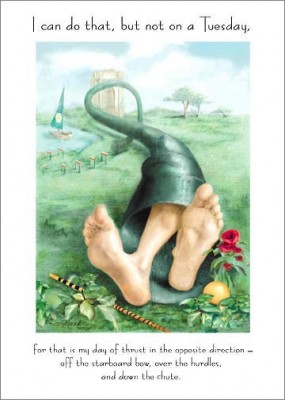
My actual birthday was yesterday, Tuesday, the day I paint with (a different) Susan and Madelaine (aka Hillaire Squelette who did the cartoon for my memoir.) We’ve been painting every Tuesday morning for five years. Five years. Yesterday Susan gave me a gratifyingly odd card, which she had been holding onto for years to give to someone when the occasion fell on a Tuesday. It’s a picture of two enormous feet coming through the end of a contorted pipe.

“I can do that,” it reads. “But not on a Tuesday. For that is my day of thrust in the opposite direction.”

There’s an idea for the rest of my life. Though I wouldn’t care to put myself through a pipe, I like the idea of thrusting in the opposite direction one day a week.  .   . at least one day a week.

card20


By Susan Mrosek  The Pondering Pool 

BooksCharles DickensEnglandLiterature

June 12, 2014

Barnaby Rudge

Tags: , , , , ,

I loved this book. Loved it. If you’re an old English major whose read some Dickens, can keep David and Oliver separate, can knit a pattern of names in the fog of Chancery, and are looking for a Dickens that’s completely new to you, read Barnaby Rudge. Or make it your first Dickens. I was so caught up in the characters that halfway through I had to read the synopsis in my Oxford Companion to Dickens because I didn’t think I could continue living unless I could be re-assured that Barnaby and his pet raven Grip would be alive and okay in the end.

I need to clarify the word okay. Barnaby Rudge is what the characters in the book call “a sort of natural.” He’d be on anti-psychotic medication today and we’d all be poorer for it. Here’s Barnaby on the subject of clothes drying on the line:

“. . . do you mark how they whisper in each other’s ears; then dance and leap, to make believe they are in sport? Do you see how they stop for a minute, when they think there is no one looking, and mutter among themselves again; and how they roll and gambol delighted with the mischief they’ve been plotting?”

When it is pointed out that “they are only clothes, “ Barnaby says:

“Clothes! Why how much better to be silly than as wise as you! You don’t see shadowy people there, like those that live in sleep—not you. Nor eyes in knotted panes of glass, nor swift ghosts when it blows hard. . .not you! I lead a merrier life than you with all your cleverness.”

Barnaby’s companion in life—other than his mother who watches over him with great compassion and understanding—is his raven Grip. I worried about this bird for 700 pages. Everywhere Barnaby showed up I needed to know if Grip was with him and Dickens never left me worrying for long.

Grip has quite a vocabulary: “I’m a devil, Never say die, Polly put the kettle on.”

After a day of rambling over the countryside, Barnaby tells his mother that when the wind rolls Grip over in the dust, he “turns manfully to bite it.  .  . and has quarreled with every bowing twig.”

“The raven, in his little basket at his master’s back, hearing frequent mention of his name in a tone of exultation, expressed his sympathy by.  .  . running over his various phrases of speech with such rapidity, and in so many varieties of hoarseness, that they sounded like the murmurs of a crowd of people.”

“He takes such care of me besides!” said Barnaby.  .  . “He watches all the time I sleep, and when I shut my eyes. . He keeps his eye on me the while.  .  .”

The raven crowed again in a rapturous manner which plainly said, “Those are certainly some of my characteristics, and I glory in them.”

Dickens describes Grip as being “alive to everything his master was unconscious of,” a notion that made me put down the book and burst into tears.

Barnaby is the titular character. I read somewhere that Dickens almost called the book Gabriel Varden so I want you to remember Gabriel for later. But first his wife Mrs. Varden, who reminded me of my own mother.  She is definitely “a type.”  Here’s a little exchange of the Vardens:

“Well, well,” said the locksmith. “That’s settled then.”

“Oh yes,” rejoined his wife. “Quite.  .  . I shall not contradict you. I know my duty. I need know it, I’m sure. I’m often obliged to bear it in mind, when my inclination perhaps would be for the moment to forget it.  .  .” And so, with a might show of humility and forgiveness, she folded her hands, and looked round again, with a smile which plainly said, “If you desire to see the first and foremost among female martyrs, here she is, on view.”

I don’t know who’s in charge of these things but here’s a scene that was replicated 150 years later between my mother and me:

“Dolly had thrown herself upon the sofa.  .  . with her face buried in her hands was crying. . .

At first sight of this phenomenon.  .  . Mrs. Varden expressed her belief that never was any woman so beset as she; that her life was a continued scene of trial; that whenever she was disposed to be well and cheerful, so sure were the people around her to throw.  .  . a damp upon her spirits;, and that as she had enjoyed herself that day, and Heaven knew it was very seldom that she did enjoy herself, so she was now to pay the penalty. . . poor Dolly grew none the better for these restoratives.  .  . though Dolly was in a swoon, it was rendered clear to the meanest capacity, that Mrs. Varden was the sufferer.” (Italics mine)

Barnaby Rudge is actually an historical novel, recounting some unpleasantness called The Gordon Riots that took place in London between the times of the American and French Revolutions. Again, I don’t know who’s in charge of these things, but the riots took place in 1780 during the same first week of June that I read the book in 2014.  It was a movement that got out of hand after a protestant named George Gordon started a petition to repeal an earlier law that had lifted restrictions on people of the Catholic faith. Dickens begins the build-up:

“If a man had stood on London Bridge, calling till he was hoarse, upon passers-by, to join with Lord George Gordon, although for an object which no man understood.  .  . and which in that very incident had a charm of its own, the probability is that he might have influenced a score of people in a month. If all zealous Protestants had been publicly urged to join an association for the avowed purpose of singing a hymn or two occasionally, and hearing some indifferent speeches made, and ultimately petitioning Parliament not to pass an act abolishing penal laws against Catholics.  .  . matters so far removed from the business and bosom of the mass, might perhaps have called together a few hundred people. But when vague rumors got abroad that.  .  . a secret power was mustering against the government for undefined and mighty purposes; then the air was filled with whispers of a confederacy among the Popish powers to degrade and enslave England, establish an inquisition in London, turn the pens of Smithfield Market into stakes and cauldrons.  .  . and by-gone bugbears which had lain quietly in their graves centuries, were raised again to haunt the ignorant and credulous.  .  . then the mania spread indeed.  .  . and grew forty thousand strong.”

Much like what goes on today between political parties and with just as much grasp of reality, people turned their insides out in the form of screaming against Popish plots, and the fire was lit. Dickens description of the massing on London is truly exciting, and with the help of a little map in the Oxford World’s Classics edition, easy to visualize. When it was over in the space of about a week, 200 (historians put it at 850) people were dead, and 72 private homes and four prisons plus numerous businesses had been burned. A distillery was burnt with the loss of 120,000 gallons of alcohol with rioters dying from alcohol poisoning.

In the first half of the book we meet Barnaby and Grip, the Vardens, other families, the usual collection of Dickensian odious characters, and those in charge of comic relief. In some cases the odious characters are also the comic ones. Also in the first half of the book, a mystery is presented. The flowing of the mystery and all its tributaries sweeps Barnaby (and Grip) into the formation of the mob. Barnaby thinks the riots are great fun. He mimics the slogans– Grip learns them, too—and carries a flag. He inadvertently becomes a hero for the Protestant side, is arrested and sentenced to hang.

While Barnaby waited to be hung along with the coward/bully hangman Ned Dennis (a historical figure) and the truly creepy, ugly, and probably stinking Hugh, I read the story’s synopsis to calm myself, and the three of them had this exchange:

“Dennis. . trembled so that all his joints and limbs seemed racked by spasms. Turning from this wretched spectacle, he (Hugh) called to Barnaby, who stood apart.

“What cheer, Barnaby? Don’t be downcast, lad. Leave that to him.”

“Bless you,” cried Barnaby. “I’m not frightened, Hugh. I’m quite happy. I wouldn’t desire to live now, if they’d let me. Look at me. Am I afraid to die? “

Hugh gazed for a moment at his face, on which there was a strange unearthly smile: and at his eye, which sparkled brightly. . .”

This was another point at which I burst into tears, even though I had just re-assured myself that Barnaby would be pardoned. He is indeed pardoned at the 11th hour, thanks to the efforts of Gabriel Varden. Besides being a lovely, likeable man, and the ethical anchor of the book, Gabriel acquits himself admirably in the riots. He faces down Hugh and Dennis while being held at gunpoint, refusing to submit to their demand that he open the lock of Newgate Prison –the lock he had made. Barnaby and Gabriel both exhibit fearlessness, the difference being that Gabriel does so in full consciousness of what it means to die.

Gabriel loves Barnaby. He thinks of him as a son. He moves heaven and earth to secure his pardon. He even steps aside and lets the novel be named Barnaby Rudge instead of Gabriel Varden.

BooksCharles Dickens

June 3, 2014

Our Mutual Friend

Tags: , , , ,

If you have never read Dickens, this isn’t the book to start with.  Not that I think it’s the one Dickens novel everyone hopes to read before they die but I thought that made for a good opening sentence.  I wonder how often the novel is taught or if many people –like me for instance—get the notion that they want to read all the novels of Dickens and inevitably get to it.  Have you heard of the Golden Dustman?  Nobby Boffin? Lizzie Hexam? I thought not.  They haven’t entered the cultural atmosphere the way Madame LeFarge, Ebenezer Scrooge or Miss Havisham have.

It’s a long book: 822 pages in the Oxford World Classics edition.  It’s always a little alarming to me when a book has a cast of characters list.  On the other hand it’s a nice service.  I photocopied and enlarged it, referred to it often and used it as a bookmark.

The expression “Our Mutual Friend” occurs at page 111.  Now here comes a convoluted Dickens plot line.  A man left all his money to his son– John Harmon—on condition he marry a certain woman, Bella Wilfur.  It was a nasty thing to do and the man was a nasty piece of work but as it turns out, Bella wasn’t.  She was quite a lovely woman and John was quite a nice man.  But neither of them knew that nor did they know if they would find the other attractive.

On a ship returning to England after hearing of his father’s death, John trades places with a man named Julius Handford with the idea that the masquerade would buy him a little time to get to know Bella. But Julius Handford drowns.  The dead man is fished out of the river by Gaffer Hexam and his daughter Lizzie.  John/Julius goes to the morgue.  This accomplishes two things: he ascertains that the dead man is Julius Handford, the fellow he is impersonating, and it allows a solicitor, Mortimer Lightwood to get a good look at him. 

Mortimer has been engaged to deal with the will of John Harmon. Now that the main beneficiary is –apparently–dead, John/Julius thinks it efficacious to change his identity again and he chooses the name John Rokesmith.  The first thing he does as John Rokesmith is find a room in the home of the Wilfurs.  Secondly he finds employment with Mr. and Mrs. Boffin, secondary beneficiaries of his father’s will.   So he becomes the mutual friend of the Wilfurs and the Boffins.  The Boffins invite Bella to live with them, recognizing that she, in a tangential way, deserves to share in the good fortune.  From these two vantage points John Rokesmith can observe Bella.

A lot of watching and spying and hiding goes on in this book.  John Rokesmith’s observing of Bella is a little creepy but it rights itself in the end.  More creepy still is a parallel plot which involves as psychopathic a character as I think one will find in Dickens, Bradley Headstone (such a name!) who stalks Eugene Wrayburn, a solicitor because they both are interested in Lizzie Hexam, the daughter of Gaffer Hexam, the riverman, and then stalks Lizzie Hexam herself.

The business of fishing things out of the river is paralleled by the business of fishing things out of the trash, which the British politely call “dust.”  John Harmon’s father made his fortune managing what Americans would call a garbage dump but what Dickens calls “dust mounds.” When the novel opens, the Boffins are the dump caretakers in a house on the edge of the garbage heaps.  When they come into their fortune, they have a glorious home built and Nobby is nicknamed “The Golden Dustman.” 

That’s probably all you need to know to nod your head intelligently at a dinner party or book club.  If you read the next several sentences without attempting to make any great sense of them, you’ll enter into the topsy-turvy world of a Dickens’ plot:

Lizzie goes into hiding to get away from Bradley Headstone but the father of her friend Jenny Wren, another creepy man who has the DTs, rats out her whereabouts. 

Bradley Headstone and Rogue Riderhood who was initially thought to have murdered Gaffer Hexam, and who is continually trying to swear “Alfred David” (an affidavit) that he didn’t, get into a fight and kill each other.

Mr. Venus a taxidermist and collector of bones has actually bought the leg bone (how weird is that?)of Silas Wegg who gets about on his peg leg and who tries to scam the Boffins. 

The Lammles married each other because each thought the other was rich.  On their honeymoon they discovered that neither had a penny.  They weave in and out of the novel scheming and conniving to keep their appearance in society, which is represented by the aptly named Veneerings.

The scrambling to keep one’s veneer in society is paralleled by the marriage of Mr. Eugene Rayburn and Lizzie Hexam. From two different classes of society, they have both been through so much they don’t care what the upper class thinks of them.  While high society is discussing the scandal, Mr Twemlow who himself rather falls through the cracks of the upper crust makes the pronouncement that shuts them all up:

“If this gentleman’s feelings of gratitude, of respect, of admiration, and affection, induced him to marry this lady.  .  .I think he is the greater gentlemen for the action and makes her the greater lady.”

Finally, to get back to the main plot which is a Pride and Prejudice sort of courtship minus the stalking, John Rokesmith and Bella marry.  Only after she becomes pregnant does he reveal that he is John Harmon the man she was expected to marry anyway.  And even then the revelation only comes about because Mortimer Lightwood who John has tried to stay clear of, recognizes him as Julian Handford whom the police have been looking for ever since the drowning of the supposed John Harmon.  Finally it is revealed that the Boffins have been in on the deception from the beginning.

George Orwell in his marvelous essay about Dickens comments that what sets Dickens’ apart is not his use of detail so much as his use of unnecessary detail.  Here, I think, is an example of what he was talking about.  What is the gratuitously unnecessary detail in the following sentence from Our Mutual Friend?

“Her letter folded, sealed and directed, and her pen wiped and her middle finger wiped, and her desk locked up and put away, and these transactions performed with an air of business sedateness which the Complete British Housewife might have assumed.  .  .she placed her husband in his chair and placed herself upon her stool.”

I think the unnecessary detail is that wiped middle finger.

Because there aren’t a lot of famous quotations born out of this novel—at least not ones that I recognized–, here are some bits that can be enjoyed without having to keep track of any particular plot line or character:

*Mrs. Wilfur sat silently giving them to understand that every breath she drew required to be drawn with a self-denial rarely paralleled in history, until Miss Bella appeared.  .  .

*There was a Miss Podsnap. And this young rocking-horse was being trained in her mother’s art of prancing in a stately manner without ever getting on.  But the high parental action was not yet imparted to her, and in truth she was but an undersized damsel with high shoulders, low spirits, chilled elbows, and a rasped surface of nose.  .  . Miss Podsnap’s life had been, from her first appearance on this planet, altogether of a shady order.  .  . (she)was likely to get little good out of association with other young persons, and had therefore been restricted to companionship with not very congenial older persons and with massive furniture.

*Ma was talking at her usual cantor, with arched head and mane, opened eyes and nostrils.

*Among these correspondents are several daughters of general officers, long accustomed to every luxury of life (except spelling).  .  .

*Veneering then says to Mrs. Veneering, “We must work,” and throws himself into a Hansom cab.  Mrs. Veneering presses her aquiline hands upon her brow, to arrange the throbbing intellect within; orders out the carriage; and repeats in a distracted and devoted manner, compounded of Ophelia, and any self-immolating female of antiquity you may prefer, “We must work.”

*(Silas Wegg, himself nearly illiterate, reads to Mr Boffin from what they insist is The Decline and Fall of the Rooshan Empire several times a week.  Here he is one evening:) “Mr Wegg’s laboring bark became beset by polysyllables, and embarrassed among a perfect archipelago of hard words.  It being necessary to take soundings every minute and to feel the way with the greatest caution.  .  .”

 Herein ends my Alfred David on Our Mutual Friend.