
BooksCharles DickensLiterature

May 27, 2014

The Old Curiosity Shop

Tags: , ,

I read The Old Curiosity Shop because it was the only Dickens checked in at the Greenwood branch of the library on the day I went looking for a new Dickens.  Throughout its 554 pages plus explanatory notes, I thought I didn’t like it but I kept reading.  Every day I measured the pages read against pages to read and I kept reading.  After I finished it, I couldn’t stop thinking about it. I decided I liked it –aptly–for a lot of curious little reasons.

The physical Old Curiosity Shop is vacated and closed up about a sixth of the way through the narrative. It’s owned by a nasty named Daniel Quilp and is managed and inhabited by an old man whose name we never learn and his granddaughter, Nell.  When Nell and her grandfather leave London, they meet up with collections of curious characters as though to suggest they have taken the shop with them. 

I had great difficulty with the main characters, especially Quilp. He’s malignant and sadistic, a queer old creep as his name suggests–queer in its 19th century, or if you will, Dickensian meaning.  He disturbed me.  I didn’t want to read about his abuse of his wife or his relentless and malevolent stalking of Nell. 

What kept me reading were the secondary characters.  I liked Kit Nubbles, a loyal friend of Nell’s who is goodness personified without sentimentality. He’s naïve and trusting, which gets him into trouble, but Dickens gets him out again.  Dick Swiveller keeps track of the streets he can’t walk down because of all the tradesmen to whom he owes money. Dick puns and quotes from popular songs of the day like a middle class Lord Peter Wimsey.  He is nimble of body and verbiage, prefiguring nearly every Wodehouse character that was to come.  Sally Brass is also taken with Dick and his antics.  Sally Brass has “reddish demonstrations that might be taken for a beard,” but as Dickens suggests “these were, however, in all probability, nothing more than eye-lashes in the wrong place.”  Sally Brass is both creepy and compelling.

I looked forward to every scene where I might encounter two very minor figures who popped up on the fringes of things: Tom Scott and Whiskers, the pony.  Tom Scott is a kind of personal assistant to Quilp.  He lives on the premises of Quilp’s man cave down by the docks where he has a chop-shop for ships.  Just a boy, he has a neat trick: he likes to walk on his hands and stand on his head and this drives Quilp crazy.

When we first meet Tom, Quilp has gone to his place of business where “the first object that presented itself to his view was a pair of very imperfectly shod feet elevated in the air with the soles upwards, which remarkable appearance was referable to the boy, who being of an eccentric spirit and having a natural taste for tumbling was now standing on his head and contemplating the aspect of the river under these uncommon circumstances.” 

Quilp “punched” him but Tom is not afraid of Quilp, which makes me wonder if Quilp has given him brain damage from all the physical abuse:

“’Now, said Quilp, passing into the counting house, ‘you mind the wharf. Stand upon your head again and I’ll cut one of your feet off.’

The boy made no answer but directly Quilp had shut himself in, stood on his head before the door then walked on his hands to the back and stood on his head there.  .  .”

When Quilp sails off in a boat with Nell, Tom taunts him by standing on his head “on the extreme verge of the wharf, during the whole time they cross the river.”

Another time when Quilp “collared” him, Tom jumped away and “walked upon his hands to the window and –if the expression be allowable—looked in with his shoes: besides rattling his feet upon the glass like a Banshee upside down.”

At the inquest after Quilp’s death, Tom is the only one who shed any tears.  When he also tried to assault the jury, presumably out of grief, he was ejected from the court, at which point “he darkened its only window by standing on his head upon the sill.  .  .”

Whiskers the pony belongs to an elderly couple, the Garlands, who regularly drive him into town to see their solicitor.  Or it might be said that the pony drove them:

“It was plain that the utmost the pony would consent to do was to go his own way up any street that the old man wished to traverse, but it was an understanding between them that he must do this after his own fashion or not at all.  .  . the pony came trotting round the corner of the street, looking as obstinate as a pony might, and picking his steps as if he were spying about for the cleanest places, and would by no means dirty his feet or hurry himself inconveniently. Behind the pony sat the little old gentleman, and by the old gentleman’s side sat the little old lady.  .  . they arrived within some half a dozen doors of the Notary’s house, when the pony, deceived by a brass-plate beneath a tailor’s knocker, came to a halt, and maintained by a sturdy silence, that that was the house they wanted.

‘Now, Sir, will you ha’ the goodness to go on; this is not the place,’ said the old gentleman.

The pony looked with great attention into a fire-plug which was near him, and appeared to be quite absorbed in contemplating it.

‘Oh dear, such a naughty Whisker!’ cried the old lady. ‘After being so good too, and coming along so well.  .  .”

The pony having thoroughly satisfied himself as to the nature and properties of the fire-plug, looked into the air after his old enemies the flies, and as there happened to be one of them tickling his ear at that moment he shook his head and whisked his tail, after which he appeared full of thought but quite comfortable and collected. The old gentleman having exhausted his powers of persuasion, alighted to lead him; whereupon the pony, perhaps because he held this to be a sufficient concession, perhaps because he happened to catch sight of the other brass-plate, or perhaps because he was in a spiteful humour, darted off with the old lady and stopped at the right house, leaving the old gentleman to come panting on behind.”

Tom Scott and Whiskers have no real bearing on the story, but they served to keep my following the main plot which is briefly this: Nell’s grandfather has a gambling habit and cannot pay his rent on the shop.  Because they are at the mercy of Quilp who wants to appropriate the 13-year old Nell as his second wife—he would murder the first one without compunction – the two of them steal away into the country in the middle of the night.  They wander, beg, and work for food and shelter. Inevitably the grandfather gambles away their money. Nell gets sick and dies.

I had a difficult time with Nell: the virtuous, pure, innocent, all good, all loving, angelic martyr.  It isn’t that a 13 year old orphan isn’t a sympathetic figure but I am not the first to suggest that Dickens overdid her just a tad.  I skimmed through the numerous passages where he strains to bring his talent to the level of her great purity, the result being the most tedious sentimentality.  I gather the Victorians loved this sort of thing but I was frankly glad when she was out of the story.

Meantime people, Quilp among them, try to find Nell because her grandfather has hinted that she will come into a lot of money when he dies.  Since he, in fact, expects to win that money gambling, there is no money except for the few pounds Nell has sewn into the hem of her skirt.  Kit searches for Nell because he loves her.  A stranger searches for Nell because he is, in fact, her father.  Dick Swiveller, Sally Brass and the usual collection of colorful characters that live and move and have their being in Dickens’ head all have some interest in finding little Nell because they all think there’s money to be had. 

The characters who make out happily in the end are Kit Nubbles whose goodness is rewarded and Dick Swiveller, the only character who matures while still maintaining his charm.  And Whiskers.

Because there was no particular place in my meandering reflections on The Old Curiosity Shop to say this, I will say now that in it Dickens used the word avuncular as a noun as in “She needs an avuncular.”  Kind of like “The witch has a familiar.”  I liked that.

The Old Curiosity Shop is the source of a famous quotation that is lovely on some days, sentimental on others and delusional much of the time.  I see it on calendars and mugs and T-shirts: “I love these little people; and it is not a slight thing when they, who are so fresh from God, love us.”

I could say the same things about cats. Reading this book can change ones sentimentality set-point.




BooksCharles DickensLiterature

May 23, 2014

In Search of the Dickensian

Tags: , , , ,

I knew the day was coming that I would embark on a cruise through Charles Dickens, I just didn’t know when the ship would sail. Reading the 38 plays of Shakespeare two summers ago was as a life-changing experience, not just because Shakespeare became like the grandfather I never knew, but also because I didn’t think I possessed the concentration needed to follow through on such a wordy project.  When I think of wordy, however, I think of Dickens.  I remember him from high school as having page-long sentences that wound around every house on the block before finally coming home.

Small things tip us into larger ones.  I read five novels of Charles Dickens in high school because of the Monkees, that pseudo-rock band that was more accessible to junior high school girls in the mid-sixties than even the Beatles were.  One of the Monkees, Davy Jones, was a British kid from Manchester who had played the Artful Dodger in the stage production of Oliver!  Davy Jones, being my crush of choice of all the available Pauls, Johns, Peters, and Mickeys, I –of course—had to read Oliver Twist.  I went on to read David Copperfield, Great Expectations, Nicholas Nickleby, and A Tale of Two Cities. For no other reason than that Davy Jones played the Artful Dodger in the stage production of Oliver!

Small things tip us into larger ones.  I loved George Orwell’s essay on Dickens, which I read during last winter’s Orwell Fest. Then last month I somewhere picked up the stray information that Hard Times was one of Dickens’ shortest and easiest novels.  The next day I ran across a 25 cent copy at a garage sale. I bought it and read it. It served the purpose of convincing me that long sentences in high school were now not quite so long. Especially not since reading the canon of Shakespeare, not to mention four volumes in the Norton Anthology series and two thirds of Ulysses at which point I am stuck.

In any case I decided this would be the summer of Dickens. Besides the novels, which are mighty, great doorstops of books, he also wrote short stories and articles and letters.  I’m not planning to read everything.  I want to read at least enough of his work to be able to use the word Dickensian with more intelligence than pretension.

So I read Hard Times. That was a month ago.  Since I don’t want to get up and get the book, let’s see what my retention is worth.  It takes place in fictitious Coketown in the industrial north of England, a town that manufactures cloth.  The book begins with Mr. Gradgrind, a teacher, bellowing to his class that FACTS are all that matter in the world.  That horrifying beginning sets the tone. 

Gradgrind has raised his family without regard to feelings of any kind.  His wife escapes into hypochondria and dies halfway through the book.  His son becomes a lazy, scheming, selfish man.  Gradgrind marries off his daughter Louisa to Mr. Bounderby, a banker who is 30 years older than her because it’s a rational thing to do.  He himself becomes an MP and goes to London.  Gradgrind is one of more sympathetic characters in the book because he changes.  His daughter is miserable with Bounderby and she confronts her parent about all that was lacking in her upbringing.  This was a curiously modern scene.  It reminded me of today’s therapeutic advice to confront the family members who have victimized you. Gradgrind softens, opens up and becomes a fuller human being.

Mr. Bounderby is a bounder—get it?  He has made up a story about himself as an orphan who created a life and got rich out of practically a piece of string and a couple of sticks.  But his (loving) mother shows near the end of the book and unwittingly unveils her son as the, well, bounder, that he is.

Mr. Bounderby has a menial who either is or thinks she is a member of the impoverished gentry.  Mrs.Sparsit.  Dickens continually represents her as one with “Coriolanus” eyebrows partly to suggest her aristocratic background, and partly to reinforce the visual of dark, thick eyebrows.  Here’s one of the funniest lines of the book:

“So, Mr. Gradgrind and his daughter took Cecelia Jupe off with them to Stone Lodge, and on the way Louisa never spoke one word, good or bad. And Mr. Bounderby went about his daily pursuits.  And Mrs. Sparsit got behind her eyebrows and meditated in the gloom of that retreat, all the evening.

That was worth my getting up off the couch, getting the book, and finding the quotation.


Garden

May 15, 2014

After the Tilth, the Deluge

Tags: , , , ,

I stretched happily at the back door on the morning I was to plant my takings from the Tilth Sale.  I had waited almost a week for a nice hunk of time to get out there and wallow in the earth.  I planted the chard in back, the nigella in front, and the herbs in pots.  I took a flat of ground cover to the bed at the fence that is choking with poppies about to bloom.  I’ve got green and sweet peas all along the fence as well as a few sprouts of corn and sunflower.  There’s a new grape finding its way along one part of the fence. At the other end is a yosta berry, a goose-currant bush, that has made itself at home over the years since I planted a few starts for no better reason than someone gave them to me.

The yosta berries are sour and up until last year I ignored them.  They formed, they fell off, and I hardly noticed.  But last year I tried putting them with the raspberries I infuse in vodka for three months.  The result after adding a sugar syrup surprised every taste bud in the mouth.  I stopped ignoring the yosta berry.

Watching its beautiful dark green leaves dress its independent espaliering, I wondered how many berries I’d get this year.  I thought I had been monitoring the yosta, but I must have looked away for about two minutes.  On this particular morning I was parceling out the ground cover in front of it when I happened to look up and notice some of the leaves had been eaten away.  I looked further– up and up and up—and saw that all the leaves had been stripped right off the bush almost up to the top. 

Up at the very top the leaves were drooping somewhat.  I turned one over to see 12 or 15 bloated greenish-black worms with tiny white spots lounging on the leaf like so many drunks at a frat party. Every leaf was another fraternity house.  Leaf after leaf was full of these, these.  .  . louts, burping and leering at me.  They had gorged themselves on the entire bush!

I started squishing them, whole handfuls of them and they squelched as though I had my hands in human intestines.  The more I squished, the more I found and the more frantically I turned over the leaves.  I think I might have been screaming. 

I checked all the plants close to the yosta.  There was an infestation of two kinds of aphids in a couple of the poppies.  It looked as though someone had emptied an entire pepper shaker over them. I know I screamed then. I yanked out the poppies.

I got my spray bottle of neem oil/Dr Bronner’s peppermint soap/cayenne. This was the day the spray bottle got temperamental and wouldn’t spray.  I shook it, I turned it upside down, I shook it again.  I cursed it.  Finally I took off the sprayer and pretty much emptied the entire bottle all over the yosta and every plant near it. Then I dusted the area with diatomaceous earth. 

I couldn’t stop re-living my showdown with those hideous, squelching worms.  I saw them everywhere.  A damp piece of banana peel on the kitchen floor was a bloated worm on my yosta berry.  A flutter of my hair meant one had dropped on my head while I was rampaging in the garden.  “Oh, god,” I thought. “Now the dreams are going to start!”

I was out there the next morning looking for the hangovers.  And again that evening.  Every day since then, I’ve been out at least once, checking what is clearly a stressed plant what with the denuding, the dousing and dusting, and the shrieks of a crazed gardener.  I squish a few more miscreants each visit.   I talk to the stems and berries and what few leaves are left, trying to reassure them.  Yesterday I gave them a big drink of fertilizer.

I’ve since learned that the little green worms are actually a particular kind of sawfly that love currant leaves.  There’s another sawfly that love rose leaves.  The day after I squished my last currant sawfly, I found tiny green ones feasting away on my roses. They had only gotten as far as the appetizer when I immediately bussed their table.

And so it goes in the garden. The game’s a-foot.  Next opponent: wasps.


CurmudgeonFriendsGarden

May 8, 2014

The Tilth Sale

Tags: , ,

Seattle Tilth is an organization that helps people to grow their own organic food.   They say this on their website in TilthSpeak, a dialect of GrantSpeak.  But that’s neither here nor there.  What is here, or rather was there is their spring edible plant sale, which I went to last Saturday.

It was Tim’s idea.  He’d been talking about it since, oh I don’t know, before I even knew him and I’ve known him for 15 years.  In case you’re new here, Tim is my friend who when he downsized, missed his garden so much I gave him mine.  We are into our second year of planning, digging, and planting and it’s been a fun collaboration.  When plants and gardening paraphernalia began showing up in stores, and when signs for sales starting sprouting at intersections, I asked Tim what his ideas were for new plants.

“Let’s see what they have at the Tilth Sale.”

That was the beginning.  Ensuing conversations went like this:

“Where would we get a thimbleberry?”

“The Tilth Sale might have one.”

“Two dollars a plant is pretty good for tomatoes, no?”

“Why don’t we wait for the Tilth Sale?

As the weekend of the sale got closer, the actual details came into focus.  For one, I would have to drive as I’m the one with a car. (I immediately and cravenly invited my neighbor Gwen who knows something about just about everything to join us knowing that she would gladly drive. Or willingly.  If I begged.  But Gwen only does flowers.) If I was driving that would mean I would have to park.  Do you know how many places I don’t go simply because I have to park?  It’s not that I don’t know how to.  I actually do a smooth, efficient parallel park that I am quite proud of.  It’s the difficulty in finding a place to park in Seattle that foils me. In Wallingford, where the sale was, the cramped streets were already lined with cars on both sides, making them essentially one way roads. Trying to park or even drive two blocks in a row creates a back-up that can last fifteen minutes.

Secondly, there was the time of day. The sale started at 9:00.  Tim wanted to get there at 8:00.  That meant picking him up at 7:30.  On a Saturday morning.  My mornings are sacro-sanct.  It’s when I write and practice.  I’m up at first light these spring mornings and I love my routine.  I’m wide awake, functioning and happy as long as I don’t have to talk to anyone or get dressed.  I would have to do both those things in order to then stand in line for a whole hour in the rain waiting for the sale to start, fight and claw for half an hour like they do in Filene’s Basement, and then a second hour of standing in line, this time laden with dripping plants, and waiting for a cashier.  Even though I agreed to this violent disruption of my life, I felt whiny about it.

 The closer it got to the date of the sale, the more Tim talked about it, and in direct proportion, the less I wanted to go.

Finally I said: “I know you’re looking forward to this, but I need to say that I’m dreading it.”

“Well, look I can stand in line and you can get coffee and fun things to eat from the Vendors.”

“Vendors? Like taco trucks?”

“Well, yeah, but organic companies.  And there’ll be music.”

“MUSIC? Oh, god NO.”  I actually started to sweat.  “Music” at sales is always bad and in the rare instances that it’s good, it’s too loud.  “I need to remember to bring earplugs.”

If all this wasn’t enough, Tim decided we needed to plan what we would buy.  Hoping to discourage this, I gave him as tiny a window as I could for when I could get together and “plan,” but he made it work.  He printed out all 28 pages of the index of plants that would be for sale and we went through every frigging cultivar, a word I now know, to draw up a list of roughly 35 plants we would get.

“There’ll be map of where everything is so we can—“

“Oh god,” I interrupted him. “It says we are issued wristbands for our entrance time.  Are we even going to be out of there by noon?”

Everything, it seemed, was getting piled on the Tilth Sale until in my imagination it became as big, noisy, crowded and as gigantic a parking nightmare as the Puyallup Fair. 

Saturday morning I woke up feeling nauseated and the sky looked like it was timing itself to dump on Wallingford at 8:00.  I wasn’t actually vomiting and I didn’t think I could convincingly call in sick so I got in my car and drove down the street to pick up Tim.

He got in the car. “Now I’m dreading this,” he said.  “I looked on Google Earth and the place is already crowded.”

We drove gloomily to Wallingford.  Here’s how the morning went:  I found a place to park a half a block from the sale.  We were 20th in a line that numbered 200 by 9:00. The (bad)music didn’t start until close to 9:00 and then after a half an hour or so it either stopped or I (unaccountably) stopped hearing it.  We had some fun conversations with interesting people.  I took a lovely walk around the Good Shepherd Center while Tim held our place in line. 

The organization of the tables of plants was a thing of beauty. And I have to say that I am glad we planned.  Otherwise I would have thrown up from sheer overstimulation. The sale was swarming with cheerful volunteers in bright orange vests, easy to spot, knowledgeable, and willing to do anything including hauling flats of plants and standing in line with them. When I called out “Hey orange person!” to get their attention, they laughed merrily. It didn’t rain. We were out by 9:50.

We came home happy and satisfied, bubbling over with plans to plant. I can’t wait til next year’s sale!

Alzheimer's diseaseChoir SingingSingingSongsTeaching

April 18, 2014

All Present Almost Past

Tags: , , , ,

All Present Song Circle knows so many songs that we can’t get through them all in a session so last week we started at the back of the song sheets.  That was a bit of a mistake in that the sheets are confusing enough without having to work through them backwards.  The singers have a way of fidgeting with their sheets between songs so they lose their places.  I’ve re-worked the sheets four times trying to make them dementia friendly and I still haven’t got the right scheme. 

Jim dangled his 24-page songsheet by one page and and gave me A Look.

“What?” I said.  “You’re looking at me like you think I’m crazy.”

“You are. So am I.”

“It’s kind of nice, isn’t it?”

Jim always wants to sing “The Old Rugged Cross.”  I told him that when I was studying voice and learning to sing Handel and Rossetti, I’d go home to my parents and demonstrate “Una voce poco fa” or “Let the Bright Seraphim.”  My mother would say, “Now sing ‘The Old Rugged Cross.’”

I never sang it for my mother, but I’ve sung it with Jim three times.  We only sing one verse.  I haven’t let on that I can’t get the other three out of my memory.

Jim seems to know every song I’ve thrown out there. 

“You’re amazing,” I told him.  “I know verses to gruesome hymns from growing up going to church three times a week and you know every word of Chattanooga Choo Choo.”

Most of the members of All Present are in their 70’s but there are a few from my generation.  Ex-flower children who want to sing Joan Baez and Dylan.  Roger especially wanted Dylan songs.  I asked him for titles. 

“I can’t think of any right now, but I have a book at home.”

“Can you bring the book? All I really need are titles.  I probably know all of the songs.”

Quizzically: “You didn’t get that in church.”

The last group on the song sheets are songs from musicals like Guys and Dolls, The Music Man, and My Fair Lady.  Last week The Other Jim and I sang “If I Loved You” from Carousel. The Other Jim has one of those golden tenor voices with Wagnerian power behind it.  I had penciled in some harmony notes for me and did my best to blend with him.  What emerged was unexpected and moving. 

The Other Jim punched the air. “Yes!!” he exclaimed.  He still had it.  He could sing!

When we sing songs like “Over the Rainbow,” “You’ll Never Walk Alone” (and especially “O Danny Boy”) we take inventory of who is crying and who needs a tissue.

“You’re so bad to make us sing these!” Helene said this week, tears running down her face.  She was beaming.

The next song was “Shall We Dance” from The King and I.  I grabbed Larry who was sitting on the end of the circle. “Dance with me,” I said.  Too late I realized he needed a cane to balance but he held on to me with his other hand and we danced.  Not quite like Deborah Kerr and Yul Brenner, but that’s a dance enshrined on film.  This was now.

That’s their great gift to me: All Present is just that.  It’s just for now.  It’s not for a performance later; it’s not to record and listen to. It’s just for that hour and a half when we sing and we can’t stop smiling at each other.

This first series is almost over.  We have one more session and then we sing on Saturday, April 26 at the Dementia Talent Show at the Ravenna Senior Center between 2:00–4:00 PM.  The public is invited.  They’ve given us a whole half hour.  At first I wondered what we would do, but then it came to me. Of course.  We will be All Present.  We will sing the songs we like the best, and we’ll do whatever occurs to us to do.  We may dance, we may cry, we may be crazy, but we won’t miss being present in the moment.  That’s more than just kind of nice.

CatsFriendsGarden

April 9, 2014

New Starts

Two huge raccoons raced in front of me last night when I was calling the cats.  The cats were sitting three yards away and refused to look at me, the person who feeds them.  They were like people at a sports event waiting for a moment they had anticipated and fantasized about all season.  The Running of the Raccoons.  For the next six months at ten o’clock at night, my cats will be in their lawn chairs with their Mojitos, waiting for the show.  They will ignore my calls for them to come in so I, the person who feeds them, can go to sleep.

It’s spring, the great turning of the earth.  The earth’s rotation to be sure, but there’s also been a great turning of the earth in my garden.  New beds have been dug and old ones expanded.  Seeds and starts are in the ground. Bare-root trees are showing signs of life.  I have done all I can to discourage scab, codling moths, and maggots to my Spartan apples. 

I don’t remember when I have been this ahead of the game.  It’s because for the first time since arthritis ruined me for ten hour days in the garden I have help.  A friend of mine whom I will call Tim (his name is Tim) recently moved into downsized digs six blocks away from me and for the first time in his life is without a garden.  One day last year he e-mailed out of the blue to say he can’t go another year without the earth and did I have any large gardening projects he could embark on.  You might well ask how did I get so lucky but I have no answer for that.

Last spring and summer was a process of exhuming a garden that had been neglected for several years and putting in a few new things.  I am not a great planner so except for a few plants, every day in the garden is like Christmas morning to me.  I tend to plant things and think, “OK, now that I’ll remember,” and neglect to set a marker.

I have showpieces: a tree peony, some magnificent lilacs, the Himalayan honeysuckle that I grew from a slip, the designer dahlias called “Wheels,” and the Peruvian Scilla.  When I found the Scilla several years ago, they were clogging up a small patch of garden in a sea of lawn.  Ever since I freed their great clumps of bulbs and planted them all over my property, they have rewarded me with great royal blue starbursts in sun, in shade, in pots, and with or without water.  They reward themselves with sexual orgies all winter long. 

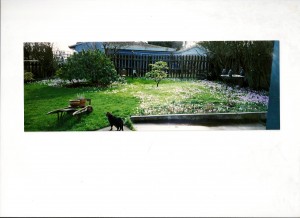
Every February I get a purple carpet of early croci in pretty much every bit of yard that hasn’t been mowed. And finally there’s the Clerodendron (Glory Bower) that I grew from a sucker of my neighbor across the street.  I gave a sucker to Gwen, my neighbor who knows something about just about everything.  Thanks to this triumvirate, our section of Crown Hill smells like the perfume counter at Nordstroms on warm summer nights.

These are the highlights of what was there, if neglected, when Tim came in the gate, so to speak.  Since we’ve been collaborating, Tim has made a serious dent in the dandelion population, done a great deal of judicious transplanting and fertilizing. (The yard smells like a fish market.)  He’s attended to details that I don’t realize until weeks later, if at all.  However it did not escape my notice that he built a rock wall, which I call The Grotto, using hunks of concrete we have scavenged from the neighborhood and the great hunks of cement that once housed fence posts.

The story of those fence posts is this: I paid a former student a smallish amount of money to learn to build a fence.  He wanted the experience, I wanted the fence.  It worked out beautifully until two years after the fact and he had moved to California, the fence came down in a windstorm and crashed on my raspberries. 

When I paid a great deal of money to have a proper fence built, the builder said he would try to leave the hunks of cement in the ground.  When it proved impossible to work around them they got a new life as an unsightly heap in the southwest corner of the yard and began collecting moss.  Tim worked them, moss and all, into a garden wall, gradually building up raised beds, which we are filling in first of all with sub-soil from the cemetery next door, then topsoil from another part of the yard and finally compost.

Besides Tim whose organic gardening creds go back years and around the world, I have Matt, the yard guy who Gwen and I employ one day a week between us to do some of the hard and admittedly tedious work of the garden. The most recent addition to the Team Garden has been Little Miss Scarecrow with plastic bags stuffed into her waterproofed gear. What’s so nice about having help is that then I feel able to do what I can.  When I think I have to do it all, it’s so overwhelming that I don’t do anything, which pretty much describes the situation in the last several years.  Now I can do the things I most enjoy: weeding, and holding the hose in one hand and a Scotch in the other.

Expect to hear more.  Like how Tim almost murdered my kerria japonica and how I am spraying tender starts with a mixture of Neem oil, cayenne, and Dr. Bronner’s peppermint soap.  And double feature night: The Running of the Raccoons and the Dancing of the Opossums.

The Grotto

The Grotto

Clerodendron

Clerodendron

The Magnificent Lilacs

The Magnificent Lilacs


Wheels

Wheels

2012

Peruvian Scilla

The Early Croci

The Early Croci


Alzheimer's diseaseChoir SingingSingingSongsTeaching

March 29, 2014

All Present. Correct is Optional.

Tags: , , ,

When you’re self-employed your income is more directly connected to your initiative than is someone’s with a contract or tenure. There can be great satisfaction in having control over your own hustle, or marketing in today’s more genteel parlance.  I’m not used to having offers drop into my lap unconnected to the aforementioned hustle, but recently something did. 

The Greenwood Senior Center, a bustling place up the street from me, approached me about starting a choir for people with ESML–early stage memory loss.  I went in for an interview and found myself immediately attracted to the idea.  Getting people singing– particularly people who aren’t sure they can sing—is what I do best.

We nailed down dates and I came up with a description and some tag-lines.  I thought for a long time of what to call this choir because I thought ESML Choir lacked pizazz.  I played with the idea of immediacy, of now, the present.  Present Tense.  I didn’t like the tense part. Future Imperfect.  No, that was definitely heading the wrong way.  I finally came up with “All Present: a song circle for people with ESML.”

After that, with hundreds of songs at the ready, there wasn’t a lot to do until I knew who my singers were.   The circle filled up immediately on paper.  I had names, ages, and voices.  Most of the participants were in their 70s so that gave me a window of what music they might have in their long-term memory. 

I went through stacks of music and picked out a handful of standards like “It Had to be You” and “As Time Goes By.”  I put together a list of popular and folk songs that had repetitive phrases: “You Are My Sunshine,” “Que Sera Sera,” and “Clementine.”  I tapped a few well-known rounds. I figured out the easiest vocal keys to pitch the songs in, keeping things within the ten notes between B and D because most voices can manage that range in some octave. I got out my guitar, which I haven’t played in 15 years and started developing some callouses.

About a week before the first class, a kind of panic set in.  I felt the same sort of thing the first time I was a camp counselor and before I began student teaching in college, and certainly before I first taught watercolor painting on that damned cruise to Alaska.  My college-roommate Mary-Ellis called it “the shakes.”  “You just have the shakes,” she said in her calm, low voice before I set off for camp.  I can still remember how comforting her words sounded to me. When I tried to say them to myself the week the song circle began, though, my voice was two octaves higher and didn’t sound comforting at all. Nor did it help to shame myself as in: you are an adult and founded a community choir and have directed it for 22 years and get a hold of yourself, for god’s sake.

So ironically, there was a lot of future anxiety and nervous energy building up in the week before the first session of All Present.  The morning of the first sessions I packed up my guitar, my lists, and my music.  At the last minute, I threw in my Rodgers and Hammerstein Songbook, a tome that weighs about five pounds.  I added a huge bottle of water, throat spray and my cough drops as I was in the midst of a beastly head cold.

I met the singers.  Now I had faces. We made name tags and I chatted with them and their caregivers.  They sat and waited quietly, docilely: eight men and six women.  I didn’t know what to expect but I had come with plenty of experience in ways to help people get started singing.  I’ve had voice students —voice students—who only managed to start peeping after weeks of coaxing.  I’ve had choirs on which I had to perform the miracle of raising the dead before I could get the work-night rehearsal started.  I just had never worked with people with early stage memory loss.  I passed out song-sheets.

In fact, nobody needed them.  I started us off with “You are My Sunshine” and they just about took the roof off.  It was as though they had been holding it all in, not just while I fussed around with the name tags, but for months, for years.  They knew everything by heart and they knew verses not on the song sheets.  When we sang “Goodnight, Irene,” someone remembered the harmony line from when he had sung Barbershop and the sweetness of the sound made me tear up.  Their faces relaxed into their own nostalgia, their own associations, and their own feelings. 

I moved to the piano and we sang standards and half of the Rodgers and Hammerstein Songbook. Then I moved back to the guitar because they had already forgotten that we’d sung “Goodnight Irene,” “Daisy, Daisy” and “Swing Low, Sweet Chariot.” We sang everything a second time. For an hour and half we sang.  I couldn’t stop smiling and they gave it right back to me.  I can’t remember when I have enjoyed myself so much.

We’ve had our second session.  I think they remembered who I was and what we were doing there, but I’m not sure.  It’s hard to know what someone with early stage memory loss remembers or how they remember.  They might not remember with their memory. They might remember with their hearts. 

TeachingTelevision

March 22, 2014

Trial and Resolution

Tags: , , , , , ,

I’ve had a cold for two weeks.  It feels like I’ve had a cold –the same one—for three months.  In fact, since September I’ve been sick more often than I have in the last five years.  I attribute this to an influx this year of piano students under the age of ten.  They are adorable, fun, and funny but they are also like disease-carrying rats.  A friend calls them walking petri-dishes.  I now have a bottle of alcohol and a roll of paper towels at the piano so I can wipe down the keys after every lesson.  If it were possible to spray my students with disinfectant before they enter my house, I would.

Every minute I haven’t been teaching, wiping the keys or blowing oceans out of my sinus cavities, I’ve been resting.  This has meant a lot of reading and a lot of TV watching.  When I was sick as a kid and got to stay home from school, an integral part of the healing process was watching The Dick Van Dyke Show at 10:30 in the morning.  Thanks to Netflix I could have streamed Dick Van Dyke all week, but I also subscribe to Acorn, which has British imports, and I haven’t finished exploring those shows. 

Thus I embarked on 23 episodes of Trial and Retribution, a show I had never heard of until my neighbor Gwen who knows something about just about everything made it possible for me to stream videos.  It’s a kind of British Law and Order.  It features a chain-smoking, personal-life-in-shambles Scottish DCS (male) with an Anger Management Problem and a tough, no-time-for-a-personal-life Irish DCI (female).   Written by Lydia La Plante who created Prime Suspect, it’s a show I normally wouldn’t watch because it’s too seamy for someone who wants Miss Marple like a child wants Goodnight Moon.  But I was in a stupor of sick and a heap of congestion.  It was too much trouble to pick up the remote.

One episode began with an American FBI profiler giving a lecture in the UK.  The minute he came onscreen he seemed “off” to me.  When he was hired by the DCI to “help the police with their inquiries” into what was looking like the work of a serial killer, I knew that he himself was the killer.  I just knew it.  I wanted to see how the police would put it together.  It was a difficult episode to watch.  I felt brutalized by the end of it. I couldn’t sleep that night.  I woke up over and over, thinking I heard someone in the house.

Now watch how  I put this together with teaching.  One of my older students—not one of the petri-dishes—is a lovely high-school girl.  Sarah is sweet.  She has a charming smile, pretty eyes, and a mellifluous speaking voice.   She plays the piano with open, unabashed feeling. She brings a magical kind of energy into my house. 

We chatted briefly at the end of her last lesson.  She asked me how I was.  I told her I hadn’t slept well in two nights because of a stupid TV show.

“The minute the profiler was called in to consult about the psycho-path,” I said, “I knew he was the killer.”

Her eyes lit up. “And was he?”

“He was,” I said proudly—see how her magical energy made me feel good about being so stupid?

She suddenly burst out, “Ooh, I love the ones about the psycho-paths! Was this a true-crime?  Those are the best!  I could watch them all night!”

I looked at her animated face and bright eyes and laughed outright.  This was the last thing I expected from Sarah.  And you know what?  I’ve slept just fine ever since.

BooksCatsCurmudgeon

March 13, 2014

Daylight Savings Time Blues

Tags: , , , ,

It’s been a discombobulating week, and not helped by the time change.  I particularly loathe Spring Forward. It throws me worse than Fall Back in terms of messing with my sleep.  In addition I am a morning person who counts the growing minutes of spring morning light like Scrooge counts his money.  I yearn for the Equinox like a sunflower for the sun.

I was beside myself a few years back when Congress (Congress! Spit.) changed the date of Daylight Savings from early April to the middle of March.  I was in the habit of watching the stately procession of the morning light as I had my morning tea and read my book.  Then suddenly I was plunged back into three weeks of darkness.  It was like suddenly being dropped into the dark ages, a time before electricity.  I was truly outraged.  Up at 5:30, I stood at the window wringing my hands.  The sun, the sun, where was the sun? Oh my life, my life!

Then there’s the difficulty–with both time changes– of getting a hold of the cats’ watches, changing the time, and getting them back on their ankles without them knowing.  This almost never works. 

Sunday I came home from a friend’s house at 5:00.  I am in the habit of giving the cats a little meal at 5:00, (Putzer, the Attorney says I feed them every hour and thinks she has the evidence to prove it) but I thought since their body clocks as well as their little cat watches were still at 4:00 I would have a peaceful hour before they started making demands on me and scratching my good couch.  But they whined on cue as I came in the door, all three of them, standing in the kitchen looking pointedly at their dishes and then reproachfully at me.

I walked with dignity through their midst out to the sunroom, collected my hori hori, and went outside to do some weeding. My neighbor Bill came across the street with a caulking gun. I had just finished up two weeks cat care for his little Suleiman the Magnificent and in exchange he made my bathtub and shower look brand new.   On the rare occasions when I’m out of town, Bill has afternoon duty with my cats –that would be the 5:00 feeding. So the cats know Bill as someone who occasionally feeds them in the afternoon. When he entered the house on Sunday I heard such a wail of pitiful voices that I checked to see if they were mauling him.  When he disappeared into the bathroom, the whining stopped and they all settled down to wait him (or me) out. 

That was Sunday.  Monday was the culmination of L’Affair Litter Box. I don’t know if it was connected with the time change.  It could have been Time Coincident but Not Causal.  In any case, Winston seems to have a preference for a litter box out in the old cabin that’s connected to my house by the sunroom roof.  He’s a cranky old man by now, and set in his ways.  He likes his cigarette on the front porch at about 9:00 in the evening and then he wants back in.  He likes to take a crap in peace, I guess, where he can take his time and not tense up when he hears the activity of the other two cats, me, and the stream of people that come in and out of my house every day. So he stinks it up pretty good back there but lately he has also taken to peeing outside the box—sort of the equivalent of missing the toilet.

The last time I cleaned up Winston’s outhouse, I made the ill-advised decision to pour the litter into a taller cat box, erroneously thinking that if the sides of the box were tall, he would be unable to jet his pee over the top.  Even though I have lived with several geriatric cats in my life I realize now that I’ve missed cues that Winston is developing arthritis. He has difficulty getting into a taller box.  That was probably why he started using the box in the cabin in the first place. It was easier to get into.

But seeing it from Winston’s point of view I imagine he firstly was aggrieved that he, the alpha-cat of the house, had to use the cold litter box in the unheated cabin rather than the ones in the house that have heated seats, so to speak.  Then I go and put in this outrageously tall box, making his already inconvenient situation untenable.

So there I was, the second morning of Daylight Savings Time, feeling grumpy that it felt like January again, but managing to settle in with my tea and my book to enjoy the dead of night at six in the morning. I left the bedroom door slightly ajar for the cats (everything for the cats) but not so wide that all the heat escapes.  I had just turned a page when Winston shoved into the room swinging the door wide open, and stalked over to the bookcase where he quite pointedly peed on my books. 

I leaped out of the chair and went dashing for a rag, a bucket, and the cat pee neutralizer stuff that smells like cat pee.  “Oh no, Winston, what have you done, oh Winston, how could you, my books, my books, not my books, oh, my life, my life.” I sounded like something out of Mildred Pierce.  Three copies of my memoir (99 Girdles on the Wall) and two knitting books seemed to have gotten the worst of it.  They, too, have been neutralized.

It took me until the middle of the afternoon to realize that this episode was most likely about my tampering with the litter box and I immediately restored the old shallow one. There are temporary plastic sheets covering all the bookcases in the house and Winston is under surveillance.

It’s Day Five of Daylight Savings Time. In another twenty days we’ll be where we would have been if Congress hadn’t decided to play Pope Gregory.


PianoTeaching

February 24, 2014

The Point System

Tags: , , , ,

I have a regressive teaching technique I called The Points.  It’s a way of not just encouraging students to play the piano but a way of helping them to focus on matters of technique that they would otherwise most likely ignore.  That they otherwise do ignore.

It costs them nothing to have me sit there week after week saying, “Two counts on that note. Half note, two counts. See this note that’s not colored in?  Hold it long enough to say ‘Hold On.’”  But if I say, “You get a point if you remember to hold every half note in this piece for two counts,” then they’ve got stakes. Then they start mining pieces for half notes.

My new six year old student who hits the piano keys like she was swatting flies looked at first to be a hopeless case.  She was resistant to all suggestions or demonstrations.  We hadn’t even gotten to a place where I could assess if she even had sufficient small motor coordination to curve her fingers at all.  But when I said she could have a point for every song she played with her fingers curved, I saw she could shape her fingers into talons on command.

Most of my students like the point system, but occasionally I’ll get one that’s just not interested.

“No thanks,” a ten year old told me.  “But I still want to get stickers.”

Another child, a tiny six year old inspected the prize box and, in the tone of a 40 year old harried mother, said “I don’t need to have stuff like this around.”

Then there is Lacie who just turned 7.  After unveiling the point system to her, I spent ten minutes trying to focus us on her music.

“Lacie, show me what you played this week.”

“What if I play a song with my fingers curved and I sing along.  Will I get two points?”

“Yes. Let’s look at “Petite Minuet.”  Does this look familiar?”

“What if I went back and memorized all the songs I’ve already learned? Would I get points for all of those?”

“Yes. Which hand begins ‘Petite Minuet?’”

“What if I learned something that wasn’t in any of my piano books but my grandma helped me a little? Would I still get a point”

“Yes. Wait. Well, no. You only get a point if you try it without help from anyone.”

“What if I get it wrong?”

“That doesn’t matter.  We’ll fix it and then you’ll get a point for trying.”

“Just for trying?”

“Yes.  Lacie, show me your right hand number two finger?”

“What if I want to learn something by myself but she forces me to let her help and I can’t stop her, will I still get a point?”

Sigh. “Is that really going to be a problem?”

Points can be cashed in for whatever stuff you certainly do not need that I can find relatively cheaply at Archee McPhee’s, the Oriental Trading Company, Dollar Stores, and yard sales. The prize booty is stored in an old suitcase of my mother’s that’s got leather edges, brass hardware, and the kind of spring lock where you push a button and the hasp goes boi-yoi-yoing.  The body is a brown tweed pattern with a specular coffee stain that looks like the land mass of India, the Middle East, Africa, part of Greece and off to the left a bit, the U.K.  Inside it smells permanently of Dorothy Gray lipstick (Edwardian Rose).

Should you be lucky enough to be a student of mine, here’s a sampling of what the points will get you:

Devil Duckies, mini pencil-top Devil Duckies, and Devil Duckie Christmas ornaments. On sale for 5-10 points.
(Clearly these are leftover from a few years back when Devil Duckies were the rage.  My current crop of students don’t know what they are.)

Mini nail polish. 15 points.

Cocktail rings, bling, mardi gras beads. 10 points.

Fortune Telling Fish. 5 points.

Sticky eyeballs. 5 points.

Erasers and pencil grips. 1 point. (limit: 2 per lesson)

Baseball cards. 10 points.

Porcelain tchotchkes. 20 points.

Sometimes the prizes aren’t what matter.    Some students watch their points add up week after week and the points take on a meaning that I’m not privy to. But with all my students who are in The Points, the end of their lesson is signaled with the question: “Do you want to look in the prize box?”