

BooksLiteraturePoemsThe Norton AnthologyWriting

August 16, 2013

Steady the Buffs: I Love Kipling

Tags: , , , , , ,

Rudyard Kipling. The few of his poems featured in the Norton reminded me that I had an old copy (1899) of Plain Tales from the Hill that has a swastika embossed on the front. In India in 1899, the swastika was a revered symbol, however between the swastika on the book and what we today would call the racism of Kipling’s language I at first I felt guilty that I enjoyed him. In fact I could not put down Plain Tales from the Hills. I found the stories wise, readable and funny, and was fascinated by the way the narrator quietly inserts himself into the pieces as though he has been there observing and listening.

Then I read the novel The Light That Failed and had a flash of memory of a scene from an old movie with James Mason that as a girl I saw on TV. It’s the story of a talented painter who has become wealthy by squandering his talent painting simplistic pictures that would sell to an unsophisticated public. He sets out to compete with another painter to paint a portrait of melancholia. As he works on the face, he is unable to find melancholy in the facial expression until he begins to experience his own rapid onset of blindness.

Kipling (1865-1936) was phenomenally popular in his time. After reading half a dozen poems and plain tales from the hills, I can see why. He’s a kind of Garrison Keillor of the late Victorian period. He received the Nobel Prize for Literature in 1907. He declined knighthood (several times) and the poet laureateship.

Here’s the second stanza from a poem that got me thinking about racism and patriarchy and what I believe is thought of as post-colonial literary criticism. It’s called “The Ladies:”

Now I aren’t no ‘and with the ladies,
For, takin’ ’em all along,
You never can say till you’ve tried ’em,
An’ then you are like to be wrong.
There’s times when you’ll think that you mightn’t,
There’s times when you’ll know that you might;
But the things you will learn from the Yellow an’ Brown,
They’ll ‘elp you a lot with the White!

Now that’s quite candid. It’s certainly the statement of a man who has gone native all over the world. Did I mention that Kipling lived for five years in Brattleboro, Vermont?
Then there’s the water-carrier “Gunga Din:”

An’ for all his dirty ‘ide
‘E was white, clear white, inside
When ‘e went to tend the wounded under fire.

I find that more offensive than the idea that Kipling apparently slept –apparently cavalierly–with women all over the world, including in Brattleboro, Vermont. But when I examine my unreflected opinions about life, and my own racism and prudishness, I think that my only objection to Kipling sleeping with yellow, brown and white women all over the world is that women of that period had not the freedom to do the same. Or maybe they did, but they weren’t going to write about it and then be chased by officials flapping the poet laureateship.

I’m much touchier about negative stereotypes of women than any other kind of misanthropy, but someone else might take huge offense from the language of “Gunga Din” and from the political and social structure that produced the situation.  I can understand someone’s visceral repulsion when I remember what happened to me when I tried to read Montaigne’s Essays. First paragraph of “It is Folly to Measure the True and False by Our Own Capacity:”

“The more a mind is empty and without counterpoise, the more easily it gives beneath the weight of the first persuasive argument. That is why children, common people, women, and sick people are most subject to being led by the ears.”

This enraged me. I put the book in the recycle bin. I don’t care how great or seminal Montaigne is, I can’t read him. Literature is full of both implicit and explicit digs at women and I have learned to filter them. Some writers are worth reading in spite of their cultural misogyny. Others go too far and rip open the filter.

I get the feeling that Kipling loved humanity: Male and female loved he them, and all the colors of the rainbow. But he was a man writing at a time when The Male sat atop the glorious British Empire. He wrote the world he knew. It’s ironic that his own candidness makes his literary reputation unsettled.

The following are bits from Plain Tales from the Hills that made me smile as well as some of the many famous lines from other works:

*Take my word for it, the silliest woman can manage a clever man but it needs a very clever woman to manage a fool. (“Three and an Extra”)

*Good work does not matter, because a man is judged by his worst output and another man takes all the credit of his best as a rule. (“Thrown Away”)

*One of these days, Strickland is going to write a little book on his experiences. That book will be worth buying; and even more worth suppressing. (“Miss Youghal’s Kiss”)

*Miss Hauksbee was sometimes nice to her own sex. Here is a story to prove this; and you can believe just as much as ever you please.

There was nothing good about Mrs. Reiver, unless it was her dress. She was bad from her hair—which started life on a Brittany girl’s head—to her boot-heels, which were two and three quarter inches high. She was not honestly mischievous like Mrs. Hauksbee; she was wicked in a business-like way. . . There was never any scandal—she had not generous impulses enough for that.

He had not many ideas at the best of times, and the few he possessed made him conceited. (“The Rescue of Pluffles”)

*Many religious people are deeply suspicious. They seem—for purely religious reasons, of course—to know more about inequity than the unregenerate. (”Watches of the Night”)

*. . .Dick delivered himself of the saga of his own doings, with all the arrogance of a young man speaking to a woman. From the beginning the he told the tale, the I—I—I’s flashing through the record as telegraph poles fly past the traveler.

Bite on the bullet, old man, and don’t let them think you’re afraid.

. . .he lodged himself in one room where the sheets on the bed were almost audibly marked in case of theft. . . (The Light that Failed)

*Oh, East is East, and West is West,
And never the two shall meet. . . (“The Ballad of East and West”)

*They’ve taken of his buttons off and
An’ cut his stripes away;
And they’re hanging Danny Deever in the morning.’ (“Danny Deever”)

*Though I’ve belted you and flayed you,
By the living Gawd that made you,
You’re a better man than I am,
Gunga Din. (“Gunga Din”)

*On the road to Mandalay
Where the flyin’ fishes play,
An’ the dawn comes up like thunder
Outer China crost the Bay! (“Mandalay”)

*Steady the Buffs. (“Soldier’s Three”)

*To the legion of the lost ones to the cohort of the damned.

We’re poor little lambs who have lost our way,
Baa! baa! baa!
We’re little black sheep who have gone astray,
Baa-aa-aa!
Gentlemen rankers out on the spree,
Damned from here to Eternity,
God ha’ mercy on such as we,
Baa! Yah! Baa! (“Gentleman Rankers”)

*The female of the species is more deadly than the male. (“The Female of the Species”)
BooksLiteraturePoliticsSpiritualityThe Norton Anthology

August 8, 2013

The Elegant Agnostic

Tags: , , ,

“A deep sense of religion (is) compatible with the entire absence of theology.” So is Thomas Henry Huxley quoted in the Norton Anthology of English Literature Vol 2, and all over the Internet but no one seems to have any source other than “a letter.” A great statement like that is, in my opinion, free for the co-opting. It was my first intimation that I was going to like Huxley who was ranked by my mother with infidels and immorals like Darwin, Freud, and Jackie Kennedy.

Huxley coined the word “agnostic.” In his essay Agnosticism and Christianity he says, “I do not very much care to speak of anything as ‘unknowable.’ What I am sure about is that there are many topics about which I know nothing; and which, so far as I can see, are out of reach of my faculties. But whether these things are knowable by anyone else is exactly one of these matters which is beyond my knowledge. . . I am quite sure that the region of uncertainty—the nebulous country in which words play the part of realities—is far more extensive than I could wish. . .the doctrine of the soul and its mortality or immortality—appear in the history of philosophy like the shades of Scandinavian heroes, eternally slaying one another and eternally coming to life again. . .”

Huxley calls Theology a science, I suppose because theologians set out a case for their conclusions. Ecclesiasticism/Clericalism he calls the “championship of a foregone conclusion.” Since we don’t use the latter words much today I will take the liberty putting their ideas—as propounded by Huxley– in the mouths of the Fundamentalists. The Fundamentalist asserts “it is morally wrong not to believe certain propositions. . .for him, the attainment of faith, not the ascertainment of truth, is the highest aim of mental life.” Huxley found that the nature of the Fundamentalist faith is too often found to be “not the mystic process of unity with the Divine. . .but that which the candid simplicity of a Sunday scholar once defined it to be.”

Really, this could have been written today. With misspellings, poor grammar and a smattering of “fucks,” it could be half of a Facebook conversation. Here’s an exchange I got into beginning with a macho character announcing that “Jesus only called men to the priest hood, women will never be priests. . . get over that.” I opined that Jesus didn’t call men or women to the priesthood in the sense that the commentator was using the term, get over that:

“Do you really think Jesus called men to dress in stupid costumes, parade around wealthy palaces, ignoring the concerns of everyone who wasn’t one of them? Jesus would be appalled at what is now called Christianity. He was a mystic. Mystics do not found religions or call anyone to anything. They live their vision. It’s the idiots who come later and who don’t understand anything except what is in concrete. They take the spiritual and make cement out of it.”

That’s me talking in case you don’t recognize the voice. My friend Chris, the unclassifiable says I am not political. My Aunt Frances used to just call me blunt. Thomas Henry Huxley was so elegant. Sigh. He came into his own politically when he decimated an opponent at a debate of the British Association for the Advancement of Science in 1860. Sixty five years before the Scopes trial, the subject was Darwin’s theories.

Back to Facebook: Someone else– I’ll call him the Admiral– came into the conversation. “Jesus said He will build His church. Jesus is God the Son,” he said with the candid simplicity of a Sunday School teacher.

I replied, “The kinds of arguments I am hearing take a simplistic, unimaginative view of what it means to “build” something that is essentially spiritual. It is entirely possible that Jesus “called” men because they needed to be called. The women were already right there in tune with him. Jesus’ mind was essentially a feminine mind.” (This is my new favorite idea, that Jesus was a woman in a male body)

The Admiral turned out to be a more reflective than many: “I’m not sure what makes you think He has a feminine mind. . . I really don’t know why you think what you do. Jesus performed miracles, spoke with authority. . .”

It was the beginning of a decent conversation and I would have liked to understand the origins of his beliefs because I think that’s the only civilized thing to do: try to understand our different subjectivities. Sadly the Admiral appears to have tired of me. I don’t have the sense that the he would say “it is morally wrong not to believe certain propositions.” But he gives indications that “for him, the attainment of faith, not the ascertainment of truth, is the highest aim of mental life.”

I split the difference between truth and faith. I’m not fond of religious labels from that “nebulous country in which words play the part of realities.” I have spiritual experiences. I have a relationship with the Divine. I live my life according to thoughts and images that resonate within me no matter where I find them. And this brings me full circle to the quotation of Huxley’s: “A deep sense of religion (is) compatible with the entire absence of theology.”

BooksLiteraturePoemsThe Norton AnthologyWriting

August 3, 2013

Rapturous, Boisterous Robert Browning

Tags: , ,

Disclosure statement: I used Grammarly.com to grammar check this post because I wanted to see what it thought of Robert Browning’s 19th century English usage: not much. Actually I took the bait of using Grammarly to enter a contest. So here we go:

In Victorian Lit class I was told that Robert Browning was set apart from his contemporaries because he wrote “dramatic monologues.” There I sat, in a confused fog of being 20 years old, hungry because I was always on a diet, unsure of my worth as a human being, scared because my parents were divorcing, depressed and dutifully writing in my notes, “dramatic monologue.” What did I care? It comes back to me now as I am reading the Norton Anthology of English Literature Vol 2 just for fun, because now I think, “Oh how interesting!” Such is one person’s on-going experience with a Liberal Arts education.

In his dramatic monologues Browning communicated what he thought through the words of the characters he created, often using historical figures as a starting point. More than just historical fiction in verse, Browning was satirical. Nothing endears me to him more than his wicked, irreverent sense of humor, especially when he gets going on religion. Exhibit A is a poem called “The Bishop Orders His Tomb at Saint Praxed Church.” Here we have a dying bishop who is apparently lying on the tomb where he will be buried once he kicks off. He is “in this state chamber, dying by degrees.” Around him stand a group of young men who he calls his nephews but then lets it slip that they are his sons, his favorite being named Anselm. (For those Protestants among us who might have forgotten, all Catholic bishops are celibate and single. All of them.) We learn that “Old Gandolf,” the bishop’s predecessor envied him because his paramour, the mother of all these young men, was beautiful (“fair.”)

So here is the Man of God in his last hours: He ruminates about the placement of his tomb in relation to that of Old Gandolf’s. Saint Praxed was “ever the church for peace” yet the bishop “fought with tooth and nail to save my niche” but “Old Gandolf cozened me” and snatched the spot the bishop wanted in the south corner. As the bishop describes the once coveted spot in the south corner where Old Gandolf now lies, he makes it sound less and less desirable. He describes his own tomb placement as he actually lies there, surrounded by his sons, that is to say nephews, who are standing in his line of sight:

. . . neath my tabernacle take my rest,
With those nine columns round me, two and two,
The odd one at my feet where Anselm stands. . .

Then he starts in on the relative quality of the actual tombs. Old Gandolf’s tomb is of an inferior marble that peels– “paltry onion stone”– whereas the bishop has ordered “peach blossom marble” for his own tomb. As he mutters aloud, reviewing his grudges against Old Gandolf, he upps the quality of stone he wants for his tomb:

Did I say basalt for my slab, sons? Black—
‘Twas ever antique black. . .
The bas relief in bronze ye promised me. . .

As the poem proceeds and his dudgeon increases he declares “all of jasper,” and finally “all lapis, all” for his tomb. Similarly he goes on about the tomb’s inscription: “Choice Latin, picked phrase, no gaudy ware like Gandolf. . .

Finally he lapses into self-pity as his sons appear to have had enough of his ramblings:

There, leave me, there!
For ye have stabbed me with ingratitude. . .
Gritstone, a-crumble! Clammy squares which sweat
As if the corpse they keep were oozing through—
And no more lapis to delight the world!”

The Man of God is left alone with his final thoughts:

And leave me in my church, the church for peace,
That I may watch at leisure if he leers—
Old Gandolf, at me, from his onion-stone,
As still he envied me, so fair was she!

Robert Browning is one of the many surprises I have found in my perusal of the Norton Anthology. A gregarious and very loud social creature, he guarded his private self. Similarly the characters in his dramatic monologues are colorful and outspoken. Between the lines are the characters’ unconscious motivations. Further back, beyond the characters and their secrets, is Browning himself, his boisterous opinions distilled into drops that intoxicate the readers who love him.

BooksHolidaysLiteraturePoemsSpiritualityThe Norton Anthology

July 30, 2013

In Memoriam Tennyson

Tags: , , , , , , , ,

“Tis better to have loved and lost than never to have loved at all.”

I thought that was Shakespeare’s line.  He’s usually my first guess when I’m unsure. But, surprise, it’s Tennyson.  I was surprised over and over at the many familiar passages in his long poem, “In Memoriam A.H.H.” A.H.H. is Arthur Hallam, a friend who died when he and Tennyson were in their 20’s.  Shaken by his friend’s death, Tennyson spent 16 years writing this poem, which expresses the process of grief that doesn’t move in a straight trajectory but in

.  .  .  Short swallow-flights of song, that dip
Their wings in tears, and skim away.

The poem has 130 sections plus an epilogue, not itself exactly a short swallow-flight of song.  I started reading:

Strong Son of God, immortal Love,
Whom we, that have not seen thy face,
By faith, and faith alone, embrace,
Believing where we cannot prove;

That sounded familiar.  It’s that hymn I always thought was strange because the last word doesn’t rhyme even though it looks like it should. I’m not wild about the hymn but I do like this verse:

We have but faith: we cannot know;
For knowledge is of things we see;
And yet we trust it comes from thee,
A beam in darkness: let it grow.

Tennyson records his feelings as several Christmases roll around and I found these especially poignant. Some years he was at peace, other years bitter, confused, or sad.  At the 2nd Christmas after Hallam’s death:

The Yule log sparkled keen with frost,
No wing of wind the region swept,
But over all things brooding slept
The quiet sense of something lost.

Another Christmas produced the stanzas that have become a song:

“Ring out, wild bells, to the wild sky,
The flying cloud, the frosty light:
The year is dying in the night;
Ring out, wild bells, and let him die.

Ring out the old, ring in the new,
Ring, happy bells, across the snow:
The year is going, let him go;
Ring out the false, ring in the true.

***************************************************

The fifth autumn after Hallam’s death, Tennyson visited a place where the two of them had once walked.  In his re-visitation, Tennyson thinks about his own death:

But where the path we walked began
To slant the fifth autumnal slope,
As we descended following Hope,
There sat the Shadow feared of man;

Who broke our fair companionship,
And spread his mantle dark and cold,
And wrapped thee formless in thy fold,
And dulled the murmur on thy lip,

And bore thee where I could not see
Nor follow though I walk in haste,
And think that somewhere in the waste
The Shadow sits and waits for me.

*****************************************************
Another section I read as a prayer to a loved one who has died, a way of keeping her or him alive in my mind:

Be near me when my light is low,
When the blood creeps, and the nerves prick
And tingle; and the heart is sick,
And all the wheels of Being slow.

Be near me when my faith is dry,
And men the flies of latter spring
That lay their eggs, and sting and sing
An weave their petty cells and die.

********************************************************

Though Tennyson was a Christian, I, personally, believe the minds of great poets are pan-spiritual.  I found these stanzas to be a Buddhist teaser combine with human longing:

That each, who seems separate whole,
Should move his rounds, and fusing all
The skirts of self again, should fall
Remerging in the general Soul,

Is faith as vague as all unsweet.
Eternal form shall still divide
The eternal soul from all beside:
And I shall know him when we meet.

*******************************************************
Tennyson is, I hope, pleased –wherever he is –to know that his is not a “long-forgotten mind” and his poem is a place for grieving people to find a companion.

These mortal lullabies of pain
May bind a book, may line a box,
May serve to curl a maiden’s locks;
Or when a thousand moons shall wane

A man upon a stall may find,
And, passing, turn the page that tells
A grief, then changed to something else,
Sung by a long-forgotten mind.

**************************************************
Here are other famous lines from Tennyson:

*“And was the day of my delight as pure and perfect as I say?”

*Our little systems have their day;
They have their day and cease to be…(In Memoriam A.H.H.)
***************************************************
*She left the web, she left the loom,
She made three paces through the room,
She saw the water-lily bloom,
She saw the helmet and the plume,
She looked down to Camelot.
Out flew the web and floated wide;
The mirror cracked from side to side:
“The curse is come upon me,”
Cried The Lady of Shalott.     (The “Lady of Shalott”)

*****************************************************************
Almost the entire “Charge of the Light Brigade” has become a Famous Quotation.  I first heard it quoted in an episode of F Troop when I was 11 years old:

*Someone had blundered.  .  .
Half a league, half a league,
Half a league onward
All in the valley of death
Rode the six hundred.

Theirs not to make reply,
Theirs not to reason why,
Theirs but to do and die.

Cannon to the right of them,
Cannon to the left of them,
Cannon in front of them
Volley’d and thunder’d
Into the jaws of death,
Into the mouth of hell
Rode the six hundred (“The Charge of the Light Brigade”)
***********************************************************************
*In the afternoon they came unto a land
In which it seemed always afternoon

(“The Lotos-Eaters” and by the way I strongly recommend reading “The Lotos-Eaters” on a hot afternoon under a tree in my back-yard)

************************************************************************
 
*Oh Death in Life, the days that are no more. (“Tears, Idle Tears)

(This quotation shows up in a Cheers episode.  Dr. Crane, sitting at the bar, has this conversation with Woody:

Dr. Crane: “Oh Death in Life, the days that are no more.”  Who said that?
Woody: Who said what?
Dr. Crane: “Oh Death in Life, the days that are no more.”
Woody: You did, Dr. Crane
Dr. Crane: But who said it first?
Woody: You said it both times.)

*****************************************************************
And thus is great literature perpetuated. Continuing in this vein, if you are a fan of Lord Peter Wimsey, you might remember him—or can certainly imagine him—quoting Tennyson:

*She is coming, my own, my sweet:
Were it ever so airy a tread.  .  .

Come into the garden, Maud,
I am here at the gate alone. (“Maud”)

********************************************************************
And finally, here is the poem that Tennyson wished to have at the end of his collection:

*Sunset and evening star,
And one clear call for me!
And may there be no moaning of the bar
When I put out to sea.  .  .

I hope to see my Pilot face to face
When I have crossed the bar (“Crossing the Bar”)

*******************************************************************
 

Tennyson’s is certainly not a long-forgotten mind.


BooksEnglandLiteraturePoliticsThe Norton Anthology

July 23, 2013

John Stuart Mill, Cosmic Comrade

Tags: , , ,

I have now left behind the Romantics and entered the age of Victorian Literature (1832-1901.)  What immediately strikes me is the similarity of the Victorian age to our own.  The anxiety, the social problems, the wide scope of attitudes towards sex, the arguments about religion, and the struggle of women all feel familiar.  After hacking my way through the scolding verbiage of Thomas Carlyle and the unimaginative ideas of John Henry Newman, both of whom I had expected to enjoy and didn’t, John Stuart Mill was like coming home.

The introduction describes him as having had a “nervous breakdown” while in his early 20’s, and he himself, enlarges on his “Crisis in My Mental History” in chapter five of his autobiography.  His description of the onset amused me: “I was in a dull state of nerves.  .  .  unsusceptible to enjoyment or pleasurable excitement, one of those moods when what is pleasure at other times becomes insipid or indifferent; the state, I should think, in which converts to Methodism usually are, when smitten by their first “conviction of sin.” (I substitute evangelical Christianity for Methodism.  In any case, I’ve experienced it all.) But this “dull state of nerves” developed into what sounds to me like a major depression that went on for years.

The depression lifted with a small piece of insight:  Mill realized he had grown up feeling he ought to “be everything” to his family, particularly his father who had educated him at home.  He realized that his internal world did not match the image expected of him.  Coming out of depression, he learned to pay attention to his inward experiences and discovered that desire and feelings were the sails of his boat.  Though he wrote prose essays, I think he was a poet in his soul.

If his experience with major depression wasn’t enough to make him my cosmic comrade, he loved and married a strong woman named Harriet Taylor and allowed her to influence him.  His essay “On the Subjection of Woman” helped change public opinion and laws in England.  The essay begins with the clear statement: “The principle which regulates the existing social relations between the sexes—the legal subordination of one sex to the other—is wrong in itself, and now one of the chief hindrances to human improvement.  .  .  it ought to be replaced by a principle of perfect equality, admitting no power or privilege on the one side, nor disability on the other.”  Take out the word legal and we have a fairly accurate description of possibly a majority of hearts and minds in this country—150 years later.

Mill makes the comparison to slavery but notes that many women are consenting parties to their enslavement. “The masters of women wanted more than simple obedience, and they turned the whole force of education to that purpose.”  He puts together three factors: 1) the attraction between opposite sexes 2) a wife’s financial dependence on her husband and 3) all social and educational pursuits obtainable only through a man.

“It would have been a miracle,” Mill writes, “if the object of being attracted to men had not become the polar star of feminine education and formation of character” and if “resignation of all individual will into the hands of a man” did not become “an essential part of sexual attractiveness.”  He goes on to say that “this relic of the past is discordant with the future and must necessarily disappear.”

“Think what it is to be a boy, to grow to manhood in the belief that without any merit or exertion of his own, though he may be the most frivolous and empty or the most ignorant.  .  .  by the mere fact of being born male, he is by right the superior of all.” When this male comes into contact with an intelligent and accomplished woman, “he sees that she is superior to him and believes that notwithstanding her superiority, he is entitled to command and she is bound to obey. What must be the effect on his character of this lesson?” (Italics mine.)

Just after this description, Mill says, “Men of the cultivated classes are often not aware how deeply it sinks into the immense majority of male minds.”  And here, ladies and gentlemen is where we are today, although I would put it this way: People are not aware of how deeply it is sunk in our culture. Even women are slow to catch on, even in this century, or we wouldn’t have the Congress or state legislatures that we do.

My mind ties these two essays together.  I don’t understand how any thinking female in the United States couldn’t have some degree of depression.  Some of us get hit with it harder than others for a confluence of reasons, but this is still a world where being female means your worth as a human being is in arrears at birth.  The way out involves what John Stuart Mill discovered: paying attention to and making choices according to our desires and feelings, and not to meet the expectation of someone—anyone—outside of us.

Rumi puts it so beautifully:  “Let yourself be silently drawn by the strange pull of what you really love.  It will not lead you astray.”


BooksCurmudgeonLiteraturePoliticsThe Norton Anthology

July 13, 2013

The Wollstonecraft Women

Tags: , , , , ,

I got a little exercised about Mary Wollstonecraft’s 1792 essay, A Vindication of the Rights of Woman, after I watched, in 2013, women being dragged out of the North Carolina and Texas legislatures and arrested for peaceful protest on their Capitol steps. I wasn’t sure I wanted to write about it because I found it utterly depressing.  She was writing in the 18th century, but she could have been describing the home in which I grew up in the 1960s as well as attitudes still on display today.  But in thinking about two remarkable women, Mary Wollstonecraft and her daughter Mary Shelley, I decided to give it a go and hope this doesn’t devolve into a feminist tirade.  When men do it, it’s called rhetoric; but when women do it, it’s called being emotional/on the rag and is automatically discounted, even though Emotion and Menstruation are how any of us happen to be alive at all.

In A Vindication of the Rights of Woman Mary Wollstonecraft does a very canny thing: she draws a parallel between the socialization of women with that of the aristocracy and the military. In all three cases, values, behaviors, and perceptions are distorted to the point that members are not allowed to be fully human.  “Women, in general, as well as the rich of both sexes, have acquired all the follies and vices of civilization, and missed the useful fruit.”  I like to think this comparison roped in many more sympathetic readers and opened the minds of others, both men and women.

Here are some of her astonishingly contemporary observations:

She refers to books for and about women “written by men who considering females rather as woman than human.  .  .have been more anxious to make them alluring mistresses than affectionate wives and rational mothers.  .  .treated as a kind of subordinate beings, and not part of the human species,” and men have “found it convenient” to believe “the whole creation was only created for his convenience or pleasure.”   This convenience creates a regal and “specious homage,” a false refinement that can be intoxicating, but is ultimately degrading.  Today, unfortunately, these kinds of books are written mostly by women.

Mary W. addresses something that women today are still defensive about: the typical way women have found power: “Women are so degraded by mistaken notions of female excellence.  .  . produces a propensity to tyrannize, and gives birth to cunning, the natural opponent of (physical)strength.”    She locates “feminine wiles” in a context informed by both sexes.  If a relationship is not egalitarian, the alternative is sadism and passive aggression as a means of survival, not as consensual play.

In an advice book of the day, a Dr. Gregory asserts that a fondness for dress is “natural” to women.  Mary W’s response gave me a full smile for 10 minutes after I read it: “I am unable to comprehend what either he or Rousseau mean when they frequently use this indefinite term.  If they told us that in a pre-existent state the soul was found of dress, and brought this inclination with it into a new body, I should listen to them with a half smile, as I often do when I hear a rant about innate elegance.   .   .It is not natural; but arises, like false ambition in men, from a love of power.”

She discusses how passion and romance give way to friendship and love but that wives, however,  are not considered friend material: “She was created to be the toy of man, his rattle, and it must jingle in his ears whenever.  .  .he chooses to be amused.”   

She asks, “Do passive, indolent women make the best wives?.  .  . However convenient it may be found in a companion—that companion will ever be considered an inferior, and only inspire a vapid tenderness which easily degenerates into contempt.”

Here’s something that many “feminists” today still do not understand, but that Mary W. articulated beautifully over 200 years ago. First she cites Rousseau: “Educate women like men, and the more they resemble our sex the less power they will have over us.”  Rousseau means well, but his is still a male-centric point of view.  Mary W. skewers his comment, “I do not wish them to have power over men; but over themselves.”  I might add that men have as much to learn from women as the other way around.  Take that, Rousseau.

After reading Mary W’s impassioned and clearly articulated essay, it’s interesting to see how her daughter, Mary Wollstonecraft Shelley turned out: “I am not a person of opinions.  .  .Some have a passion for reforming the world. That my parents and Shelley were of the former class makes me respect it.  .  .If I have never written to vindicate the rights of women, I have ever defended women when oppressed.  .  .” Rattling the cages of  19th century norms may have skipped a generation in the Wollstonecraft family, but Mary Shelley wrote with the genius, grace, and insight that would have catapulted a man into the canon immediately. 

It’s telling that Mary Shelley wrote about doppelgängers and split personalities.  She must have felt both split and doubled within herself.  She wrote Frankenstein when she was just 20 years old, and created a myth which entered the Zeitgeist and has not exited yet.  One of her short stories, “Transformation,” is included in the Norton.  It was an astonishing read.  Astonishing because I think she’s a writer equal to her contemporaries in the male canon; and she is only getting the respect due her 200 years after her death.

The Marys are not anomalies.  Dorothy Wordsworth was a writer and thinker equal to her famous brother William and their good friend Coleridge. How many more intelligent, articulate and provocative women there must be! The edition of the Norton anthology we used when I was in college, had admitted, as I re-call, three women into their canon: Virginia Woolf, Christina Rossetti and Elizabeth Barrett Browning.  The 4th edition of Volume Two, which I am reading this summer, presents 14 different women writers. The 9th Edition presents 35.  It’s nowhere near an equal percentage but definitely a good trend.

And incidentally, Wollstonecraft: what a great name!

BooksFriendsLiteraturePoemsThe Norton Anthology

July 9, 2013

Making Delicious Moan with a Pip-Civilian

Tags: , , , ,

On the inside cover of my college text, Complete Poetry and Selected Prose of Keats (edited, with an introduction by Harold Edgar Briggs, The Modern Library) is a penciled note, “read in Mary-Ellis’ book pg. 312, 317, 329-30” that I’ve been puzzling over.  I think it has to do with Romantic Lit being at 9:00 AM.  I missed so many classes that apparently Mr. Tosswill enquired several times if I was unwell. I wish I could get back those classes when I missed pages 312,317, and 329-30 in the Keats text.  I might have made useful notes that I would appreciate seeing now that I am a morning person.  On the other hand, when I was 20 years old my notes said things like:

Flora—goddess of flowers

Darkling—in the dark

Lethe—river of forgetfulness

Heinous- hā´ nes –odious, hateful

These aren’t words I need help with any longer

John Keats died at age 26, a shooting star who didn’t begin writing until he was 18, and matured as a poet in about six years.  His father was an ostler who died when John was eight.  His mother died when he was fourteen.  He trained as an apothecary but never practiced.  He is nowadays considered to have had bi-polar disease.

His brief life was troubled but sensitivity, grace, and compassion come through his poems and letters.  After Shelley who seems so full of himself, Keats has an astonishing maturity, the kind of personality I love to spend an evening with.  Shelley reminds me of people I skulk down the far aisle to avoid.  The two of them are often linked because—I believe– they wrote during the same time period and both died young.

After reading Keats in the over-footnoted Norton, I will never again wonder about the meaning of eremite (hermit) or Aeolian harp (harp played by the wind.) All the times I played Aeolian in Scrabble I never cared what it meant, but now I know.  Also I have begun looking for individuals who can be described as “alone and palely loitering” (from “La Belle Dame Sans Merci”) because it is such an outstanding descriptive phrase.

Keats learned construction by writing sonnets, but he felt constrained enough by the form to create the odes:

“So if we may not let the muse be free,

she will be bound by garlands of her own.”

(If By Dull Rhymes Our English Must Be Chained).

I love the odes.  They have a sweet sadness that suggests Keats knew he wouldn’t live long. “Ode to a Nightingale” comforted me in years when I was deeply depressed.  It contained so much feeling that it helped me manage mine:

Darkling, I listen; and for many a time

I have been half in love with easeful Death,

Call’d him soft names in many a mused rhyme,

To take into the air my quiet breath;

Now more than ever seems it rich to die,

To cease upon the midnight with no pain,

While thou art pouring forth thy soul abroad

In such an ecstasy!

Beyond the sonnets and the odes, I was impressed this week with the letters.  Here are some bits and pieces from Keat’s letters:


*I am certain of nothing but the holiness of the Heart’s affections, and the Truth of Imagination.

*Nothing startles me beyond the moment.

(letter to Benjamin Bailey, Nov 22, 1817)


*Every man has his speculations but every man does not brood and peacock over them till he makes false coinage and deceives himself.

(letter to John Hamilton Reynolds, Feb 3, 1818)


*I.  .  . intend to become a sort of Pip-civilian.  An extensive knowledge is needful to thinking people.  .  .

(letter to John Hamilton Reynolds, May 3, 1818.  A pip-civilian seems to be an enthusiastic amateur, a dilettante)


*What shocks the virtuous philosopher delights the camelion poet.  It does no harm from its relish of the dark side of things any more than from its taste for the bright one; because they both end in speculation.

(letter to Richard Woodhouse, Oct 27, 1818)


*Nothing ever becomes real until it is experienced—Even a Proverb is no proverb to you till your Life has illustrated it.

*Call the world, if you please, “The Vale of Soul-making–”  then you will find out the use of The World.  .  .

(letter to George and Georgiana Keats, Feb-May, 1819)


And finally, here are some lines that have entered the language and Hallmark shops:

*A thing of beauty is a joy forever:

Its loveliness increases, it will never

Pass into nothingness; but will still keep

A bower quiet for us, and a sleep

Full of sweet dreams, and health, and quiet breathing.

(Endymion)


*O for a beaker full of the warm south.  .  .

*.  .  . tender is the night.  . .

*.  .  . amid the alien corn.  .  .

(Ode to a Nightingale)


*Heard melodies are sweet, but those unheard

Are sweeter; therefore ye soft pipes, play on:

Not to the sensual ear, but more endear’d

Pipe to the spirit ditties of no tone.  .  .


*“Beauty is truth, truth beauty,”–that is all

Ye know on earth, and all ye need to know.

(Ode on a Grecian Urn)


*Ay, In the very temple of Delight

Veil’d melancholy has her sovrain shrine

(Ode on Melancholy)


*Season of mists and mellow fruitfulness.  .  .

(To Autumn)

And if Mary-Ellis will just have a look inside her college Keats text and tell me what she’s written on pg 312, 317, 329-30, I’d be grateful.


BooksLiteraturePoemsThe Norton AnthologyWriting

July 5, 2013

O Blithe Spirit, Hire an Editor

Tags: , , , ,

Percy Bysshe Shelley was an intense, wordy young man.  As I plowed through the Shelley selections in the Norton Anthology, I wondered why he was given so much more space than the other romantic poets.  Then I did a calculation (can you tell I am wearying of the Romantics?) and found that Byron, Coleridge, and Shelley filled roughly 150 pages each and Wordsworth filled 250 pages.

How to explain why Shelley seemed so interminable?  I love it that he is unconventional, intense, idealistic, and passionate about both art and about the equality of human beings; but I don’t find his personality all that appealing.  He’s too self-absorbed and self-congratulatory for me. Every so often he introduces an idea that excites me only to have him dive into an adoring pool of his own language.  When Shelley describes his poem “Adonais” as a “highly wrought piece of art” I think he’s talking about himself.

I’ve gotten used to the grandiosity of people who themselves aren’t writers (psychoanalysts come to mind) and who refuse to let anyone edit their papers.  Writers need editors just as singers need other singers to listen to them.  We all need someone to tell us what we sound like outside our own head.

But with Shelley it was an article of faith that he wasn’t to be edited. In his prose piece “A Defence of Poetry,” which I actually like and what’s more, mostly agree with, he says this about the creative process: “. . . the mind in creation is as a fading coal which some invisible influence, like an inconstant wind, awakens to transitory brightness; this power arises from within.  .  .”  So far so good, but he goes on to say that once the composition begins, inspiration is on its decline and the finest passages of poetry are not “produced by labour and study,” and by the way, keep your hands off my poem.  I made up that last part.

Shelley thinks that “the greatest poets have been men of the most spotless virtue” and “a poet is more delicately organized than other men.” I can forgive him his extravagant idealism and his grandiosity when I consider that he died at age 30, practically a boy, in a sailing accident.  But it doesn’t make me want to spend any more time reading his unedited poems.

I enjoyed some of the shorter poems because I could keep track of what they were about from beginning to end.  Many of the inclusions in the Norton anthology are abridged or excerpted. Those little ellipses that marked the end of an excerpt became my little friends.  If I could just keep track of things until I got to the little ellipses, I could usually stay with the longer poem.  Here are some of the lines I liked:

*“Sunset and its gorgeous ministers”— (“Alastor: or The Spirit of Solitude”)


*Hail to thee, blithe Spirit!

Bird thou never wert—

That from Heaven, or near it,

Pourest thy full heart

In profuse strains of unpremeditated art. (“To a Skylark”)


*Music when soft voices die,

Vibrates in the memory.

Odours, when sweet violets sicken

Live within the sense they quicken.

Rose leaves when the rose in dead,

Are heaped for the beloved’s bed—

And so my thoughts when thou art gone,

Love itself will slumber on.

(“Music when soft voices die” –I sing this set to music by the inestimable Roger Quilter)


*Most musical of mourners, weep anew.   .   .

.  .  .Whilst burning thought the inmost veil of Heaven

The soul of Adonais, like a star,

Beacons from the abode where the Eternal are.  (Adonais)


*Best and brightest, come away!  (“To Jane. The Invitation”)


*The everlasting universe of things

Flows through the mind, and rolls its rapid waves,

Now dark—now glittering—now reflecting gloom—

Now lending splendor.  .  .  (“Mont Blanc”)


*The awful shadow of some unseen Power

Floats through unseen among us,–visiting

This various world with as inconstant wing

As summer winds that creep from flower to flower.

(“Hymn to Intellectual Beauty”)

BooksLiteraturePoemsPsychoanalysisThe Norton Anthology

June 30, 2013

Romantic Imprisonments

Tags: , , , , ,

I just spent a week getting reacquainted with Byron—George Gordon, Lord Byron–and the magic wasn’t happening. When I was in college, he was my favorite of all the romantic poets because he was easiest to understand and he was funny. This mid-life trek through the Norton anthology is highlighting how much I have changed: my tastes, my understanding of life, my values.  I’m reading through more layers than when I was 20.  Still the poets, they seem to understand everything.  Here’s Byron:


And all that Memory loves the most

Was once our only Hope to be,

And all that Hope adored and lost

Hath melted into Memory.


Alas it is delusion all:

The future cheats us from afar,

Nor can we be what we recall

Nor dare we think on what we are. (“Stanzas For Music”)


Byron’s masterpiece is Don Juan, a book length poem in five cantos that begins with the great line “I want a hero” and proceeds to give us a satirical one.  Incidentally it’s pronounced “Don Jooan.”  I didn’t believe it when Mr. Tosswill told us that in the Romantics class.  I thought he had misunderstood somewhere along the way and had been mis-pronouncing it all his life.

I still find Byron funny but my favorite is one of his serious poems.  It’s not actually in the Norton Anthology: “The Prisoner of Chillon.”  There’s a section of it I memorized once when I was coming out of depression. This past week I found the complete poem in an old Rinehart edition of Byron and read it one afternoon in my garden while the cats snoozed and mock orange blossoms fell on me and I thought how wonderful it is to be nearly 60.

Chillon is a castle on Lake Geneva that was used as a prison for a short time in the 16th century. That was enough to set Bryon off.   In the poem three brothers are imprisoned, the eldest being the narrator.  He describes how they are each shackled to a column and unable to see one another.  One by one the younger brothers die and are buried where they were shackled. For years, the narrator is alone in the dungeon next to the graves of his two brothers.  The depression that Byron describes is familiar to me:


.  .  . vacancy absorbing space,

And fixedness without a place:

There were no stars, no earth, no time

No check, no change, no good, no crime,

But silence, and a stirless breath

Which neither was of life nor death:

A sea of stagnant idleness,

Blind, boundless, mute, and motionless.


His journey out of depression is also familiar to me.  It begins with some small effort from the prisoner himself: the willingness to be open to goodness:


A light broke in upon my brain,–

It was the carol of a bird.  .  .

.  .  .then by dull degrees came back

My senses to their wonted track.  .  .


Then the prisoner is in a position to accept help from others: One of the jailers takes pity on him, doesn’t renew his chains when they rust open, thus allowing him a bit of freedom.

What Byron describes next is, I think, brilliant, and it had a profound effect on me.  The “Prisoner of Chillon” does not end with a rainbow.  What the prisoner (and I) had to confront was how much the long imprisonment/depression had defined us.  In my case, I found myself so identified with being depressed that depression became a glorified state.  Look at how strong I am, how much pain I can take.  Happiness is for sissies.

In the “Prisoner of Chillon” I found a companion who understood that intermediary state of not being quite sure I wanted to step into a foreign world even when that world offered the experience of Joy. Here is the end of the poem and the part I memorized:


It might be months, or years or days,

I kept no count, I took no note,

I had no hope my eyes to raise,

And clear them of their dreary mote:

At last men came to set me free:

I ask’d not why and reck’d not where:

It was at length the same to me,

Fetter’d or fetterless to be,

I learn’d to love despair.

And thus when they appear’d at last

And all my bonds aside were cast,

These heavy walls to me had grown

A hermitage—and all my own!

And half I felt as they were come

To tear me from a second home:

With spiders I had friendship made,

And watch’d them in their sullen trade,

Had seen the mice by moonlight play,

And why should I feel less than they?

We were all inmates of one place,

And I, the monarch of each race,

Had power to kill—yet, strange to tell!

In quiet we had learn’d to dwell:

My very chains and I grew friends,

So much a long communion tends

To make us what we are:–even I

Regain’d my freedom with a sigh.

AnglophiliaBooksEnglandLiteratureThe Norton AnthologyWriting

June 25, 2013

The Opium Essayists

Tags: , , , , , ,

Thanks to a chilly morning which got my annual yard sale off to a slow start, I had the leisure to power through the Norton Anthology’s selection of Romantic period essayists, Charles Lamb, William Hazlitt, and Thomas De Quincey.  They were all fond of laudanum (opium dissolved in alcohol) which led the Norton editors to an overuse of footnotes defining laudanum (opium dissolved in alcohol).  I will never forget the definition of laudanum: opium dissolved in alcohol.

Charles Lamb, had he been alive today, would no doubt have been a blogger.  The lively pieces he wrote under the pseudonym of Elia are just right for a post, if a bit long.  In “Old China” he describes the comings and goings of the figures on some cups and saucers, free associates to observations on human foibles and comes back to “Now do just look at that merry little Chinese waiter holding an umbrella, big enough for a bed-tester, over the head of that pretty insipid half-Madonna-ish chit of a lady in that very blue summerhouse.”

“The Two Races of Men” posits that the human species is composed of two distinct races: the borrowers and the lenders.  Here is his encomium to the borrowers:

“What careless, even deportment hath your borrower.  .  . what a beautiful reliance on Providence.  .  .what contempt for money—accounting it (yours and mine especially) no better than dross.  What a liberal confounding of those pedantic distinctions of meum and tuum*.  .  .what a noble simplification of language resolving those supposed opposites into one clear intelligible pronoun.”

William Hazlitt I have to thank for pointing out how great an effect the French Revolution had on the Romantic poets, especially Wordsworth.  It leaned him toward using the vernacular and writing about The Common Man.  I’m sure they told us this in college and I’m sure I wrote it in my notes: “Wordsworth influenced by Fr. Rev,” and wasn’t remotely curious as to what that had to do with anything.  Having more of a history myself than I did when I was 20, I can now appreciate what the flow of events birthed. 

I also have Hazlitt to thank for the phrase “we quaffed our flip,” flip being a sweet, spicy ale not unlike the Whisky Mac my friend Eileen introduced me to, and quaff being what I and my neighbor Gwen-who- knows-something-about-just-about-everything did with said Whisky Mac the other night.  We quaffed it.

One of Hazlitt’s essays is entitled “On Going a Journey” You read that correctly.  It’s an affirmation for those of us who like to travel alone: “We go a journey chiefly to be free of all impediments and of all inconveniences; to leave ourselves behind, much more to get rid of others.”

I liked Thomas De Quincey best.  His best known essay has the provocative title, “Confessions of an English Opium Eater.” De Quincey’s story has a contemporary resonance.  He became addicted to laudanum (opium dissolved in alcohol), which he originally began taking for pain.  Sometimes he was able to support himself, his family and his habit, and sometimes he lived rough on the streets of London.  Like many of the homeless that we today take for granted, he was an intelligent and sensitive human being. 

De Quincey seems to be writing in a dream state.  It’s unclear what are waking day dreams, nightmares, withdrawal hallucinations, fantasizing and illusion.  He writes movingly of Ann, a prostitute who befriended him.  One night when De Quincey became violently ill, Ann bought a medicinal tonic out of what little money she had and so helped him get through a bad patch.  Then she disappeared.  Nearly twenty years after the incident with Ann, and while in one of his trance-like states he imagines he sees her and says, “So then I have found you at last.”  Just that.  And I burst into tears.

On some other tangent in “Confessions.  .  .” De Quincey says “The dread book of account, which the Scriptures speak of, is, in fact, the mind itself of each individual.”  Now there’s a road I can go down.

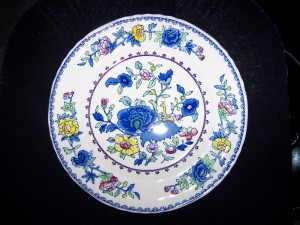
It was a pleasant morning reading these guys, and sipping tea out of an old cup and saucer of my great Aunt Ann’s Johnson Brothers’ Blue Regency pattern: Do just look at that odd looking bird, a bird I don’t think resembles anything in nature, but rather might be some creature imagined while under the influence of laudanum. (Opium dissolved in alcohol.)

Blue Regency china

Blue Regency china

*I hope your intelligence isn’t offended if I tell you these words mean “mine and thine.”