
Ah, HumanityChoir SingingCurmudgeonSongs

April 7, 2013

A Short Exercise in Black Humor

Tags: , , , , ,

The Ballard Writer’s Collective took over Egan’s Jam House last Tuesday night to showcase the considerable literary talent that lurks in unassuming little Ballard. (For those of you unfamiliar with the Puget Sound area, Ballard began life as a Norwegian fishing village but was subsequently swallowed by Seattle. It lives on as a distinctive neighborhood and as home to a disproportionate number of writers.) Those of us participating were given an assignment: a three-minute piece, approximately 450 words, that took the form of a voice mail, email, tweet, or some kind of electronic emission.  What follows was my contribution, a tale told by an exasperated choir director.  It characterizes something that actually happened with *almost* no elaboration on my part:

Thursday, July 8,

To: The OK Chorale

Regarding the eruption last night during the rehearsal, I want to reiterate that “The Titanic” is a camp song and it is part of a set we are doing of camp songs. It was suggested by Bill (bass) who actually learned the song at camp when he was a child.  It’s in the same category as “Glory, glory hallelujah, teacher hit me with a ruler.”  I encourage you to keep that perspective.

Thursday, July 15

To: The OK Chorale

To those of you who are still objecting to the singing of “The Titanic:” Please e-mail me your comments so I can try to understand your viewpoints without using anymore rehearsal time as we have 9 other songs to learn.

Friday, July 16

To: Eleanor (soprano)

I really don’t see that the song is making fun of children.  The line in question is “Husbands and wives, little children lost their lives.” That’s a statement of fact.  I realize we are singing it in a carefree way but no one disputes the next line: “It was sad when that great ship went down.”

Thursday, July 22

To: The OK Chorale

To follow up on last night’s attempted mutiny: we are performers.  Performers entertain audiences who have a wide range of sensibilities.  For example, I was raised by alcoholic parents and there’s nothing about drunkenness that amuses me.  But every winter quarter I pull out the Irish drinking songs, and the pub songs.  I know that many people like them and I see how they can be funny even though I don’t find them funny. Some people will not like the black humor in “The Titanic” but some will.

Friday, July 23

To: Harriet (alto)

Harriet, I understand you to say that your grandparents lived in Germany during the Hitler regime. I do agree that was a tragic time. I wish to point out that you didn’t live in Germany during the Hitler regime, no one is forcing you to watch Hogan’s Heroes, and I don’t quite see why any of this means the Chorale shouldn’t sing “The Titanic.”

Sunday, July 25

To: Richard (tenor)

Yes, I know that before her maiden voyage people said, “Not even God could sink ‘The Titanic,’” and while it may add some historical and, as you say, moral perspective, telling the audience that “God is not mocked” is outside the parameters of the OK Chorale’s mission.

Sunday, Aug 1

To: The OK Chorale

When we sing, “The Titanic,” this week Eleanor (soprano) and Harriet (alto) will move to the back of the group and sit.  Roberta (alto) will wear a black arm band and close her mouth for all the lines she finds too flippant.  In exchange for Richard not bellowing this out during the performance, I have agreed to tell you here that God is not mocked.

*        *        *        *        *        *        *        *        *        *        *        *

Postscript: we sang “The Titanic” on a Puget Sound ferry boat and got a write-up in the Seattle Times.



Choir SingingFriendsHolidaysMoviesSingingSongsSpirituality

April 1, 2013

Behold, the Lamb of Gwen

Tags: , , , ,

The Lambie

The Lambie

Easter Sunday.  I got up early, read the New York Times, and spent some extra time warming up my voice because I was singing Mozart’s “Alleluia” in a few hours.  I let the neighbor’s cat out.  I had been cat-sitting for the week and Sunday was my last day on duty.  Sulei had been furious with me for tricking her into the house the afternoon before, and she had a point: it was 60 degrees and there were hours of daylight left.  Easter morning she shot out into the yard, throwing energetic meows back at me.

The church choir arrived at church en masse and on time to run through their anthem, proving that UCC churches can also have Easter miracles.  Tommie, my accompanist and one of earth’s treasures, arrived early to do a sound check with me, giving all the elderly and deaf people who come 20 minutes early a preview of my high C.  The service started.  The Mozart went beautifully.  Tommie and I changed places on the piano bench and I played the service.  My hands were a little shaky from the adrenalin after singing the Alleluia, but “Christ the Lord is Risen Today” is in the key of C so there’s not a lot to think about.  Toward the end of the service the choir sang “Jubilate, a Jazz motet,” which would have scandalized my mother.

It was a tiring morning.  Besides playing the service, singing a solo and directing the choir, I felt a certain amount of pressure to not be the Elena Show—so tacky to attempt to show up the Christ.  Maybe I shouldn’t have gone looking like an Easter egg in turquoise blue and bright white but everything else in my closet is either black or similarly flamboyant.

Home by noon, it took ten minutes to get a sighting of Sulei.  Then I had to explain to Winston, Artemis and Freud why I love the neighbor’s cat better than I do them.

At one o’clock I put the spiral ham in the oven.  In an hour I would be sinking into the bliss of a made-to-order, stress-free holiday dinner with my neighbor Gwen who knows something about just about everything.  Gwen and I have created our single-persons, child-free holiday celebrations by choice.  I want to emphasize the choice part.  We’re not losers.  We both get other invitations and sometimes we opt to do something different than our little routine.  But speaking for myself as a working musician, I find that by the time the actual “family” celebration rolls around, I have had enough of any given holiday, am nearly comatose with fatigue, and don’t want to rouse myself to cheerfulness.

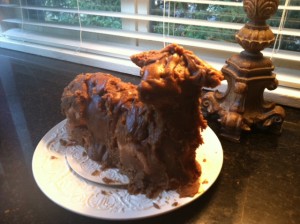
For our celebrations Gwen and I choose items of the traditional holiday meal we liked the most as kids.  For this Easter, the menu was ham and cake.  We put in a relish tray as an afterthought and it was heavy on the olives.  It was my turn to buy the ham.  Gwen had clearly given herself the cake assignment because for weeks she had been going on about the Lambie cake she was making.  I was too busy with cats, emissions tests, taxes, and choirs to pay a lot of attention.  I envisioned a flat round cake with little ears or something.  But Gwen has a cast iron mold in the shape of a lamb’s body over there.  It turns out it was her mother’s.  It’s the Lambie cake mold of her childhood.

“What kind of cake do you want?  I want it to be something you can eat.”

“Easter is my Eat Anything Day.  Can you make that walnut cake you made last year?”

“I didn’t make a walnut cake.  Do you mean the yellow cake with caramel icing?”

“Yeah, what you said.”  The stuff was like penuche.

Gwen baked a dense yellow cake inside the cast iron mold.  The icing is supposed to be boiled white icing with coconut sprinkles to replicate a lamb’s white wool, but in deference to me, the cranky musician who was providing the ham, Gwen made the penuche-like icing, rendering the lambie more of a goatie.  The heaviness of the icing started to drag down the lamb so Gwen cleaved its little head straight down the middle, giving us each half a head and an ear for our first helping of cake.

The Goatie

The Goatie

After the menu, the next most important decision is the entertainment—other than us, that is.  We’re pretty entertaining, just the two of us.  Last year we started watching The Vicar of Dibley on Easter Sunday and didn’t finish the series until the Fourth of July.

“It needs to have a suitable theme,” Gwen said. “Something resurrectional.  Or new life.”

We chose “The Snapper.”  A young woman gets knocked up by a man in the hood and her Irish family takes it all in stride.  There’s not a priest or a Magdalene laundry in sight.  Better yet there are no American republicans to rant about the break-down of the family.  There are no smarmy democrats to put their hand on the girl’s arm and talk to her earnestly about abortion.   No one once uses the phrase “moral compass.”

Life: we figure out what we want to do and we do it without shame.


.


BooksCatsFriendsLiterature

March 29, 2013

Cats Distract

Tags: , , ,

I have a list of time sensitive stuff I need to be attending to and every time I look at it, I can’t focus.  There they are, swimming in front of me, the soul-destroying articles of an over-scheduled, self-employed life: taxes, emissions, ink cartridges, Easter ham, April billing, water-color classes (Five items, all dependent on the first which involves the aforementioned ink cartridges), The OK Chorale (three items), church choir (two items).  I realize it’s no different than the list in everyone else’s life but it’s annoying when I come to write a blog post –something that truly is a joy—and find I can’t come up with a decent idea.  It’s like my mind is playing that game of statues and it’s frozen in the position of trying to focus.  Someone needs to call “Time.”

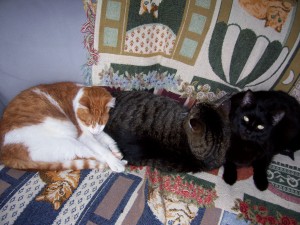
Then I hear Pkgnao!  It’s Freud, my cat, making the sound that is similar to the one made by Leopold Bloom’s cat in Ulysses which, in case you’re new here, I am reading at the rate of one episode a week. Leopold’s cat plus the sac-religious humor was what first convinced me I was going to enjoy Ulysses.  Leopold’s cat says Mkgnao.   Freud’s meow is similar except it begins with a plosive: Pkgnao.  Phonetically, it could read, “pi-cow” with an emphasis and nasally elongation of the second syllable, and a hefty amount of irritation. Freud says “Pkgnao” when he is both hungry and annoyed that I haven’t done something about it.  What with the way I serve my cats, there aren’t a lot of occasions when Freud is either hungry or justified in being annoyed—but that is my point of view, not his.

It’s been a week of cat drama.  Artemis and Freud had their annual exam and shots, followed by Artemis playing the guilt card for 36 hours.  She skulked around the house, giving me black looks that said, “I’ve always suspected you were trying to kill me and this just proves it,” before running away in terror.

Then Winston didn’t show up for breakfast, which is almost unheard of.  I found him in the bedroom looking pitiful.  I put my face near his to talk baby talk and ask him what was wrong, and reared back from the stench.  Probing my way to the odor, I found a furless patch with two suppurating puncture wounds the size of quarter inch drill bits, and half a dozen smaller bites and scratches.

Yikes, I thought.  The former neighborhood bully—that would be Winston– is getting his comeuppance.  He’s too old to be getting into fights.

I poured hydrogen peroxide on the area and started in with hot compresses.  Artemis had probably licked off all the fur.  She’s the resident cat nurse when she isn’t on the lam from me.  Plus she loves smelly pus.  It’s cat Stilton to her.

Freud was quoting Joyce.  Winston, having jettisoned his gold cup for prizefighting, was recuperating. Artemis was doing surveillance on me. I grabbed a key and went across the street to wait attendance on Suleiman the Magnificent.

Sulei is a black kitten, acquired by my neighbor Bill a year ago.  I’ve taken care of her since she was just a scruff of black, whenever he was away.  She’s a fierce little thing, prone to coming into my yard to hiss, spit and strut sideways in front of a bemused Winston and Freud who are each three times her size.

Sulei started out as Suleiman the Magnificent, but when Bill took him in to be neutered, it turned out she needed to be spayed. It explained a lot of things: why she was so tiny and why while the boys over at my house tolerate her, even find her amusing while Artemis is viciously opposed to her being on this side of the street.

Sulei’s people are gone for a few days but I am here, imprisoned by all the work I am not doing.  The weather has been lovely and there’s much in the air for even a human nose to enjoy, so I have let Sulei out for long stretches.  I go over for periodic sightings, and sometimes bring her across the street for classes in feline social etiquette.  All the enrolled cats are failing the course, and they are quite rude about it, like a bunch of punks forced to go to driving school.

I tried to interest Gwen’s cat Lucy in my social etiquette classes but she bit me.  I took that as a No.  I go on Lucy duty when Gwen is out of town so Lucy can’t afford to alienate me completely.  When I have an evening at The Gwen, Lucy and I always have a conversation about how little Gwen feeds her.  She snoozes on her heating pad while Gwen and I watch a movie.  Occasionally she looks like she might curl up on me, but then she remembers the time I tried to abduct her into that class –that cult, that brainwashing seminar—and thinks better of it. She curls up on Gwen and gives me a look that says “there are consequences to your actions.”

Lucy used to be a fearless feline, rather like the up and coming Sulei.  Then there was The Incident.  Gwen was at the family compound on Lake Pewaukee when Lucy got stuck up a tree in Seattle.  It took three days of coaxing, cooing, cross-continental phone conferences and finally a Seattle City Light worker who asked us not to tell his boss, to get her out of the tree.

Ever since then she has pretty much stayed inside Gwen’s courtyard garden, patrolling her defensive perimeter and shrieking at intruders. Sometimes at dusk I see her atop the fence or rolling on her back in the alley, but there’s a lot for a cat to do inside Gwen’s fence. (There’s a lot for Gwen to do, too, as she has a magnificent European-style jardin in there.)

Ok, that’s the neighborhood cat update.  What’s on my list?  Ah geez. Taxes.

100_1839

Freud, Winston, Artemis


BooksLiteraturePsychoanalysis

March 20, 2013

And Again I say, Re:Joyce

Tags: , , , , ,

In my last blog post I was a week away from the Just Off Broadview Music Festival and more or less losing my mind with trying to control its outcome.  If you recall, my friend Mary-Ellis had counseled me to do something else, to think about something else.  I did.  I started reading the psychoanalyst Adam Phillips’ latest collection of essays, Missing Out.  One of his essays speaks to my ongoing project of reading James Joyce’s Ulysses.  The essay is called “On Not Getting It.”

All through this essay he tantalizes with the idea that we assume there is something to “get.” We may not know what “it” is but we seem to know when we are without it. Even when we have “it,” we may still not know what it is. Whatever “it” is, we want it because we don’t want to be left out.

Cliff notes and Sparks notes exist so students can all have a shot at being in the group that “gets” a piece of literature, and not incidentally the passing grade.  However canned or scripted an interpretation, we assume it is valid because someone in the group we aspire to: the ones who “get” it, said so.  Do this often enough and you, too, can be an English major.  The task becomes not so much to experience literature as to not humiliate ourselves.

I am a middle-aged woman, former English major with a blog, living in a culture where it’s commonplace to humiliate oneself on the Internet, and who wants to read Ulysses for the first time and probably write about the experience whether I “get” Joyce or not.  Along comes Phillips who wants to know what is available if the project is “to not get it.” He suggests that to “get some things. . . is to misrecognize their nature; to pre-empt the experience . . .by articulating the meaning.” We can, he says, be “oddly enlivened by the perplexity of not getting it.”

This reminds me of the anxiety I sometimes see in my voice students when they manage to try something new.  A student plays with vocal sound in a new way (and kudos to her, by the way) and I hear new dimensions to her voice, but she laughs sheepishly and says, “I know that’s crappy singing.”  In that statement she has misrecognized and preempted the experience of singing by articulating a meaning.

Phillips invites us to “consider what it would be to live a life in which getting it is not always the point, in which there is nothing, to all intents and purposes to get.”  In adult life this can be “when we are lost in thought, absorbed in something without needing to know why we are absorbed or indeed what we are absorbed in; or when we dream.”

I can’t imagine a less threatening approach to reading Ulysses, which I never thought I could just pick up and read without taking a class.  Phillips says there is a “difference between reading something intelligible and reading something that has a powerful effect; between words as procurers of experience and words as consolidators of knowledge.”

“Words as procurers of experience” seems to be the approach I and my reading compatriots have adopted.  We all bring to this project a lifetime of our own idiosyncratic reading and there are a few English teachers among us. We’ve got a user-friendly guidebook to grab in case of existential panic.

I like the idea of having an initial experience that is all my own, but I wasn’t three lines into Ulysses before I was itching to look something up.  Buck Mulligan descends the stairs holding aloft a bowl of shaving lather crossed with a mirror and his razor. “Introibo ad altare Dei,” he intones. “I will go to the altar of God.”  Later there’s another image of him slapping down 3 plates of eggs saying, “In nomine Patris et Filii et Spiritus Sancti,” which I did not have to look up. Oh goodie, I thought, religious humor.  It was a good start.

It turns out that Buck Mulligan is the sophomoric, wise-cracking, comic relief character.  He’s the one with all the fart jokes, the masturbation references, and the sac-religious reenactments.  The other characters actually fart, masturbate, defecate, void, pick their noses, and do things that will send them straight to hell, but they don’t make comic productions of them. It’s interesting that I want to back away from, say, the non-comic scene where Leopold Bloom reads a magazine while defecating in the W.C. and we get a plop by plop account of it. This is something we all do every day and we all have a sort of intimacy with it.  But unless you’re in the medical profession or the mother of young children, you don’t talk about it.  It’s so intensely private, we require humor to air the subject, so to speak.

So I “get” the sophomoric humor.  Then every so often Joyce leaks out an epigrammatic expression:

*Pier. . . a disappointed bridge.

*“You have the cursed Jesuit strain in you, only it’s injected the wrong way.”

*“You behold in me, Stephen said with grim displeasure, a horrible example of free thought.”

*“History is a nightmare from which I am trying to awake.”

So much for what I “get.”  I don’t know that I have read any other writer besides Shakespeare where I have so received “words as procurers of experience.”  Some of these expressions had me putting down the book and following whatever daydream the words suggested:

*The scrotumtightening sea.

*Clammy slaver of the lather

*dark men in mien and movement, flashing in their mocking mirrors the obscure soul of the world, a darkness shining in brightness which brightness could not comprehend.

*Ineluctable modality of the visible.  .  .  signatures of all things I am here to read, seaspawn and seawrack, the nearing tide, that rusty boot. Snotgreeen, bluesilver, rust.

The third episode, “Proteus,” was difficult. Stephen Dedalus takes a long walk on the beach, musing about the signature of all things, the ineluctable modality of the visible and the ineluctable modality of the audible interspersed with his own mundane stream of consciousness.  His thoughts roam in fragments.  We are inside his mind only it’s not such familiar territory as inside our own minds.  Since we are not such experts on our own minds it’s amazing to me that Joyce would attempt to reproduce the activity of a mind, let alone that any reader would expect to “get” it.

Interspersed with paragraphs of “interior monologue” were descriptions of the sound of Stephen walking in the beach: damp crackling mast, razorshells, squeaking pebbles, that on the unnumbered pebbles beats.  .  . unwholesome sandflats waited to suck his treading soles.  .  .”

That’s what reading Ulysses is like for me: I am lost in an experience of words and images.  Then something grounds me, something I “get”—a walk on the beach or a fart joke.

And by the way, The Just Off Broadview Music Festival was a ripping success.


Ah, HumanityFriends

March 12, 2013

The Just Off Broadview Music Festival

Tags: , , , , , , ,

Let me begin by saying I am supposed to be thinking of something else besides the subject of this post.

It all began when I made an attempt to get out of some work. When The OK Chorale finishes a quarter’s worth of rehearsals, we sing somewhere in the community.  The Christmas season has a glut of opportunities to perform, but by March people in Seattle aren’t looking for ways to rise above the gloom, we’re all just waiting out the winter.  So I thought I would save myself the minor nuisance of scheduling us to sing at a retirement home and instead organize an entire music festival.

It was easy enough to get the support of the tiny Broadview UCC church where I am the music director.  In any small church there are two rotating groups of people: 1) People who do all the work and 2) People who used to do all the work and are currently incapacitated.   Then there’s Kay who visited an earlier post in this blog. As far as I can make out Kay has been at the church for 40 years and has yet to be incapacitated.  She keeps a resignation/blackmail letter on her person, ready to sign when she’s finally had enough.  She and I went to work on the idea of a music festival.  It inhaled from an evening concert to Day of Music and exhaled into: The First Annual Just Off Broadview Music Festival, Saturday, March 16, 3:00-9:00 PM 325 N 125th St in Seattle.

Musical folks with connections to the church leaped at it:  The Weavils, a bluegrass group had the paramount claim to the festival’s finale by virtue of the fact that people sometimes pay money to hear them.  I made The OK Chorale second to the last because, as the organizer, I could.  Off the Hook, a garage band of dads with a preference for the Rolling Stones would open.

Then I got Bill, local singer-songwriter, and Terry, a golden-voiced folk-singer. Kai who busks at the Ballard Farmer’s Market was featured in the Ballard News Tribune last summer.  The paper misspelled his name and got a fair amount of information wrong, but Kay tracked him down and he was game to play his clarinet, guitar, sax, ukulele or mandolin.

Members of the OK Chorale surged into the mix. Jessi, who sings in Gilbert and Sullivan productions, wanted to sing one song.  Tim wanted to sing an Irish song in honor of his Irish grandfather. Susan, who corralled her family into making a CD several years ago, asked me if Susan and the Family Band could have 15 minutes.  The pastor of the Congolese church who shares our facilities agreed to his little congregation singing traditional African call and response folk music.

“With microphones?” he asked me.

“Do you have to use mikes?” As immigrants, I think they are trying to fit into American culture by distorting their lovely sound with horrible electronics.

“No, we can sing Congolese songs like we do at home.”

I clutched his arm.  “Yes, YES, that’s what I want!”  I said

“Do you want us to wear our African clothes?

“Oh, would you?” This was a coup!

I immediately bumped the Chorale to an earlier time so the Congolese church could be next to last.  It was partly a political move, and partly a gesture of delight at the thought of their music which is jaw-droppingly beautiful.  It was also in anticipation of the potential scheduling nightmare that the African concept of time might visit upon me.  If the Congolese were next to last, and didn’t quite make it on time, it minimized the chances of the whole show getting thrown off.  And I knew The Weavils would play all night if we let them.

I got all the participants on a mailing list so we could communicate via e-mail.  We needed a flyer and a publicity plan.  Chris the unclassifiable and tenor in the OK Chorale, who manages to do the job of three people at her work plus put out fires at her home, and gossip via e-mail with me, calmly helped with the flyer and publicity, and with her most valued advice: “It’s all good.”

I finalized the schedule. Susan asked if she could have more time. I tweaked the schedule. Kai was immersed in his college semester and didn’t confirm until I put his mother onto him.  Jessi wanted me to accompany her solo “Hymn à l’amour.”  OK, find me the music.  Tim decided he wouldn’t sing after all but he did some work on the publicity flyer. The Weavils patiently reminded me several times to correct my spelling of Weevils and tactfully blamed it on Spell-Check. Susan worried there wouldn’t be enough time for the Family Band to set up and she needed another ten minutes.  I tweaked again. Terry had a family emergency and had to pull out.  There was a flurry of suggestions before we found John who plays mandolin and banjo.  I slid him into Terry’s time.  Meantime Kay was nailing down what we decided to call concessions: corned beef sandwiches, Irish soda bread, PB&J sandwiches, cookies, pop and water.

The show got more complicated.  We share the church facilities with other congregations and we were spilling out of the church sanctuary.  We needed a green room for the performers.  We needed the wheelchair accessible rest rooms.  We needed the food to be removed from the performance area.  Over my dead body was this going to turn into an evening at Zoo Tunes where I want to walk around and say to every single picnicking, card-playing family whose children are shrieking while Joan Baez is 30 feet away, “Why did you even bother to come?  Go home!” In short we needed the whole church.

I don’t know who paid off who but we got the whole church.  That freed up the wheel-chair accessible bathrooms and a venue for the concessions. Then I started looking at the bare walls of the foyer like I used to look at my mother’s house except that with my mother’s house, it was the clutter.  But I thought the same thing: I’m embarrassed to have people see this. We’ve got to tart this place up.  Fortunately we have a flamboyant window dresser-artist in the church who works with a full spectrum.

I woke up one night: signs, SIGNS! Someone has to make signs to direct people to the church and once inside the church we need signs to the wheelchair accessible rest rooms, and the green room.  I had some sandwich boards already primed with white paint.  But if I had to make signs, by god I would do it with so much resentment that I would never organize one of these events again.  Ever.

I asked four different people if they would take on the signs.  I waited.  I reached a new level of freak-out-dom.  When I didn’t get a response within an hour, I was on the phone.  I contacted spouses and asked them to relay messages to the dilatory.  I became a stalker. I e-mailed Chris to find out if it was still “all good.” I took Xanax.

I became one of those self-important people who think everything depends on her.  It got to where people would see me coming and instead of saying hello, they said things like, “I haven’t had a chance to update the Facebook page yet.”  Am I a monster? I’d think.  It made me want to grab them by their procrastinating lapels and breathe hot and sour into their faces, “What do you think I am? Some kind of monster?”

In these final two weeks before the festival, the non-monsters are responding.

“We’ll do the signs. Take that off your list.” (“Take that off your list.”  What a lovely thing to say to an organizer.)

“Yes I am planning to bake the bread in the church kitchen that day so there’ll be an aroma.”

“Bup bup bup, who do you think you’re talking to?  I’ve already been to the Dollar Store and bought everything that’s green.”

I e-mailed my friend Mary-Ellis who organizes much bigger events than ours all the time.

“Do you have any advice for me in this final week before the festival?” I asked.

“I advise you to think about something else,” she said.

And that was when I started writing this post.


BooksFriendsLiterature

March 4, 2013

Re:Joyce

Tags: , , , , , , ,

I would never have decided to read Ulysses all on my own.  But my friend Nancy invited me to join her in a project of reading one episode a week, and I thought there are worse ways to spend four months.  I knew that Ulysses is considered Difficult.  Whole college courses are devoted to this book.  In a documentary called “Joyce to the World,” someone said that no one had ever really read the book at all.

A lot of writing is Difficult.  The Bible is Difficult.  That doesn’t stop unimaginative, unreflective people from making their living tell others what it says.  OK, that’s not the best introduction to a post about reading Ulysses.  The thing is, it bothers me that we are taught to be afraid of reading something difficult because we assume we need someone to tell us what it means.  I make my living telling people they can have their own experience with music and with art that is valid simply because it is theirs.  It was in that spirit that I joined Nancy in reading Ulysses.

In my teaching I like to find out what students are already thinking.  It’s gives us a place to start.  Here’s what I knew about Ulysses before I started reading it: it takes place in one day in Dublin, June 16, 1904, which is known and celebrated all over the world as Bloomsday.  Leopold Bloom is the main character.  The story is a hero’s journey that roughly follows Homer’s Odyssey. Leopold is married to Molly Bloom whose soliloquy at the end of the book is magnificent.   Stephen Dedalus is a character.

Stephen Dedalus and I go way back to a high school English class and Mrs.LaBell, a beloved English teacher.  She infused me with A Portrait of the Artist as a Young Man. I was drawn to Stephen and his dreamy reflections, his earnestness, and his struggle to find meaning in the sterile religious atmosphere of Ireland.  Towards the end of A Portrait of the Artist as a Young Man are words that I memorized and have repeated to myself for forty years:

“I shall not serve that in which I no longer believe whether it call itself my home, my fatherland or my church.  .  . I do not fear to be alone.  .  . I am not afraid to make a mistake.”

Stephen was a great comfort to me as I separated from parents who did not understand what I needed as a young and female Person, and when I left the religion that had been pounded relentlessly into me from an early age.  I have often felt alone in my life and I’ve made a great many mistakes (which Joyce calls “portals of discoveries” in Ulysses) and I have never forgotten that Stephen Dedalus went before me.

So this present day Joycean Odyssey began with Nancy and this article by Edwin Turner.  Nancy had already started reading when I joined her in early January.  A few more people signed up for the project.

I asked my neighbor Gwen who knows something about just about everything, and who is a great reader, if she wanted to join us.

“I’ll think about it, “she said

That’s what I say every time she urges me to read Patrick O’Brien.

As things stand now I am about to embark on Episode 9.  We have lost one of the originals who called herself a fallen English major and gave herself an F.  I’m not sure if another of us has stalled out or not.  Chris the unclassifiable joined us even after getting a look at the guide that Edwin Turner called “a dour book that manages to suck all the fun out of Joyce’s work.”   We also have in our midst someone who has already read Ulysses twice and who cheers us on without telling us how much we are missing. I look forward to his comments about our comments.

My routine is to read the episode and make notes on whatever strikes me as interesting or in some cases, whatever I can manage to understand.  Episode Seven was so confusing I ended up just making a list of the characters.  But there is always wondrous poetry, humor, and Joycean words and expressions that make me gaze out the window and muse.  I post my notes to our group, and then I read Nancy’s notes and Blamire’s commentary to find out what really went on in the episode.

A lot of things about grower older have taken me by surprise: 1) once I started reading the plays of Shakespeare, I did not stop until I had read them all (that was last summer and you can read about every play here in my blog plus collect well known phrases to quote at social gatherings.) 2) I have a taste for single-malt Scotch. 3) I am thoroughly enjoying reading Ulysses.


Ah, HumanityFriends

February 27, 2013

Who is Seth Burnside and Why is He Living in My House?

Tags: ,

Public Utility bills began coming to Seth Burnside at my address last November.  At first I thought the bills had been mis-delivered as they sometimes are.  But it was my address, and my house that I have owned for 15 years.  I sent the bills back with “No such resident” written on the envelopes.  A week later, and rather obstinately, there they were again.  I opened them.  There was my address and there was the name Seth Burnside.

Seattle Public Utilities told me, “Seth Burnside is listed as the owner of the house.  He bought it in November.”

I swayed a little bit.

“I have owned this house for 15 years.  I didn’t sell it in November.”

“But who is Seth Burnside?”

“I don’t know.”

“He doesn’t live there?”

“I don’t know anyone by that name.”

“Well, where does he live?”

“Look,” I said. “I have owned this house and lived here for 15 years. I don’t know anyone named Seth Burnside.”

“Are you sure you don’t live at 2622 29th Ave?”

Am I what? I sat down.  An address on the other side of town. Oh. my. God.  Twilight Zone, party of one.

It took some doing but the customer service person finally put my name back on my account.  In the next billing cycle another bill came to Seth, as well as some “Welcome to the City” materials which I scanned for freebies before putting them in the recycle.  (There were no freebies.) I checked my online bill pay.  Evidently Seth’s bills were being paid.

I called Seattle Public Utilities and went through another disorienting conversation.  “Are you getting any calls from Seth Burnside?” I asked.

No.  Apparently Seth wasn’t concerned about his recent investment.  The customer service person again corrected the name on my account, and said, unconvincingly, that it should be ok, now.

The third time I had to call the billing office I learned that Seth had been given my old account number when he bought my house. I had been assigned a different number by Customer Service Representative Number One.  It would have been nice to not have to pry this information out of them. On-line bill pay likes you to have the correct account number when they credit your account with your money to pay utility bills for the house you have owned for 15 years.

Can anyone call the city, say they’ve bought a house and get their name put on the account?  In my third conference with customer service I learned that no, it was not that easy.  Evidently someone had sung through a rest or two.  The billing office expects to first receive notice from the vacating owner.  City planning and development must confirm the change of ownership.  Then Billing closes out the old account and begins a new one.

There was a lull in the excitement for a month.  Then I got a letter from the city with several forms to fill out, one for me and one for Seth.  They wanted address, phone and bra size.  And furthermore, each form was headed with an account number, leaving me to guess which one they were currently ascribing to me and which one to Seth.

I filled out one form.  Then I wrote a sarcastic letter, sealed and stamped it and just missed the postal carrier for the day.  And herein lays the reason for writing this story:  I got up the next morning, saw the letter on my desk and thought of my friend Nancy.

In my circle of friends are a great many tactful people.  This is a good thing because I tend not to be, though I do try.  I’m my own boss and I don’t have a lot of people I have to get along with. I don’t pop off at people the way I used to and it has been a while since I wrote a sarcastic letter, but I can be blunt and impatient with everyone except my students and the friends I don’t want to lose.  I learned that much from analysis.

I have often heard Nancy say when describing what sounds like an intractable situation at her work, “I try to treat people like I want to be treated.  I don’t like to be yelled at.”

I looked at the letter scorching a patch on my desk, and thought of how civilized, kind and productive it sounds when Nancy says she tries to treat people the way she wants to be treated.  I took a deep breath, weighed the pleasure of zinging someone with my wit, and tore the letter up, saving the stamp because my parents went through The Great Depression.

I wrote another letter.  I politely explained the chronology of my association with Seth Burnside, episode by episode, ending with a mild joke about the learning curve of a computer.  Then I sealed, stamped, and posted the letter.

If I behaved this reasonably more often I might not have been surprised by the tone of the letter I got in return.  The representative of Seattle Public Utilities expressed appreciation for my taking the time to write to them and for being so patient in awaiting resolution. He went through the chronology of what happened on the bureaucratic end and stated quite convincingly that everything was now resolved.  He gave me his email address and phone number should I have any lingering questions.  Thinking about the letter even now just makes me smile. To have behaved civilly is so satisfying. Congress should consider it.

In a few months I hope to write happily about how the IRS resolved what they consider to be a $77,000 discrepancy in my taxes.  This one has taxed–ha ha–every social and self-care skill I have. Stay tuned.


SingingSongsTeaching

February 19, 2013

Who’s Behind the Screen:Terrified Adult or Spotlight Whore?

Tags: , , , , , , , , , , ,

At last Sunday’s Terrified Adults and Spotlight Whores Sunday Afternoon Musicale I asked how many of the seven participants considered themselves Terrified Adults.  Six hands went up. And so we began.

Stephanie and I sang “The Flower Duet” from Lakme with me playing the bare bones of the accompaniment.  We had been working on this piece for months and our voices rang together in a balance we hadn’t yet found in rehearsal.  Some students, I’ve noticed, need an audience to sing their best. They rise to the enhanced chemistry of other people listening to them.

Then Stephanie sang Schubert.   I asked her to explain to the audience why a nice Jewish girl was singing “Ave Maria.” As a hospice OT Stephanie wanted to be able to sing it for her Catholic patients.  She now knows it by heart in the Latin.   I can think of no richer sauce than Stephanie’s voice stirring the surroundings of a person lying in hospice, fingering her rosary, and living her last moments on earth.

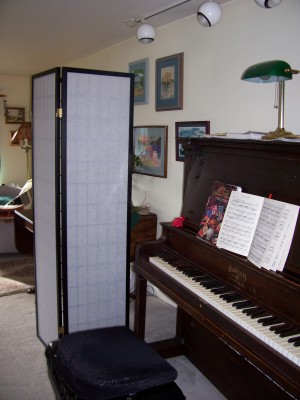
I asked Nina (rhymes with Dinah) to sing next because I knew she would help promote use of The Privacy Screen in Performance.  All week long my students had been experimenting with a screen in various ways just to see what it felt like.  Nina boxed herself in and sang “I Don’t Know How to Love Him.”  Then we screened her in such a way that she and I could see each other but the audience couldn’t see her.  She sang “I Have Twelve Oxen.” Don’t laugh.  It’s a classical song by John Ireland.  Nina reported that she liked being inside the box.  It didn’t have anything to do with not being seen or not seeing the audience.

“It was,” she said, “a different way to have an audience.  The acoustics are different. You and your voice are in this safe, small space—like the shower.  The screen shuts out other stimuli and reflects your voice to you.”

Exactly. It gives an experience of being with yourself , and your voice reflecting yourself.  Of being alone with yourself and yet also knowing that you aren’t alone.  The most compelling performances take place in the balance of these two states.

Eileen found that balance when she sang “Send in the Clowns.” She teared up every time she rehearsed it with me; and she was determined she would get through it without crying.  Her feelings built up as she sang and the suppressed tears behind her singing contributed to an affecting performance, at the end of which, she did cry and so did some of the audience.  From my point of view as the accompanist, I felt swept into that magical space where I felt privileged to play in the glow of those few minutes of that particular song, gone now, never to be recovered.

Then Eileen cut loose with a rendition of “Somewhere” from West Side Story.  First she sang it straight, and then she sang it using every corner of her voice that she could find: she whined, roared, hooted, sighed; and with a sweep of her hand, invited the audience to join her.

There’s nothing quite like the relaxation of a bunch of tense adults after they’ve been allowed to behave like children for a few minutes.  I calculated that it was the best time for Eva to sing “Regnava nel silenzio” from Lucia de Lammermoor, because as someone said afterwards, “that has got to be about the hardest piece there is in the world.”

Eva and I have only been working for about a year together.  It took one lesson for me to recognize a natural coloratura.  When she gets past her passagio and achieves her high G, her face and body relax noticeably and she flies up almost another octave like—well, there’s a reason the coloratura literature is sometimes referred to as “bird songs.”   In Regnava, we discovered a natural trill that thrums like a bird’s heartbeat.  Trilling is hard to teach, and can be hard to do, but Eva only needed it demonstrated once.  Her trills and her high notes were impressive on Sunday.

Anna sang next.  She, too, loved using the screen.  (It was actually originally her screen.  She donated it to the cause of The Terrified Adults).  We set it up so she and I could see each other but she wasn’t visible to the audience.  This gave her cover to hiss “Not so fast!” two pages into “Carol from an Irish Cabin.”

Anna used the screen in the way I would have: to do anything I wanted to with my body, anything that I thought would help me sing better: stretch my arms, screw up my face, peel off my clothes and throw them over the screen –that’s my fantasy, Anna didn’t do that.  She sang two songs behind the screen and then repeated “The Call” by Ralph Vaughan Williams in full view.  I believe that the screen helped her incorporate in her public performance new advances she’s made in her singing technique.  She did a lovely job.

Susan not only sang two Valentine’s Day songs but she brought a heart-shaped cherry- chocolate cake for Afters.  She sang “Be My Love” in French and English and “My Funny Valentine.”  It was the best performance I have ever heard her give.  She was relaxed.  She didn’t seem to tense up before her self-identified scary notes. Susan is usually critical of her performances but even she was satisfied with the way she sang on Sunday.  She told me later that it was all about getting enough breath.

Yep.  That is what singing is: It’s breathing.  It’s Spirit and Life.

Everyone’s sweetheart, Deborah, sang last.  This is her fourth musicale.  She had sat through all the other singers, waiting for her nerves to subside, which they didn’t, until there was no one left to sing but her.

“I’m not going to wait til the end anymore,” she announced. Then she sang “Dancing Queen” with great heart and cheerfulness.  She ended her rendition of “You Don’t Own Me” with a snide “you little shit.”

And so we wrapped up an enjoyable afternoon.  Can you guess who the Spotlight Whore was?

Who's behind the screen?

Who’s behind the screen?

Travel

February 16, 2013

Parts North

Tags: , , , , ,

Though I live in a major Seattle neighborhood, the city sidewalks end two blocks south of me.  This is rather a point of pride for some of us.  In my case, it gives my street as it runs north alongside Crown Hill cemetery a country feel.  I can see the street from my studio window (if I dis-lodge a cat) and whenever I take out the garbage.

Cemetery Lane

Cemetery Lane

Cemetery Lane is my favored route when I visit—keep in mind I live in a major Seattle neighborhood—the sheep, the geese and the ducks.  The sheep I found one day as I turned down 92nd.  There they were, two of them with their little curly horns, munching grass and giving me the once over.  For several years they wintered in the city and summered in east King County, but they’ve been gone for a while and the land was sold and bulldozed.  I still walk by their former pied a terre on my way to the duck pond.

The duck pond at 95th and 4th takes me back to the 1980s when three piano students – called The Three by the child whose lesson followed –rode bicycles to their lessons on Friday afternoon.  The Three always came via the duck pond and every spring, they gave me duckling reports so I knew when it was worth a special trip to see the babies.

Currently there are geese in the yard across the street from the duck pond.  Great honking geese, waddling around, practicing their arms sweeps.  I like to stand still at the edge of their pen and let them give me the news of the day.  I try to stay until one of them flap his wings but I am usually the first to blink.

Two blocks south of the geese and ducks and across busy Holman Road is Art’s Food Center.  Art’s was a family-owned, local grocery store, but it’s been a QFC for some time now and some of us still resent it.  There’s a 50 foot pole with a lighted ball that used to illuminate the word Art’s and it was cool.  Now that it reads QFC, it’s just tacky.  I got into a tacky squabble with someone at the QFC a few years back.  I asked a woman to stop bellowing into her cell phone and we exchanged a few choice lines ending with her telling me my pants were stupid.  That wouldn’t have happened when the store was called Art’s, partly, I suppose, because that was before cell phones.

Beyond the QFC is Carkeek Park, one of the loveliest of Seattle’s preserves.  Though the entrance is a paved road, there’s a walking path on the QFC side. Leaving all tackiness temporarily behind, the path takes you immediately into the woods with choice of trails blazed by the boy scouts, the city and neighborhood volunteers.  The main trail takes you through the lovely Piper’s Apple Orchard and –tackiness returns–past a smelly sewage treatment plant, over the railroad tracks and finally to a sandy Puget Sound beach.

Carkeek is a walk for a warm day because it’s cool in the woods and cold at the beach. During the cold weather months of November and December you can’t do better than a brisk walk to 90th and Dibble to see the giant Nutcracker.  I happened to pass by one January when some guys were dis-assembling it and I got the whole story.  It’s a prop from an old Maurice Sendak production of The Nutcracker.  The set had been dismantled and this particular nutcracker was destined for a landfill.  My Dibble neighbor went down to Seattle Center at three in the morning with a flatbed truck and rescued the fiberglass artifact.  It’s been a holiday fixture in my neighborhood for years.

It’s a damp, cold February day in Seattle.  If I had a dog, I’d have to walk whether I liked it or not.  But my cats are demonstrating that it’s just as nice to be warm and still and to watch the world go by the window. And so here endeth my series of one mile out in the four directions.

100_1724


FriendsTravel

February 8, 2013

Going South

Tags: , , ,

When I take a walk to the south of my house, I usually begin with a slight jog east through Crown Hill cemetery because the only reason to go due south is to visit my neighbor Gwen who knows something about just about everything.  Gwen is not a point of interest on a walk: she’s a whole day’s outing.  Oh, and one seasonal reason to walk directly south is to get a load of Italian plums from Sue who, in September, is always trying to get rid of her excess.

Once through the cemetery, I head south to 85th, following the scent of baking bread, to the tiny commercial bakery on the corner at 11th. More than ever, now that I eat gluten-free and bread is forbidden fruit, I enjoy gazing at the loaves in the window and inhaling the fragrance.  I chatted with the bakers once and found out they baked for a familiar Seattle label.  Just off hand I can’t remember if it is Old Mill or Bread Garden.

Across 85th and a bit west is the Butterfly Garden, a city pocket park wedged next to a clinic and a behemoth Safeway.  I make a point to walk the S-shaped path of the park every chance I get, and to spend a minute at the fire pit and the totem pole.  I like to read the inscriptions in the bricks of the wall: these are the people who donated money to create the park.  My favorite is the one that’s upside down and reads “Why be normal?”  Why indeed?

One reason I might be walking through the Butterfly Park is to get to Queens Natural Nails on the other side of 15th.  I discovered this business when I was camped out one week at Kinkos, preparing for a new quarter of The OK Chorale.

I walk in the door and say hello to Huong.

“You pi cula?” she motions towards the rack of nail polish and disappears to get a tub for hot water.

I pick my usual “cula,” midnight blue, and sit in a chair.  Her husband, Minh, brings me tea and a hot pack for my neck.  The pedicure begins.  If the shop is busy, Minh does my foot and leg massage.  He has strong hands and the massage goes on and on and on.  My book falls to the floor.

Huong is an artist.  She loves each toe.  After all the massaging oiling, pushing, clipping and filing, she carefully paints each one, stopping to scrape with her fingernail a stray streak of polish that dares to touch my skin.  If I am exceptionally lucky, she misses a faint smear or two.  I pray for this.  Because then she gets out the polish remover and a little paintbrush and delicately, exquisitely touches the offending bit of polish. The buzzes of pleasure run up and down by spine, chatting excitedly with each other.

“I love it when you do that,” I tell her.

She doesn’t understand.  We don’t talk much because it’s a lot of effort on Huong’s part and it spoils the mood for me.  Minh has even less English than his wife but he gets that I love his massages.

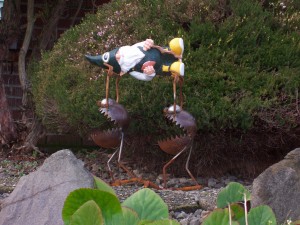
After a pedicure I would more than likely just go home but continuing my virtual tour of attractions south of my house, I have to show you a front yard on Dibble Ave where a garden gnome is continually being harassed by two clams:

gnomes 001

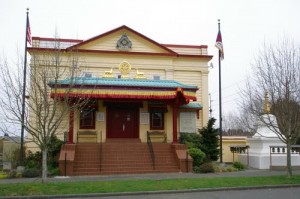
The best kept and most spectacular secret of the Greenwood neighborhood is the Tibetan Buddhist Sakya Monastery  http://www.sakya.org/index.php.  It’s ornate enough on the outside but the shrine room is so exotic that the only way I can get through a Friday night meditation is with my eyes closed.  Otherwise I am gazing at the clouds on the domed ceiling and trying to pinpoint exactly what shade of blue the sky is.  I am counting the elephant statues.  I am memorizing the patterns of the wall hangings.  I am wondering why some of the figures in the murals are angry.  I am straining to see what’s in the little dishes by the Big Buddha.  I am musing at the $100,000,000 bill in the donation bowl. I am thinking that the cushions reserved for the monks look a lot more comfortable than where I sit.

Mid-way through the Friday night meditation we get to “circumnavigate the shrine” three times.  Along the way there’s a stone lion with a ball in its mouth.  Once I saw a leader agitate the ball as she walked by so that’s what I do.  Three times around the shrine, three times I put my hand in the lion’s mouth.  I can’t remember the point of it but I’m nothing if not participatory.

Outside the shrine I rotate the prayer wheels that send my thought, wishes, hope and dreams into the universe.  And on the way home, I stop for a coffee at the Four Spoons Café at 85th and Dibble.

Prayer Wheels

Prayer Wheels

Sakya Monastery

Sakya Monastery