

Shakespeare

August 23, 2012

Titus Andronicus

Tags: , , , , ,

I had heard this play was not for the faint-hearted.  It hadn’t been performed for a hundred or so odd years when Olivier mounted a production at Stratford in 1955.  They used to tally up how many people fainted every night, the record being 22.  In the same spirit of accounting, I have tallied up the body count:

Act 1

1 stabbed body: hewn and thrown on a fire, and entrails ritually sacrificed.

1 additional fatal stabbing


Act II

1 fatal stabbing

1 rape (with victim laying on her husband’s dead body, see previous item)

2 hands cut off

1 tongue cut out


Act III

1 hand cut off

2 decapitations


Act IV

1 fatal stabbing

1 hanging


Act V

2 cut throats

2 decapitated heads baked into a pie (and fed to their mother)

3 fatal stabbings

1 multiple stabbing (also fatal)

1 dead baby (not clear how this comes about)

1 live burial


Apparently revenge plays were all the rage for a time with the Elizabethans and this was Shakespeare’s contribution.  Call it a pot-boiler, artists need to live after all.  The whole business starts when Titus Andronicus comes home triumphant after nine years of battling the Goths.  With him are his eldest son in a coffin, and his captives: Tamora, Queen of the Goths, her three sons and her lover, Aaron the Moor.

“Honor” demands that Titus Andronicus sacrifice one of the captives so he chooses the oldest son. Tamora pleads for her son but Titus can’t offend the gods.  This is one of the few deaths that occur offstage but we, along with the gods, do get to see the entrails brought back for the sacrifice.  And thus begins the chain of revenge.

Of all the horrible things that happen in this play, the most haunting is what happens to Titus’ daughter Lavinia.  The two remaining sons of Tamora kill Lavinia’s husband, and rape her with her head lying across her husband’s body.  Then they hack off her hands and cut out her tongue.  For the rest of the play until her own father “puts her out of her misery” at the end, she is in most of the scenes, haunting the stage.

Her uncle Marcus finds Lavinia wandering around in a state of shock.  He is a decent man but the first thing he does when he sees his niece is launch into a speech that’s 50 lines long.  When the men in the family manage to gather around Lavinia to comfort and care for her, their attentions spans are short and they soon drift off into more speeches, leaving her to sit alone.  I decided that this is partly the way shock behaves.  Even these warriors who think nothing of hacking people to pieces are at a loss when it comes to the mutilation of someone they love.

The reason given for Lavinia’s mutilation is so she can’t communicate who has raped her.  She can’t speak nor write their names.  But she finally manages to scratch their names in the sand with a stick that she guides with her mouth and the stumps of her arms.  She indicates that she was raped by directing the men’s attention to a copy of Ovid’s Metamorphosis and the story of Philomela whose tongue was cut out so she couldn’t say who raped her.  It’s still a powerful image today: women (or young altar boys) being silenced not necessarily by mutilation but by means of shame, disbelief or threats of violence.  The images in this play are hideous and grotesque but there is a sense in which some things have not changed.

There weren’t a lot of lines I wanted to remember.  Aaron the Moor has some funny comments but they need their context.

*Stage direction: Enter a messenger with two heads and a hand. (III, i)


*I have done a thousand dreadful things

As willingly as one would kill a fly.  (V,i)


*If one good deed in all my life I did,

I do repent it from my very soul. (V, iii)


Here’s a line I thought I might use with the next solicitor who knocks on my door. It might make them leave faster than my trying to explain what “No Solicitors” means:

*Who doth molest my contemplation? (V, ii)


Shakespeare

August 20, 2012

Antony and Cleopatra

Tags: , , , , , ,

At first read, I couldn’t have been less interested in this play.  But it is classed as one of Shakespeare’s great tragedies. There had to be something in it besides an aging playboy slobbering all over a drama queen.  It was finally the sheer extravagance of the language that worked its way into me.  I found myself going around the house thinking, “I wish you joy of the worm” (V, ii) and opening the door on a glorious summer morning, thinking “O thou day o’ the world!” (IV, viii)

Here’s the plot:

Antony, Caesar, and Lepidus are the triumvirate holding down the Roman Empire. Caesar has the west, Antony has the east and Lepidus has the far west and Africa. Cleopatra is Queen of Egypt.

When the play opens, Antony and Cleopatra are debauching around Egypt when word comes that Fulvia, Antony’s wife, who has been waging war against the empire, is dead.  Caesar thinks Antony has been aligned with his late wife. Antony has been more interested in dressing himself up in Cleopatra’s little things than aligning with his wife, but he knows that without the pre-occupation of fighting Fulvia, Caesar will come after him. Antony decides he must leave his “lascivious wassails” and hie to Rome.  Or as Cleopatra puts it: “on the sudden a Roman thought has struck him.” (I, ii)  Antony prepares to leave.  Cleopatra pouts.  She and Antony slobber over each other.  But it’s exquisite slobbering:

*Eternity was in our lips and eyes,

Bliss in our brows bent.


*O my oblivion is a very Antony,

And I am all forgotten (I, iii)

So we leave the “strange invisible perfume” of Egypt and follow Antony to sterile, proper Rome where people yammer about honor while they kill each other. In order to assure Caesar of his loyalty Antony marries Caesar’s sister Octavia.  The poor messenger who has to relay this news to Cleopatra is nearly mauled by her.  But Antony longs for his “serpent of old Nile.”  He finds a reason to leave Octavia.  The reason isn’t good enough for Caesar who then pursues Antony.

Throughout the play, Antony is identified with the element of earth while Cleopatra takes up water, fire, and all the air, which seems about right for someone who today would probably be diagnosed with narcissistic personality disorder.  In any case, Cleopatra talks Antony, who was once a celebrated soldier, into fighting Caesar on the sea. Cleopatra joins him with her fleet.  During the battle, she retreats, and Antony –because he is so besotted with her—follows.  Many of his men defect to Caesar in disgust and fear, giving Caesar the day.

There follows scenes of recriminations, reminiscences and regret. Cleopatra for whom self-preservation trumps even Antony makes noises about aligning with Caesar.  Antony erupts to the point where Cleopatra and her two women hole up in Cleopatra’s “monument,” that is, in the tomb she has built for her own burial.  From here she sends a messenger to tell Antony that she has died, hoping to jerk him out of his rage. She wants a report his reaction.

She has tried this before.  In Act I she demonstrated her technique when she wanted to keep Antony from leaving for Rome:

*See where he is, who’s with him, what he does:
I did not send you: if you find him sad,
Say I am dancing; if in mirth, report
That I am sudden sick: quick, and return. (I, iii)

But now the stakes are higher and the game is more dangerous. In despair over what has happened to his life, his fortunes, and his love, Antony stabs himself.  Barely alive, he is taken to Cleopatra.  “I am dying, Egypt, dying. . .” he says to her.  By now (Act IV) I have stopped rolling my eyes over Cleopatra’s manipulations and Antony’s infatuation and I am getting choked up. Something ancient and human seems to come pouring through the language.  Antony dies and Cleopatra says:

*O! Wither’d is the garland of the war,

Th’ soldier’s pole is fall’n; young boys and girls

Are level now with man; the odds is gone;

And there is nothing left remarkable

Beneath the visiting moon.  (IV, xv)

“The visiting moon.”  What a lovely image.  It suggests the movement and changeability of the moon, of Cleopatra, and of life itself.

Caesar shows up and assures Cleopatra that he is only concerned about her welfare, her needs, and her comfort.  He wants to make sure she stays fattened up for the oven.  Cleopatra offers him a complete inventory of her wealth but makes sure that he finds out she has held back half of it.  She wants him to think she is planning for a future. Two reptilian politicians circling each other.

When Caesar leaves, one of his men, less than loyal and probably infatuated with Cleopatra, tells her that it is Caesar’s plan to lead her through the streets of Rome in chains before she is executed.  She had guessed as much. She has her women dress her in her robes and crown preparatory to her suicide.

An odd little fellow comes to visit. “He brings you figs,” says the guard.

Amongst the figs are asps. “I wish you joy o’ th’ worm,” says the odd little fellow.

Cleopatra and her two women are found dead from snake venom when Caesar comes for her.  He has her buried with Antony.  More of The Language:

*Kingdoms are clay (I, i)


*In time we hate that which we often fear. (I, ii)


*The barge she sat in, like a burnish’d throne

Burn’d on the water; the poop was beaten gold,

Purple the sails, and so perfumed that

The winds were love-sick with them. . .

From the barge
A strange invisible perfume hits the sense
Of the adjacent wharfs. The city cast
Her people out upon her; and Antony,
Enthroned i’ the market-place, did sit alone,
Whistling to the air; which, but for vacancy,
Had gone to gaze on Cleopatra too,
And made a gap in nature.  (II, ii)


*My salad days,

When I was green in judgment. (I, v)


*Give me some music: music, moody food

Of us that trade in love. (II, v)


*To be furious is to be frightened out of fear. (III, xiii)


*Secret house of death. . . the case of that huge spirit is cold. (IV, xv)


*O sun!

Burn the great sphere thou mov’st in; darkling stand

The varying shore o’ the world (IV, xiii)


*The bright day is done,

And we are for the dark. (V, ii)


*A woman is a dish for the gods,

If the devil drive her not. (V, ii)


*His face was as the heavens, and therein stuck

A sun and moon, which kept their course and lighted

The little O, th’earth. (V, ii)


*From head to foot, I am marble-constant. (V, ii)


ShakespeareSongs

August 17, 2012

The Two Gentlemen of Verona

Tags: , , ,

My immediate thought when I started reading this play was it could be called The Two Frat Boys of Verona.  After I met the rest of the cast, I regressed the characters even further.  This is a great play for a high school drama department. Teen-aged Love and Angst in Verona.  In fact, this could be happening one street over from Romeo and Juliet, also set in Verona. Bizarro Romeo and Juliet.  There are six good parts for young actors—Valentine and Proteus, the two “gentlemen,” and their servants plus Silvia and Julia, the two unfortunate young women they are involved with and several smaller roles, including a dog.  In any case, once I settled down to this being a play about young people, I stopped fussing about the immaturity of the characters and found things to enjoy.

Valentine’s servant is named Speed and for his first entrance he is running late.  Just a funny little detail.  Proteus’ servant is Launce and he’s the one with the dog whose name is Crab. I have to say I think the last thing two adolescent boys need are servants but that’s the aristocracy for you.

The “gentlemen” Proteus is named after the mythological sea god who was, like water, capable of changing forms.  Proteus’ tacking back and forth is what drives the plot. Speed and Launce, along for the sail, lounge on the deck and make funny comments.

Here’s the plot: Valentine and Silvia moon over each other. Proteus and Julia moon over each other but Proteus is also is attached to Valentine in an ambiguous way. Then Proteus starts to swoon over Silvia, possibly as a stand-in for Valentine. Julia hears Proteus singing a love song to Silvia and is heartbroken.

The four of them end up in a forest outside Mantua where Proteus tries to rape Silvia and is intercepted by Valentine who is outraged.  Proteus immediately begs forgiveness and Valentine immediately forgives while Silvia remains silent for the rest of the play.  Apparently the outrage was the betrayal of Valentine not the attempted assault on Silvia.  Julia swoons.  When she comes to, the four of them get things sorted, plan a double wedding and have a group hug.

It reads like a half-baked play (and is considered one of Shakespeare’s first) so I don’t know if it warrants some of my comments but it did get me thinking about relationships if only as a way to bring some value (other than comic) to the play.

There are triangles within triangles within The Two Gentlemen of Verona that suggest different kinds of love.  The love between the two gentlemen volleys back and forth between the loves the two gentlemen have for the two women. Unaddressed is the love between women: the relationship between Julia and her servant is close and sweet.  The friendship between Julia and Silvia is undefined.  We are all used to this.  Women’s love for women has quietly gone on in all its various forms whether the women were single or married.  Men’s love for men has been more public and more strictly monitored in western society. That love and friendship can intermingle has been taken up in TV comedies like Seinfeld and Friends.

Love is an ambiguous business and I think Shakespeare was comfortable with that.  I get the feeling he was attracted to whoever he was attracted to regardless of what was between his or her legs. I personally loathe the labels of gay, straight, bi, trans.  These partitions are initial gates into a vast field of love where people’s experiences and feelings are remarkably similar and there is room for everyone.

This play includes the poem “Who is Silvia?” which Schubert set to music and which is a famous song in classical vocal literature.  I first heard it in the German, sung by (the sublime) Dietrich Fischer-Dieskau.

*Who is Silvia? what is she,

That all our swains commend her?

Holy, fair and wise is she;

The heavens such grace did lend her,

That she might admiréd be. (IV, ii)


Other lines I liked:


*Fire that’s closest kept burns most of all. (I, ii)


*O! how this spring of love resembleth

The uncertain glory of an April day! (I, iii)


*Alas, how love can trifle with itself (IV, iv)


“allycholly” (IV, ii)—a wheedling word for melancholy.  Kind of like saying “the blues” on a day that’s not terminally bad, but bad enough.


Shakespeare

August 14, 2012

All’s Well that Ends Well

Tags: , , , ,

When I was an English major at Whitman College we used to say “a done paper is a good paper.”  That wasn’t true and neither is all well that ends well.  I found this to be a sour play with a depressing ending a wee bit too close to home.

When it opens, we meet the Countess, her son Bertram and her adopted daughter Helena.  We learn that Helena’s father was a brilliant physician who died when Helena was a child. The Countess adopted her and raised her as a much beloved daughter. We learn that Helena never stopped mourning her father: “the tyranny of her sorrows takes all livelihood from her cheek.” And finally we learn that Helena pines after Bertram:

“I think not on my father. . .

I have forgot him.  My imagination

carries no favor in’t but Bertam’s. . .

a bright particular star.”

That was all the information I needed.  She says she has forgotten her father and clearly she idealizes Bertram.  Those are the ingredients for an obsession that a woman might call love but is actually a longing for a father.  It’s an obsession one does not easily give up.

Sigmund Freud said that wherever he went he found the poets had preceded him. Even so, I found myself a bit stunned at Shakespeare’s perspicuity in this play. He seems to have an understanding of female sexuality that I’m not sure is even all that common today.  It certainly wasn’t mentioned in any commentaries I looked at. They mostly wondered what Helena could possibly see in Bertram. To me it seemed obvious that what she sees is her own idealization since Bertram is vapid, arrogant, and shallow.  His own mother sees that.  But that is the nature of obsession.  One idealizes the object without regard for any clear assessment of his qualities or for how he treats her.

In the second act, Helena goes to the dying king of France with secret medicinal preparations that her doctor father left to her in his will.  She thinks she can offer the king a cure.  She is introduced to the king by a lord who refers to himself as “Cressid’s uncle.”  This would be a reference to Pandarus, the pimp, from Troilus and Cressida.  With its hint of sexual exploitation, it further suggests Helena’s fatherless vulnerability to men.

She does provide the cure the king needs and in gratitude, he offers to reward her with whatever she wants.  She says she wants to marry Bertram.  At this point, I am holding my own head and groaning.  Even if Bertram wasn’t a dickhead, this is not the way to experience love in one’s life.

Bertram is appalled.  Him marry a doctor’s daughter?  He refuses.  The king forces the marriage.  Bertram leaves for the wars without so much as kissing Helena.  He gives her a nasty note saying “when thou canst get the ring from my finger which never shall come off, and show me a child begotten of thy body that I am father to, then call me husband.”

This kind of humiliation is nothing to a woman obsessed.  Helena is determined to have the object of her obsession.  She follows Bertram and meets Diana, a woman with whom he is trying to conduct an affair. Diana persuades Bertram to give her his ring and then the two women hatch The Bed Trick whereby Bertram thinks he is bedding Diana, but Helena slips between the sheets instead.  So Bertram is stupid on top of everything else.

When it all gets untangled, Bertram, because he is again forced to by the king, promises to “love her dearly–ever, ever dearly.” Those “evers” sound pretty oily to me.  Since Helena finally possesses the object of her obsession and since she says (twice) that all’s well that ends well, scholars and critics have been unable to class this play as a tragedy.  I think it’s a tragedy when any person (male or female) thinks so poorly of herself that she settles for a loveless relationship because she thinks this is the best life has to offer.

Here are some lines to throw around at social gatherings:

*Our remedies oft in ourselves do lie,

Which we ascribe to heaven.  (I, i)


*I should love a bright, particular star. (I, i)


*He must needs go that the devil drives. (I, iii)


*Countess: Marry, that’s a bountiful answer that fits all questions.

LaVatch: It’s like barber’s chair that fits all buttocks.  (II, ii)


*The web of our life is of a mingled yarn, good and ill together. (IV, iii)


*Simply the thing that I am shall make me live. . .there’s place and means for every man alive. (IV, iii)


*All’s well that ends well; still the fine’s the crown. (IV, iv)

(It helps here to know that the word fine means “the end,” like the Fine in music.  Now read it again.  It’s elegant, no? I still don’t think Helena is happy.)


Shakespeare

August 11, 2012

Measure For Measure

Tags: , , , ,

I enjoyed this nasty little play.  It’s got sex, religion and hypocrisy.  It’s so topical I don’t understand why theater companies all over the country aren’t performing it. The title comes from the Sermon on the Mount, the King James version because Shakespeare loves his thees and thous: “Judge not that ye be not judged.  For with what judgment ye judge, ye shall be judged, and with what measure ye mete, it shall be measured to you again.” The play takes place in Shakespeare’s imagination but he calls the city Vienna where “corruption boil and bubble til it o’er run the stew.” (V, i) Among the self-deluded bunch of characters are:

The Duke. He has recently passed a law that punishes fornication with death.  Now he claims to be going away and leaving his deputy to enforce it.  But instead he hides out in the friary pretending to be a friar so he can see what happens.

Angelo. The Duke’s deputy. He is so upright he “scarce confesses that his blood flows.”

Isabella. She’s becoming a nun in order to keep the lid on her sensuality and sexual energy.

The ironic heart of the play is carried by Lucio, a goodhearted trickster, and possibly the only sane person in Vienna.  He weaves in and out of the action with mischief and compassion.  There’s an odd character called Barnardine.  In prison for murder, his nine years of appeals have run out.  His odd little scene expresses the absurdity of what passes for civic order in society.  Then there’s a collection of drabs, knaves, bawds and tapsters who interact like Monty Python’s Flying Circus.

Angelo’s first action as Deputy of this city of vice is to sentence to death Claudio, the brother of Isabella, the sublimating novice. Claudio and Juliet, his fiancée, are pregnant and that actually would have been legal but they hadn’t officially registered their common law marriage because they are waiting for Juliet’s family to pony up a dowry.  Juliet, incidentally is also sentenced to death, after the baby is born.  Angelo, the upright, had dumped his legal fiancée, Mariana when her dowry disappeared in a family misfortune.

Isabella pleads with Angelo for her brother’s life, thus putting two repressed individuals in close proximity.  Isabella plays the guilt or mercy card, depending on how one looks at it, and says, “Ask your heart what it dost know that’s like my brother’s fault.”  Angelo’s alarm, hypocrisy and sado-masochism are activated.  He tells Isabella he will spare her brother’s life if she will sleep with him. At this she wants to forfeit the game, but the Duke who has been playing friar all this time, gets wind of things and begins to meddle.  He proposes The Bed Trick: he suggests that Isabella accept Angelo’s terms but Angelo’s ex-fiancèe, Mariana, will be substituted in the bed.

While this is going on, Barnardine’s time on earth has finally run out and he has this conversation with the executioner’s assistant, Pompey:

Pompey: Master Barnardine, you must rise and be hanged, Master Barnardine.

Barnardine: A pox o’ your throat, who makes that noise there?  What are you?

Pompey: Your friends, sir, the hangmen.  You must be so good, sir, to rise and be put to death.

Barnardine: Away you rogue, away!  I am sleepy.

Pompey: Pray Master Barnardine, awake til you are executed and sleep afterwards. . .

Barnardine: I swear I will not die today for any man’s persuasion.  (IV, iii)


After the assignation with Isabella/Mariana, Angelo starts worrying that this will get about: “a deflowered maid, and by an eminent body that enforced the law against it.”  He reneges on his promise to Isabella, orders the execution of Claudio and decides to dispose of the murderer Barnardine at the same time.  The Duke/friar intervenes and prevents the execution but because he is a sadist, who by now is playing God, he tells Isabella that her brother is dead.

The Duke comes back to town as the Duke and there’s a public meeting.  At this point, Angelo thinks he has slept with Isabella and both Angelo and Isabella think Claudio is dead.  The truth is publicly untangled. Angelo is humiliated but I get the feeling that his masochism rather enjoys this.  The Duke sentences him to death and Isabella seconds this.  In doing so, her inability to show the mercy she wanted for herself is exposed.   Mariana pleads for Angelo’s life until finally the Duke pardons everyone except Lucio who is sentenced to death for the heinous crime of poking fun at the Duke.

Angelo and Mariana are forced to marry. And Isabella sets aside her vows and marries the Duke.  As a character much later in history might say: “Too, too sick-making.”  Also much later in history, nothing much has changed.  Civic leaders are still lying to citizens and still breaking their own laws.  The church is still self-deluded, repressed, and sado-masochistic.  Proud little men and women “dressed in brief authority” still play God.  The innocent are still punished.

Claudio and Juliet are married. That’s the only good thing that happens in this play. Except that Barnardine gets his way: he will not die for any man’s persuasion.

Here are lines I liked:

*Pompey- Yonder man is carried to prison.

Mistress Overdone: Well, what’s he done?

Pompey: A woman.

Mistress Overdone: But what’s his offense?

Pompey: Fishing for trout in a peculiar river. (I, ii)


*We must not make a scarecrow of the law,

Setting it up to fear the birds of prey,

And let it keep one shape til custom make it

Their perch and not their terror. (II, i)


*Does your worship mean to geld and splay all the youth of the city? (II, i)


*. . .man, proud man,

Dressed in a little brief authority,

Most ignorant of what he’s most assured. . .

Plays such fantastical tricks before high heaven

As make the angels weep.  (II, ii)


*. . .is this her fault or mine?

The tempter or the tempted, who sins most? (II, ii)


*Thou hast not youth nor age,

But as it were an after-dinner’s sleep,

Dreaming on both.  (III, i)


*Take, O take these lips away,

That so sweetly were forsworn

And those eyes, the break of day,

Lights that do mislead the morn;

But my kisses bring again, bring again,

Seals of love, but sealed in vain, sealed in vain (IV, i)


*I am a kind of burr.  I shall stick. (IV, iii)


*Like doth quit like, and measure still for measure. (V, i)


Shakespeare

August 8, 2012

Love’s Labors Lost

Tags: , , , , , , , ,

Reading this play was like standing in an ocean of words and having twelve foot waves of verbiage crash over me.  It’s full of puns, inside jokes, 16th century topical allusions, patter dialogue and about 15 characters who “have been at a great feast of language and have stolen the scraps.”

One of these characters is called Dull.  Sir Anthony Dull.  He has a dull little riddle, which was one of the few exchanges that I immediately understood:

Dull: What was a month old at Cain’s birth that’s not five weeks old as yet?

Holofernes: The moon was a month old when Adam was no more,

And raught not to five weeks when he came to five-score

The allusion holds in the exchange.


Dull: ‘Tis true indeed; the collusion holds in the exchange.


So I got that one.  I needed help for what went on before the dull riddle:


Holofernes: The deer was, as you know, sanguis, in blood.  .  .and anon falleth like a crab on the face of terra, the soil, the land, the earth.

Nathaniel: Truly, Master Holofernes.  .  . it was a buck of the first head.

Holofernes:Sir Nathaniel, haud credo.

Dull: ‘Twas not a haud credo; ’twas a pricket.

Holofernes: Most barbarous intimation! yet a kind of insinuation, as it were, in via, in way, of explication; facere, as it were, replication, or rather, ostentare, to show, as it were, his inclination, after his undressed, unpolished, uneducated, unpruned, untrained, or rather, unlettered, or ratherest, unconfirmed fashion, to insert again my haud credo for a deer.

Dull: I said the deer was not a haud credo; twas a pricket.

What you have to know—and you have to know it because it took me twenty minutes to get it straight and I’m damned if that is going to waste—is that a “buck of the first head” is a five year old buck, not a deer.  Haud credo is Latin for “I do not think so” but Sir Anthony Dull is hearing the last syllable of “credo” and thinks the reference is to a doe.  A pricket is a two year old male deer, so he keeps insisting that the animal in question is a two year old male deer, not a doe and not a buck.  And Holofernes always talks “ostentare, to show, as it were, his inclination” to verbiate way too much.

Here’s the plot of Love’s Labor’s Lost: The King of Navarre has gathered three young men to his headquarters who are prepared to deny themselves female company in order to study philosophy with him for three years.  One flaw in the plan–beyond the obvious– is that the Princess of France is due on a state visit the very next day. She comes with three female attendants. The men fall in love with the women and try to keep it secret from each other but they all get together in the end. That’s kind of it. There are other characters and, as I said, a tsunami of words.

One interesting word that comes up twice is yclep.  It’s the old English past participle of the verb clepe, which means to call or to name.  Mostly in Shakespeare, I am familiar with the actual words.  It’s the way he uses them that flummoxes me. But yclep was downright weird.  I never took a class in Chaucer in college but I remember hearing the inimitable Dr Thomas D. Howells reading Middle English.  And that reminds me of my advisor Dr. Walter Broman (who I adored) telling us he had spent the summer lying on the porch reading The Faerie Queene and that it had been a pleasant way to pass the summer. I was 19 years old. I thought that sounded nuts.  But here I am spending the summer reading Shakespeare and loving it.

I picked up another strand of memory when I got to Act IV, scene i.  I was sitting outside after dark, reading from a nifty bed-desk with reading light, a Christmas present from my neighbor Gwen who knows something about just about everything.  The character Rosaline sings:

Thou canst not hit it, hit it, hit it,

Thou canst not hit, my good man.

I bolted upright.  My father and I used to chant that song around the house when I was growing up.  Where did we get it?  We must have heard it somewhere.  Lawrence Welk?  What an odd thing to trip over after all this time. The footnote says it’s “ribald” but doesn’t explain how.

But I digress.  Which is kind of what Love Labor’s Lost does all over its five acts.  Here are some exchanges I enjoyed (after I figured them out) and some of the famous lines:

*King: Did you hear the proclamation?

Costard: I do confess much of the hearing it, but little of the marking of it . . .(I, i)


*Armado: Boy, what sign is it when a man of great spirit grows melancholy?

Moth: A great sign, sir, that he will look sad. (I, ii)


*Remuneration! O! That’s the Latin word for three farthings.  (III, i)


*Let us once lose our oaths to find ourselves,

Or else we lose ourselves to keep our oaths.

It is religion to be thus forsworn,

For charity itself fulfills the law

And who can sever love from charity (IV, iii)


*Moth (pronounced Mote): They have been at a great feast of language and stolen the scraps.

Costard: O, they have lived long on the alms-basket of words.  I marvel thy master hath not eaten thee for a word, for thou art not so long by the head as honorificabilitudinitatibus. Thou are easier swallowed than a flap-dragon. (V, i)

(And here you need a footnote to tell you a flap-dragon is a drink of brandy containing a flaming raisin.  Sounds like a Christmas party thing.)


*In the posterior of the day which the rude multitude call the afternoon. (V, i)


*He draweth out the thread of his verbosity finer than the staple of his argument.(V,i)


*A light heart lives long. (V, ii)


* (Sung by Winter)

When icicles hang by the wall,

And Dick the shepherd blows his nail,

And Tom bears logs into the hall,

And milk comes frozen home in pail,

When blood is nipp’d, and ways be foul,

Then nightly sings the staring-owl,

Tu-who;

Tu-whit, tu-who—a merry note,

While greasy Joan doth keel the pot.


When all aloud the wind doth blow,

And coughing drowns the parson’s saw,

And birds sit brooding in the snow,

And Marian’s nose looks red and raw,

When roasted crabs hiss in the bowl,

Then nightly sings the staring owl,

Tu-who;

Tu-whit, tu-who—a merry note,

While greasy Joan doth keel the pot.   (V, ii)


Shakespeare

August 5, 2012

Julius Caesar

Tags: , , , , , , , , ,

I was eager to read Julius Caesar because I wanted to know the context for the line, “Cry ‘Havoc!’ and let slip the dogs of war.”  But I didn’t much care for the play.  I was going to lump it with Henry VIII and write about Julius and Henry but I actually have other plans for Henry.  On top of which, if I just quoted all the famous lines from Julius Caesar, it would take up half this post. So I’ll make my few comments and then leave you to contemplate how much of this play has entered literary consciousness.

I am not all that interested in a bunch of men standing around in togas, overly impressed with themselves, and plotting how they plan to topple one another.  That’s half the play.  The rest of it is war, which interests me even less.

There are two small parts for women: Chalpurnia and Portia, Caesar’s and Brutus’ wives, respectively.  They are so minor they don’t each even get a sentence from me. Actually I think one of Portia’s few speeches makes a good monologue for actors.  The one where she shows off the wound she gave herself in the thigh just to show how tough she was.  Later in the play we learn she has died by swallowing hot coals and Brutus gets to show how stoic he is by not reacting.

I couldn’t read the play as history and think, okay, that’s what happened.  Some of the things that “happened” make me want to first vomit and then pass out: After Caesar is stabbed 23 times, the assassins wash their hands in his blood to suggest the assassination was a holy undertaking.  At the end of the play Cassius and Brutus, knowing they have lost the battle, both die by falling on their swords.  When I read this, I wonder what kind of deformed minds create a culture so obscene that these are understandable, even celebrated actions.  A whole culture still exists–in our country– that glorifies killing other human beings, yammering all the while about honor and freedom, dressing up in little outfits, and leeching the life from our country so they can continue to validate their twisted little ceremonies.

OK, whew, I think this diatribe is also being fed by all the War of the Roses plays that I just read.  It is truly time to move on to the comedies and fantasies.  I found out that the cry of “Havoc!” means that wholesale slaughtering, butchering, plundering, pillaging and raping can begin.  Just the sort of trivia I like to have bustling around my mind.

Here are lines, some of which I have heard since I was in junior high school:

*Beware the ides of March (I, ii)


*. . . with himself at war,

Forgets the shows of love to other men. (I, ii)


*He doth bestride the narrow-world

Like a Colossus, and we petty men

Walk under his huge legs and peep about

To find ourselves dishonorable graves. (I, ii)


*Yond Cassius has a lean and hungry look.

He thinks too much.  Such men are dangerous. (I, ii)


*. . . it was Greek to me (I, ii)


*Between the acting of a dreadful thing

And the first motion, all the interim is

Like a phantasma or a hideous dream.

The genius and the mortal instruments

Are then in council, and the state of a man,

Like to a little kingdom, suffers then

The nature of an insurrection. (II, i)


*. . . grey lines than fret the clouds are messengers of day. (II, i)


*Cowards die many times before their deaths;

The valiant never taste of death but once. . .

It seems to me most strange that men should fear,

Seeing that death, a necessary end,

Will come when it will come. (II, ii)


*Et tu, Bruté? (III, i)


*Cry ‘Havoc!’ and let slip the dogs of war. . . (III, i)


*Friends, Romans, countrymen, lend me your ears. .

The evil that men do lives after them;

The good is oft interrèd with their bones. . .


Brutus is an honorable man;

So are they all, all honorable men. . .  (III, ii)


*The most unkindest cut of all. (III, ii)


*Now let it work. Mischief, thou art afoot. (III, ii)


*There is a tide in the affairs of men

Which, taken at the flood, leads on to fortune;

Omitted, all the voyage of their life

Is bound in shallows and miseries.

On such a full sea are we now afloat,

And we must take the current when it serves

Or lose our ventures. (IV, iii)


*Thou shalt see me at Philippi (IV, iii)


*For ever and for ever, farewell. . . (V, i)


Shakespeare

August 2, 2012

The Taming of the Shrew

Tags: , , ,

I read this play in college when I was still half asleep in the Woman’s Movement.  When I came to it last week, I had a vague idea about the usual characterization of the plot: a bitchy woman is tamed into docility by a husband who asserts his God-given authority over her.  I decided to read it this time with a conviction that Shakespeare doesn’t write that simplistically and that he often subverts the world view of his time.

So here’s this woman, Kate, who’s a scold.  She’s got a younger sister, Bianca, who is an insufferable and superficial flirt, and an ineffectual father.  There’s no mention of what happened to the mother.  Whatever the particulars of the family, I assume that Kate’s shrewishness is her response to it.  She isn’t happy –actually I think she’s frightened–and her temper keeps people from getting in her way.  Everyone is scared of her.

The first thing I noticed about Petruchio, the fellow who is going to “tame” her, is that he’s not afraid of her.  He’s not fazed by her anger.  I deduce from this that he’s not afraid if his own anger either.  He recognizes that Kate is a kindred spirit and he’s immediately interested.  Because she’s a kindred spirit he knows what she might respond to.  I speculate that the course he embarks on is a strategy that someone once used with him.

I think this is subtle.  A man who is planning to dominate a woman is, underneath all the bluster, frightened of her and himself.  Since Petruchio is not frightened, something deeper is going on.  In their first encounter, Kate is intrigued though she tries not to be.  He is at ease. He flirts. He pushes his limits, and sets his limits.

P- Who knows where a wasp does wear his sting?  In his tail.

K -In his tongue.

P -Whose tongue?

K-Yours, if you talk of tales, and so farewell.

P -What, with my tongue in your tail?

She slaps him.

P- I swear I’ll cuff you if you strike me again.

Petruchio makes a quick business arrangement with Kate’s father –all that dowry crap makes me want to gag but this is 500 years ago after all.  Contrast this with the bidding war that goes between the several suitors of Bianca.  In the end I felt that Petruchio truly loves Kate and wants to marry her and the business arrangement hardly matters to him.

The wedding day arrives (III, ii) and Petruchio is late, causing Kate some humiliation and anxiety.

. . .a mad-brain rudesby, full of spleen,

Who wooed in haste and means to wed at leisure.

. . .a frantic fool

Hiding his bitter jests in blunt behavior.


Right there: “. . .full of spleen, hiding his bitter jests in blunt behavior.”  Kate could be talking about herself.

Petruchio finally shows up dressed in outlandish clothes.  Kate is further upset, her father is perturbed, and a friend, Tranio, offers the loan of some clothes more appropriate to a wedding.

Petruchio says, “To me she’s married, not unto my clothes.”

Tranio nods, “He hath some meaning in his mad attire.”

I think the meaning is that Petruchio understands the difference between appearance and something deep inside another human being. He understands the fear underneath Kate’s bad temper.   After the wedding he begins a series of games to disarm her.  He hyperbolizes her behavior by out-shrewing her and by making unreasonable demands.  He is contrary, insisting that she say the moon is out when it’s the sun that’s out.  Some of the “games” involve sleep and food deprivation and what seem like crazy-making brain washing techniques. “He kills her in her own humor.” (IV,i)

The “taming” is farce.  Petruchio doesn’t need to dominate Kate just because it might be his right in Elizabethan England.  Kate doesn’t appear to be a masochist.  She’s not afraid of Petruchio and she doesn’t have to stay with him, get along with him or change at all.  But he treats her differently than anyone ever has and she appears to be thinking about that.  It reminds me of the fights between Helen Keller and Annie Sullivan in The Miracle Worker.  Annie Sullivan and Petruchio recognize Helen and Kate as persons.  They respect them even as they wait for the respect to be acknowledged and returned.

There is a small lovely moment in the streets of Padua when Kate wants to do something and they have this exchange:

P-First kiss me, Kate, and we will.

K- What in the middle of the street.

P- What, art thou ashamed of me?

K-No sir, God forbid, but ashamed to kiss.

P-Why, then let’s home again . . .

K- Nay I will give thee a kiss. Now pray thee, love, stay.

P-Is this not well? Come, my sweet Kate.

Better once than never, for never’s too late.

This little scene worked for me.  I found it as compelling as I did the scene when Kate and Petruchio first meet and have that racy exchange about tongues and tails.  The play is almost finished and my thesis seemingly is blown all to hell by Kate’s speech which Cole Porter turned into a song in Kiss Me, Kate:

I am ashamed that women are so simple

To offer war when they should sue for peace,

Or seek for rule, supremacy and sway,

When they are bound to serve, love and obey. (V,ii)

Ugh.

On the other hand, the above could also be said of men because he who rules can also be ruled.  I think Petruchio knows this. If The Taming of the Shrew is about solving anything by women’s (even consensual) subservience then this is a really stupid play in any historical age.

I don’t care for words like rule and obedience, but I think the idea here is that in love, there is a mutual surrender.  I could argue that Petruchio has already surrendered to Kate.  I think he is smitten with Kate and he wants a relationship of equals and not one where each is hiding bitter jests in blunt behavior.

Here are some great lines:


*I’ll not budge an inch. (Ind, i)


*No profit grows where is no pleasure taken.

In brief sir, study what you most affect. (I,i)


*Kiss me, Kate. (II,i V,i V,ii)


*When will he be here?

When he stands where I am and sees you there. (III, ii)


*The oats have eaten the horses. (III, iii)


*Thereby hangs a tale. (IV, i)


*Where is the life that late I led? (IV, i)


*My cake is dough. (V, i)


*He that is giddy thinks the world turns round. (V, ii)


Shakespeare

July 31, 2012

The Comedy of Errors

Tags: , , , , ,

As a Gemini, I loved this little play full of doppelgangers, losing and finding oneself and mistaken identities.  Shakespeare juggles two sets of look-a-likes like four balls: Antipholus of Syracuse and Antipholus of Ephesus with their corresponding bondsmen, Dromio of Syracuse and Dromio of Ephesus. (Bondsmen.  After 18 plays and five weeks, a person starts talking about bondsmen like they’re nothing out of the ordinary.)

The two Antipholi are twins that have been separated since birth.  Both have acquired, against all odds, twin slaves who were also separated at birth.  Antipholus(S) arrives in Ephesus with Dromio(S) while on a quest for his long lost twin brother.  Ephesus reminds me of Northhampton, Massachusetts.  The downtown area of both places are an on-going carnival with dancing dogs, fortune tellers, people in costumes, street vendors, dancing and performance art on every corner. The setting is whimsical (rather than sin-darkened like the Bible’s characterization of Ephesus) giving it a dream-like setting, which to me signals that there is symbolism to explore.

There’s a carnival whirl of a plot, too, with confusions like these:  1) Antipholus (S) gives Dromio(S) a bag of ducats to take to their hotel for safe-keeping.  Shortly after Dromio (S)leaves, Dromio (E) shows up to call his master to dinner.  When Antipholus (S) asks him what he has done with the ducats, Dromio (E) doesn’t know what he is referring to and Antipholus (S) does not understand why he’s going on about a wife and dinner.  2) Antipholus (S) dines with Antipholus’ (E) wife (who can’t tell he isn’t her husband, of course) and locks her actual husband out of the house. Repeat with a dozen variations, creating a comedy of errors.  Finally at the end all is revealed.

The play is full of people losing and finding themselves.  The two Dromios are both quite merry fellows and when they recognize each other, they are delighted.  Of the two Antipholi, one is affable, the other is disagreeable.  When they acknowledge each other at the end of the play, they seem less than thrilled and they keep their distance. I saw the two Antipholi as suggesting the dark and light side of the same person.  Sometimes we don’t want to know our darker aspects.  And sometimes we are ashamed of our superficialities.  And sometimes we like to keep things permanently disassociated.

There’s another theme of Being Seen and Being Known. Antipholus (S) is uneasy when he walks through the town and everyone seems to know him.  He sends Dromio to the harbor to see if they can ship out the very afternoon of the morning they come in.   Being seen and being known can make a person uneasy.  (Aha, here’s a chance to plug my radio interview.  An NPR interview had been in the works for a few months. When I got word that it was going to air last weekend, I got panicky.  More people are going to hear a particularly difficult part of my story.  It’s a lot of exposure and even though it’s what I signed on for when I published a memoir, it still has to be lived through.  I understand the impulse to ship out.  Here’s the link: http://www.kuow.org/program.php?id=27466.)

The plot winds itself around the theme of mistaken identities and I got to thinking about ways we mistake ourselves and others:  We mistake someone else’s true nature, we mistake our own natures, and we mistake how others see us.  I can forget that while I live in my own internal world, so does everyone else live in theirs.  I don’t have any control over what others think of me.

This play has to be seen.  It’s too hard to keep everyone straight while one is reading.  The BBC has a great production with Michael Kitchen as the Antipholi and Roger Daltrey of The Who as the two Dromios.  And here are some lines I liked:

*He that commends me to mine own content,

Commends me to the thing I cannot get (I, ii)


*Why, headstrong liberty is lashed with woe,

There’s nothing situate under heaven’s eye

But hath his bound. . . (II, i)


*They say every why hath a wherefore.  (II, ii)

*There’s something in the wind. (III, i)

*If she lives til doomsday, she’ll burn a week longer than the whole world.  (III, ii)

Shakespeare

July 29, 2012

Richard III

Tags: , , , , , , ,

I have a Shakespearean Insults coffee mug.  As I read Richard III, I noticed that a fair number of the slurs from the coffee mug were ones directed at Richard:

*Lump of foul deformity (I, ii)

*Diffused infection of a man (I, ii)

*Thou canst make excuse current but to hang thyself (I, ii)

And these were delivered by the woman he was shortly to marry! He interrupts the funeral procession of Henry VI to propose to Henry’s daughter-in-law whose husband Richard has also killed.  And sure enough by the time the Lady Anne has spit out enough insults, a creepy sort of sexual chemistry has developed.

Then our old friend from Henry VI, Queen Margaret, rears her vicious head says:

*Thou elvish-marked abortive rooting hog! (I, iii)

*This poisonous bunch-backed toad (I, iii)


So he wasn’t the sweetest guy.  Richard himself says:

*Since I cannot prove a lover

To entertain these fair well-spoken days

I am determined to prove a villain. (I, i)


Richard is introduced in Henry VI Part Three.  King Henry holds forth at the end of the play:

*The owl shrieked at thy birth, an evil sign;

The night crow cried, aboding luckless time;

Dogs howled and hideous tempest shook down trees. . .

Thy mother felt more than a mother’s pain,

And yet brought forth less than a mother’s hope,

To wit, an indigested and deformed lump. . .

Teeth hadst thou in thy head when thou wast born

To signify thou cam’st to bite the world. . .


Richard puts a stop to this litany by killing Henry.  Then he carries on with:


*And this word ‘love,’ which grey beards call divine,

Be resident in men like one another,

And not in me.  I am myself alone. (Henry VI Part Three, V, iv)


Tho I wouldn’t want to live next door to either of them, I feel drawn to Richard III, kind of like I feel drawn to Stieg Larson’s Lisbeth Salander.  My mother rarely missed a chance to let me know that I was “less than a mother’s hope.” But it is the line “I am myself alone” that touched me, especially during the earlier part of my life when I was depressed and lonely.  I sympathize with Richard even though my deformities were imagined and my murders were symbolic.

After his eldest brother, King Edward IV, dies, Richard manages to snatch the crown even though there are a dozen people ahead of him.  A weasel-like Eddie Haskell character, he goes about the deadly business of making his position secure.  He has the middle brother, the Duke of Clarence, killed, and the story gets about that Clarence was “drowned in a butt of malmsey.” Richard has it put about that some of his rivals were illegitimate.  He does away with a number of lords who arouse his suspicions and even poisons his own wife.  His sadistic and sneaky crimes are compounded until he has his two small nephews, Edward’s sons, murdered.  After this, he starts to decompensate.  His paranoia becomes profound and his erratic behavior loses him so much support that even his horse deserts him.  He dies in battle screaming,

*A horse! a horse! my kingdom for a horse!

So here’s the thing: as irritating as it is to encounter Isaac Asimov’s frustration over every single note of Shakespeare’s improvisations with historical fact, I concur and cheer him on when he says that nothing in Shakespeare’s characterization of Richard II is true.  The historical Richard was quite a lovely fellow.

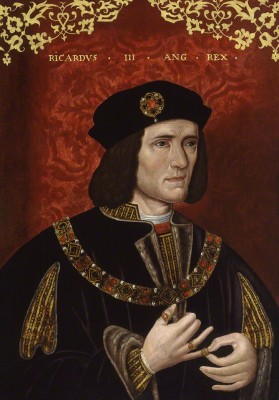
Josephine Tey, (aka Elizabeth Mackintosh and Gordon Daviot) classic writer of murder mysteries, has written a great little book called The Daughter of Time.  Her detective, Alan Grant, is laid up in hospital recuperating from having fallen through a trap door whilst in pursuit of a criminal.  To while away the time he researches the history of Richard III.  His actress friend brings him a copy of the portrait of Richard from the National Gallery in London.  She says his face is “full of the most dreadful pain.” Grant’s nurse says the man in the portrait has a liver disorder.  His surgeon says he had polio-myelitis as a child.  His sergeant pegs Richard as a judge.  No one thinks it’s the face of a murderer.

Richard III

As Grant finds out, the historical account that everyone cites for Richard was written by a shill of Henry VII who Henry then made Archbishop of Canterbury.  Sir Thomas More took up the slander without questioning its validity and his account made it into both legends and history books which is where Shakespeare found it.

But Grant is a policemen. He looks at what people actually do, where they are, what are their alibis and what eye-witnesses say. His research assistant find records, letters and histories written while Richard was alive.  Turns out he was wise, generous, courageous, able and popular.  There was no outrage about any nephews in the tower being murdered while Richard was alive.  The outrage came two year’s later when Henry VII’s lackey put it about that Richard had murdered the boys.  What seems more than likely is that Henry VII was the one who had them murdered.  In fact Henry VII seems to resemble the Richard in Shakespeare’s play in everything but the hunched-back and the shortened leg.  It wasn’t politic to say any of this until the last of the Tudors was gone.  The record was corrected when James I succeeded Elizabeth I.

The evidence in the case has been known and conceded for hundreds of years but the insistence persists in some dark corners that Richard III was a villain.  This I think we can lay this at the feet of Shakespeare who created a memorable, indelible character that we love to hate and hate to love. The odd thing is that though I love the idea of Richard III being a good guy, I still am charmed and mesmerized by Shakespeare’s villain.  I am glad they are both there.