
BooksPoemsShakespeare

June 22, 2012

The Shakepeare Project Act 1 Sc 1

Tags: , , , , , ,

In which I begin to cobble together what literary flotsam I do possess and attempt to read the entire works of William Shakespeare.

It’s summer.  People are talking about their summer reading lists.  Here’s what happened to me: I loved Stephen Greenblatt’s book The Swerve.( https://www.elenalouiserichmond.com/2012/05/swerving-and-centering/) It  led me to dust off his Will in the World.  Then I took a look at my copy of Harold Bloom’s Shakespeare, the Invention of the Human which had belonged to my father and which I have held back from my annual yard sale for ten years because I thought I might one day read it.  Bloom is a little stuffy, a little too enamored of his opinions; but I’m the same way so I’ll suffer him as a reference.  In any case, somewhere in all this stuffy dusting, I decided I would read the entire Shakespeare canon using an eight-volume Folio edition of the plays with large print and smooth clean pages, another legacy from my father.

I feel like I am announcing the start of a diet and I’ll be embarrassed if I don’t follow through, but here is the plan:  I will read a little every day even if that means only fifteen minutes. I’ve got a notebook to record all the famous bits and all the parts I especially like.  It’s my impression that a Shakespeare play is one long train of well-known phrases.  I hope that these phrases will function like a treasure hunt to get me through the more obfuscating parts.

And so I have commenced.  Commenceth.

I began with The Life and Death of King John I.  Two pages in, I had no idea what I had just read.  I started over and read it out loud.  It’s hard going from David Sedaris and murder mysteries to Shakespearean English.  Even my friend Nancy who can tell me every time I have deconstructed a thought and who teaches English, told me that it takes her a few pages before she sinks into the language.  I wonder if she’s reading one of those editions where the print is so small that a few pages are almost an entire play.

I decided I would skip King John for now and read Richard II because I had studied that play in college.  It was reasonably familiar and there were patches I had memorized.  Then I discovered that if I watched a BBC production of the play with the sub-titles on, that was better than reading it from a book and the visuals helped enormously.

On to Henry IV Parts I and II, which I had seen at Stratford in 1977.  Like that was going to help.  All I remember is where I was sitting in the theatre.  I decided the Folio edition presumed too much about a reader’s ability so I got out my old Pelican edition of the Complete Works of Shakespeare crammed into one volume.  Even though the print is miniscule, I need those comforting little footnotes.  I slogged through Henry IV Parts 1 and 2, the result being mostly confusion.  I watched the BBC movie.  The actors’ inflections helped not only with the meaning of the lines but they also pulled me into a rhythm where I started to feel fluent.

It’s beginning to feel fun.  Maybe I’ll get to where I don’t actually need the help of the BBC.

Did you know that these (now famous) expressions come from Henry IV Parts One and Two:

*The better part of valour is discretion

*Sink or swim

*He hath eaten me out of house and home


Here’s some of my literary flotsam:  In Part One, Hotspur has a line “A plague upon it! I have forgot the map.”  Later in the play he says:

O gentlemen, the time of life is short!
To spend that shortness basely were too long,
If life did ride upon a dial’s point,
Still ending at the arrival of an hour.


The poet, Lisa Fishman has a poem (which I love) called:


“I have forgot the map”—Hotspur


Too quickly the fields unfolded

in the mind at the end of the palm

on the map in the lines of the palm

O gentlemen

if life did ride upon a dial’s point

the name would not be a map

the map could not be refolded

there would be no map to forget


Discuss.

And if you don’t hear any more about my Shakespeare Project, just assume I am reading fifteen minutes a day and I hope to finish before the dial’s point arrives at the hour.


FriendsTravel

June 20, 2012

The Very Miss Kiss-My-Ass Girl

Tags: , , , , ,

Last week before the lilac fell and Gwen, my neighbor who knows something about just about everything, brought her chain saw over to lay waste both to the tree and to any fragments of male chauvinism in this neighborhood of powerful women, I had written a series of politicizing, sermonizing, sarcasmizing blogs posts which prompted my friend Mary-Ellis to complain.  Maybe complain is too strong a word.  She politely inquired, “When are you gonna blog about something funny, or ordinary, or ordinary and funny which you’re so good at?” by which I gather she meant stuff like how much time I waste on Facebook or about finding cat hairs in the cream pitcher or how the cat vomited a hairball on me in the middle of the night.  I could write a post about that but there’s nothing more to say except that the cat vomited a hairball on me in the middle of the night.  In any case, one should be careful about wishes:

When we were at Whitman College my friend acquired the title of “The Very Miss Mary-Ellis Lacy.”  I believe this came about because she had a Junior League demeanor belied by frequent eruptions into the girl-energy of a fifth grader at camp.  I loved this about her.  She projected calm and maturity making the contrast so much starker when she jumped on a table and belted “I ain’t nothin’ but a hound dog,” in a spot-on Elvis impersonation complete with jousting knees and rotating hips.

We sometimes called her “Mellis” for short.  There was one friend, Kurt, who, impervious to how much she disliked it, called her “Smell.”   But Kurt put a cow pie in my crock-pot.  I found it when I set out to make split pea soup one fall.  That was Kurt.  You couldn’t control him.

When I stayed with Mary-Ellis at her childhood home in southern California the year we graduated, I found the progenitor of that junior league demeanor.  We rolled out of bed and in our pajamas with our hair sticking to our heads, encountered The Mater, Mary-Paul, at the breakfast table.  She presided impeccably over the formal coffee service and counseled us about our plans for each day.

“Mary-Paul’s titillating tours,” Mary-Ellis murmured on our way out the door our first morning.

We were so young, just the word titillating made us snicker.

On that particular visit, we headed out to Palm desert, bought date shakes at Hadleys, and found Elvis Presley’s house.  And you guessed it, we roared past bellowing “You Ain’t Nothing But a Hound-dog.”

That was a fun trip.  I drove to California from Walla Walla with two other classmates, Gail and a guy we called Mr. Perfect.  Mr. Perfect told us that the center crack in the pavement of I-5 was the San Andreas fault.  We were so young, we believed him.  We dropped Mr. Perfect off in the Bay area and continued to southern California for Hadleys date shakes and Mary-Paul’s titillating tours.

Mary-Ellis moved to San Francisco the next year for a job at the St Francis hotel. She and I explored San Francisco by bus during my many visits to her.  Off the top of my head: the Sutro baths, Haight-Ashbury, Golden Gate Park, Golden Gate bridge,the Castro district, Ghiradelli Square, Fisherman’s Wharf, Union Square, North Beach, Lombard St, Chinatown, the Presidio, Telegraph Hill, Barbary Lane, Gumps.  We were so young we went into Gumps primarily to snicker at the name of the store.  We could afford to buy anything. Mary-Ellis took me to an exotic coffee shop near Union Square called the Caravansery.  In those days, coffee shops were not at all common and I thought my friend was the most adventurous person I had ever known.

Mary-Ellis lived in an apartment building owned and managed by two elderly ladies who were clearly suffering from dementia.  They would leave the building, get confused and lost, and show up hours later in a taxi, uncertain of what had happened.  More than once Mary-Ellis bailed them out of some scrape, made phone calls to their families, paid off taxis.  We called them the Minkies.  We were so young we could shriek with laughter at the situation.

Mary-Ellis had an Aunt Maudie who I met on one visit.  She told me a story about a little girl in the family, maybe three years old, who was observed one day sitting at the piano in her little pink dress, playing piano keys with her fat little fingers and warbling away in free-association about something, making up the song as she went along.  When Maudie got close enough to hear the lyrics, she heard, “kiss my ass, kiss my ass.”

Mary-Ellis swears the story wasn’t about her. Fair enough. But that little Junior League Wanna Be in her pink dress was the muse and the spirit of my friend, the Very Miss Mary Ellis Lacy.


Ah, HumanityFriends

June 12, 2012

Gwen Almighty

Tags: , , , , ,

It started out to be a quiet Monday morning with sunshine, a bright blue sky, and the promise of 70 degrees.  I was up early, reading in my sun room, stopping occasionally to look at the downed lilac tree that had keeled over from its roots during a wind storm a few days ago. I happened to witness its dramatic fall.  When I went out to inspect, the cats followed.  They marked the tree and proprietorially stationed themselves around it. It had indeed taken its curtain call. But a group of lilacs was still standing, disoriented without their senior member.  One tree in particular seemed to be attempting to breed with the mock orange to the east.  Several others looked like they were about to hop the twig.

I live across the alley from celebrity gardeners, John and Cass Turnbull.  (http://www.plantamnesty.org/ABOUT/about.aspx) That evening I asked John to take a squint at the tree.

“That’s what lilacs do,” he said. “It’s an old tree.  What are you going to do with it?”

“Gwen wants to come over with her chain saw.”

That would be Gwen, my neighbor who knows something about just about everything.

John grinned.  Everyone in these parts knows Gwen.

“Well if she needs some help, let me know.”

Gwen was in my yard the next morning inspecting (but not marking) the tree when John was preparing his gardening truck to leave for points east.  He leaned against the fence.

“I’ll cut it up for you this afternoon,” he told us expansively.  “It’s Man’s work.”  I guess you could say that, in a sense, he marked it.

The air around Gwen began to displace in waves.  I could sense it although there was nothing in her Welsh face or Wisconsin demeanor to foreshadow the fury of the next hour.  I went into the house to rescue a whistling teakettle.  Five minutes later I heard snapping and whisking and cursing.  Actually I didn’t hear the cursing.  Curse words were understood to be trapped in the waves of indignation around Gwen.  I looked out the window while wrapping an ace bandage around my foot since I seemed to have pulled something near the toe.  There was Gwen with a pruning saw and a long-handled pruner.  She was energetically loping off branches and pulling them through the weave of the lilac and the mock orange.

I crammed the sprained foot into a shoe and hopped out the sun room door. “Gwen, you’re cutting the mock orange,” I said.

“Can’t be helped. It’s in the way.”

I have to say I was little shocked at her tone.  I looked around the yard.  Branches and bunches were growing in heaps.

“What can I do?” I asked.  I didn’t want to do anything.  I had this broken foot, you see.

“This is the first branch that needs to go.” She patted one.  “They all look to be dying but this is the most unstable. Here why don’t you start sawing? NO! Not that side!  It’ll come loose and snap you right in the head.”  (She didn’t add, “you big fool.”)

“Can’t we just . . .”

“No. Here, give me that. Now pull it this way while I saw. Fulcrum and pivots, fulcrum and pivots.  Make your life easier.” I swear that is exactly what she said because as soon as we got that branch down I hopped into the house and wrote it down.  Then later in the day I looked up the word fulcrum.

“Girls have to think,” she said. “Boys muscle.”

“Can I take pictures of this?”

“No,” she said. “No photos.”  Again: tone.

“Can I blog about it?”  Like I have ever asked her permission before and how many of you have heard me mention my neighbor Gwen who knows something about just about everything?

“Yes you can blog about your neighbor who will not be photographed.”

We worked at the unstable trees branch by branch.  Gwen analyzed their positions and size, and barked out orders while I whined about my foot, the heat, and how I had to be someplace at noon.

I left for my Yoga for Over 50’s class.  I would have skipped it altogether but I missed it last week because Putzer the attorney was in town and I thought it was more important to take her to Archee McPhees.  I got back from class to find Gwen hauling a jaw horse through my front gate.

“If you will just move those branches off the tree on the ground, I can start cutting,” she said.  “I’ll need an electric cord.”

For the next hour she cut up the old spent lilac, figuring out the best ways to prop up each hunk of wood so as to cut it safely.  I approximated a continuation of all the forward bends I had done in yoga and picked up the pieces of wood.

“John really got under your skin, didn’t he?”  I asked when I handed her a double Jameson in the cool of the house.

“He probably wasn’t going to do it anyway,” she said.  “He was posturing.”

Here was one of the definitions for fulcrum: “one that supplies capability for action.” That would be Gwen.  Makes my life easier.


Ah, HumanityHolidaysPolitics

June 6, 2012

Everybody’s a Victim

Tags: , , ,

“I have no interest in being constantly catered to or forcing my beliefs on others,” confesses a former conservative. Recently I found my way to his web site via a blog post called “Things I Can’t Do Anymore.” http://formerconservative.wordpress.com/2012/05/30/things-i-cant-do-anymore/

One of the things this particular individual can’t do anymore is feel a sense of entitlement.  That’s not something I hear very often.  When I track the battles of the Entitlement Factions in this country I think of the exhausting, high-maintenance people who show up at family holidays or who highjack other people’s parties. https://www.elenalouiserichmond.com/2010/10/the-harp-that-hijacked-a-party/

It was the word catered in the above quote that caught me, having, as it does, an association with food. It took me back to childhood meals when my mother was the center of attention.  She controlled the conversation even when the rest of us sat in the dining room and she was in the kitchen rescuing her Parker House rolls from the oven.  She carried on a (full voiced) monologue of her own without reference to the conversation in the dining room.

Back at the table she interrupted whoever was speaking in order to introduce her rolls which were a bit brown around the edges but most of them turned out all right there’s butter and jam —Elena what did you do with the raspberry jam?–oh here it is now where were we?  Everyone dutifully took a Parker House roll, passed the basket to his neighbor and waited for my mother to introduce her next topic.

The lull pushed her into a supervisory position: “Elena aren’t you eating any peas? Mrs.Snodgrass can I pass you the gravy oh you don’t?  Dad here’s the potatoes why is no one eating the salad did I forget the dressing?”

No. Mom. The reason no one is eating the salad is because currently no one wants to.  People are eating what they want to eat.  It’s not about you.

That’s what I want to say to groups of people who privilege their own entitlements and prescribe the country’s beliefs and activities: It’s not about you. You can want what you want for yourselves, but that’s it. You don’t get to force feed the rest of us your salad and dressing.  There’s nothing more exhausting than to be around someone who can only get what she wants by making everyone else do what she wants.

I once spend two interminable weeks with a family whose main entertainment was parsing what and wasn’t sin and how to make something that seemed like sin be something that technically wasn’t so they could commit it with impunity.  The woman was reading a book that was going to tell her, me, and everyone else in the world if it was a sin for Christians to drink alcohol.

In those days I didn’t say things like, “Go ahead and commit the sin and go to hell.  It couldn’t be any worse than what you’ve got going on here.”

We’ve got people whining they can’t have their crèches in public places. Meanwhile someone else complains that the people in her office are all talking about what they are giving up for lent and they aren’t even Christians.  Lent doesn’t mean anything to them.  Evangelicals say they are discriminated against in college classrooms.  Everyone is someone’s victim.

These are worthless preoccupations and alienating pronouncements.  But I expect people have always been this way. It’s just that in the past it was confined to the dining room and one could ultimately get away from it by going to college (a private liberal arts one like Whitman College in Walla Walla). Human beings are never going to feel, think, or behave in a unity of spirit. No one is going to get everything she wants.  Kindness matters.  And not sucking the life out of holidays.


PsychoanalysisSpiritualityTeaching

May 28, 2012

Gods Interrupting Each Other

Tags: , , , , , ,

“I am sorry– the middle of my sentence interrupted the beginning of yours.” A quote from my friend Jim.

Conversation with friends is near the top of my list of life’s pleasures.  Even when topics get heated, there’s humor and a reasonable confidence that I am still loved. And since I live in the Scandinavia occupied Pacific Northwest, there’s the distanced politeness that east coast transplants complain about. So I am taken aback when I read ungrammatical, badly punctuated and vituperative if not downright obscene comments on web sites.

Nothing gets people screaming at each other faster than religion.  I can only speak for myself when I speculate why this is.  I grew up in a fundamentalist Christian home that was powered by fear and craziness (if you’re new here, you can read all about it in: 99 Girdles on the Wall, which, thanks to my witty friend Susan, has been newly copy-edited to within an inch of its life. https://www.elenalouiserichmond.com/99-girdles/ ) It took nearly 25 years to soften a simplistic code of Right and Wrong into a brain wired to cope with the nuance and ambivalence in life.

Recently Marilyn, a new enough friend that for now she can be Marilyn, the untagged, courageously examined some reasons that, as she put it, she doesn’t “want people to speak while I’m interrupting.” http://communicatingacrossboundariesblog.com/2012/05/17/dont-speak-while-im-interrupting-thoughts-on-faith-dialogue/.

I found some of her reasons poignant: “Fear that my faith, this faith that is the foundation of my life, will be found wanting.”

I don’t know much about my new friend’s world, but in any case, I can only respond from mine.  As a music teacher I sometimes get parents who ask me, “Is she practicing enough?”

My response is, “For whom?”

Is she practicing enough for me, the teacher?  Answer: Irrelevant.

Is she practicing enough for you, the parent?  This begs more questions: Is this about feeling like a good enough parent? Is this about getting your money’s worth out of your daughter’s lessons?  Are you comparing your child’s progress to someone else’s? Answer to all: Not my area of expertise.

Is she practicing enough for herself? Answer:  If she is playing the piano enough that she enjoys the process of learning, isn’t worried about doing it wrong, is curious about music and can anticipate pleasure and challenge in making music in the future, then she’s practicing enough.  Let that be the foundation of her music training.

So to Marilyn’s question, I could ask, “Wanting for whom?”  This isn’t about what anyone else thinks, feels or wants.  It isn’t about what’s right or wrong for anyone but you.

This poses a problem for fundamentalist thinking—and we all do it–and brings in another reason my friend gave for why she doesn’t want people to speak while she’s interrupting: “fear that I will not have a defense.”  A lot of us feel this way when we get outside our thought communities.  But why should anyone have to defend their faith any more than why they suck the chocolate off peanut M and M’s and spit out the peanut?  Not that anyone I know does that.

To allow that someone else has different idiosyncrasies, conceptualizations, experiences, and emphases is to recognize her subjectivity.  If one believes that “God” is the Life that permeates the universe then every different being, thought, and thing is a part of the whole.  To disallow the logic of another person’s mind is to suggest that one can fathom all of life including the whole of the unseen, the ineffable, the numinous.

Humility is one of the least understood and least practiced qualities in society. Cultivating a sense of another person’s subjectivity can transport one into the peace of humility: Here is another human being who has his own compendium of experiences, memories, desire, fears, goodness, rage, sadness, and humor with a life that has cultivated and made meaning of those qualities and energies.

This person is not me.

Namaste.


BooksLiteraturePsychoanalysisSpirituality

May 18, 2012

Swerving and Centering

Tags: , , , , , ,

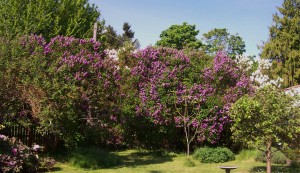
Here in Seattle we have had a week of lovely early summer weather.   It was warm enough to sit under my magnificent 40 year old lilac trees at six in the morning, drink tea and read.  I was so engrossed in the book by Stephen Greenblatt called The Swerve that I read it straight through, started over and read it again.  It’s the story of a poem called De rerum natura (On the Nature of Things ) by a Roman named Lucretius Carus (99-55 BCE) who put in verse the philosophy of Epicurus (341-270 BCE).  Now I am working my way through the actual poem.  It’s going to take more than a week of nice weather because it’s 7800 lines.  But I’m hooked.

I will leave it to scholars to squabble about the poet, the philosopher, the physics involved, and the author of The Swerve.  Me, I had an Epicurean experience just from reading the book.  Sitting under my lilacs watching hummingbirds zipping around the branches and my cats quivering with all their senses, it was easy to believe that I am made of the same substance as the world around me.  And that is the core of what Epicurus and Lucretius have to say.

“The stuff of the universe, Lucretius proposed, is an infinite number of atoms moving randomly through space, like dust motes in a sunbeam, colliding, hooking together, forming complex structures, breaking apart again, in a ceaseless process of creation and destruction.” (Stephen Greenblatt,The Swerve)

This is not a startling idea nowadays but it was first proposed as a philosophy in classical Greece long before modern day physicists got a hold of it.  Having no science/math background I had only encountered the idea from studying eastern religions. Its logical conclusion is that when we die, we cease to be anything other than the particles of which we are made.

We may be reassured that in our Death

We have no cause for fear, we cannot be

Wretched in non-existence.

Death alone has immortality, and takes away

Our mortal life.  It does not matter a bit

If once we lived before.

(From De rerum natura , Rolfe Humphries translation)

When I read these words something happened that I was not expecting: warmth, comfort and relief washed through me. These were ideas that felt at home in my internal world.  This doesn’t mean I have now become a complete Epicurean. It’s just that in the surprising appeal of this idea I learned something new about myself: that I wouldn’t mind if when I died, that was it for me.  What was once Me might join the dance of motes in the sunbeam and I would simply cease.

Stephen Greenblatt in his preface—which I’m glad I read because I hardly ever read prefaces—says that the poem struck a deep chord in him because at its core it is a “profound, therapeutic meditation on the fear of death, and that fear dominated my entire childhood.”  He goes on to say that “art always penetrates the particular fissures of one’s own psychic life.”

The same could be said about religion (and by religion I mean any particular structure and language whereby one can apprehend the spiritual dimension).    Religion and art affect us where we are most vulnerable and idiosyncratic which is why it is so important to listen to each other and let each other be.  Interfering with other people’s processes, demanding they believe something they simply do not believe is like cleaving a sculpture at a crack in its surface.

I learned something else in this remarkable book, something I might already have known if I had paid better attention to classics lectures in college.  I learned about Ciceronian conversation: the “discussion itself is what most matters, the fact that we can reason together easily, with a blend of wit and seriousness.  .  .  always allowing room for alternative views.”

There is arrogance, indignation and narcissistic rage in both public and private interaction these days.  We think our ideas are correct and anyone who disagrees is incorrect.  We are out to convert anyone who disagrees with us and have no use for anyone who doesn’t succumb to our arguments.  We are afraid of looking stupid. We are afraid of what might fracture if we were open to the influence of The Other.   There’s a good reason for that fear.  We don’t expose our vulnerabilities when the atmosphere is hostile.

When I was in analysis and would practically levitate off the couch with anxiety over something my analyst said, he sometimes reminded me, “These are just thoughts.  We’re just talking here. That’s all.”

I am as bad as anyone at staying detached and curious, and I’d like to get better.  I crave conversation.  I want to treat ideas like motes in a sunbeam.  To that end I started a page on Facebook called Civilities.  If you’re interested, go have a look.  https://www.facebook.com/Civilities Treat me like a shut-in who just wants someone to talk to.

Under the Lilacs


Ah, HumanityTravel

May 15, 2012

Bye Bye to Walla Walla

Tags: , , , ,

When I was a student at Whitman I had little interaction with the town of Walla Walla.  These days, the town is part of the fun of the visit. But being a Whitman graduate it’s hard to match wits with people outside the college.  Here are three vignettes:

As a student I once rode my bicycle out to College Place just to see what was there, at the time not much that interested me.  But 35 years later, and drinking green smoothies every day for arthritis, Seventh Day Adventist country was the place to go for a fix. In the health food cafe I inquired of a woman whose long gray hair stood out in points like the crown on the Statue of Liberty if she could make me a vegetable smoothie.

“You mean juice?”

“No, I want you to puree the whole food, pulp and all.”

“You know,” she said to me. “Dr Carbolic’s book?  He says that pulp isn’t good for you.”

I had no idea what she was referencing but my evangelical upbringing has taught me to sense one of the species, no matter what the subject matter.

“Yes, I’ve read his book.  I still want the pulp.”

“But he says that pulp is really quite bad for–here let me get you his diagram.”

“No, please. I’ve seen his diagram.”

“He says.  .  .”

“I know what he says.”

She looked flummoxed.  I started over.

“Can you make me a whole smoothie?”

“I don’t actually make them.  Laura?”

While Laura was popping beets and carrots into an ancient blender which was not going to make either a smoothie or juice, Miss Liberty came bustling over with a piece of paper.

“Since you are interested in health,” she began. “You’ll want to know about dangerous fats.  You see, this is how–”

“Thank you very much, I’ll read it.”  I plucked it out of her hand and folded it up.  I wondered if Laura, who appeared to not be listening to the conversation, was resigned to ceding a certain amount of potential business to this woman.  I wondered what the politics were.

“The fat begins.  .  .”

“You know,” I put my hand on her arm.  “I prefer to pay attention to my own body and make my decisions based on whether or not I feel better.”

“Yes,” she conceded doubtfully. “That’s important, too, but Dr. Carbolic–”

“Thank you very much.”  I said loudly.

*               *               *                *                *                 *

I had an odd conversation when I stopped for coffee on my way out of town on Sunday morning.   The girl behind the register looked in her early twenties.

“Do you make espresso drinks?” I asked.  I didn’t see any of the usual equipment.

“What do you mean by espresso?”

“Your sign out front says that you make espresso drinks.”

“You mean like a cappuchino?”

“I mean like an Americano.”

“All we have are those coffee machines.”  She gestured to the Boyd’s drip coffee machines, one of which had a sign that said “Capucchino.”

“OK, well, never mind.  Can I use the rest room?”

“You need the key,” she informed me.

Pause.

“OK,” I said.

Long pause.

“The key isn’t here. Somebody must be in the rest room.”

“It’s 9:00 on a Sunday morning and mine is the only car within two blocks.  Who could be in the rest room?”

She looked like she hoped I would stop asking such hard questions.  “Someone must not have returned the key.”

I stared at her, trying to imagine what she did with her mind in her spare time. I imagine she was relieved when I left but I was both unrelieved and unfulfilled.

*               *               *              *              *               *                *

I saved this vignette for last because I think it’s sweet and because the only sarcasm in the exchange wasn’t mine which in itself is worth noting.

I was on my bicycle trying to work off either the morning’s lemon Shaker pie or the afternoon’s Umpqua ice cream.  Coming around a familiar loop in Pioneer Park I heard boys’ voices.

“There’s another one!”

“My stick broke, hand me yours.”

“No get down, it’s my turn.”

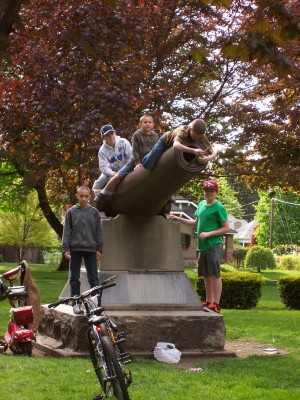
Five boys were clustered around an old Civil War cannon.  One was wrapped around the barrel, poking a stick into its innards.

I stopped.

“What are you doing?”

“There are messages down there,” said one of the boys.

“What kind of messages?”

“This one says, ‘Help, help, I’m a prisoner in here!’”

“Hey, can I take your picture?” I asked

“Are you from the UB?”  That would be the Walla Walla Union Bulletin, which was misguided enough to not give my book signing a listing so we don’t like them.

“No,” I said.  “But I might write about you.  Would that be all right?”

“Can we read it?”

“It’ll be on the Internet.  I bet you guys are pretty good on the computer.”

One of them said –and here’s my next to favorite part– “No, not really.”

Five boys, ages around 10 or 11, playing outside, and not particularly good on the computer.  I bet they’re better than me but never mind.

None of us had a pen or paper (or IPod).  I asked “How will I get ahold of you when I’ve written my piece?”

Long pause.  (Now here’s my favorite part:)

“My name’s David,” said the boy on the cannon.

I smiled.

“Oh, that’ll help,” said the boy withholding the stick.

David, wherever you are, I hope you see this because you were a sparkle on my most recent visit to WallaWalla.


FriendsTravel

May 8, 2012

Pie for Breakfast

Tags: , , , , , , ,

LIVE TV!

I could write a whole post about eating my way through Walla Walla and then put up a few photos of me bloated from days of wheat and sugar.  But I won’t.  At least I won’t post the photos.  But here are some notes from the weekend’s menu:

In my Postcard from Walla Walla I mentioned the bacon and asparagus pizza that former piano student and soon to be Whitman graduate Katie and I shared at Olive Marketplace and Cafe. (http://www.elenalouiserichmond.com/2012/05/postcard-from-walla-walla/) Then there was the penuche I bought every time I walked past Bright’s Candies smack in the center of Main Street on the same side as Olive’s.

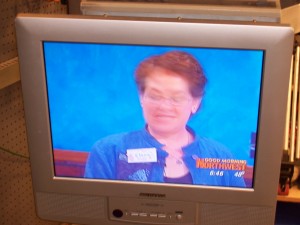
The one place where I didn’t eat was the TV station in Kennewick.  I don’t know exactly what I expected other than slightly less of the carnival crowds than at the Today Show in Rockefeller Center.  Actually I do know what I had expected.  I expected a breakfast buffet and someone to do my camera make-up.  There wasn’t so much as a Mr Coffee or a stick of lipstick on the premises.

I had to get up at 4:30 in order to be at KVEW-TV in Kennewick for my 6:45 spot on Good Morning Northwest.  Over the aforementioned pizza at Olive’s, Katie offered to pick me up the next morning and be my chauffeur. She told me she would set four alarm clocks and put them in different places in her bedroom.  Even so I called her at 4:55 to see if she was up.  It is a measure either of her easy-going nature or of how much she loves me that there was scarcely a hint of exasperation in her voice when she said, “I just got out of the shower.”  At 5:10 her car’s headlights were shining up the drive and into the kitchen where Debi and I were yawning and grunting at each other.

Katie and I watched the sun rise through the rear view mirrors as we drove to Kennewick.  At the TV station we loitered outside the control room and watched until we were moved into the studio where the segment before us was some guys cooking crayfish.  Katie documented my TV debut on her smart phone.  We ate some crayfish and drove back to Walla Walla where we had breakfast at Olive’s.

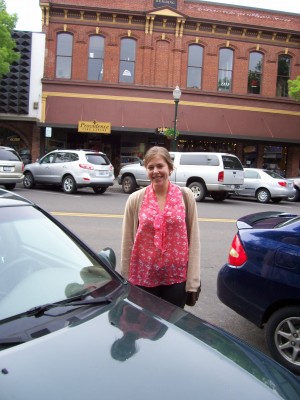
Katie on Main Street outside Olive's and down the street from Bright's Candies

I got on my bicycle to make my rounds of Walla Walla which included coffee and a little nosh at Colville Street Patisserie and culminating with a visit to Willis and Toews, Debi’s law office.  In a spacious room Debi’s head bobbed up from an oceanic desk—handcrafted by husband Jim– and a sea of papers.

“Debi, this is a gorgeous office!”  I said. “For some reason I expected a cramped room in a seedy alley.”

“Why? Because I’m a seedy little person?”

Debi is hardly that.  Beneath her unflappable demeanor, she is funny and outgoing. She recently went through two corneal transplants with grace and humor.

Debi and Jim buy their milk at the dairy, their produce and meat at the farm, their bread at the Walla Walla Bread Co, and their coffee beans at the Walla Walla Roastery out by the airport.  I think the only actual store they frequent is Andy’s Market in College Place, Seventh-Day Adventist country where you can get all manner of herbs and healthy food in bulk.

Jim is the chef at The Toews Towers on Tieton.  Don’t try to make reservations.  It’s their home.  I just have a foible for alliterations.  For dinner Jim made enough savory Cioppino to feed a ship full of Portuguese fisherman.

So endeth the second day.

On Saturday morning we were up and eating again.  I sampled everything available in paper pill cups at the Walla Walla Farmer’s Market.  Debi and I went to the Walla Walla Bread Co where we ordered pieces of strawberry rhubarb pie and lemon Shaker pie. Debi leaned against the display case and said, “Put it on my tab.” Debi can eat like this because she bicycles fifty miles a day.  But as Eeyore says: “We can’t all and some of us don’t.”

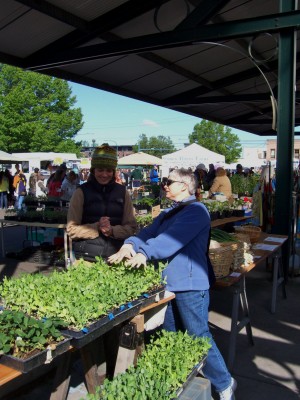
Debi casting a spell on the produce at Walla2 Farmer's Market

Really, my book signing at Book and Game Co (across Main Street from Bright’s Candies) that began at 11:00 takes a back seat to the gustatory pleasures of the weekend.   When I had signed my last book and the bookstore had written me a check (yay!), Debi and I made our way north to Klickers which was a seasonal fruit stand when I was at Whitman.  I remember cycling out to it for berries.  Now it’s open year round and has antiques, yard art, produce, cheese, jams, honey, condiments, and what we were there for: Umpqua ice cream.

Four hours later I had just enough room to pack in tender, brined chicken with caramelized onions which Jim had been preparing pretty much ever since we left the house to go to the farmer’s market in the morning.

Now that I’m back home in Seattle, I’m on a diet of herb tea and sticks.


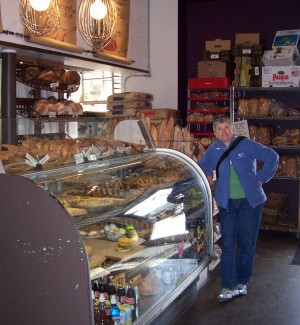
Debi running a tab at Walla Walla Bread Company


Chef James

FriendsTravel

May 5, 2012

Postcard from Walla Walla

Tags: , , , ,

I am taking a break from raging against the Catholic church and breathing feminist fire to sing a little song of Walla Walla, Washington.  I am here to do a book signing at Book and Game Co on Main Street and to stay with my college roommate Putzer, the attorney, and her husband, Jim.

My earliest memories of Walla Walla are from the late 50s when I was five or six years old.  My great-aunt lived on Marcus Street next to the foot bridge that crosses Mill Creek. My Aunt Ann was the most elegant of Victorian ladies.  College kids have long since taken over her former house and now it’s as unkempt as a dorm room.

I have my little rituals when I come to Walla Walla.  I walk across the Marcus Street foot bridge.  I visit Pioneer Park to commune with the huge, gnarled trees and talk to the ducks.   I cycle to Mountain View Cemetery where are buried the grandparents I never knew.  I always make a tour of the Whitman College campus and spend some time wandering along Lakem Duckem.  I go into the college bookstore to inspect the most recent promotional memorabilia and alumni crap.  This trip I checked to see if my book (99 Girdles on the Wall in case you’re new here) was on the alumni shelf.  It wasn’t because it had sold out (yay!) so I left more copies.

Walla Walla has undergone a renaissance in the past 35 years since I was a student.  When I was in school, there were plenty of wheat fields but no wineries.  The ratio has flipped.  Now there are 150 wineries and a dwindling number of wheat fields.  Main Street is full of  tasting rooms, coffee houses, and boutiques.  Falkenburg Jewelers and Baker-Boyer Bank are the only downtown businesses I recognize.

I applied for my first credit card at the bank. In the 70s, it was hard for a single woman to be approved for a credit card.  If you were of the female species, you could be attached to your husband’s credit card but you couldn’t have one of your own.  However as a Whitman graduate in Walla Walla’s own Baker-Boyer Bank I had hometown cachet and was issued a Mastercard.  I suppose they thought that a Whitman education was so impressive that even a single woman could get a decent job with it.

I always bring my bicycle to Walla Walla. I know of no other place so conducive to bicycling.  Commodious streets with large leafy trees and very little traffic make it a pleasure to meander or run errands.  In Seattle on Thursday morning I lashed it to the bike rack with half a dozen bungee cords.  I further secured it with a length of rope wrapped so thoroughly as to almost obscure the bike.  My neighbor Gwen who knows something about just about everything came over to see me off.

“Do you think the bike will stay on?” I asked.

“I think the car will probably fall off first,” she said.

There was a thunderstorm coming in over my shoulder when I was untying my bike in Debi’s (that would be Putzer’s given name) driveway.  Who would have thought a bunch of granny knots would be so hard to wriggle free but I got the bicycle unhitched just before the squall broke.

I abandoned Debi and Jim to pick up Katie, my former piano student and soon to be Whitman graduate.  We went to dinner at Olive’s on Main Street and shared a fabulous asparagus and bacon pizza.  A long time ago just before I graduated in 1976, Olive’s was called Merchants, was half as big, but just as good.  From dinner, Katie and I went to a poetry reading at Hunter Conservatory.  On the corner of Boyer and Park, Hunter conservatory used to be the Hall of Music and the little Victorian era stage was called MacDowell Hall after the little Victorian composer Edward MacDowell.  As a student at Whitman, I sang in recitals on the little Victorian stage.  The offices upstairs used to be practice rooms.  I practiced singing and piano in those rooms.  The piano I learned to play on, and which stands in my house today was once in the Whitman Hall of Music.

I will skip over how much I enjoyed the readings to complain about the One Who Read for Too Long. The poets had been publicly reminded they should read for no longer than seven minutes and everyone did fine until near the end, someone read a piece about the Titanic that went on for longer than it took the ship to sink.  It was during this presentation that I felt myself crashing.  I needed an early night because I had to get up at 4:30 the next morning for an early morning TV spot to promote my book.

I laid everything out for the next morning in the order that I would be donning it or putting it in my hair.  I fiddled with the bathroom shower fixture which looked like Sputnik.  Not wanting to have to solve a space-age dilemma at 4:30 in the morning, I padded down the hall to Debi and Jim’s room and knocked.

Debi poked her head out, a toothbrush in her mouth.

“Can you show me how to use the shower?”

“Is it 4:30 already?” she asked.

“Ha ha, very funny. Better I ask you now than tomorrow morning while you’re still in bed.”

Debi showed me how to use the shower and I went to bed.  Therein endeth the first day.


PoliticsPosts

April 30, 2012

Vagina is not a Four Letter Word

Tags: , , , , , , ,

Two months ago a woman in Michigan named Karen Teegarden called her friend Desiree Jordan in New York.  They both wondered why women all over this country weren’t marching in the streets in response to hundreds of pieces of state legislation that many of us feel are whittling away at women’s dignity, autonomy and rights as human beings.  Karen started a Facebook page that night and called it UniteWomen.org.  The next morning 500 people had signed on. By last Saturday morning, there were nearly 38,000.

Nancy, my friend who can tell me every time I have deconstructed a thought, and I met up with several hundred of them at Westlake Center.   I hadn’t been to a rally since I went with Nancy to see Bill Clinton, or in this case, his hair, at Westlake Center in 1992.   I almost never do anything that puts me in a crowd.  By Friday evening, I was wondering if it was enough to say I was going even if I instead stayed home and ate popcorn.

But Nancy suggested we go together and take signs.   Slogans poured out of her like water.  We settled on these: Ejaculation is a Choice.  Preach Condoms.  Conception Begins at Erection.  I decided that I would go all out and get a poster made from a cartoon that I have been circulating quietly among my friends because I am just middle-aged enough to feel self-conscious about the word vagina

Thanks to folks like Gov. Bob McDonnell of Virginia, a lot of us are using the v-word more freely. Gov. McDonnell is the one who nearly signed into law the infamous trans-vaginal ultra-sound required before an abortion.  The bill was reconsidered when it was pointed out how invasive the mandated trans-vaginal ultrasound truly is, how similar it was to rape in other words.  This had to be pointed out.  Then there’s Gov. Tom Corbett of Pennsylvania.  He wants to sign into law mandatory ultrasounds for women seeking abortions but he says, “I’m not making anybody watch, ok. Because you just have to close your eyes.”

When I was in college we were told not to struggle if we were attacked and raped because we could be hurt even worse if we fought back.  Is that what they tell people who go into the armed forces?  One of the effects of declaring a section of the population subjugated, dependent, and defenseless is that the rest of the population can despise them.  That is what we do with adults who don’t fight back when others abuse or try to control them.  We despise them.

This isn’t just about ignorant male politicians.  Truly, the only sour note in the day came from an exceptionally sour-faced woman who looked at the Preach Condoms sign and said, “You should preach abstinence.  That’s what the Bible says.”   If it were possible to have a conversation with anyone who makes statements that involve the phrase “the Bible says,” I would have told her that what the Bible does or doesn’t say was irrelevant to me.  But for the record, the Bible doesn’t say any such thing.

There were a lot of great signs at Westlake. The only one I didn’t like was: “No Uterus? No opinion.”   I don’t agree with that.  I know the risk we run with allowing uterus-less persons to have opinions is that they may have the Wrong One. (For the one or two fundamentalists mistakenly reading this blog, that is a joke.) But the larger point is that if you are male and want your opinion about pregnancy, abortion and birth to be respected, than you’d better plan to spend 20 years of your life shouldering 50% of the responsibility for the consequences of your sperm.

Women are not alone in feeling this way: One of the most delightful aspects of the afternoon was the male support for our signs.  We got thumbs-up and comments like “We’re with you!” and “It’s not just about women!”  And our favorite : “That’s the best fucking sign I’ve ever seen! High five!”