SingingSongsSpirituality

December 19, 2011

Love and Attention

Tags: , , , ,

“Writing a poem is an attention-getting act, so it might be worth asking whose attention are you getting and why?”  says Billy Collins in an interview in The Paris Review, Fall 2001.  Billy Collins, a rock star among American poets, knows something about attention.

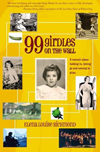
I’ve gotten almost more attention than I can stand this past week. There was the book launch for 99 Girdles on the Wall at the Secret Garden Book Shop in the Ballard neighborhood of Seattle. An hour before it began I realized I had never even been to a book launch.  I had a vague idea that I would be signing books and people would stand around talking and eating what my witty, not to say wise-ass, friend Susan calls “fiddlies on crackers.”  I called the Secret Garden to ask what exactly was I expected to do.

“Well, of course you’ll want to read.  And to say some things about the book.  We’ll have a book signing table for you”

Book signing is a whole new skill set for me.  Jenni, who single-handedly improved my sight-reading ability by learning new music at an alarming rate, handed me her copy of my book and said, “Write something clever.”  I froze.   The above-mentioned Susan gave me an even more clever-quelling assignment when weeks ago she e-mailed me to say she was buying a copy for her sister and one for herself and I could now start working on an inscription.

So I started a list of pithy things to write of which I will share none.

My memory of the book launch is of faces beaming at me.  Like those camera angles where you see all the cooing adults from the point of view of the infant in the crib.  The faces in the book store advanced upon me in groups of three or four, not saying much, just beaming.

I haven’t discussed this with everyone who has ever lived but I think I am on solid ground when I say everyone needs attention. And I believe that although the preferred form varies, everyone likes attention; and there’s a common tendency amongst our species to not be able to admit it.

Attention is a form of love.  This is what I felt at the book launch to the point that it was almost unbearably intense.  I felt loved.  All those people did not come to the launch because I had written a book.  They came because they loved me.  The vulnerability I felt after an hour and half made me ask the event planner if I could go home now.

Fast forward to the end of last week when I did something hadn’t done in 14 years, something that none of my current friends have ever heard me do:  I sang a classical vocal solo in a Christmas recital.  I sang Norman Dello Joio’s “A Christmas Carol.”  It climaxes on a luscious high G, a soprano’s most beloved note, although B-flat and high C are great fun, too.

I judge my vocal solos by how much I enjoy myself; this is directly related to how present I am when I sing.  While I was a real neurotic all day long, when it came time to sing, I enjoyed myself; and the performance presented me with a metaphor for life.  When I got to that G which sings for 8 counts, I started with an easy onset, a small portal in which the sound could seed itself.  Then I fed it.  I poured breath into it until it filled up the sanctuary, a hall so alive it almost sings itself.

This is a different form of attention.  I attend to my note, starting small, paying attention, and loving what I am doing.  This is my job from start to finish.  What happens after that is out of my control. People listening, people attending to me, hear what they hear and have the experience they have.  Some people hate classical singing. Some people are just impressed that a singer can sing so loud without a microphone. Others feel thrilled or blissful. Others are in the smile and nod category.

One answer to Billy Collin’s question is that I am getting attention for the purpose of both enjoying and sharing myself.   Narcissism, the new bogey word that has replaced dysfunctional, shame, and trauma as a collective diagnosis for the human condition, is not a preoccupation with ourselves.  It’s a preoccupation with an image we have of ourselves coupled with a desire to control how others perceive us.

In this week that I have gotten so much attention, I am happy to remind myself to just start the note and send breath into it.  Then let it go.


Choir SingingHolidaysSingingSongsTeaching

December 14, 2011

Christmas With The OK Chorale

Tags: , , , ,

The full moon is waning and I am following it down the backside of my Christmas schedule.  Three performances were crushed into this past weekend and my book launch was scheduled for Monday, or in other words, on the day I would typically expect to crash.  Just as I was about to cry “uncle,” on the events that had accumulated, a college friend who I hadn’t seen in 35 years wrote to me out of the blue that he would be in Seattle on this busy weekend.

I sat down and breathed.  I often have a hard time living in the moment.  It’s easy for me to get exercised about something I imagine might happen (read: go wrong) in the days that are yet to come.  I have had many moments in the past three weeks when I have heard myself say something in this vein: “You know what?  Nothing is happening.  You are sitting here knitting.  There’s nothing going on to be anxious about.”

I managed to convince myself that what I was calling anxiety could just as accurately be termed excitement.  My body might not know the difference but my mind knows and it makes life more manageable.  I told myself that since I am 57 years old, there wasn’t all that much coming up that I hadn’t been through at least 150 times.   The only surprises left were either the fun ones—like if someone farts during a music rest– or the gratifying experience of knowing I could get through a disaster –if I am the one who farts–philosophically and with humor.

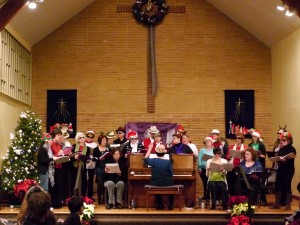
The Chorale did its usual fearless job at the church concert on Friday night.  When the Chorale was in its early years and I told people to dress casually and wear Santa hats and elf tights, one or two brave souls came partially costumed.  Friday night nearly everyone had reindeer antlers, angel haloes, elf hats, santa hats, or bobblies of some kind. When we sang Cool Yule, out came the sunglasses and straw fedoras.

The Maccabean tenors (always the tenors) had cigarette lighter apps on their i-phones for “Light the Legend” and socks for “When shepherds washed their socks by night, all seated round the tub, the angel of the Lord came down and they began to scrub.”  The tenors plan these things when I am working with the other parts.  It’s why they like to sit as far from the piano as possible. https://www.elenalouiserichmond.com/2011/11/screaming-the-legend/

“Carol of the Bells” is the song with the soprano ostinato:  Harkhowthebells,sweetsilverbells, allseemtosay, throwcaresaway, Christmasishere, and so on.  You’d recognize it if you heard it. The other voices join in one by one, building in excitement to the moment the sopranos break out of their pattern and cut loose with “Gaily they ring” on a high G.  Except that what so often comes out is not a glorious ringing of a soprano’s most beloved note, but a series of little bat squeaks.  I don’t just mean in my choir, I mean in many choirs.  It’s a difficult passage.

The problem is that the note is high and exposed and singers lose their nerves at the 59th second and back away from it.  One rehearsal I told them all to fling their arms in the air when they sang the G.  The sound reverberated through the sanctuary.  It was stunning.  I encouraged them to fling their arms every time we practiced the song.  Some did, some didn’t.  If at least one soprano threw her arms in the air, the note rang like a bell.  I was pretty certain I could count on Susan (in her second career as domestic goddess), to come through in the performance.  After all she once brought down the house prancing around like a chicken while we sang “The Hen’s Duet” in the Charlotte Martin Theater at Seattle Center.  This was chicken feed compared to that.  She didn’t disappoint, the sopranos were marvelous and I have never worried less about that piece.

The night after the church concert we sang at University House where I heard a resident say “Look, it’s a herd of reindeer!”  I told the tenors that if they were going to brandish their socks they ought to go all out and hang them on their antlers whereby Jean, the civic minded tenor, threw her pair at me, civic minded not being the same as civil. So I backed off.

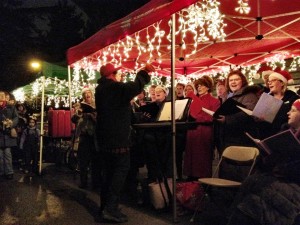
From University House we trooped down to our annual stake-out of the 6:00 time slot at the aqua theatre and the Green Lake luminaria.  This is my favorite December activity, baking Christmas bread running a close second.  The lake is lined with 3,000 tea-lights sunk in sand and housed in plain brown paper lunch bags.  Music groups are scheduled at three locations along the pathway.  On a warm-ish dry night like last Saturday, 10,000 people were expected to walk along at least part of the three-mile lake.

The OK Chorale has sung at the luminarias for 15 years.  For most of those years, it’s rained.  The poor little candles go out and the bags wilt but we carry on.  True Northwesterners come out in their rain gear.  One year it snowed big, fat flakes. Another year we sang on a full moon.

My first experience of the luminarias was magical.  It was a clear, cold night.  This is what people did before TV, I thought.  That was in the nineties.  Now I think it’s what people did before the Internet.  It’s a different kind of magic with the tenors lighting their Smart Phone candles.

Cool Yule


At the Green Lake Luminarias

Ah, HumanityChoir SingingHolidaysSinging

December 7, 2011

Notes From a Bazaar

Tags: , , , , ,

The Great Bazaar Weekends are over.  In spite of all the work they entail, I look forward to them.  All the stuff that didn’t sell last year comes back like favorite Christmas tree ornaments, along with artists and crafters I only see once a year.

The Dibble House Craft sale is an institution.  I was a shopper for fifteen years, back when Sue Gregor, the Dibble House proprietor, was a mythic figure.  I had heard her name, but I had never seen the person who went with it.  It’s still true that you can’t blink if you want a sighting of Sue because she moves with the speed of a hummingbird.

Some of the guests at Dibble House Bed and Breakfast don’t believe in her actual existence.  When I was lugging my watercolor card display into the house, I met a couple who had been coming for five years and had yet to meet Sue.

“It’s like living out The Elves and the Shoemaker,” the tall distinguished man told me. “We make the arrangements by e-mail, she’s not here when we arrive, but our breakfast tray appears at our door the next morning.”

“Well, she should be along shortly,” I said. “You can meet her then.”

“We’ve heard that before,” they laughed.

Sue has more energy than is decent in a middle-aged woman.  Besides single-handedly running Dibble House with its four rooms, she works as a caterer, a dog-walker, a dog sitter, a house cleaner, and on weekends, as a barista.  In her free time she works out at the gym, and does volunteer work as well as things that she says I can’t write down.

She opens up her home once a year for artists and crafters to invade and set up their creative output.  It’s a neighborhood affair.  Greater Ballard is full of knitters, painters, and jewelry and candy makers.  I have bought sheaves of holly, fleece hats, cards made by children, and elderberry syrup.  I began by first selling my watercolor cards, added my organic raspberry liqueur the next year, and this year I also sold *my book.*

There were some changes this year.  There was new and controversial signage.  (By the way, when did we all start saying signage?  The word sign wasn’t specific enough?) On my way to Dibble House the afternoon of the set-up, I saw Sue’s familiar signs announcing the sale.  I’ve seen them for twenty years.  But at one intersection sat a huge green sign with a swath of blood red running down the middle like a face out of Braveheart.  “Holiday Sale” it announced in bold, black letters.

“Cool,” I thought. “Another sale on the same street.”

But when I pulled up to Dibble House, a second red and green sign was perched on a stepladder, leering at me as I went up the front walk.  Inside the house I detected a bit of tension.  The husband of one of the crafters, laden with knitted children’s sweaters, followed me in.

“Great signage!” he announced.

The sign painter beamed.  She was new, didn’t know the traditions, hadn’t gotten the memo.  A few repressive looks quelled the subject of the sign.

I studied the red and green sign the next morning when I arrived for my shift.  “I suppose someone could just lay the thing down on the ground and put all of us out of our misery,” I thought.  I am more than capable of such an action.

One of the crafters murmured, “I was thinking I would just push it over, but then I remembered that I am too old to be so passive-aggressive.  I don’t do stuff like that anymore.”

We all lived with the sign. Or signage, if you prefer. It wasn’t all that bad.  Just better suited to a garage sale which I have nothing against.  It’s just that we were going for more class.

Bigger than the great signage controversy was the move we all made to Mary O’s house for the second weekend.  The new venue pulled in new people from a different corner of the neighborhood, and demonstrated that we were all vital, vigorous artists and craftspeople, willing to try new things.  We tried having live music.  Specifically, me.  Mary owns a Boston grand piano.  And I have piles of Christmas music.

I said I would play the piano, sing, and not grumble about being background music. This latter was a Must See.  For the most part, I kept to it.  But two crafters who were supposed to be greeting got to chatting heavily eight feet from where I was vamping “Santa Baby’ and fluting “Lo, How a Rose.”  When I crescendoed, they talked louder.  It was too much.

Once when The OK Chorale sang at the Phinney Neighborhood Center Winter Craft sale, a couple sitting in the first row of the audience were conversing when we started to sing.  Rather than move to a quieter area, they yelled over the choir.  I couldn’t concentrate on directing.  I get to seething when this happens.  I’ve been known to walk over to people in the audience and say, “You know we aren’t background music.”

I wanted to whirl around to this couple, and shout, “Why the fuck are you yelling when we’re singing? Do you understand we are live human beings? If you want to talk, go someplace quiet where there isn’t a group that’s been rehearsing for eight weeks just to entertain cretins like you!”

I did not make any such scene at Mary’s house.  I slipped into the kitchen and tattled on the chatterers. (Is that passive-aggressive?) Mary had A Word with them.  They de-crescendoed a bit, or at least they turned away from me.

I foam up over the subject of live performers as background music. It’s pitiable, really, because it’s such a futile fight.  I need to stop now and have a quiet, little break-down.  We’ll talk later.


Ah, Humanity

November 30, 2011

Plumbing My Stupidity

Tags: , ,

I met Fletcher when I was gunning the engine of my car preparatory to screeching away to an appointment for which I was already late.  He was perambulating down the street and further detained me by draping himself on my car, singling that he wanted to talk to me.  I rolled down the window.

“Hi,” I said in that bright voice that women of my generation learned to use when we needed to mask any number of conflicting feelings.

“I was wond’ring.  What kind of tree is that?”

“Apple,” I started to roll up the window.

“Now what kind of apples would they be?”

“Spartan.”

“Cause you know, I walk down this street a lot and I’ve noticed.  .  .   say, my name’s Fletcher.”

He stuck out his hand. We shook.  I inched up the window.

“I’m an electrician.  If you ever need anything—”

“Really?  An electrician.” I rolled the window back down.  “Do you have a card?”

“And a plumber.”

“No kidding?”

“Yeah I’ve done some plumbing.”

He pulled about 175 cards out of three different pockets and began sorting.

“I just had some new ones made. Darn.  Must have left them.  .  .  here’s one. Wait, I need that phone number I’ve written on it right there.”

“I’ll write your number down and then I need to shove off,” I said.

“Yeah, yeah, good.  You write down my number and you call me if you need any plumbing or electrical work. Yeah.”

I was going to throw the number away.  I don’t hire electricians and plumbers off the street.  On the other hand, I am on an austerity budget.  And being one of their kind myself, I am often willing to give an odd duck the benefit of the doubt.

My kitchen faucet had been making death groans for some time and the gasket was disintegrating and leaking black gunk.  I had two electrical outlets that needed new boxes.   Gwen, my neighbor who knows something about just about everything, knows how to perform both these household chores.  I was to learn later that so does Nina (rhymes with Dinah) and Chris, the unclassifiable.  But they all lost out to Fletcher because he lived close and demonstrably had the time.

He arrived on foot with three bags of tools hanging off him but he didn’t have the one tool he needed nor were the two electrical replacement boxes useable.  I took in the situation along with a couple of deep breaths.  Fletcher had told me the job would take an hour.  I was working on re-writing the bass part of “Cool Yule” so the tenors could sing it.  It needed all my concentration.  I needed him out of my hair.

I took him to Fred Meyer, swung by the bank, and stopped at the liquor store for bottle of Jameson.  When I returned to Fred Meyer, Fletcher was still wandering the aisles.  I drove him to his house where he recovered the one crucial tool he had neglected to bring the first time.  In short, the job that was supposed to take an hour, took four.

When he finally left, the wall around the electrical outlets looked like a kindergartener’s project.  The first time I turned on the water in the kitchen, the faucet handle snapped right off.   I wasn’t going to confess any of this to anyone but the decision was usurped by Fletcher when he knocked at the door two days later during Nina’s voice lesson.

“Hi, how’s it going?  Say I was wond’ring if you found my green work gloves anywhere?”

I pretended to think carefully. “No, sorry.”

“How’s everything working?”

“Fine.  I’m working here, too.”

“Oh, sorry to interrupt.  Look I have a few cards for you if you know anyone who-” out came the 175 cards– “needs a plumber or an electrician.  I’m up here a lot and –”

“OK, I’ve got your number and I’ll call you. Bye.”

Nina looked amused.  “What was that about?” she asked when I shut the door.

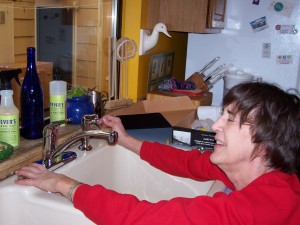
Once the whole story came out, I meekly accepted Nina’s offer to replace the kitchen faucet.  No, gratefully accepted.  She came the next Saturday afternoon with a most impressive collection of tools, a baseball cap on her head, and no butt crack.

“I’ve replaced at least five sink fixtures in my life but I’m having a small crisis of confidence at the moment.  I don’t mind screwing up my own house.”  She looked at me.   “On the other hand, you let an itinerant hack into your walls.”

Nina replaced my kitchen faucet, not without incident, but I need another blog entry to do it justice.  Suffice it to say that she has a friend who knows how to sweat copper.  And Nina knew that sweating is what one does with copper.  I was no end of impressed with the venous quality of her knowledge.  I need to spend more time around scientists.

By the way, Fletcher called last week to see how things were going—a good business practice—and to tell me that he also fixes cars.

Nina at work


Nina in full confidence

Choir SingingHolidaysSongsSpirituality

November 21, 2011

Bedighted with Joy

Tags: , , , , , ,

Yesterday morning the church choir sang an old-fashioned romantic piece of music that I first learned as a beginning voice student.  It’s called “Thanks Be to God” by Stanley Dickson and it has the word “bedight” in it.  That’s enough to mark it as a piece for Aunt Maud to sing for The Special Music at a Sunday evening church service.  It schmaltzes along in a waltz meter, full of romantic harmonies as only Noble Cain could do, and we loved singing it!   The song begins:

                                                                                                                   Thanks be to God for roses rare.

My childhood church would have considered that line too secular for Sunday morning.  Or Sunday evening.  Or Wednesday night pray service.  The second verse continues:

Thanks be to God for lovely night,

    For mystic fields with stars bedight,

       For hours of dream and deep delight.

Now this would have been downright pagan, especially the usage of “dream” in the singular.

Even though I was raised fundamentalist Protestant, I can get religiously verklempt.  And I did when this little church choir got up there, a dozen strong, and sang their UCC hearts out in four-part harmony which I had transposed down and re-written so there was no screeching:

For all the joy that now is mine, thanks be to God.

This is not the time for me to engage in hermeneutics and I don’t want to ruin the moment by bloviating about my notion of the meaning of “God.”  (N.B.-See other blog entries for that.  They’re under “Spirituality.”)   By the time we finished singing, I felt full and complete.   I have too often in my life under-estimated the amount of joy– and hope and love, for that matter– just laying around for the taking.

Thanksgiving Day, the American holiday least susceptible to the influence of popular culture, is this week.  Then comes a series of events like –as my longest known friend, Mary-Ellis says—storms from Alaska. (  https://www.elenalouiserichmond.com/2010/11/doin-our-stuff/.) One after another, here they come: Dibble House Holiday Sale, Home for the Holidays Sale, the OK Chorale’s concert and Green Lake luminaria concert, an annual dinner at the home of my painting buddy, Susan, my *Book Launch* at the Secret Garden Book Shop, singing at yet another Christmas concert, a Terrified Adults and Spotlight Whores Christmas afternoon, and finally the Christmas Eve service.  I must have been out of my mind to agree to any of this, except maybe Susan’s dinner and of course, the *Book Launch.*

So it’s good that Thanksgiving is going to be quiet.  This year my neighbor Gwen who knows something about just about everything, is in residence.  We decided that we would share the dinner and dispense with all parts we didn’t care about.  Pursuant to this decision, I stated frankly that I didn’t care about the turkey; I just wanted lots of stuffing and gravy.

So Gwen is doing a chicken because it’s easier and to get the gravy. She’s making the stuffing because I have never been good at it.  She’s also responsible for the potatoes but I don’t think she knows it yet.  Baked is fine, I don’t care about mashed especially with the outrageous trend to mash garlic into them.  Garlic has its place but not in the mashed potatoes, thank you very much.

I am baking a pumpkin pie because only recently, for the first time in my 57 years, have I tasted a good pumpkin pie.  Now that I know how good they can be, I am game to try one; game in the sense of it being diverting, not as in a slaughtered Thanksgiving turkey.  I am also doing cranberry sauce and my mother’s celery almondine which tastes better than it sounds like it would.

We will share a meal, watch a movie at The Gwen, drink some Irish whiskey and spend the other 21 hours of the day in our respective caves.  Whatever your plans for Thursday, whether it’s a holiday or a regular work day, be safe and well; and don’t underestimate the love, joy, and hope that is there for the taking.


AstrologyBooksWriting

November 13, 2011

99 Girdles On the Shelves

Tags: , , , , , , , ,

My book came out last Thursday on the full moon in Taurus, an auspicious day.   Taurean energy is both creative and possessive and my book, two and a half years in the writing, is all about me.   A memoir is not history.  I didn’t pretend to set out facts.  I wrote as I remembered but my memory is colored by my personality, my vulnerabilities, such self-image as I try to prop up, and by perspective that came after the events related in the book.  The frame of memory tilts this way and that, it’s constantly in motion, and it cuts through the layers of life.

The book design was a Taurean business as well.  Vladimer Verano at Third Place Press designed a splendid book and we had a jolly collaboration around the images on the front cover.  The zucchini was his idea.  You’ll have to read the book to find out what it’s doing there.  On the back cover is an image by my compatriot in watercolor, Madelaine Ramey, who signs her cartoons Hilaire Squelette.

Back cover design by Hilaire Squelette

I did not wait for this book publication with grace or patience.  My Gemini energy raced around inside of me, demanding to know what was taking so long, culminating last week in my yelling at the sopranos in The OK Chorale.  Exactly a week after that regrettable incident, Vlad told me the paperwork was waiting to be signed and the books were ready to go on sale. The earliest he could see me was 11:00 the next day.  It was a date.

I woke up at 3:00 that morning remembering that I had a chiropractic appointment at 10:30.  I lay there and fussed for three hours.  By 8:00, I had gotten the chiropractic appointment changed to 9:30 so I was reasonably certain I could make it out to Third Place Press without having an accident.  Even so, I took surface streets to get there.  Nobody needed me driving on the freeway in my state of mind.

I chose to self-publish after a year of cruising the current publishing scene.  Several editors and agents on both coasts saw my manuscript and said lovely things about it but stopped short of committing to anything.  I started hearing things like: Madeleine L’Engle’s A Wrinkle in Time was rejected 26 times, Margaret Mitchell’s Gone With the Wind 38 timesSome of my informants put a one in front of those numbers.  Have you any idea how much I did not want to get 138 rejections? It’s not in my nature to sit around waiting for the phone to ring. It’s that Gemini thing again.  So I looked for alternatives.

Three years ago I thought of self-publishing as not quite legitimate.  But I could see with my own eyes that books published in the traditional way were not necessarily well-written.  I learned that writers are expected to bring an audience with them which is rather a neat trick for a new author.  The Internet has thrown both the publishing business and bookselling into confusion.

Third Place Books in Lake Forest Park, Washington

Third Place Books has been a Seattle area institution for as long as I can remember.  The main store is in Lake Forest Park, a community north of Seattle which fronts Lake Washington and backs the woods.  It bustles with the large bookstore, a commons with a food court, the wonderful Honey Bear Bakery, and a stage on which The OK Chorale has performed several times. The calendar is scheduled three months out for readings and musical performances. In one corner of the commons is Third Place Press, run pretty much single-handedly by Vlad and featuring Ginger, the Espresso book machine.

Third Place Books

99 Girdles on the Wall is on the shelves at Third Place Books and they will ship anywhere in the world.  It’s also available at The Secret Garden Book Shop in my Seattle neighborhood of Ballard.  It’s not currently available through Amazon and this was the trade-off for collaborating with Vlad and getting to be involved in the process from start to finish at a small independent book store and publishing house — except I wasn’t there when the books were actually printed.  That’s probably a good thing, my energy has been known to short circuit small appliances.

Occupy the publishing and bookselling business.  Buy from a small independent bookseller.  Buy my book!  http://www.thirdplacebooks.com/99-girdles-wall-memoir-elena-louise-richmond

Third Place Press


BooksChoir SingingHolidaysSongsTeaching

November 7, 2011

Screaming the Legend

Tags: , , , , ,

I was hoping I could come up with something more interesting, certainly more laudatory, than today’s topic but since I haven’t: I yelled at the sopranos the other night.  I was appalled.  I am not in the habit of yelling at my singers.  But after having succumbed to the impulse, what came out of me wasn’t even a decent yell.  It was more of a whine two octaves above my speaking voice.

Since I, myself, am the most prima donna of singers, a coloratura, I can say this: sopranos tend to be a supercilious bunch, only responsible for holding down the tune, the part everyone knows, the part everyone sings in the shower.  I’m not entirely sure what the sopranos in the OK Chorale do over there in their gated community when I am plunking out the other parts; it’s only when they get to chatting rather too enthusiastically that I notice them at all.  I’ve been especially neglectful this quarter because the basses are my problem children in that they are mostly tenors who are attempting to make a home on the baritone range.

Last week we were working on a Chanukah song called “Light the Legend.”  I’d been hammering out parts for an hour (or so it seemed, it probably had only been five minutes) and was already regretting pulling this song out.  In 20 years of directing the Chorale, I’ve been inspired by only two Chanukah songs and these I alternate one year to the next, occasionally throwing in a song from the second tier.  “Light the Legend” is one of these.

My (limp) affection for it has mostly to do with what a good time we had the first year we sang it.  Some of the women did a funny stylized Las Vegas routine at rehearsals and their joyousness permeated the performance.  But it was the tenors who inadvertently made an indelible mark on Chorale history.  We had a very loud tenor with no discernible head voice who was in the habit of singing as high as he needed to go in full chest voice.  On the phrase “Maccabeans went to battle” he positively screeched.  We got to where we looked forward to the line every time it came around and in subsequent quarters the piece became known as the “Legend of the Screaming Maccabeans.”

The ending had always demanded more rehearsal time than it was worth so for this quarter I had re-written it.   Instead of the Cecil B. DeMille ending with every part running off, circling around and meeting the rest like water in a gigantic fountain, all the parts sang in unison until the last two counts where they moved into a simple harmony to end the piece.  The only complicated thing about this was that the sopranos had to move off melody for 2/3 of a triplet.

I rehearsed the other three parts for two hours, maybe three.  Finally I said to the sopranos, “You’re fine, right?  You don’t need me to play anything.” I didn’t wait for them to answer. “Ok, let’s run this thing.”  I wanted to get through it and move on to something else.

We went along reasonably well until the triplet at the end.  The other parts finished smoothly but out of the corner of my eye I saw the sopranos flailing around like a bunch of windmills.  I was still holding the last chord on the piano.  I wiggled my hand in the air, “Ok, sopranos at the next to last measure, 3 and 4 and—”

But the sopranos were laughing, pointing to their music and chatting like girls at camp.

“Sopranos, c’mon let’s go. ‘Golden arabesques of.  .  .’  Sopranos! What the hell?”

They looked up.

“What is it with you?” I shrieky whined. “It’s two notes and you all fall apart, c’mon!”

They laughed.  They laughed.

What I wanted to say was this: “My god, it’s two fucking notes and now it’s going to take five minutes to get you organized and I wish we had never started this piece, you aren’t going to laugh when you tank in front of all your friends, and I just want to go home and everything is taking too long and I wish my book was published and on sale right now, right now!”

I took a deep breath through my teeth. I can remember a few other times that I wanted to scream at the Chorale or at particular individuals.  I have had 10 Xanax quarters where I obsessed about being ready for a performance.  But I usually manage to contain these regrettable flights of narcissism.  People don’t look forward to rehearsals if they anticipate yelling. People don’t sing well in performance if they haven’t enjoyed the rehearsals. Including me.

The Chorale always pulls it off at the end.  It doesn’t mean that our rhythm is pristine or our intonation perfect.  We get the unplanned solo work in a rest and the crucial entrance that doesn’t materialize.  But music is alive.  It sings for its short life and that’s it.  I don’t want to be the person who hooks us up to life support. So note to self: no yelling or shrieking (whining is ok) in rehearsals.

If you live in Seattle, you can hear us lighting the legend at the Green Lake Luminaria.  And maybe I’ll be signing copies of my book.


Ah, HumanityBooksWriting

November 1, 2011

Are We There Yet?

Tags: , , ,

Waiting.  I’ve never been good at it.   When I was a girl and Halloween fell on a school night, the school day lasted a week, no, a year.  Waiting for this book to be published is like waiting for that moment when I would step out the door in my gypsy costume (scarf tied backward on my head, all my mother’s strings of beads around my neck, lipstick all over my face) and begin to relieve all the neighborhood moms of their candy.

I’ve been working with book designer, Vladimer Verano, at Third Place Press which is connected to Third Place Books, a local independent bookstore in Seattle. I chose to publish with them after meeting Vlad and being impressed with his professionalism and craft.  At our first meeting, he outlined the steps that produce a book, calling me back to earth when I said things like, “What if I get 500 orders the first week?” or “What about my blog readers in Germany?”

“Let’s start with you sending me your draft so I can give you an estimate,” he said calmly.

After I signed the estimate, I checked in with him once a month –or so I imagine.  I had only a vague notion that he had other clients and I had entered at the bottom of the list.  It took me a while to get used to his style and pacing which he maintains with admirable unflappability.   When I made it to the top of the list, things– including my anticipatory mechanisms–accelerated.

The “interiors” came and I saw what the pages would look like.  I posted my excitement on Facebook.   I went into a flurry over the size of the book and the font.

“I’m afraid it doesn’t look like a real book,” I fussed.

“It looks just right,” Gwen, my neighbor who knows something about just about everything, assured me. “It’s what I expect when I open a book.”

“It’s the size of a trade paperback,” said Joan, my friend with the theological chops.

When it came time to choose the book cover,  I showed the mock-ups to far too many people, weakening my decision making ability.  I usually don’t vacillate.  I make quick decisions and then live with them.  But I was so confused by the time everyone had weighed in that my friend Nancy’s voice scarcely penetrated:

“Whatever you decide will be right,” she said.

I chose the basic concept for the cover and sent Vlad some images from what he referred to as my “archives,” but what is essentially several disorganized boxes of photos.  We finalized the book cover.

“It’s time to start telling everyone that the book is coming out soon,” Vlad said.

This was rather an unfortunate way to put it.  It was a Monday.  I thought he meant I had until Wednesday.  I immediately posted on Facebook, put my webmaster on alert and called Danielle who does all my print work at Office Depot to talk about making postcards.

The next day Vlad emailed me to say that the proof was ready, I could pick it up at the bookstore which closed at 10:00, and he was “calling out sick” the next day but he would talk to me on Thursday.  Again, unfortunate language although I was halted briefly in my flights of unreality to wonder what part of the country nurtures the expression “calling out sick” instead of “calling in sick.”  I raced out after choir practice that very night and picked up my proof which I am thrilled to report looks just like a real book.  When I didn’t hear from Vlad on Thursday, I knew he had died and Third Place Press had closed its doors for good.

The weekend came.  Weekends weren’t so bad because I knew there was no chance of hearing that the book was published and on sale.  So I used my considerable fidget units to hem some pants, iron a skirt too wrinkled to wear since last spring, re-arrange one piece of music to accommodate this quarter’s OK Chorale’s diminished bass section and another to bring down the stratospheric soprano part for the church choir; and rub Goo-Gone over half a dozen bottles that have been cluttering up my kitchen for months.

A week ago Monday, I e-mailed Vlad to ask if it’s too late to order more books as I have some book readings coming up.  No, not too late, I am next in the print run, and give him a few more days to get all the paperwork together.

A few days.  That’s maybe two, four at the most.  But by last Friday, I had heard exactly nothing.  Last weekend I might have finally started a mailing list, something I have superstitiously put off for months.  Now I feel justified in having not wasted my time because clearly the book is never going to be published.

Yesterday rolls around.  I send a “check-in” e-mail.  Vlad responds, detailing the next few steps, and ending with “I understand that you’re eager, but please be patient as we move through the final process a step at a time.”

I show the e-mail to Nina (rhymes with Dinah).  “Do you think I’m being a nuisance?” I ask.

She laughs.  Her laugh is infectious. “Maybe you don’t need to e-mail him again,” she says indulgently.

I forward the e-mail exchange to Nancy, who has a Libra sun, and ask her what she thinks.

“I think,” she responds. “You’re in Narnia. He’s in the big old world outside the wardrobe.”

Nicely put, I thought.  And that, ladies and gentlemen, is where I am right now.  That I have been able to sit in a chair and write 998 words, some of them formed into complete sentences, is a good sign that a foot is protruding from the wardrobe. I expect the book will be published before too long.


Choir SingingSongs

October 26, 2011

Shut Up and Sing. . .please

Tags: , ,

Awaiting imminent publication of my book, 99 Girdles on the Wall, a memoir about holding in, letting go, and coming to grips.  Meanwhile, life goes on.  Here’s the latest:

My church choir has started up after the summer hiatus. For some unaccountable reason, it has swelled to twice what it had been.  New people usually mean new energy but the group on Tuesday looked more than tired because it was a work night.  They looked stunned from having managed to do one more thing that day.

We dirged through the Sunday anthem, a piece called “Sing Out, Earth and Skies” by Marty Haugen.  (For those of you who recognize this name, yes, I am robbing the Catholic hymnal).  The tempo was marked “light and dancing.”   But the choir was a row of basset hounds like NoMo, the dog that sat in front of the camera and did exactly nothing for 18 seasons of the old Stan Boreson show.  I leashed the choir together and pulled.

“OK,” I said.  “Hold your music in one hand and hold the pointer finger of the other hand in the air.  While you sing, move your finger.  It doesn’t matter what you do, just keep it moving.  Dance it.  Direct with it.”

This perked everyone up a little, if grudgingly, and we got through the Tuesday night rehearsal.

Sunday morning, choir members came straggling in, looking like Tuesday night but with different excuses.  We were out an alto and two tenors due to sickness and because Chris, the inexplicable or rather unclassifiable, has not been to any rehearsals yet this year.  Marvin the Magnificent hasn’t been either, primarily because he doesn’t come without Karen, who has the dog biscuits.  https://www.elenalouiserichmond.com/2011/04/choir-dogs/.  Maxine, the Feng Shui goddess, was there to sing alto and Ruth, a soprano, graciously agreed to sing alto so the parts balanced.  Dennis, the last tenor standing, was picking up an elderly church member so he missed the practice.  We only have the one bass, Dan, who balances out the other three parts easily. Everyone faced the piano to warm up.

And now I will drop all mention of names in order to protect the innocent choir director.  To the best of my retentive (and elaborative) abilities, this is what the next ten minutes were like:

“Which song are we singing?”

(While this is a timeless question, the timing was off.  The time to ask a choir director “which song are we singing?” is when the choir stands up in the service to sing.  We love that.)

“We’re singing “‘Sing Out, Earth and Skies.’”

“Oh, I thought we were doing ‘Sing!’  I brought the wrong music.”

“‘Sing Out, Earth and Skies’—here’s a spare copy.  OK everyone, here’s the introduction.”

“Wait. Are we singing it like this?”

They were grouped around the piano, backs to the sanctuary.  I looked over the tops of my glasses.  Then I looked through my glasses.  Were we going to sing with our backs to the congregation?

I wanted to be sarcastic, but resisted. I didn’t think it would serve my purposes.  “I thought we’d just sing it once to warm up.”

“I want to practice how we are singing it.”

“Then let’s get into formation.”

They all turned their backs on me.

A soprano turned around to inquire of me, “Which hand did you want in the air?”

“Come again?”

“Didn’t you want us to wave our fingers around when we sang?”

“Oh, you mean like we did in rehearsal?  No actually I want you to put your fingers in your noses for the service.”  Resistance shot.  “Can we just get through this once and see where we are?”

We sang through the anthem.  This is where we were:

“It’s going too fast.”

“We can slow down.”

“No, I don’t want to do that.”

“This d is too high because I had oatmeal for breakfast.”

“Don’t sing it then.”

“No, I can sing it.”

(These were the kinds of conversations I had with my mother when she was sliding into senility.)

“Let’s try it once more.   We’re singing the chorus twice at the end so don’t slow down until we’ve repeated it.”

We barged through it again.  We were waking up, the music was starting to dance.  It’s a wonderful song.  At the end, misunderstood directions collided so the soprano finished first, the altos came in last, the lone tenor still hadn’t arrived for rehearsal and the single bass had left the stage to help someone in a wheelchair.

You know what? It’s good to be back.


BooksSingingSpiritualityTeachingWriting

October 22, 2011

How I Happened to Write a Memoir

Tags: , , , ,

At a demonstration at Daniel Smith’s Artist Materials, I watched the watercolorist finish a painting in a 45 min demo.   Some cretin in the audience asked the price of her painting.  She said she would ask her full price, something like $300.

“For a painting that took you 45 minutes?” he sneered.

She was more gracious than I would have been.  “Actually,” she said, “This painting took 63 years and 45 minutes to paint.”

Now that my book is about to be published (and for sale exclusively at Third Place Books, including mail order, domestic and international), I’ve been thinking about all the steps that got me to this point.   I had been a secret writer all my life because as a music student, I felt brutalized by some of my teachers.  I chose to protect my writing from the kind of criticism that had made learning to sing a source of as much anxiety as joy.

In a journal begun when I was 18, I experimented with writing.  I developed an ear for conversations and could do up a credible anecdote.  I explored metaphor, and indulged my sense of humor and turn of sarcastic phrase.  I reflected on the writing of others and noticed what appealed to me.

I learned to trust myself to write without editing. (“You can’t say that!”  “Why not?”)  I learned to sing when I stopped worrying about what sounds I was making and began making sounds simply because they were the sounds that came out.  In both singing and writing, the voice is richer when it sings all the different ways it wants to.

I wanted to write a grand story, but aside from small vignettes, I couldn’t think of a plot.  Then my mother and our torturous relationship died.  Her death ended a sentence, pun intended.  There was such a stark sense of something being finished that it made the concept of plot pop into focus.  My life was a plot.   It had begun, there was this awful middle period and now something had definitely ended.

A year after my mother died, I read a (badly written) memoir by someone who had a religious upbringing similar to mine.  When I came to the end, I closed the book and sat thinking.  “I could write a memoir,” I said out loud.  People who live alone talk aloud to themselves all the time –in case you didn’t know.

I went to the computer, pulled up the free word processing program I had because I was too cheap to buy Word, and wrote, “I was born to be middle-aged.” That is still the first line of my book.  The memories began to pour themselves out of me.  For two months I wrote for five hours a day.   I wrote past my (sacrosanct) bed-time night after night.  I wrote without editing, not stopping to consider whether anyone in the world needed to know how much I weighed when I was at my heaviest.

I had nearly 500 pages of material when I finally stopped.  I spent a year working with editors (principally the extraordinary Thomas Orton) and fussing over the book.  I played both characters in a New Yorker cartoon: a woman standing at the top of the stairs looks at her husband who sits in the basement at a table with a typewriter (remember those?) surrounded by piles of paper.

“Finish it?” the caption reads. “Why would I want to finish it?”

I did decide that no one needed to know how much I weighed when I was at my heaviest, but there were plenty of other exposures I chose to retain.  My mantra was:  If I don’t tell the truth, it’s not worth doing at all.  Even so, every time I let a friend read what I had written, I went through days of feeling a little sick, a little frightened.

There’s a conventional notion that it’s helpful to tell a person with depression to think about other people who are worse off.   When I was suffering from depression, anyone who said something that asinine to me was never invited to say it again.   While counting our blessings has its place, it’s a reductive idea that doesn’t begin to embrace the complexities of what it means to feel our own lives within us.

We all have stories to tell.  In the grand scheme, my story is a small one.  But our lives are big to us.  Whether we live alone or live with others, our lives are the only things that belong purely to us.  We all have the same terrifying and magnificent freedom to desire and to choose.

We all have stories to tell and our stories deserve to be heard.  I wrote a memoir because I happen to like to write and because maybe I got a little alarmed at how much I talk to myself.