
Ah, HumanityCurmudgeon

August 11, 2011

My Night Out

Tags: , , , , , ,

I went to a meeting the other night:  the parking lot of the church where The OK Chorale rehearses floods and loses a quarter of its parking lot every time it rains.  The church got a grant from the city to correct the drainage problem.  As a community member representing an organization that uses the lot, I was asked to write a letter to support the project.  This was the first meeting since the grant was granted.

A meeting!  I’ve been a self-employed sole proprietor since 1983.  Do you know how many meetings I typically go to in a year?  None.  So it was kind of exciting.  I took my knitting and everything (https://www.elenalouiserichmond.com/2011/07/how-i-learned-to-knit/). I even made brownies decorated to look like a parking lot.  It was a social event for me.  It was all fun and games until an octogenarian from the church broke a tooth on one of the candy cars in the brownie parking lot.

Before we all went home, the moderator said we would need to hold a meeting that would be open to the public, not just the steering committee.

I leaned over and whispered to Chris, the unclassifiable but who was president of the church until last month, “Am I on the steering committee?”

“You didn’t know that?”

“Is that what this is, the steering committee?”

“You’re killing me,” she said.

I do think the drainage problem is serious.  Though I am often in a leadership, not to say bossy position, in a matter like this one, I am happy to just be an ass in a seat.  Besides the lighting is good in that church and I had two inches on this friggin’ sock cuff that I had been knitting and ripping out for days because I couldn’t see it properly.

My friend, Mary-Ellis, who can do a spot on impersonation of the Cowardly Lion singing “When I am king of the forest,” is a civic-minded individual  (https://www.elenalouiserichmond.com/2010/11/doin-our-stuff/). She was president of the University Section Club at Berkeley last year.  I am guessing that involved a lot of meetings.  I would have been able to make dozens of pairs of socks.  Either that or have stabbed myself with the needles because the truth is, I am not a good person in a meeting.  That’s why I seldom go to meetings; it has nothing to do with being self-employed.  Back in the (pre-knitting) 1980’s when I was secretary for the Seattle music teachers’ association, I was the one rapping the table and saying “What agenda item were we discussing?” at the same time that I passed the photos of the president’s grandchildren to my right without looking at them.

I have my own forms of civic-mindedness.  For example, I vote. We just got our ballots and voters’ guides here in Seattle.  (And by the way, speaking as someone who works at home, I loved going to the polls.  I resent having to vote by mail.)   I see we are being asked again to vote on that ancient structure, the Alaska Way viaduct.

OK, wait I have European readers.  The viaduct is not ancient.  It was built in the 1950’s.  Seattle itself has only been around since the 1800’s.

The viaduct is a well-traveled, double-decker elevated road that has not been retro-fitted. I know people who refuse to use it because they are convinced it could simply cave in at any time.  How many meetings has the viaduct claimed, I wonder?  How many times have we voted to tear it down and build it again or build a tunnel or not build a tunnel, or re-route it or make it a monorail or have I left something out?

Oh, I know, I left out the four times we voted to not, repeat, NOT build a sports stadium, and they built it anyway and made us pay for it.

With all the money gone into meetings, plans, proposals, and ballots for the Alaska Way viaduct, by now we could have re-built it and a monorail and a tunnel, fixed the church’s drainage problem and taken care of the dental bill for Charles’s tooth.

Here’s what I would say if I was on the steering committee for the viaduct: we should have one last ballot to vote on one proposal:  Do you think we should wait until the viaduct crashes in an earthquake and then fix it?  Vote yes or no.  Meeting adjourned.

So anyway .   .   . what was I writing about?  I don’t have photos of grandchildren to show you.
 

Ah, HumanityAnglophiliaAstrologyBooks

August 4, 2011

Who’s Crazy Now?

Tags: , , , , ,

A mild Facebook discussion broke out the other day as a result of a post about Nassir Ghaemi’s new book, First Rate Madness, a book that documents many influential historical figures who showed “signs of mental illness” and were better leaders because the “illness” enhanced creative thinking and empathy.  I agree with the conclusion, but let’s say I am not crazy about the labels.

My block watch did a traffic study a few years back when one of us got it into her head (ok, it was not me) that people were driving too fast in our neighborhood.  We petitioned the city (and that’s an endeavor that can make you feel crazy) numerous times, had speed counters, and took turns trying to get license plate numbers.  It turns out that it only sounded like people were speeding because drivers accelerate coming out of the traffic circles (which the British call “calming devices”—don’t you love it?).

People do speed along the back of the cemetery that abuts my house, however, and barely miss the swerve that would prevent them crashing right into my studio.  Someone did plow right through my fence and into a corner of my house one night when I was sitting with a student at the piano.

But the point of this little digression is to introduce you to William.  He used to live three doors down from me and across the street from the cemetery.  A war veteran, he was a character I could hear and smell half a block away.  After his death when the men in Hazmat suits went into his house, we learned he had been living without plumbing.

William swept the street in the middle of most nights.  On warm nights when I woke up and heard his broom making its way from his house to half a block past mine, it was comforting to know he was there.  During the day, he walked in the neighborhood carrying on an animated conversation with himself. My neighbor at the time, Gretchen, was the one who modeled the ability to respond to him as though his behavior was nothing out of the ordinary.  Occasionally she could carry on a little conversation with him.  He had his own logic; I learned the trick of not insisting that it be the same as mine.

One day as I was yakking on my phone in my side yard, I saw William assembling several buckets of bright white paint. He painted a line across the street from his house to the cemetery.  He suddenly put down his brush and started toward me.  For all his seeming oblivion, he had seen me talking on the phone.  He  must have assumed I was talking about him and he wanted to make sure I had the correct information.

“Drive too fast down this street.”

I think that’s what he said.  He didn’t have many teeth and his speech was garbled at best.

“You want it to be safe for people to cross the street.” I said.

“I want it safe for me.” He was indignant, that seemed clear. “I need to get to my rocks.”

“Oh?”

It took him two weeks, but gradually a generous, official-looking crosswalk (the British call them “zebra crossings”—you gotta love it) appeared.  It gave William safe passage from his front door to the other side of the street where a collection of large rocks cropped up like ancient standing stones except they were painted a garish yellow.

People stopped speeding on that stretch of road because they slowed down to see what the heck the riot of paint was all about.  When I thought of the rest of us feverishly spying on each other and taking down license plate numbers, I had to wonder, who was the crazy one here?

The ancient typologies like astrology and enneagrams, have their limitations. But they are not guilty of what my friend Nancy, who can tell me every time I have deconstructed a thought, would call binary oppositions.  They don’t encourage us to categorize people as sane or insane, mentally ill or healthy.  Every personality “type” has value, has strengths and weaknesses.  Everyone’s mind has its own logic.

For twenty-five years, I have had a poster above my desk where I see it every day.  There’s a list of names: Winston Churchill, Abraham Lincoln, Virginia Woolf, Patty Duke, Leo Tolstoy, John Keats, Michelangelo, Beethoven, Robert Schumann.  So even though I am not enamored of the binary opposition it upholds, I do like the starkness of what it says in red letters:

People with mental illness enrich our lives.


Teaching

July 28, 2011

How I Learned to Knit

Tags: , , ,

In the first season of 30-Rock, Jack Donaghy staticizes Liz Lemon as “New York, third wave feminist, college educated,” a bunch of offensive stuff, and “Every two years you take up knitting for a week.”

I have tried to learn to knit at least half a dozen times.  Within that demographic,  that’s roughly twelve years out of my life that I could have been a calmer person.  Because I have finally learned to knit and I find it calming, mesmerizing even.

Chris, the unclassifiable, except she spent her Army years as a Russian translator, was over the other day because I said I could show her how to knit. She had some bulky purple Peruvian wool and two size 11 knitting needles.  We wound one skein into a ball and sat down together on the sofa.

The first difficulty I ran into was that while I have known right from left for quite a long time, I sometimes can’t articulate it without visualizing a piano in front of me. Sitting there with Chris, her small hands, and those ginormous needles, it was hard to visualize the piano because as I watched her fingers gyrate, I kept seeing one of those Octopus rides at amusement parks.

“You better not put this in your blog,” she said as we watched her fingers manipulate the needles.

“I won’t.”

But that was me six months ago.  Prior to six months ago, when I tried to knit, my neighbor Gwen, who knows something about just about everything, had to cast on for me.  Gwen, of course, knows at least three ways to cast on and I think favors something obscure like the old Norwegian method.  She would do the cast on and I would mutate stitches, creating prits and knurls, until I quietly put it all away and watched a re-run of 30-Rock.

I don’t like a challenge. I don’t.  Life is hard enough.  So six months ago I decided I would give up any investment in actually making something.  Instead I would do what I tell my adult piano students to do: enjoy the process.

I sometimes get a beginning student, someone in their 50’s like me, who tells me she wants to play the Beethoven Appassionata.  That’s the goal.  Everything is to be directed toward that end and this student will evaluate everything she does according to how it measures up.  When the first thing I need to explain is that one plays the piano with the tips of the fingers but the side of the thumb, then I’m sorry, but this student hasn’t yet found a parking place in the neighborhood of the field.  Unless she can seriously adjust her expectations –and students often do– neither of us is going to have any fun at her lessons.

So, to knitting: I decided that I would do nothing but cast-on until I felt comfortable with casting on and the stitches looked reasonably even.  To that end, I cast on, ripped out, and cast on for days.

Then I moved on to the knit stitch.  I knit until I used up a ball of yarn, ripped it all out and knit it up again.   I did the same thing for the purl stitch.  Then I knit-purled.  It took weeks.  Finally I knit a scarf in a rib stitch, ripped it out several times and did it again.  You get the idea.

Fast forward two months to my first hat.  I ripped this out three times before I got it looking respectable.  But it was too big.   I tried to shrink it but it didn’t shrink around, it shrunk up into a beanie that was too big for pretty much anybody’s head except maybe Renee Fleming’s.  So I ripped out the hat and used the now ratty yarn to have a go at making a sock.

Knitting socks on double-pointed needles was a developmental step that interrupted my long stretch of knitting with tranquility. When I graduated myself from working with bulky yarn to using worsted, I also experienced some turbulence.  But I adopted the same policy as when I first learned to do my own income taxes: when I started crying, I just put it away for the rest of the day.

By now I have knit a dozen socks if you count all the ones I ripped out.  But I have four pair of them, three of which are respectable and that’s counting the pair that features a sock slightly smaller than its mate.  I am staying calm about that pair.

My mother was famous for making large afghans with a loose crochet stitch and giving them to just about everyone that walked in the door.  She passed them out like other people might pass around a candy bowl.

“Did you get one of my afghans?  I have a blue, a yellow, and a purple one here.  Which one would you like?”

All the neighbors, all her friends, and their children and grandchildren had at least one each.  Her priest and his family each had one and so did the priest before him.  Any of my friends who had gone with me to Olympia in the 25 years before her death had one.   My mother kept trying to give them to me.  I think five had passed through my hands over the years.  I never wanted one but my policy was to take them and give them away.  It was easier than fighting with her about why I didn’t want another or why I didn’t want that one.

“What’s wrong with it?  You said green.  It’s green”

“That’s not my idea of green.  I said forest green.  Oh never mind, give it here.”

I think about my mother’s afghans when I look at the pile of socks I’ve made.  Some are too small, some too large for me.  I am going to have to start giving them away.  .  .  just like my mother.

Stay calm.


Ah, HumanityBooks

July 24, 2011

Yard Sailing

Tags: , ,

“It’s a nice, relaxing thing to do on a Saturday,” said Carol, a neighbor down the street.

You’ll never guess what Carol was doing at the time.  Since you’ll never guess, I’ll save you the time trying: she was unpacking boxes for a yard sale.  All of Crown Hill was disgorging its garages for the neighborhood event.  I, myself, was on my way to the corner to put up a sign.

I don’t often hear a yard sale described as relaxing, especially not by the folks hosting it and especially not by the ones who declare “No early birds” in their Craig’s List ad.  These are the ones who have their back yards protected with electric wire that they turn off when the sale starts.  They follow you around with a clipboard where they’ve itemized everything down to the number of paperclips in the baby food jar and the number of hotel soaps that Aunt Liza brought back from her trip to New England.

I love the early birds. I’ve done sales where I made the bulk of my money before the sale officially opened.  Besides the early birds sometimes help me move heavy things.  When my fairy god child, Jessie, was school-aged, she and I put together yards sales every summer.  “Here come the experts,” she said when people arrived two hours early.  https://www.elenalouiserichmond.com/2011/05/selling-the-vibrator/

This year’s neighborhood sale was not so relaxing because there was no break in the flow of people.  I didn’t get a chance to pee until 1:30.  It reminded me of the 1980’s before yard sales became so commonplace.  Back then, a sale required two able-bodied people and neither of them had time to pee until 1:30.

So yeah, I’ve been doing yards sales for a long time but until I moved into my current house, I never had such a sweet set-up.  There are two structures on my property: a little cabin built in 1880 and the actual house built in 1936.  I’ve connected the two with a fiber-glass roof and made a sun-room where I can have dinners, teas, singing parties, and recital receptions; and where my painting buddies and I can paint.  I use the sun-room to hang laundry that dries in an hour on a hot day.  I have wood delivered and stacked so it can bake under the fiber-glass roof until November.  A tomato in my sun-room will ripen before September when the summer is chilly.  I read out there on summer mornings.

The cabin in the back provides a storage area so I have a stock room, as it were, where I keep the sale merchandise, much of it left over from the estate sale of my parents’ house three year’s ago.  I can take my time setting up a sale in the sun-room, and take my time packing it away in the cabin until next year.  In between sales I live in my house and pretend I’m a minimalist.

I had parents who never threw anything away—not entirely true.  My mother never threw anything away.  My father threw away a lot of my mother’s junk under cover of darkness.  Even though my parents have been gone for years, they are still supplying me with material for both my yard sales and other less welcome areas of life.

My father never threw out a book.  Over the years I have lugged car load after car load of his books from Olympia to Seattle. They’ve furnished their own little book nook in the cabin.  When life gets to be too much for me, I go back there and alphabetize books.  I’ve sold hundreds of books from that little room but it is always continually stuffed because my friends find it easier to bring boxes of books here than to Good Will. Their cast-off junk as well.

“Here, can you put this in your sale?”

“Sure, I’ll take it.”

It’s the inverse of taking things out of my parents’ house where the exchange was more like this:

“Elena. What have you got in there?”

“It’s that box of mine that we talked about last time, remember? Okay, gotta go!”

Clearly the point of my yearly yard sale is not to get rid of stuff: it’s to play store and make some mad money.

A year ago, in my second post on this website, Freud, the cat, had peed on the Great Books. https://www.elenalouiserichmond.com/2010/08/book-chi-part-one/   I never thought it would happen, but I sold those books, de-scented and sterilized to within an inch of their great lives, in the sale this weekend—and to some lovely people who were excited to get them.  What a great way to mark the anniversary of this blog.

FriendsTravel

July 14, 2011

A Day in Ketchikan

Tags: , , , ,

There’s a candy store in Ketchikan called KetchiCandies.

“Oh, that’s .  .  . clever.”  I said

The owner looked up dolefully, “Yeah,” he said. “I was drunk.”

It has a reputation for the rough and rowdy, does Ketchikan. The stormy afternoon we arrived, four ships had already tried to dock, had given up and moved on.  Our captain was an intrepid guy.  Earlier in the week he had gotten us closer to the Hubbard glacier than the ship before us.  He managed to dock at Ketchikan despite the storm. The wind blew us down the gangway and onto a street that miraculously turned into a walkway through a huge tourist warehouse.  Who’d have thought?

Spit out the end of the warehouse, we found ourselves on the Street of Many Jewelers with shop guys waving us into their dens like the men in the Tenderloin in San Francisco.  We had coupons for free umbrellas at one of the jewelry stores and we availed ourselves of this rare value. While the wind was snapping the hinges right off the frame of mine, Nancy stopped to talk to the shop guy on the sidewalk.  He was our source about the four ships that didn’t dock.  Apparently they listen in to the ship’s bridges on their Ham radios.

“Is this a formal night for you folks?” he wanted to know.  Jewelry sales go up on formal night.

I buttoned the top of my raincoat and put my hood up. Our destination was Dolly’s House, the brothel museum at 24 Creek Street.  It was staffed by women in the kind of business attire that would have gotten us put off the boat at Juneau.  Our guide, who I immediately pegged as a 10-packs-a-day-for-25-years smoker, was poured into her bustier and leaking out the top of her tights.  She rasped through her introduction with no inflection and hustled us into the next room where we listened to a video that informed us all the wallpaper was original.

“I think our guide might be a cross-dresser,” Nancy whispered.

I stuck my head out the beaded curtain and looked casually around the front parlor.

“Did you need something?”

“This wall paper is original?”

“Everything in the house is the way Dolly left it.”

I pulled back into the video room.

“She doesn’t have an Adam’s apple.”  I whispered.  I learned this tip from watching The Crying Game with a gay friend

Here are a few highlights from Dolly’s House:  In the bathroom are flowers that Dolly made from French early 20th century silk condoms that were demonstrably not good for anything else.  In the hall is a framed copy of an application for employment.  Here are a few of the questions:


Do you speak any foreign languages?

Any other skills our clients might find pleasurable?  How do you know?

Dress size?  Shoe size?  Unmentionable size?

Have you ever worked this side of the street before?


Okay, I am guessing the employment application might not be as original as the wallpaper or the condoms.

We wandered back into town.  I found a Russian tchotchke shop and KetchiCandies.   Nancy found a free WiFi spot in a tavern in a back alley.  We were wet and tired when we re-boarded the ship.

It had been just the sort of day that wanted to end up in Michael’s Club, a quiet little place which I had discovered earlier when I was attempting to flee the noisier venues on the ship.  I had stood inside the door and listened to Tom sing old standards while his fingers danced up and down the keys of the piano.  Clean, simple, and no subwoofer.

Nancy and I went back the next night for a drink.  She ordered a Manhattan and I asked for a Laphroaig.  The bartender, Valentine, looked at me in surprise.

“Laphroaig,” he said.  “That is a very fine Scotch.”

“Yes it is,” I said.  “I like it neat.”

Later that evening, I said to Nancy, “Did you see how appreciative Valentine was when I ordered the Scotch?”

“Yes, Elena,” Nancy said patiently.  “I was there, remember?”

We went back several more nights.  Nancy has a varied palette but I always asked for a Laphroaig.  We chatted with Valentine.  He was Romanian from Transylvania.  My maternal grandparents were from Romania, but when I told Valentine they were ethnic Bulgarians from what used to be called Bessarabia, I believe I lost all the points I had racked up from ordering Laphroiags.  I expect there are hidden political animosities in the Balkans that are beyond me.   Not unlike my mother’s family where all the adults seemed to be seething at one other in no particular order and with no fathomable reason.

On this evening in Michael’s Club, and while we were still docked in Ketchikan, we got to chatting with an old Korean War vet and his wife.  They asked if we had done much traveling.  I have, in fact, done a lot of traveling but I shoved Nancy onto the front line.

“Nancy, here, has been traveling all her life,”

“Don’t get it started,” Nancy murmured to me.

It was too late.  The Story of Nancy began to unravel, beginning with her birth in Beirut.  Nancy told me later she doesn’t like to reveal anything about herself in such situations because she ends up having the kind of conversation I had with the war vet.

“She was born in Beirut?” he asked me as though Nancy wasn’t right there.  “But she lives in the United States now?  Well, that’s good she can live here.”

“She’s American,” I said. “Her parents were American.”

“Well, good for her.  She’s all settled here then?  She can be here permanently?”

“She’s an American.”

“Well, good for her.”

*               *                *               *               *                *               *

I have a friend who has wisely commented that sometimes the farther away one gets from a trip, the better it becomes.  That has been the case here.  Except for the time spent with my congenial traveling companion, I have enjoyed writing about this trip more than the actual experience of it.   Someday, if I drink too much Laphroaig, I might even sign up to do it again.


Ah, HumanityFriendsTeachingTravel

July 10, 2011

People of the Boat

Tags: , , , ,

On my recent stint as a water-colorist on board a cruise ship, Nancy, my traveling companion and occasional container for my mental health, took photographs to preserve her impressions.  I wrote.  Here are some vignettes:

*                            *                             *

Our stateroom steward came in a half dozen times a day to empty the wastebasket, check the bathroom supplies, bring fresh flowers and make towel sculptures.  “Fred,” in his late 60’s, was from the Indian subcontinent.  His English was as difficult to decipher as some of the things he did for us.

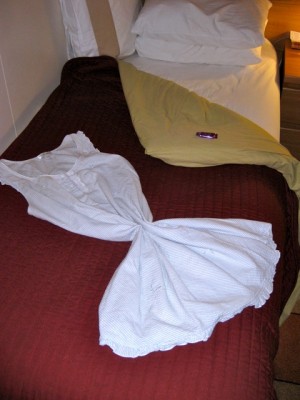
Most nights when he turned down our beds, I found my nightshirt in a lump by my pillow.  But Nancy’s nightgown would be arranged to look like a butterfly or a fairy.  The first time this happened, we stared at it together.  Nancy took a photo.

“Do you suppose he’s naked when he does that?” I asked

“I don’t know, Elena,” Nancy said.  “That’s your fantasy.”

*                           *                           *

One morning we were ushered into breakfast near a woman who was finishing her own meal.  Our butts hadn’t even touched our chairs before her words shot at us like BBs.

“The muffins are good and I like the way they do the eggs my coffee wasn’t hot enough it looks like it’s going to be a better day than yesterday I enjoyed the glacier I’m from Ottawa–”

I made an immediate decision to not engage, to be surly if necessary.  Nancy murmured something.  It didn’t matter one way or the other.

“I’ve never been on this coast it’s a long way to come for a week on a ship there are so many nationalities I can’t understand what half of them are saying it’s a problem we have in Canada the multi-culturalists bah they violate my civil rights these Muslims with their robes and head-gear.”

Nancy and I exchanged glances.  I thought about spitting my prune pit at her.  Nancy, in her gracious Libra way, asked, “How do they violate your civil rights?”

The woman slammed down her (cold) coffee cup and raised her voice, unnecessarily because she had already cracked my water glass.  “Well, I don’t want to have to look at them!” she declared.

There was a pause.  “Where are you ladies from?” she asked.

“From Seattle.”

“Oh really, you’re American?   You aren’t as aggressive as most Americans.  That’s a compliment, by the way.  I would never live in America.  Your political parties hate each other.”

Nancy and the woman actually shook hands when we left.  I do admire her ability to be civil.

*                      *                           *

But then I have my gracious moments, too.  When I called in at Guest Relations the day after my first watercolor class, Umar informed me that a student had complained about me.

“She said that she asked you for some paint and you ignored her.”  He looked sympathetic.  “I wasn’t going to say anything to you because this lady, she seems to have so many concerns but maybe there’s something you can do for her.”

I took the name and stateroom number. The only person I could remember offending was the reporter from the major newspaper which will continue to go un-named. I thought about the chaos of that class when 50 people swarmed the table fighting for a few squeezed out tubes of paint.     https://www.elenalouiserichmond.com/2011/07/meltdown-in-alaska/

I said to Nancy, “My god, couldn’t she see what was going on in there?”  But of course, so often we can only see what affects us.

I called the student and gushed over the phone that I was sorry I had ignored her.  I asked her to introduce herself to me at the next class and I would make sure she had everything she needed.  I can do this for a student but I don’t care to put myself out for a spiteful woman who launches herself at me before I’ve had my tea.

We never saw the woman from Ottawa again and I never heard back from the offended student.  But for the rest of week, whenever I saw Umar at Guest Relations, he smiled conspiratorially and asked “And have you seen our friend today?”

*                           *                           *

Nancy’s favorite person on the ship was Graham Sunderland, The Naturalist.  He gave lectures about pretty much everything on land and sea that we could see from the decks.

After teaching my first watercolor class, I spent two days in fetal position so I didn’t hear Graham’s early lectures.

“His humor is off-color,” Nancy said.  “I know he would appeal to you.”

After the second lecture, Nancy reported that The Naturalist –she always referred to him as The Naturalist–said, “Whales are like people on a cruise ship. They open their mouths and food swims right in.”

At the first lecture I attended, The Naturalist explained that while most salmon return to the stream where they were born, it is a myth that they all do.

“Salmon are like human beings.  There are always some bozos who get it wrong.”

We ran into The Naturalist one evening on an outdoor deck that was unpopulated because there was no place to sit. The three of us talked about the ship’s caste system.  I told him that our running joke was what we might do that could get us put off the boat in Juneau.

Graham’s degree was in Ornithology.  His first year on a ship, he had rescued the dead bodies of various birds that flew against the boat and knocked themselves out.  He had wrapped them up and put them in kitchen’s freezer intending to use them (somehow) for his lectures.  He was not branded a bozo who got it wrong and he was not put off the boat in Juneau.  He was asked back for a subsequent year.

“I hope we run into The Naturalist again,” Nancy said at least once a day.

Our last day on the ship, Graham, Nancy and I met for tea which stretched into dinner.  He told us more funny stories from his twenty years of experience.  One question that seems to be asked quite often, prompting Graham to an aside that salmon have a higher I.Q. than a lot of folks on cruise ships, is

“Does the crew sleep on board?”

On one run, a sarcastic staff person replied, “No, we are air-lifted off at night to sleep onshore.”

In the evaluation forms at the end of that cruise, someone had commented, “I enjoyed everything about this trip except the noise from the helicopters at night when I was trying to sleep.”

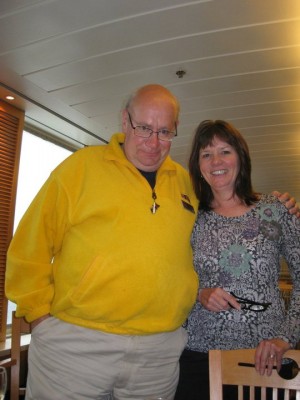
Graham’s comment about the photos that Nancy took that evening was that he looked like a Taxi Cab in his yellow shirt.  I said I looked like the drunken fare he had to take home.  And Nancy looks like someone who got her wish to run into The Naturalist again.

Nancy and The Naturalist

Taxi cab and drunken fare


The Nightie

Ah, HumanityCurmudgeonFriendsTravel

July 7, 2011

Nancy to the Rescue

Tags: , , ,

In our entire week aboard a cruise ship (the S.S. Wish-I-Was-Home), Nancy and I did not use the Fitness Center once.  I wasn’t even sure where it was.  However, except for the day we came on board after a cold, wet 8 hours in Juneau, we did not use the elevator either.  We used the stairs.  This activity combined with the state of rage I was in for the first three days, resulted in my actually losing a pound.(https://www.elenalouiserichmond.com/2011/07/meltdown-in-alaska/)

Our stateroom was on the 5th deck, or Below Stairs, so to speak.  Most of the activities were on the 6th and 7th decks and the constant supply of food was on the 11th.  In addition, I was always getting lost and having to retrace my steps in order to start over.  So it was a lot stair climbing. My glutes, which historically hang off me like empty vacuum cleaner bags, were doing their job quite efficiently by the third day.

Cruise ships are legendary for their continual supply of food.  There were guilt-inducing amounts.  Something was available twenty-four hours a day.  It may not always have been what we wanted, but it was available and we were free to take it anywhere on the ship.  Nancy sometimes asked for smaller portions.

One Romanian waiter was puzzled.  His pen was poised while he tried to figure out what to write.

“Just one egg,” Nancy repeated. “I don’t like to waste.”

He raised his eyebrows. “You’ve come to the wrong place,” he said

When I said in my previous blog that we were bumped from the dining room, I wasn’t entirely accurate.  I was going for pity.  We could eat breakfast and lunch in the dining room, but we were bumped from the 6 PM dinner because I was a Non-Revenue Guest with little social standing in ship society; and Nancy, by her unfortunate association with me, was regarded similarly.  The second seating was at 8:30, far too late for me with my particular digestive situation and sleeping habits.  So here is where the pity comes in: poor me, on a ship with enough food to feed several continents, and available in some form 24 hours a day, but I couldn’t eat in the (hot, noisy) formal dining room when I wanted to.

Nancy could have gone without me at 8:30 had she wanted to, but she didn’t.  So we usually ate dinner on Deck 11 where it was quiet and the grilled fish and the raw sushi were good, at least at the beginning of the week.

At the end of that cold, wet, tiring day in Juneau when we took the elevator for the first time, we also sat in the Jacuzzi, all of which left me with the impression that I had actually used the Fitness Center.  We looked at each other and agreed that we were tired of dinner on Deck 11.  Maybe we could get into the dining room at the early seating because other people who also might be tired could be opting to dine in Juneau.

“Will you do the asking?”  I asked Nancy.  “I’ve bothered them all so many times that I am sure they will pre-emptively refuse when they see me coming down the hall.”

At the dining room I skulked around the corner while Nancy charmed an affirmative out of the assistant maître d’.  It was a formal dinner but Nancy assured him we would change and be back in fifteen minutes.

“Did he actually say we weren’t presentable?” I asked.

“I don’t know, Elena.  I don’t do details, I get general impressions.”

(“What will I say in my blog?” I thought.  “I need a quote.”)

Nancy had a cocktail dress that could double as a skirt and I had a black dress with a jacket that could double as either a bathrobe or a swim suit cover-up.  This is what one calls Travel Chic.  We wet down our cowlicks, pulled the hayseeds out of our teeth, and  hurried back to the dining room.

The head maître d’, a man I had bothered even more than his assistant and the hostess, was standing guard at the entrance to the dining room.  His decisions were final.  I flattened myself against the wall, something that was harder than usual to do given the shape my glutes were now in.  I waited a long time.  Finally Nancy peeked around the corner and beckoned.  I scrunched down and tried to hide behind her as we were ushered into the dining room and handed from waiter to waiter until we ended up on the lower level and across the room from where we started.

A protest went up from the people at the table.  Those seats were taken by others in their party.  I looked away, watching for the maître d’ and pretending I wasn’t part of the drama.  I was prepared to see something so fascinating out the window I would cross the room to look at it.

Nancy is diplomatic and gracious.  She employed just the right tone to cut through the complexities of the interaction.  I could learn so much from her.  It all got sorted out.  The folks at the table suddenly remembered that two of their group had been given a complimentary dinner in the ship’s exclusive restaurant because they had complained about the noisy conditions surrounding their stateroom.  This is what the Revenue Guests get when they complain.

Our status then changed from Interlopers to Persons of Interest.  We were welcomed into the large party of retirees from a community on the Jersey shore.  It was a fun evening of lively conversation, and a good meal: tender lobster followed by baked Alaska.

Later in the evening, on our way through the ship, we ran into the cruise director who assured me he had spent $200 on art supplies in Juneau.  My awful week had begun to turn around.


CurmudgeonTeachingTravel

July 4, 2011

Meltdown in Alaska

Tags: , , ,

(written aboard the S.S. Wish I Was Home, June/2011)

A cruise ship operates on a feudal system.  The peasants smile, say good morning, look exhausted and serve the Revenue Guests until their wide feet ache.  The RGs have so many needs that I understand why room service sometimes brings the cream but the water is cold, or the water is hot but they forget the cream.  I am grateful that I am allowed to order room service at all given my position on this ship.

I am in the artisan class.  Our position in society has not changed in a thousand years.  We are paid mostly in the form of appreciative comments like:

“Oh how lovely.”

“I wish I could do that.”

“I haven’t a creative bone in my body.”

Musicians, artists, and writers are arguably who make life bearable for everyone.  We are a bridge that connects the poor with the mighty.  We finance our own maintenance and are walked on regularly.

If you want to be in the artisan class, you have to not only love what you do, you have to find your internal survival in your art.  Painting, singing, and writing is where I go when life gets unbearable.  Here on this ship, I am glad I have my paints, a pen and a notebook because I am not cleared to touch the pianos.

I was tense my first day of teaching watercolor on board.  The watercolor teacher is so low on the list of who matters that I only saw the activity director twice in a week.  I learned I could be bounced from just about anything without notice.

I arrived at my first class half an hour early, terrified by the fascist language that ordered me to be 20 minutes early and dressed in “business attire,” whatever that meant. And I was feeling inferior because I had just been unceremoniously bumped from dinner in the dining room.  I waited for 25 minutes.  I didn’t know where anything was, I had been assured that Housekeeping would set up the tables, and get out the 35 art kits, each of which contained six tubes of paint, three brushes, ten sheets of cold-pressed watercolor paper, and a palette.  They would hand out numbers to the first 35 people who arrived; the rest could try again at the next class.

There were 45 students milling around before Housekeeping set up the demonstration table and got out the box of supplies.  Instead of 35 art kits, there were, in fact, twelve palettes, three trays of mostly used up watercolor paints in odd colors, and nine small pieces of watercolor paper about the size I use to test for paint saturation.

“Where’s the paper?”  I asked.  “Where are the kits?”

“This is what you use,”  Housekeeping said.

“I can’t teach 50 people to paint with these supplies!”

“This was enough for the other teacher.”  Housekeeping looked at me with contempt.  She added in a hiss, “This is not the place to have this conversation.”

Forty-five people waited expectantly.  So I did what any professional teacher with thirty years of experience would do:  I turned away and burst into tears.

I knew instinctively that what was expected of me as a team player (which I have never been and was not going to start now) was to say, “I’m sorry, but due to my incompetence and ill-preparedness, there are inadequate supplies.  Please blame me.”

But I wiped my eyes, turned around and chirped into the microphone, “Hi, My name is Elena.  If you have heard that watercolor is difficult, I want to show you why it doesn’t have to be.”

I hissed right back at Housekeeping to cut down some cups to make “palettes,”  find me some paper and bring me some drinking water.  Someone brought drawing paper from the children’s center.  It was little more than newsprint that was going to disintegrate with my wet-into-wet technique.  I gave the nine pieces of watercolor paper to the first people who had come in.

I lined up the meager supplies and without thinking, invited people to line up and take one of everything.  What was now over 50 people swarmed the table and began squirting gobs of paint into cups, fighting each other for brushes and water from the bucket.  I watched in dismay.

Someone politely asked me if I could find her some blue paint.

“No,” I snapped.

She was a reporter from a major newspaper which I will not name because I don’t want you going into their archives and reading of my shame.

Somehow we all got through it.  Some folks were even delighted with their paintings.  When they all left for their next activity, I sat down amidst the ruins of Art and sobbed.

My traveling companion on this ship, my great friend, Nancy, who can tell me every time I have de-constructed a thought, had watched the whole mess from the back of the room.  She told me she hadn’t been able to tell anything was wrong.

Two fellow artists, who sat in the front row and who had come mostly for the pleasure of not having to be the teachers themselves, told me I had handled things beautifully.  I was glad I had given them pieces of the watercolor paper because they knew the difference.

But Nancy talked to the cruise director for me.  “She is not going to be able to pull this off again,” she told him.  “She is going to need watercolor paper.”

The paper was three days away in Juneau.  It took me that long to recover from my first class.  Things got better.  Stay tuned.  I think I have one more cruise blog in me.


Ah, HumanityTravel

June 24, 2011

Anticipatory Activities

Tags: , ,

Today is the day I pack for a trip—teaching watercolor on a ship cruising up the Inland Passage into Alaska– but I have reached a point where I would rather stay home than cope with the mounting number of things to do before I leave.  A few weeks ago when I hauled out the suitcase and put a few things in, that was fun.  I started a list, that was fun.  The anticipation was mild and dreamy and nothing was crucial because there was plenty of time. I took a whole hour to plan the paints I would take and to squeeze them into my travel palette.

But as the departure day got closer, the list of things to remember to do got more complicated: re-new prescriptions, hold the mail, pay bills before I go, anticipate bills that expect to be paid while I am gone, instructions for the house/cat-sitter and oh my god, I got rid of cable TV months ago and though I have been quite happy without it, what if the cat sitter requires the ability to watch Animal Planet while she’s here?  Sheets.  She needs clean sheets and I leave at 5 in the morning, must remember to make the bed.  What if I forget my passport?  Did I put it back where I always keep it or did I put it someplace new so as not to forget it? What if that book comes in at the library and I miss picking it up?  Then I am back to number 458 on three copies.

Mid-week, a puddle of water collected outside the water meter hole on my parking strip.  I pried open the lid of the hole to discover eight inches of standing water.

“Oh god,” I thought. “I have to get the entire house re-plumbed.  My house-sitter won’t have any water.  I can’t go.  ”

The city’s emergency techs came at 1:00 in the morning, woke me up and got the cats all excited, but fixed the leak.

Then my friend Nancy who can tell every time I have de-constructed a thought, and who is going with me on this trip, called to say that after reading all the material from the booking agent, she isn’t sure she has any clothes appropriate for the trip.

“What are you talking about?”

“Haven’t you read the material?” Nancy is an English teacher.  I wonder how many times a quarter she asks that question.

“Not yet, why?”

“They are very particular about how you, as an ambassadress for the ship, and your guest, me, present ourselves.

“Nancy,” I said. “I don’t think you have anything in your closet that isn’t appropriate for this trip. I think they are concerned about someone coming to dinner in a thong and a tank top with no bra.”

My painting partner, Susan, told me a great story from when she was running a nursing agency in central California.  A male aide came in one day wearing see-through pants and no underwear.

“You’ll have to go home and change,” Susan told him.

“There’s nothing in the regulations,” he challenged her.

“I realize there is nothing in our regulations that say you are not allowed to come to work naked, nevertheless, you are not.”

“I can report you.”

“Go right ahead. But for today you need to put some underpants on.”

I looked through the massive amount of info from the booking agent and by the time I got done reading it, I seriously wondered if I had anything in my closet appropriate to their dress code.  And there were an inordinate number of references to reasons a staff member might be “put off the boat.”

Nancy and I had a long discussion about what clothes we would take.  The new on-going joke looks to be what we might do that would get us put off the boat.  I am supposed to wear business attire when I teach, specifically slacks and a blouse.  I don’t own any blouses, as such.  Could I get “put off the boat” for teaching in what are essentially leggings and a T-shirt?  I mean they are very nice leggings, new in fact, and very nice T-shirts.  They aren’t even T-shirts, they are “tops.”

As of this writing, Nancy is already on her way to our port so she is theoretically out of my worry range.  I leave tomorrow morning.  I can just get the suitcase closed.  That was another thing: the challenge —and the commitment —was to get everything into a carry-on bag.  And use up all the perishables in the fridge but still have what I need tomorrow morning.  I wonder if they put people off the boat for obsessing.

In any case, you might not hear from me for a week.  If I have the appropriate attire, I will post a blog from the ship.  Or wherever I am when they put me off the boat.


Ah, HumanitySpirituality

June 19, 2011

Adventures in Alcohol

Tags: , , , , ,

No one was more surprised than I was to discover I had a taste for Scotch whiskey.  The child of an alcoholic, I grew up with a fear of alcohol and a dislike of being in situations where people were likely to be drunk.

I, myself, have only been drunk once: the night before I was graduated from Whitman College.  Too many Singapore Slings followed by some nasty Madeira was an effective inoculation against alcohol of any kind.  Thirty five years later I still don’t care all that much for gin.

Wine offered a safer field in which to wander.  I learned how it’s made, how to savor it and talk about it; how to escape a wine snob etc.  I had one moment at L’Ecole No. 41 in Lowden, Washington on the way to Walla Walla when I tasted their Apogee: an entire Christmas season passed through my mouth: the carols, the food, the lights, the warmth, the angels.

For one sip I understood what all the fuss was about.  And immediately after I understood the meaning of “Sic transit gloria mundi” as well.  It never happened again.  Not in the second sip that day nor two years later when I was again on my way to Walla Walla.

I learned a lot about wine.  I just never learned to like it. And wine, indisputably, doesn’t like me.  I don’t get a warm glow or a nice buzz.  I get stupid and slightly nauseated.  It would be more efficient just to give me Rohypnal.

When Joan, my friend with the theological chops, the one with whom I have long conversations about spirituality, offered me some Lagavulin Scotch, it seemed a long way from throwing up in a toilet in College House on the Whitman campus.   I took a sip.  What a revelation!  The Comforter had come.  I didn’t brush my teeth that night because I wanted to fall sleep with that smoky, peaty finish in my mouth.

Fast forward a year or two.  I was watching TV with Chris and Dee.  Chris, the unclassifiable except she is an excellent cook and a CERT trainer.  Dee who missed church this (and every) morning because she was out practicing witchcraft and becoming a lesbian.  That Chris and Dee.  And their four Chinooks.

“Do you have any hard liquor?” I asked.

Chris’ head swiveled.  She thinks of me as a gluten-free vegan wimp.  No wait, I’m the one who thinks of me as a gluten-free vegan wimp.

“I do,” she said.  (I love it when people answer in the affirmative with “I do” instead of “Yes.”  It gives me a frisson.)

She had some Laphroaig and, as a bonus, she knew how to pronounce it.  Another revelation.  I thought nothing could be smokier or peatier than Lagavulin but  Laphroaig out-smoked and out-peated it.  I wouldn’t want to brush my teeth for days.

I was over at Gwen’s the next day –Gwen, my neighbor who knows something about just about everything—trumpeting the delights of Laphroaig and asking her what she knew about cigars.  That seemed the next step.

I have not advanced –yet –to cigars, but my birthday was two days ago and both Gwen and Chris gave me bottles of Laphroaig.  I got out the Lagavulin as well.  We sat outside with the salads and the gluten-free birthday cake and compared  Scotches.  They both have their charms.  I’m not sure we came to any definite conclusions, especially not after I brought out the Absinthe.

My bottle of Absinthe is a novelty that will last me for the rest of my life even if I live to be 100 which I sincerely hope I do not.  I bought it years ago when it was illegal to sell but not to own, go figure.  Absinthe has fascinated me since college because I was an English major.  I don’t think you have to be an English major to be interested in Absinthe.  I think it works if you are an art major or have read a Graham Greene novel.

In any case, there was an article in The New Yorker a few years back called “Green Gold” about some Americans in France who were making Absinthe from 19th century recipes.  I ordered a bottle from their website.  The shipping cost more than the bottle itself.  It was an extremely expensive proposition.  It seemed the risk was all theirs.  I clicked “submit,” and waited.

A week later at 5:00 in the morning, I heard a thump at my front door and the sound of a car speeding away.  On the front doorstep was a package with a customs label that said “printed material.”  I get things from across the pond now and again from my English cousins but this didn’t look like anything they would send.  This looked like something out of a Graham Greene novel.  It was my Absinthe!  It had gone from France to England, sailed across an ocean, slipped through customs as “printed material” and was couriered across the continent.

Absinthe is (famously) chartreuse and (also famously) hallucinogenic although I believe that has been contested.  I maintain that any alcohol can be hallucinogenic if one drinks enough of it which is not an issue with the Absinthe.  It is so strong, it’s almost undrinkable.  And once you’ve had some, you can’t feel your own tongue.

I pour a little in a bowl, everyone soaks a sugar cube in it, take a few sucks off the sugar cube and that’s it until the next time I entertain.  Except I get to tell the story about how the bottle came into my possession.  About 20 more years of telling the story and it will have been worth what I paid for it.

Now I have enough Scotch to last, well, a few years.  So don’t give me any next Christmas.  But I am running low on Drambuie and I like that, too.