
Choir SingingDogsFriendsHolidaysPosts

April 24, 2011

Choir Dogs

Tags: , , , , ,

I’ve been waiting for the traffic on my last blog to slow down before I posted another.  I don’t know if it delivered all that it promised, but “Sex and Betrayal at the OK Chorale” sure got a lot of hits. (www.elenalouiserichmond.com/2011/04/851/)

If that’s what it takes—a racy title—I was toying with the idea of calling this blog “Easter Debauchery” but that would be cynically misleading.  It’s just that I feel debauched.  Holidays are exhausting for musicians and florists.  By Christmas Day I don’t want to have brunch or dinner or see anyone or ever get out of bed.  If you polled members of both professions, you would probably find a shocking lack of reverence around Easter. And this year with Easter coming so late, working with the church choir has felt like one of the U.S.’s endless election seasons.

But it had its fun moments. Last February I introduced the choir to a couple of pieces that I thought would be good for Easter morning.  One called “Resucitό,” is a dramatic Spanish language piece in a Flamenco style.  We struggled with it for months. Finally I took out the most awkward verse.  Literally.  I whited it out and made copies of the redacted music so as to eliminate confusion. We worked on the elisions which the Spanish speakers in our little group had more trouble with than those of us with grade school Spanish whose pronunciation was never pristine to start with.  Just thinking about the effort makes me want to sleep until August.

The other piece was called “Oh, What Beauty, Lord, Appears.”  Or as Chris, the unclassifiable except that she owns three Chinooks and is a great tenor, called it: “Oh-comma-what-beauty-comma-lord-comma-appears.”  The attraction of this piece is that the text is set to music of Mozart and arranged in a Mozartean style, evocative of powdered wigs and candelabras.  I referred to it as “The Mozart.”  It was difficult but I knew it would be satisfying to learn.

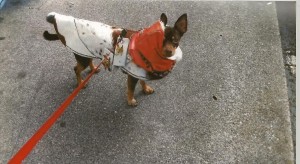
The two pieces were just coming together when two rehearsals before Easter, Marvin showed up.   Marvin is a Min Pin—a miniature Pinscher—and the comfort dog of a woman in the church named Karen.  Karen is another good tenor but we hadn’t seen her all year.  I don’t know why she up and decided to come to choir rehearsal two weeks before Easter, but she chose an evening when Starfire, the Chinook, fresh from Shy Dog Class was already there with Chris to practice her social skills.  Starfire was practicing her social skills, not Chris.  Chris has been in the army.

Little Marvin was swathed in a fur cape with an orange hood to protect him from the cold.  Karen had added beaded tassels to the hood and flaps of leather festooned with pirate heads to the cape.  Marvin almost disappears inside this regalia except for his little legs that scurry him around.

I was already feeding dog biscuits to Starry who was blissed out under the piano bench.  Marvin joined the picnic.  The doggie activity that night was more to my tastes than the mounting frenzy around preparations for the Easter morning service which had begun to feel like the atmosphere around my mother on Thanksgiving morning. (https://www.elenalouiserichmond.com/2010/11/thanksgiving-day-circa-1965/)

As far as Marvin was concerned, Easter morning church was no different than Tuesday evening rehearsal.  There I was, the cookie lady, and he expected treats.  Everyone else in the church got an Easter egg, compliments of the kids so why not Marvin?  I had dog biscuits lined up on the music rack and at the end of every verse of “Resucitό,” I swept another onto the floor for him.

The last chorus of the dramatic Spanish anthem was sung a capella.  I hit the first chord, then maneuvered my way from the piano, through the   sopranos and our lone alto so I could direct the ending.  I looked up at this tiny choir that I have worked with for four years. There they stood, looking like a street gang, the Sharks in formation, thundering “Re-su-ci-tό” with little Marvin dancing around everyone’s legs, a little ballerina in a tutu.  The very image makes me smile.

The Mozart came off just as beautifully.  The operative concept for Mozart is “grace.”  There were a couple of rests in the music adequate for gracefully flicking dog biscuits onto the floor.   It was very satisfying.

I think Marvin is probably a soprano but we are fully stocked with those.  We need more altos.  I may audition Starfire.
Marvin the Magnificent



Choir SingingPostsTeaching

April 14, 2011

Sex and Betrayal at the OK Chorale

Tags: , , , , ,

I’ve got this lovely piece of music in front of me and I am musing about loss of innocence in a post Thomas/Hill world.  It’s called “Matona, Lovely Maiden,” and I first heard it on a long playing LP of the Obernkirchen Children’s Choir.  I was probably eight years old.  On the album cover was a photograph of the children.  I listened to the record over and over, and stared at the faces, trying to imagine whose voice it was that stood out in this line, on that note, and who was the soprano whose partials floated to the top on that last note.

“Matona, Lovely Maiden” is an old war-horse of an Italian madrigal.  It has a recurring refrain of the “derry derry, dong dong.” variety.  The German kids sang “diri diri, don don”  in the original Italian.   The harmonies and rhythms are easy-ish and it seemed like a good choice after all the challenges of last quarter’s music. (https://www.elenalouiserichmond.com/2011/03/makin-time-with-the-ok-chorale/)

The OK Chorale has sung it once or twice in the past with no repercussions.  Maybe the last time, there were some snickers.  Last night we couldn’t get through it even once.


Matonna, lovely maiden, Oh, listen to the song;

We sing beneath thy window while night clouds roll along

Dong dong dong, derry derry, dong dong, dong dong


Sweet, no?  So far, so good.  The dongs still referred to bells in a majority of minds.


“I pray you hear my ditty, tis sweet and not too long.”

(The edges of the group began to crack.)


“Tis pointed, if not witty and sharpened as a prong.”

(Safe to say the dongs are no longer about bells.)


“The words of choicest tissue, to shoot .  .  .”

(This line was interrupted by an an implosion.)


I exchanged my piano glasses for ones that can distinguish faces.  The first face I saw was that of Maxine, a mother and grandmother, formerly a pastor’s wife and owner of a business called “Altars Everywhere,” a name which in this climate could no doubt acquire unintended associations.  Her face was crumpled in laughter and tears were running down her checks. (http://www.maxinemanning.com/)

“OK,” I thought.  “If Maxine can’t get through this for laughing, we’d better pack it in.”

We moved on to “All Around My Hat,” also one we have done before.  It’s an old Steeleye Span hit that I have arranged somewhat staidly because we all don’t have Maddy Prior’s instincts for rhythmic flourish.  When I am the arranger, the music is always a work in progress; I am continually finding typos and notes out of alignment.  When I get enough of a mess on any one page, I re-write it.

We found a couple of typos in last night’s rehearsal.  A minor skirmish broke out over the line-up of words to notes.   In verse one, we had a “false deluding woman”—six syllables—to parcel out to eight notes.  In verse two, we had a “false deluding young man” –-also six syllables to eight notes.   It wasn’t flowing.

I get no end of advice in these situations.  Pages rattled, basses leaned over to tap things out on their neighbor’s music, altos called out instructions to me.  The tenors tried to tie in the ding dongs so they could continue snickering.  (Do you know, the tenors, who sit farthest from the piano, all brought binoculars to a rehearsal once?  They are an unruly bunch.)

“You have the deluding young woman on the first beat but the deluding young man is on the second beat, that’s the problem,” someone said.

We had the only silence in the entire evening while everyone considered this.  It was broken by Sandi, author of Humor in the Workplace, who announced, “The deluding woman is not young.”

The Chorale exploded.  I looked at the clock.  Five more minutes.  No, really, I was enjoying myself.  It was a great beginning to the quarter.  Not too late to sign up.

Sadly, I will retire Matona and her dongs for good.  I wonder what those Obernkirchen kids are doing these days.


AnglophiliaEnglandTravel

April 10, 2011

Wellspotting

Tags: , , , , , ,

I sent some marshmallow Peeps to my cousins in England.  It was partially to reciprocate the chocolate Tiddly Reindeers they sent at Christmas, partly to contribute to good relations across the pond and partly because Peeps don’t weigh very much so the postage isn’t twice the cost of the item.  Well, actually it is but the item doesn’t cost much in the first place.

And partially because I am grateful to England for the Cadbury creme egg.  So this was a return gesture not unlike the kindergartner who gives a glue-encrusted macaroni sculpture to the mother who gave him life.

I love the cultural exchange between the two countries.  I keep a file of words that my friend Sue has interpreted for me.  Like “moreish.”  Chocolate Tiddly reindeer are moreish.  They make me want more.   I was made over with them (i.e. pleased.)

It’s fun to learn the expressions here and then encounter them over there.  I was flipping though some brochures in St Mary’s church in Rye when I found some with a picture of the church on the cover but with the inside copy missing.  I gathered up the blanks.  When I showed them to the volunteer at the till, he –to my utter delight—said, “Oh well spotted!”

I had another church experience in Bath.  I was there with my cousins, Pamela and Mervyn.  We usually split up when we get to a town because I have my peculiar interests and Pamela mostly likes to find the Marks and Spencers, especially on a hot day because they have such lovely air conditioning.

It was hot.  I had a Sally Lund at the Sally Lund house while it was still morning, and then decided to do a tour of Bath Abbey tower.  Three hundred steps up and I thought, “Aw geez, you haven’t recovered from the hill climb the other day at Cheddar which was also a bad idea and this involves an even greater height.”  I get queasy at high altitudes.

I went straight to the center of the tower and breathed deeply. Then I crept to the side and peered far down into the market place where people were milling around like so many ambulatory dolls.  The first things my eyes focused on were Pamela’s familiar plaid skirt, her bright handbag and Mervyn’s distinctive gait.

I just about toppled over the edge of the tower. “Look!”  I grabbed the person closest to me who happened to be the tour guide.  “There are my cousins down there, going into Edinburgh Woolen Mills!

“Oh well spotted!” she said.

The street, or dual carriageway, if you will, runs in both directions.  A taxi driver at Paddington, who would have been a young boy during World War II, told me, “I will always love the Americans for what they did for us.”  I gave him a whacking great tip.  He grinned and saluted.

I spent an afternoon at spooky, old Highgate Cemetery on that same trip.  The guide opened the wrought iron gate with a whacking great skeleton key and then locked us all inside for the tour.  As she was unlocking the gate to let us out, we were halted by a thunder and lightning storm.  Very exciting, but the point is that I got to chatting with a group who were old school chums, Julie, Jill, and June, while we waited for the rain to abate.  They invited me to join them for lunch.

At the café, I ordered a chicken Caesar with dressing on the side.  A whoop went up from all three women simultaneously.

“What?” I asked, astonished.

“Oh!” said Julie.  “I have always wanted to hear an American say ‘dressing on the side!’  They always say it in the movies and now I have heard it for real!”

“An English person would never ask for that, or for anything, really,” Jill explained.  “But the Americans will do.”

Oh, I don’t know about that.  They asked us to come over and help with that war a while back.  I’m really glad we did.

Highgate Cemetery, London, watercolor by Elena Louise Richmond

PianoTeaching

April 5, 2011

Every Girl (and) Boy Do Just Fine

Tags: , ,

Most of us of a certain age have heard that “Every Good Boy Does Fine.”  It was de rigueur for learning music notes on the lines of the treble staff.  I must rant about the inherent sexism but before I do, I want to launch the news that piano isn’t taught that way anymore.

When I was a child in music lessons, names of the notes were drilled into me.  When I played, I translated note to letter name to piano key until, as with any language, I began thinking in music.

I taught note names exclusively for years until intervals began showing up in the method books.  With interval reading you learned to judge the distance from one note to the next or in the case of chords, you read shapes rather than individual notes. Eventually, of course, you learn the names of the notes as well.  Sight reading skills grow quickly when one uses both techniques.

Over the years I have encountered parents who are suspicious of interval reading because like me, they had note names drilled into them.  The suspicion seems to be that interval reading is designed to teach students to understand music without actually teaching them to play.

“She doesn’t know the names of her notes!” a mother threw the accusation at me as though she was exposing a fraud.

“Not all of them,” I said.  “Not yet.”

“What is she doing at her lessons?”

“Well, she’s having the experience she’s having,” I said.  “Would you like to sit in on a lesson?”

I didn’t want her there—talk about having an unbeliever at the séance–but she was signing my checks.  Turns out she didn’t want to be there anyway and her daughter wanted her there the least of all.

Some students need to know where every note is, what it’s called, and what it’s doing.  These are our future accountants.  Other personalities would sooner bang their heads on the music rack –and some do—than do note drills. Still others don’t care about anything except sound;  they can get into quite difficult music before it’s clear they don’t know how to read a note.  I have students whose hands are constantly caressing the keys: they rely to a great extent on feeling the relation of the black keys to the white keys.

So it’s good there is more than one way to go about learning something.

I overheard a couple of old school music teachers cluck their tongues at a young teacher who let a student play a piece in the key of D, leaving out the sharps on the first pass through.  The second time through, the student sharped all the F’s and C’s; the third time through, she counted and finally worked out the fingering.  The older teachers had the same look my mother would get whenever she suspected that somewhere in the world some child might be learning to read without using phonics.

Teachers cannot control what or how a student learns.  I liked the young teacher’s idea because it allowed her student to make choices about her learning.  When you learn a new piece of music, everything comes at you at once: notes, counts, fingering, tempo.  It interests me to watch a student choose the most manageable way to begin.

I really want to get to my rant about sexism in piano lessons.  Why was it only the boys who did fine?  I mean, it’s not true, for one thing.  Even worse than “Every Good Boy Does Fine” was the variation that filtered into my piano lessons when I was ten: “Every Good Boy Deserves Fudge.”   How is that fair?

When I started teaching I changed the mnemonic to “Every Girl and Boy Deserve Fudge.”  But one year I ran a contest to see if my students could come up with something better although there isn’t much that’s better than fudge.  The winner was Jeremy Caci who came up with “Elvis Goes Boogieing Down Fremont.”

Adult students are dismayed when they learn that the bass clef has a completely different mnemonic.  The line notes — G-B-D-F-A –are traditionally taught with some uninspired saying like “Great Big Dogs Fight Animals” (or Ants.)   This is what I call aclever.

But my friend Chris, the unclassifiable except that she is a good cook, recently came up with a splendid mnemonic for the bass clef line notes:  “Good Bikes Don’t Fall Apart.”

So far we have only been talking about line notes.  The space notes in the bass clef still insist that “All Cows Eat Grass.”  The space notes in the treble clef still just spell F-A-C-E, which every boy and girl deserves to stuff fudge into.


CatsPianoTeaching

March 28, 2011

More Tales From the Studio

Tags: , ,

Winston and the late Edwina and were five year old cats when Freud and Artemis joined the household.  Just six weeks old, they were stray pieces of fluff, one orange and white, one jet black; with flat baby noses, pink tongues and soft paws.  They pounced on anything that moved and stalked single grains of rice that had fallen to the floor.

It had been several years since Edwina was that playful and Winston, born a big ol’ doofus, had never been much inclined to anything except eating.  Neither of them was pleased with the attention the interlopers received from my students.  And they begrudged me every minute I spent in the kitchen which was barricaded to function as a playpen.

Abby was eight when her twin brother and sister were born and she began lessons with me.  Abby knew something about being the eldest.

We were sitting at the piano when Winston grouched into the room, well into his season of discontent over the imposition of the kittens.  Abby assessed him expertly and nailed me with her eyes.

“Are you spending extra time with him?” she demanded.

I needed extra time to keep up with this next little guy, aged around ten:

Jacob told me he was making a duplicating machine in his bedroom.  I heard about it every week for several weeks.  One day he came in and announced,

“I’m not Jacob.  I’m his duplication.”

“Is that so?  He must have got that thing to work.”

Next week the boy who came for his lessons was a duplication of the duplication.  I had images of multiple Jacobs flying out of a machine that was out of control.  I wondered if I was going to be getting multiple checks, but the machine broke down and only the original Jacob came after that.

He was an original. And here are two more originals:

“Here we are, two little ghouls come to ruin your life!”

Enter Anna and Julia.

Even the cat looked forward to the girls’ lessons on Monday nights.  I might not have seen (the late) Edith all day, but at 6:30 on Monday night, she was waiting at the door for Anna and Julia who kept to a policy of being businesslike.  This endeared them to Edith all the more.

As distracting as cats are (to me), the subject of this vignette is “ghoul.”  I don’t remember how it started but Anna and Julia created an imaginary world they called Ghouldom.   It had nothing to do with the undead or anything dark.  I think they just liked the sound of the word.  They had ghoul identification cards. They made maps of Ghouldom and established an academy at which one could learn to be a ghoul.  Week after week they brought in travel brochures and literature until I expressed an interest in becoming a ghoul.

I feel the need to reiterate that the weekly visits were for piano lessons–a minor point that may get lost– and yes, we did piano.  Both girls practiced more or less regularly and learned how to play.  See: https://www.elenalouiserichmond.com/2010/12/tales-of-the-high-teas/

The next week the first of my study guides were handed to me, I signed a contract and was issued a temporary identification card.  The following week brought in a flood of welcome notes.

The one from Mayor Henry Ghoul said, “I am honored to welcome you to the land of ghouls.  I hope you try your hardest to ruin people’s lives.  Good luck!”

Dude Ghoul wrote, “Waz up, Man! Dude, have fun bein’ like a ghoul! Later.”

Five year old Patrick Ghoul wrote: “Congragulsion Ms Eleanea. Goood luke at ghoul.  Luov.”

The next week I got an exam schedule.  Every few weeks, a new exam was left for me to complete which I usually did five minutes before the cat stationed herself by the front door and the girls showed up for their lessons.  The whole business had been going on for over a year when Anna who had begun adolescing, dropped out of the game entirely.  Julia and I managed to hold on until I finished the final exam and got my ghoul license.

I saved my final essay because I was quite proud of it (you’ll want to imagine this in Chiller font):


What it means to be a Ghoul

The first thing it means is that there once were two utterly delightful girls who took piano lessons from me, a reasonably sane woman.  One day the girls came to their lesson and they were no longer just Girls, they were Ghouls, come to ruin my life.  While maybe my life wasn’t definitively ruined, it certainly has not been the same since.

One of the hardest things about being a ghoul is learning the list of all the ghoul presidents. Only about 8 are women.  That’s not good news.

The best part of being a ghoul is getting the certificate/license and all the congratulation notes from Very Important Ghouls.  But then my Sponsor took them all away so I couldn’t use them for my exam.  She had better not lose them.

The ghoul diet is kind of restrictive but it’s better than Weight Watchers or The Zone or even Eating For Your Blood Type.

The Very Best Part about being a Ghoul is seeing my Ghoul Students/Sponsor every Monday night.

Respectively Submitted (and this better be good enough to make senior ghoul),

Elena Louise Richmond (Ghoul nickname, Itch)


Mayor Henry Ghoul is proud to see Julia at M.I.T. and Anna about to become president of the student body of Western Washington University.


PoemsPosts

March 25, 2011

Two Hours at Lakem Duckem

Tags: , ,

A few years ago I spent two inert hours sitting at the duck pond on the Whitman College campus in Walla Walla.  It was 109 degrees which is why I was inert.  The two hours produced a poem. The poem was printed in this quarter’s Whitman College alumni magazine.

Lakem Duckem gets its name from more than the ducks.  It has long been a body of water used for fraternity pranks and for consequences of the same.  When I was at Whitman College in the 70’s, I was thrown into what was then a stagnant pond of duck poop on account of having masterminded an RF (Royal Fuck).  A bunch of us dug about 300 earthworms and distributed them all over the TKE house at 3:00 in the morning.

As I write this, I think how incredibly stupid it all was.  The definition of sophomoric humor.  Worms?  It wasn’t even particularly imaginative, which is probably the harshest judgment I can make about anything.  Here’s penance:


Two Hours at Lakem Duckem


They cluster in easy silence

These sleek, green mallards

Like a bunch of uncles after Christmas dinner

With a mutter and squawk of conversation

Now and then.


One of the uncles

declares himself a Father

When I get too close to the ducklings

Tucked up under their mother,

Who is keeping an eye on me.


They are too small, too hot, too alive

To rest for long, these ducklings.

They cannonball into the warm water,

And zoom around the rocks and plants.

They raise up on tiny motorized unicycles

and speed across the pond.


The whole family goes for a lap,

Visiting ivy, ferns, moss;

the goo, the slime, the bugs.

They tank over rocks,

Slide into the water and paddle in circles.


Days later,

I can still see you:

Mother in full sail,

Your flotilla of fluffies

Following your waltz up the pond,

Making mischief behind your back,

Then finding a place in your sway.


Elena Louise Richmond, July 1, 2008


part of the Lakem Duckem stream, 2008

Choir SingingHolidaysSingingTeaching

March 21, 2011

Makin’ Time with The OK Chorale

Tags: , , , , , ,

It was a six Xanax quarter with the OK Chorale.  They always pull it off in the end but three pieces made me wonder if this was the quarter when we would break our streak:

I didn’t know much about Abba.  My popular music education stopped in 1972. (See https://www.elenalouiserichmond.com/2011/03/piano-students-part-2-the-adolescents/ )  Then one of my students who had me in a stupor with Taylor Swift music, brought in the score of Mamma Mia.  I came out of my coma to ask Chris, the unclassifiable, except that she did surveillance on Russian spies when she was in the army, if she had any Abba in her collection.  I was attracted to the possibility of the OK Chorale singing “Take a Chance on Me.”

I decided of my own free will to arrange this repetitive piece of music.  That meant writing “take a chance, take a chance, take, * chance chance” fifteen (15) times for the tenor and bass parts.  That ostinato was the first thing to start waking me up at three in the morning.  That and the cramp in my hand.

I tarted up a little transitional bit with a classical music sequence which didn’t work as well with real people as it had in my head.  We went over and over it.  Individually the parts were not difficult but together, everyone sang like they weren’t sure what they were doing.

I said, “Look, it’s the fault of the arranger; it’s not very well written, so please just sing loud.”  Then it worked.  They made it sound well written.

Every week my friend Nina (rhymes with Dinah) reminded me that there were rests in “Take a Chance on Me” that when observed, made all the difference to the disco feel to the rhythm.  Every week.  Every week we carved a little more sound out of the general areas where there were rests.  Nina is still my friend.

“Why don’t we have Gail’s kindergartners make us a paper maché disco ball like they did the boar’s head?” someone asked. “Then no one will notice the rests one way or another.” (https://www.elenalouiserichmond.com/2010/12/a-boars-head-in-the-hand/)

“No.” said Gail flatly.

“Juramento” is one of the hardest pieces the Chorale has ever attempted.  I fell in love with the sound of this lush and beautiful Cuban song with the grotesque translation, and told the Chorale it was worth the price of the whole quarter.  It was undoubtedly a difficult arrangement and singing in Spanish was a challenge. The score had been published in Cuba and was hard to read.

There was almost a mutiny in the tenor section.

“I can’t read this tenor part.  Why is that stem going down?”  Jean, who is usually ironic, wasn’t.

“There’s no relationship with the bass part,” Hal declared. “There’s nothing to anchor us!”   Hal only ever says funny things.  Here he was, almost rising up with a saber.  Maybe the presence of Chris who used to do surveillance on Russian spies prevented a coup, but eventually the tenors were pacified.

Don, baritone, found a web site where the arrangement was parsed out in midi-files so everyone could listen to their own part in that boopy-doopy midi sound.  Evidently we weren’t the first choir to need the help.  Everyone loved the midi-files.

No one raved so much about how helpful I was.   When I get busy trying to play all the parts and the accompaniment at the same time, I make all kinds of mistakes.  I wonder if everyone realizes this and is too polite to say so.  No, that doesn’t sound like the Chorale.  They probably suffer from some variant of Stockholm syndrome.

The Spanish complicated things.  We learned it on “la” and “ooh.”   I told them to start adding a few of the Spanish words and let them accrue a little at a time as we rehearsed.  I figured some people would get them all and some wouldn’t get any and the rest would fall in a continuum.  This has always been my policy when we sing in Latin and I think it’s a fine one for relieving pressure.

Eileen, tenor, who is fluent in Spanish, told me fifteen times if she told me once that the title was pronounced “Hooramento” not “Yooramento.”  Driving home from the last rehearsal, I finally heard her.  “Oh,” I thought. “I keep calling it Yooramento and she keeps putting her face six inches from mine, saying slowly and patiently, ‘It’s Hoo, Hoo, Hooramento.’”

My shirt was sticking to my back earlier and earlier in rehearsals.  “Hooramento” was supposed to be the only hard song this quarter.  But in addition to it and “Take a Chance on Me,” there was “The Birth of the Blues.” I have done this arrangement with a compliant group of women who knew how to count.  They bore little resemblance to the Chorale.

The rhythm in “The Birth of the Blues” is difficult if you want it to rock, even pebble, in the slightest.  Nearly every entrance is off the beat.  But instead of everyone coming in cleanly on the off beat, we got an echo chamber: st st st st start  fofof  buh buh blues.

We went over and over the entrances.  We counted, we clapped.  I beat my head on the piano.

Finally I said “Just get this one entrance.  This is all I am asking of you.”  I picked out my favorite phrase. The rest were on their own.

Rehearsals were disrupted by the snow that never came.  Noaa had predicted four inches of snow on a rehearsal evening.  When it finally started snowing at 5:00, I learned that four people weren’t coming to rehearsal on the grounds that they didn’t want to risk walking out at 8:30 with two inches of snow on the ground.  At the last minute, I cancelled an OK Chorale rehearsal for the first time in 18 years.  The snow didn’t stick.

The next rehearsal was abysmal.  It was like no one had even seen the music.

The week after the abysmal rehearsal, we were displaced from the church because of an Ash Wednesday service.  Shelley, alto, opened her large house with the grand piano and the cat named Zack.   That rehearsal went so splendidly that I decided I would invite people to the performance.

“Well, you’ve made music out of a molehill once again” Jean said.  Once again she was not being ironic.

The performance last Saturday night was splendid.  The Chorale always pulls it off.  They observed the rests.  They sang loud where directed.  They sang in Spanish.  They rocked.


Ah, HumanityChoir SingingCurmudgeonSinging

March 17, 2011

March Forth

Tags: , ,

This is a curmudgeonly blog so if you don’t want to hear me whine, have a look at the new photo on the teaching page of this web site.  Doesn’t that look cozy and delightful?  My nose is not that big.

Ok, here it comes:  I hate daylight savings time.  I have always hated it but I hate it even more since it started a full month earlier than it used to.  Ok, well, I just fact-checked this and it’s actually only two weeks early.  But the hate-chill factor makes it feel a month early.

We used to spring forward in early April but about 4 years ago, Congress decided to change the date.  Congress. It takes several administrations to pass anything of value but they can agree on this.  Most likely it was some upstart freshman who wanted more light for his golf game after twiddling away the day on the floor who pushed it through.  Little twerp.

I could cry discrimination.  This is, after all, the country of freedom to cry discrimination and to scream obscenities.  This earlier daylight savings time date discriminates against those of us who get up early, love the morning light, and who don’t golf.

Four years ago I did scream obscenities when I got up at my usual 5:30, knowing that the sun would have risen by the time I was settled in with my book, breakfast, and tea; and found instead that it was still the dead of night.  I stood at the window and actually wrung my hands, wondering how this had happened.

In the past few years, I have spent the first part of March watching the early morning light, and saying to myself, “Don’t get used to it.  Don’t look outside.  Ignore it.  It’s going to be snatched away from you in a week.  In 5 days.  Tomorrow!”

Yes, I do have better things to do, thanks for asking, but I’d rather do this.

Because I had the flu last week, I cancelled the Tuesday night church choir rehearsal, and told the choir to be at the church at 9:30 Sunday morning to run through the anthem. This is a lot to expect of people who have lost an hour on Saturday night in the middle of March.

On Sunday at 9:30, one soprano who sings the melody, and another who sings whatever notes she wants to sing were there, as well as the pastor who holds down the entire bass section.  We sang through the anthem.

At 9:40, two altos and a tenor who had left his reading glasses at home arrived.  The tenor was offered three pairs of reading glasses before he found a pair he could use.  We sang through the anthem again.

At 9:45, Mary, the soloist, arrived, hoping to get some warm up time.  Then Chris who still had the jagged ends of a bad cold, arrived.  Chris, the basically unclassifiable, but who is a great tenor.  I played the tenor part with Chris and the other tenor who had spent much of the second sing- through adjusting his borrowed reading glasses.

At 9:55, Mary asked if she could warm up before singing the prelude.

“What, you want to do scales? Now?”

“No,” she said putting her gum on the edge of the piano. “Can I just ooh through it once before I start the words?”

“OK.” I said.  I looked at the little green gob on my music rack.  “If you forget that, I’ll put it in the offering plate.”

Mary and I got through the prelude.  The service was ten minutes late getting started because of the people who having lost an hour during the night were ten minutes late to church.  I kept vamping the prelude even after Mary stopped singing.

I played the anthem introduction as the choir trooped up to the platform.  I played it again while looking into the narthex where Chris, the unclassifiable, loitered.  I repeated the last two lines of the introduction. Chris didn’t look like she was planning to join us any time soon, so we sang without her.

After the service, I ran her to ground.  “Thank you for showing up at all,” I said.

“Didn’t you hear me coughing out there?”

“No.”

“Well, I was.  Every time I try to sing, I start coughing.”

You know what?  Here are my sentiments for everyone for the rest of this dark, wet month: Thank you for showing up at all.

Oh yeah, and have fun out there on the golf course in this rain.

PianoTeaching

March 13, 2011

Piano Students, Part 2: The Adolescents

Tags: , , , ,

Robert didn’t want to take piano lessons.   His brother had been with me for three years and it took Robert a month to decide the mystique was off.  Two years and eleven months to go.  The boys’ mother had decreed that her sons would each have three years of piano lessons as part of their education.  Alan had survived; now it was Robert’s turn.

I don’t normally agree to teach anyone on the steam of a parent’s desire, but I knew the family and I said I would give it a try.  I told Robert as much.

“What can we do to make this fun for both of us?”

“I’ll let you know.”

I bribed him with maraschino cherry ice cubes.  In fact, I joined Costco just to keep that boy in maraschino cherry ice cubes.  During the warm weather months, we started every lesson with one.  Or four.

We got past beginner material, spent several months on the overtures to the Barber of Seville and William Tell—not my choice, mind you.  I think he knew them from cartoons or video games.

Then he told me he wanted to play “Brain Damage.”

“Come again?”

“Haven’t you heard of “Brain Damage?”

This was an opening I wouldn’t exploit in a young person.   “No. What is it?”

“It’s Pink Floyd.”

“OK.”

“Let’s go over to your neighbor’s and borrow a CD so you can hear it.”

“How do you know my neighbor has the CD?”

“Your neighbor has thousands of CDs.  He has to have it.  Everyone has it but you.”

Robert was correct on all counts.  I borrowed “Dark Side of the Moon,” listened to the song, found the music and Robert learned it.  It was his crowning achievement.

Being the younger of the two brothers, he wore his mother down until she sprung him from piano lessons if he promised to do a year of bagpipes instead.   I believe he managed nine months.  After he passed the three year mark for music lessons, he popped in to visit me and finish off the maraschino cherry ice cubes.

Elizabeth introduced me to another song I didn’t know.  It was circa 1998.  I stopped paying attention to popular music when I left high school in 1972.  I found Elizabeth a book of popular songs arranged for level four piano.

“Oh, look, the Y.M.C.A. song!  I want to play that.” Elizabeth said.

“Oh, ok.  What’s that?”

“You don’t know the Y.M.C.A. song?”

“No.”
“But.  .  . but.  .  . do you know how popular it is?”

“Obviously not.”

“But you have to know it.  Aren’t you like an old hippie?”

“Who told you that?”

“I’m gonna tell my mom to call you and tell you how popular that song is.  They sing it at football games and do the motions.”

Well, there was the problem.  I don’t do sports either.  On a tour of upstate New York, I went to the Baseball Hall of Fame museum shop in Cooperstown and bought ten postcards which I sent to ten of my students telling them I had seen the Baseball Hall of Fame museum shop.

Max was one of those students.  He had no end of patience with me.

“Sorry I’m late,” he said one summer day.  “We got caught in the game traffic.”

“Oh, is there a football game today?”

Max smiled kindly. Piteously, really.  “Yeah,” he said. “Only it’s baseball.”

I’m like my mother who called every kind of stemware a wine glass and every kind of alcohol wine.  Football, baseball, soccer, it’s all the same thing to me: a conspiracy to prevent any new generations from learning music.

Here comes my all-time favorite story.  It’s re-told in my friend Sandi Meggert’s book called Creating Humor in the Workplace:

Christian, 14, came one day when I was tired and had a headache.  We were ten minutes into a lesson that wasn’t going very well when he asked,

“Are you mad at me?”

“Oh, no,” I said.  “I’m just tired and a little out of it today.”

Behind the concerned expression, his eyes were grinning, “Is it that time of month?” he inquired.

It took me ten seconds to think how to respond.

“No,” I finally said.  “But thanks for asking.”


PianoTeaching

March 11, 2011

Piano Students Say the Darnedest Things

Tags:

I taught pre-school for four years when I was in my 20’s and had the energy. I love those ages, but it’s been a while since I worked with a child under the age of five in private lessons.

Luciana is 4.  At her first lesson, she exploded into the house at the end of Michiko’s lesson. Michiko was wailing away on level 3 “Down By the Bay.” Luciana went shy. She watch with awe as Michiko packed up her music books and put on her coat.

Luciana and I sat down together. “Your grandpa calls you ‘Lu-chi.’ Is that what you want me to call you?” I asked

“I want you to call me Lu-see-ana, Lucy and Luce,” she informed me.

I made a note.

“I want to play big like that girl who was here first.” Luciana demonstrated with fingers flying above the keys culminating in a crash.

“How are you going to do that?” I asked

If I had asked a ten year old this question, she would have rolled her eyes and said resignedly, “By practicing.”

But Luci said, “I’ll need a book like she had.”

“Let’s start with you picking out an assignment book,” I said.  I have one of those long armed staplers just to make these little books in different colors.

Luci picked out a hot pink book and wrote her name on it. Watching her write her name gave me a chance to watch her small motor skills and to make a guess at where she was with understanding symbols.  It gave us a chance to talk about right and left hands.

I always make sure my student knows my name.  Parents don’t always think to inform them.  I write my name on the first page of the assignment book and my phone number next to it.  I tell my students they can always call me if they forget what to do or forget how to do it or decide they don’t want to do it or hate the music, or any reason at all.

(I had a student once who took that literally.  Amy called one afternoon and said,

“My mother’s not home, my sister’s talking to her boyfriend and I’m trying to do my homework.  What’s 7 times 6?”)

At Luciana’s next lesson, she told me her name was Sparkle.  She refused to answer to anything else.  The following week, she was Flower.

She came in with a handful of ratty looking tissues.  I put out a box of Kleenex.

“Do you want some fresh ones?”

“That’s okay,” she said.  “I need these because I have lots of boogers.”

I remember when Michiko was a tiny little girl.  Now that she is eleven, she’s the big girl.  She has developed something of a mystique in Luci’s eyes.  I think I will ask Michiko to tell Luci how she learned piano. That’s a conversation I look forward to listening in on.

One of my favorite stories from teaching stars a little guy named Reid.  He was a tiny kindergartener who walked into his lesson one day and handed me the check his mother had written for that month’s lessons.

“What is that?” he asked me.

“It’s a check,” I said.  “Your mother pays me to teach you to play the piano.”

Reid looked at me for a long time while he reflected on this new idea.  Then he smiled his charming smile and said, “Well that’s a pretty good deal for you.”

With the imaginative, funny and talented students I have had in nearly thirty years of teaching piano, it has been a pretty good deal for me.