

Ah, HumanityPostsTelevision

March 4, 2011

Retro

Tags: , , , , , ,

Perry Mason. It was the Law and Order of its day.  It ran from 1957 to 1966 with a dramatic theme song by Fred Steiner.

It’s a world of pre-furnished apartments and twin beds.  Everyone has a little drinks cart or bar in their front room.  Everyone drinks martinis or highballs. Men and women meet in public ballrooms.  There is no need for lessons half an hour before the band plays because everyone knows how to ballroom dance.

It’s a world of hats, gloves, pearls, and clothing with asymmetrical collars, imaginative yoke fronts, funky buttons.  Women use compacts to powder their noses and refresh their lipstick.

My neighbor Gwen who knows something about just about everything, including how to take apart and put together a vintage car, speaks more intelligently than I can about the cars.  I told her I thought the convertibles were Cadillacs and the two- toned bodies with the wing-tipped designs were Chevys.  Gwen said, “If somebody knows it’s a fin, not a wing, you’re screwed.”  She sounded like someone right out of Perry Mason.

The attorney Perry Mason is squeaky clean and has enough moral integrity to fill the entire Brent Building in Los Angeles where he practices law.

“C’mon Mason make this deal and we can get out of this rat race,” says a scummy attorney skilled in the art of the double-cross.

Perry looks grave and stern. “It’s only a rat race if you Run. With.  .  .  . Rats.”

Almost every episode features some trampy glamor-puss named Inez in a tight, low-cut cocktail dress, diamond earrings dripping from her ears to her shoulders, and a mink stole.  If she is a secretary to some slick high-flyer, she shows up for work dressed that way.  Otherwise, she drapes herself around her apartment with nothing to do but her nails.   We know her type by the silky saxophone that introduces her scenes and by the amount of cleavage she reveals.

A fugitive heiress named Vera trails silk dressing gowns around her secret apartment and glamour smokes from a long cigarette holder.  A waster named Johnny who sneers things like “Hey wait a minute, I’m not gonna take that rap!” is hiding out in her bedroom.  He’ll exit down the fire escape after establishing his alibi which Vera isn’t anxious to corroborate because she doesn’t want her step- father to find out where she is.

The attorney Perry Mason communicates with his side-kick, detective Paul Drake, through big black phones usually dialed by Della Street, Perry’s lovely confidential secretary.  Paul hangs out in hotel lobbies and bribes switchboard operators to cut off the phone line of the gentlemen in 308 in order to flush him downstairs so Paul can see the number he dials from the public pay phone booth.

It’s almost always the same plot. The second half of the show is the courtroom scene.  Perry either wrings a surprise confession out of Johnny or Inez or else someone named Doris jumps up in the middle of proceedings and screams, “I can’t take it anymore!  I did it! I killed him because.  .  . because I loved him!”

Perry Mason must be the inspiration for the Gary Larson cartoon where a cow jumps up in the middle of the gallery and blurts, “All right!  All right! I confess!  I did it! Yes! That’s right! The cow! Ha ha ha!  And I feel great!”

I was three years old when Perry Mason started its TV run.  My parents loved the show.  When I was older, the whole family watched it.  It was the only thing we could do together without fighting.  My mother was completely pre-occupied with the cleavages, tight pants and what she called Bedroom Eyes.

My father pointed out what he called the Significant Looks that went on in the courtroom.  “Now watch Burger and Tragg give each other a Significant Look,” he would say.

Burger is Hamilton Burger, the prosecuting attorney who only won one case against Perry Mason in nine years.  Apparently fans just howled when Perry lost a case so it never happened again.  Lt Tragg, is the aging homicide detective who always seemed to be chewing his own teeth.

When Lt. Tragg examined People’s Exhibit A on the witness stand, my father would pipe up, “It has your mark on it” seconds before Lt. Tragg would say, “Yes, it has my mark on it.”  I would look at my father who would snap his emery board against his hand and continue his nail filing with a small smile on his face.

Twenty-five years ago, Perry Mason was in syndication about six hours a day on several different channels. More recently he is out on DVD.  I am neither proud nor ashamed to say I can quote from episodes.  These are brain wrinkles I can’t iron out.
BooksPostsPsychoanalysisSingingSpiritualityTeaching

February 23, 2011

The Artist’s Way

Tags: , ,

My friend Jenni, a student who single-handedly improved my sight-reading abilities by 75% by showing up with new music every week, recently accomplished something admirable: She went without words for a week.  Part of an Artist’s Way class, she called it her Reading Deprivation week.  She went without books, television and computer, explaining in part why my Facebook news feed was so meager.  My friend Nancy, who teaches college-level English and can point out every time I have deconstructed a thought, was so busy with module four of her online course, that she, too, was absent from Facebook.  I didn’t realize how much fun that news feed was until some of its big contributors weren’t there.

Oh dear, I hope this isn’t going to be one of those dreary pieces about stress, over-stimulation, and the pace of life.  But you know, these blogs just pour out of me.  I have no control over them.  It’s the Artist’s Way.

When I realized that Jenni had gone a week without reading, I thought it was nothing I wanted to do –like anyone suggested I should.  It was my fundamentalist upbringing talking: If someone has found a way to deprive herself of life, then it must have some Biblical basis and we should all take it up.

“Did John the Baptist read novels?”

“Not with his head on a platter he didn’t.”

“Somebody, pass the sackcloth.”

I love the things Jenni did with her week:  she sang, she sat at the piano bench and swung her feet; she cleaned out a closet, did yoga, gazed at the moon, and admired a hummingbird; she and her husband ate dinner at the table.

Jenni didn’t actually go a week without words.  She went a week without written words. It’s an interesting distinction.  Written words can be taken back.  They can be revoked, edited, censored, changed, and enhanced.  You can write “fuck you” all over a hurtful letter, and then tear it up.  It helps, trust me. Reading written words can be escapism.  Not that there’s anything wrong with escapism. Not that that is what I am doing when I read formulaic mysteries with short sentences.

But spoken words are carriers of energy.  That’s why reading aloud can be so powerful.  (Can be.  It can also be boring.  I don’t want to go all fundamentalist here.) Do you remember that stupid thing the adults taught us to say when we were in grade school: “Sticks and stones can break my bones but words can never hurt me.”

I see a lot of adults in my studio who were hurt by words.

“You shouldn’t try to draw. You have no talent.”

“Mouth the words.  You aren’t a singer.”

Words scare the artist out of us.  We focus on the irrelevant question of whether or not we are a singer or writer or painter rather than wallow in the experience of singing, writing, and painting.  The magic shows up when we show up and then lose ourselves.

When I was first learning to write, back when I needed a pen in my hand in order to think, I found myself stopping and thinking, “Can I really say that?”  I learned to answer myself, “Of course you can, just write it down.”  Soon I stopped asking the question.  I just wrote.  The more I wrote, the more it flowed.  I could always go back and tweak.  Editing is a different part of the creative process.

My singing students try to edit themselves prematurely.  They have their own version of “Can I really say that?”  Students often want to know, “What good is that?”  “Is that singing?”  I say, “Try it and see what happens.”  It’s on the other side of the experience that we understand what the experience was about.

What I love about watercolor painting is that the paint is hard to control.  I love to wet the paper (Arches 130 lb cold pressed), wait a few minutes, then drop in some rose madder genuine, aureolin yellow and cobalt blue and watch a sky materialize. The paint will paint itself if I stay out of the way. Just like the words will flow and the voice will sing.

It’s the artist’s way.

Ah, HumanityPoemsPsychoanalysisSpirituality

February 16, 2011

Composting Missed Connections

Tags: , ,

I was browsing at the library when I heard a distinctive voice I hadn’t heard in 35 years.  It sounded exactly like someone I had known at college.  I followed the sound and sure enough it was Pat.  Then I ducked my head.  I didn’t have a thing against her.  I had liked her well enough.  I just didn’t feel like talking to anyone, let alone someone I hadn’t seen since college, with all the attendant expectations of appearing interested in what she’d been doing.

I got to thinking about other times I have skulked down a side aisle to avoid having to talk to someone:  I was in a hurry.  I felt grungy.  My hair needed washing.  I was wearing clothes I had told myself I could not wear in public.

I have avoided whole sections of the city out of fear of running into people I didn’t want to see.    Once I moved in with a friend and moved out three months later, estranged.  I was uncomfortable being on Queen Anne Hill until other acquaintances made it a friendly place again.

I had a voice teacher who I didn’t realize was harassing me until the Thomas-Hill hearings educated us all.  After I quit my lessons I didn’t drive by Cornish Institute for 25 years because I was uncomfortable at the thought of even seeing him on the street.  I found out recently that he died in 1990.  All this time I could have taken that back road up Capitol Hill.

Does anyone else behave this way?  Shall we just pretend otherwise so I can finish my blog?

I am not always so retiring. There are the people for whom I would strut naked in front of their house if I thought it would annoy them.

And there are people I run into habitually who I enjoy seeing.  We smile, catch up briefly and say “Til next time!”  It’s like a quickie lunch date without the calories or the tip.

Do you get animal visitations?  Every so often I’ll see raccoons for five days running and then not again for six months.  My Native American spiritualist friends would get out the medicine cards and read up on the meaning and message of raccoon.  It rarely has anything to do with my having left loose the yard waste lid.

On the other hand, there could be a whole story behind why the yard waste lid was loose.  That story could contain the secret of life.  Something about compost.  Death and transformation.  See this is what psycho-analysis does to one.

I do think there are missed connections everywhere because I think there are connections everywhere.  I can get into a twit sometimes imagining that I’ve missed a once in a lifetime chance for something.  It’s the tug and regret of the “if onlys.”

If only I had said it differently.

If only I hadn’t said it at all.

If only I had felt like talking.

If only I had queued at the other cash register.

Tommie Eckert, one of earth’s treasures and the only music teacher in my life I haven’t been afraid of, said this to me when I was bemoaning a missed opportunity:

“There are hundreds of missed opportunities every day.”

So there are.  Missed is not the same as wasted. I don’t believe anything is wasted.  (I am back to the compost.)  There is so much out there and the inter-connections are beyond our control.  Every moment holds more than we could possibly take in.

T.S. Eliot who says so many things well, says in “Burnt Norton:”

“What might have been and what has been

Point to one end which is always present.”

I like that.

Teaching

February 9, 2011

Pajamas and Pink Lemonade

Tags: , , ,

It’s Pajama Week at the Local Dilettante studio.  When I get up in the morning, I exchange my sleeping pajamas for my bright red pajamas with the Scotty dogs. This is my teaching attire for the week.  My students come to their lessons in their pajamas.  I have hot cocoa, and marshmallows for roasting in the wood stove.  Sometimes I get out the brandy for the adults.  Eventually we get to the music.

My adult students and elementary age girls are the most vocal about enjoying Pajama Week.   But middle school age boys have been known to bluster in, toughened from a day of school, and go into the bathroom to change into their pajamas before their lessons.   And this year I am –per her request–doing a Pajama Week reprise next week just for Genevieve, whose singing voice is of unearthly beauty, because she is missing this week.

I originally instituted the week to help me cope with the time change in November.  But after many years I decided I needed it more in January than I did in November. By the middle of October, there are enough holidays going and coming to distract from the encroaching darkness.   Pajama Week is late this year because it took me all of January to recover from Christmas.

The first Pajama Week of my career was exhausting.  First there was the nuisance of having to change back into my clothes when I had errands to run between students.  Then I had to supervise the making of the cocoa for twenty-five children, give or take a child, who of course had to be allowed to manipulate the lever on the old fashioned church potluck coffee maker that I rescued from my parent’s basement in Olympia.  It’s astonishing where I found smears of chocolate at the end of each day.  More important than the cocoa making was the supervision of  the roasting of the marshmallow in a wood stove that was hot enough to bake Hansel and Gretel, not that I am a witch, at least not a wicked one.

Which association of the gingerbread house with candy trimmings brings me to another of my institutions: Treats Week, which happens four times a year to coincide roughly with Halloween, Christmas, Valentine’s Day, and Easter.   Some years I push a cart down the aisle at Bartells or Ballard Market and load up with bags of candy canes, Fortune cookies, chocolates, conversation hearts, Cadbury crème eggs—whatever looks fun, and increasingly, whatever I, myself, won’t be too tempted to deplete before the week itself.

Other years I find things at Archee McPhees or through the Oriental Trading Company which, unlikely as it seems, is in Omaha, Nebraska.  They are especially good at Halloween: candy witches warts and skeleton bones, Dracula balls (bubble gum balls with a thick red fluid inside), wax lips, candy blood bags, ear wax gummy candy.  Classic stuff.

The week before Treats Week, I lay everything out in an assembly line and make up 30-50 little packages from the endless supply of wrapping paper and ribbon rescued from my parent’s attic. My longtime students can set their watches by Treats Week.  They come in and immediately case the front room to find the basket, bowl, or display of packages.

One child surveyed her holiday package and informed me that it wasn’t very big.  Another told me he didn’t like the sugary things and could he please get all chocolate.  With another child it was the other way around.  Almost every child pokes and prods and weighs the packages and asks me if they are all the same.

I don’t have 50 students now.  I did once and it was too many.  It seemed like they were all breaking off little bits of me when they left the house.  But I often still unload 50 packages because I make extra ones for friends and siblings of students, and for alumni who stay in touch.

My favorite Treats Week story, as related to me by her mother, concerns Neah who at the time was the younger sister of a student.  I knew her because she sometimes came to Michael’s lesson and sat shyly and noticed everything. When Michael entered middle school, there was a discussion around their family table about his dis-continuing his lessons.

Neah burst into tears. “I don’t want him to quit piano lessons!”

Heads turned in astonishment.  “Why on earth would it matter to you?” her mother asked.

“Because I want to get the treats!” she sobbed.

Neah resolved her dilemma by starting lessons with me herself.  She is now in college and is one of the regular alumni I see several times a year:  https://www.elenalouiserichmond.com/2010/12/tales-of-the-high-teas/

This year has felt a little off.  The old coffee urn is up with the tea bags and the cocoa packets.  But Pajama Week is late and I ran out of wood by the end of January so we aren’t doing the marshmallows.  The treats are little boxes of chocolates and Jolly Rancher lollipops, of which the pink lemonade ones were gone before the week even started.  Yes, that’s right, I picked every last pink lemonade flavored lollipop out of the bag.  It’s both a hazard of the tradition and a privilege of the premier dilettante.

Ah, HumanityChoir SingingFriendsPoemsPsychoanalysisSingingSpirituality

February 6, 2011

Away With Discrepancies

Tags: , , , , ,


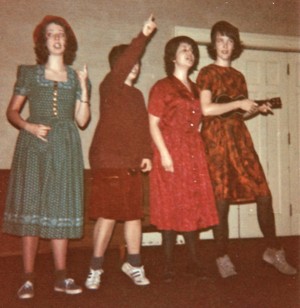
The Temperance Union of Prentiss Hall

When I was at Whitman College in Walla Walla (not Spokane, that’s Whitworth) I was part of a recurring act called the Temperance Union.  Four of us donned the frumpiest outfits we could put together and performed “Away with Rum” to whoever would listen:

We’re coming, we’re coming, our brave little band,

On the right side of temperance we do take our stand.

We don’t chew tobacco because we do think

That the people who use it are likely to drink.

One of the quartet was Debi.  After college she married a townie and got to live happily ever after in Walla Walla, one of the loveliest towns in America. Debi is an attorney now but when I knew her, we called her Putzer.  I thought it might be nice to add that information to her firm’s Facebook page but she says not.

Anyway Putzer is the shortest one in the Temperance Union line-up, her face obscured by her arm: the future attorney already cognizant of liability issues.  Mary-Ellis who I’ve written about:  www.elenalouiserichmond.com/2010/11/doin-our-stuff/  is the one on the end playing the ukulele. I am the one who looks the most like my mother.

Putzer, who for liability reasons shall now be called Debi, and I were out of touch for nearly 30 years.  We saw each other at a few re-unions, but there wasn’t even the odd Christmas card between us until I started using Facebook as part of my shameless self-promotion of my writing.  That’s how we got re-connected and how I found out that I bicycled by her house every time I visited Walla Walla.  I found out that because her son lives in Seattle, she probably knows downtown and the bus system better than I do.

Debi spent a night with me this week.  She is definitely on my short list of people to be marooned on an island with.  There was never a lull, always something to talk about and lots of laughter.  I’d forgotten how quick and wry her humor is and how much it meshes with mine.

It’s disorienting when someone remembers something I’d forgotten, especially because I pride myself on my memory.  I do not remember catching my ring on a hayride wagon (a hayride?) and ending up in the emergency room with a swollen finger.  But it also reminds me how interconnected we are, even when it’s been 30 years.

I hear the word “connection” a lot when people talk about friends and family. That covers a lot of images.  There’s the spark of recognition, or compatibility; or the frisson of sexual attraction.  The connection I felt this week was of past to present and (I hope) reaching ahead to the future.

Debi was an implant from a world I used to know into the world in which I now live.  When she walked into my house she brought some kind of integration.  I am the still the person I was as well as being the person I am.  When a long-time student walked in and Debi and I were in the middle of a rendition of “It’s cheese that makes the mice go round,” he didn’t bat an eye.

Psychoanalysis has taught me that the mind is not discrete, and it’s not static. There is really no such thing as a “type.”  In the final analysis (no pun intended), we are all “that type;” we are all human.  And we are influenced by each other whether we care to admit that or not. We have many more feeling states than we sometimes allow are there.  We all have backrooms in our minds, memories and experiences.   When the doors swing open, we can be caught by a rancid odor or by delight.

In “Discrepancies,” the poet, Stephen Dunn, says:

“.  .  .  I’ve tried

to become someone else for a while,

only to discover that he, too, was me.”

If I ever thought I had become someone else, Debi’s re-entry into my life reminded me that I am still all the persons I have always been.  That’s both comforting and humbling.

And now I need to put the rum bottles in the re-cycling.

Ah, HumanityPianoSinging

February 3, 2011

Poor Wandering One

Tags: , , , ,

Over the weekend I attended a piano concert performed by the same artist –Fred Kronacher–who played a Bach concert a few months back.  I attend these concerts with my friend Nina (rhymes with Dinah), and her husband, Bill. I blogged about that concert (https://www.elenalouiserichmond.com/2010/10/digressions-from-an-afternoon-with-bach/), taking a rather supercilious tone, compared with what I have to say about the Chopin and Liszt concert on Sunday afternoon.

I’ll start by saying that it was absolutely glorious piano music.  These two composers knew how to utilize every partial of the piano with grace and charm. Hearing Liszt’s “Au bord d’une source” was like sitting in the middle of a cold mountain stream on a hot day.  I could feel as well as hear the ripples of water.  With Chopin’s Nocturne in D-flat, with any Chopin if it comes to that, I can understand why George Sand liked to lie on the floor under the piano.

Then I ruined my own experience of Valse Oublieé (Forgotten Waltz) because I thought Fred had reversed the order of the program and was playing Gnomenreigen (Dancing gnomes).  The beginning of Valse Oublieé sounded like gnomes running around.  So I leaned over to Nina and ruined her experience of it, too, by fussing about whether or not he was playing the waltz or the gnomes.  Or had I daydreamed all the way through Valse Oublieé which would be ironic, and missed it altogether.

So I was not behaving like a very sophisticated concert goer.  I wonder why that was.

Sometimes I listen on purpose like a musician:  “Hmmm, he’s modulated and there’s a sequence, here comes the cadence.”  If I have played the piece myself, I can visualize how the fingers are moving through certain passages and how I can’t imagine getting through that bit so smoothly.  Sometimes I think, “Oh, that’s how that goes!”  With some inside melodies, my reaction is “Geez, where did that note come from?  How is he getting that?”

But here’s a dirty little secret: my mind wanders.  A lot.

My mind even wanders when I am the one performing.  In the middle of singing a Schubert song, I might have this thought: “I’ll need to get milk on the way home, then I have to do laundry, my god, how long have I been thinking about this?” All this can thread through my mind in less than four counts so it’s not like getting lost in a foreign city, but it is alarming when I’ve got an audience that has come to hear me sing, not wool-gather.

Anyway after the piano concert, I compared notes with my companions about the wanders our minds took:  it boiled down to work and sex.

It got me thinking about minds and how I don’t know what goes on in other people’s minds but how often I assume that I do.  Especially in regards to feelings. Someone has a physiological response to life, expresses it in words and I say, “I understand completely” or “I know exactly how you feel,” when in fact, I have no way of knowing exactly how anything feels to anyone but me and even I am hazy about my own feelings much of the time.

Most people report that they find music evocative, but what it evokes is difficult to verbalize.  Trying to explain its magic is like trying to encapsulate spirituality or sex in words.  So after a concert, you hear people saying banal things like, “You know I thought the tempo dragged a bit during the relative minor sequence in the 2nd movement” or “Those two composers knew how to utilize every partial of the piano with grace and charm.”

You rarely hear anyone say, “I was imagining myself in Australia having sex on a beach with two didgeridoo players,” or “I was thinking if he doesn’t call that contractor tomorrow morning, I am going to rip out bathroom sink myself” or “I just know she’s not at the library, she’s out getting another piercing.”

While I am in this confessional mode, I’ll attempt to redeem myself by saying my mind usually doesn’t wander during a Bach concert.  But I almost always fall asleep in the 3rd act of an opera.

AnglophiliaBooksEnglandTravel

January 28, 2011

Royalty in Richmond

Tags: , , ,

I just finished a book set in Yorkshire.  You don’t need to know its title because it wasn’t very good and I’ll recommend a better book later on.  The point here is that it got me thinking about Richmond, a splendid market town in North Yorkshire which I visited a few years back.   I am in possession of a family genealogy that traces my family to this particular town in the year 1000.  I visited it on the same trip to England wherein I got a look at St Margaret of Clitherow’s hand (https://www.elenalouiserichmond.com/2010/10/st-margarets-hand/) so you can imagine the scale of the highlights of that trip.

I was booked to stay two nights at The King’s Head hotel in Richmond.  (What does that mean exactly?  Did they erect a hotel after a be-heading?  Kind of like apartments in the states are named after whatever got torn down to clear the land—the Willow Grove Apartments, for example, when there’s not a willow in a 5 mile radius.  There wasn’t a severed head anywhere that I could see which just illustrates my point.  And this was before I saw St Margaret’s hand.)

In any case, when I learned that Charles and Camilla were coming on the day I was leaving, I immediately booked a third night.

I was up early that third morning and went for a walk.  Someone was collecting minute bits of trash in the square and bagging it.  All the dustbins had been shrink-wrapped—no place for a bomb to hide.  I overheard the comment, “They were paintin’ the flagstones. Paint’s not even dry.  Mind you, if it takes a royal visit to get things done, we all come out right.”

The royals were not expected til noon but I was rushed out of a shop at “just gone ten.”  “Can I ring you up a card, luv, because we’re closing for the royal visit, He’s sometimes early.”   This was being promoted as the first royal visit to Richmond in 200 years so it seemed rather sweet to hope He would be early.

By “half ten” the crowd was massing in the large, oddly shaped market square.  Lines of schoolchildren in uniforms and paper crowns, waving tiny Union Jacks streamed into the square.  Women in huge flowery hats and their best shoes stood, smiling and animated. A military band started to play.  When they launched into “All Through the Night,” I started to cry, having what I call a “little containment problem.”

The news went around that They had arrived. I stationed myself behind a class of children, figuring I looked like a teacher and would get my best view over the tops of their heads.  Also it was very hot, and I didn’t think the Royals would make children wait in the heat for long.  I said as much to a woman in a flowery green hat and fine shoes who raised her eyebrows and said “Oh, they’ll make them wait.”

We all waited for an hour.  Then the royal guards appeared in their furry busby hats looking like the wicked witch’s guards in The Wizard of Oz.  The town council swept through in black robes and white wigs, carrying scepters.  And suddenly, there was Camilla.  She shook my hand.  What that means is that she came though and grabbed every out-stretched hand that she could and squeezed it slightly.  She looked like someone who never thought this would happen to her.  So she looked rather like I felt.

Charles halted for a bit of a chat with the busby standing a foot from me.  The lady in the green flowery hat and I eavesdropped shamelessly.  They chatted about the garrison outside of town and how long the young man had been in the military. Boy, he would have something to tell his mum that night!  I wanted in the worst way to take a photo but I was afraid of the Royal Disapproval should a flash go off right in His face and He were to find out I was an American on top of that.

After I returned to Seattle, I discovered a writer named Robert Barnard who sets all his very literate mysteries in Yorkshire. One of his books is called Fete Fatale in the states. In England its title is The Disposal of the Living which in this case is a clever pun since the murder involves a rector.  A rector’s right to the tithe from his church is called “a living.”

Here is his description of Hexton-on-Weir, the town in the book: “A town of stone houses, most of them very old and slightly cramped, centered around a town square which is not a square but a highly irregular form unknown to geometry.  In the centre is a church which . . .  has been turned into a museum to a famous regiments whose barracks are a few miles outside of town.”

The description goes on but I didn’t need to read more.  I shrieked, “But that’s Richmond!  It’s Richmond!”

Here is where living with only cats is dis-satisfying. They opened an eye a piece, checked their watches to see if there was the remotest chance it could be meal time, and went back to sleep.

I wanted to call up everyone in my address book and say, “Hey guess what? I started reading this book and the author says his fictitious town is really a real town and from the description, I could tell it was Richmond!  It’s Richmond!  Okay, goodbye, I have 37 other people to call!!”

The last thing I want to say about Richmond (for now) is that there’s a Richmond Castle whose Norman ruins are lovingly maintained. So there was yet another reason I didn’t want to do something so down-market as flash a photo in Prince Charles’ face. I am a Richmond, after all.  I have a certain dignity to maintain in that town.

Ah, HumanityFriends

January 24, 2011

Dining With Nina

Tags: , , ,

If you ever meet my friend Nina, don’t rhyme her name with Deena because I will be hearing about it for a month.  Her name rhymes with Dinah. We went out to dinner the other night.  We talked about a dismal blog entry I was wrestling with.  By the time we had turned the topic inside out, I decided to scrap it and write about Nina instead.

I have known Nina for 30 years.  Her daughter, Jocelyn, was in my Pinkers group when I taught music at Perkins Pre-School in the early 1980’s.  I thought of her as “that cool mom.” We got to know each other better during the ten years that Jocelyn took private piano lessons from me.

We’ve been doing the restaurant circuit since the year we both committed to using as many coupons out of the Entertainment book as was reasonable.   Neither of us needed the hair implants, for instance.  Every six weeks or so, we decided it was time to go out to dinner.  We each hoped the other one would go through the Entertainment book and pick a restaurant.  We usually went through it together while on the phone.  Now that the Entertainment book is as watered down as a bad Old Fashioned, we use Groupons or the Chinook book or other middle-class mollifications.

We’ve been to Rock Salt, McCormick and Schmidt, The Rickshaw (yes, we have), 125th St Grill, Berkshire Grill, The Library Café, The Rusty Pelican, Thai Siam, Ivars, Palimino, Rositas.   Nina is from Montana.  She grew up on a cattle ranch and  likes her steak.  I’m a Pacific Northwest native so I usually get fish. We were more adventurous before I started having digestion issues.

Food, however, is not why we go.  We go to get our money’s worth.

We want to maximize the value of the coupon on principle.  If the coupon is for the 2nd entrée free up to $20, then we aren’t allowed to waste it on an entrée of fish and chips for $15.  We try to approximate two entrees for at least $20 each.  One of us usually says magnanimously, “You know what?  You get whatever you want.” But we don’t mean it.

When we first sit down, I always ask the waitperson to turn down the music.  Then I want a glass of water with no ice.  Nina smiles and stares ahead of her while I get my quirks out of the way.  Then she orders an Old Fashioned.  Nina used to instruct the bartenders while I looked out the window or pretended to read the menu.  Now that this classic drink is back in fashion, mixologists know how to make it properly, but this wasn’t the case ten years ago.  Even today Nina specifies still water and enough whiskey.

“An Old Fashioned is not a drink to be watered down with goddamn fizzy water,” she says sotto voce.

Dessert is a continual problem which we have not yet resolved.  Here comes the waitperson with an evil grin and the dessert menu.  We look at each other.

“Do you want to split one?”

“I am just the right amount of full and dessert will spoil that.”

“They never are as good as they sound.”

“We should go out for just dessert sometime.”

We are like actors in a long running play, saying the same lines.  For years we said our lines and ordered dessert anyway.   Lately we have gotten better at not ordering it in the first place.  I bring a couple of pieces of hard candy or chocolate for our Afters.

“Just a little something to let your mouth know the meal is over,” Nina says.

Nina contributed to the dessert one weekend when I was with her at her Montana ranch.  She collected the mail, and bought a gallon of milk and a huge tub of Wilcoxson’s vanilla ice cream at the Melville store.  “Downtown” Melville consists of a post office/ store/lunch counter.  And a public telephone booth that was used by Robert Redford in a scene from The Horse Whisperer.  Actually I think the phone booth was just a prop.

On the way back to the ranch house at the far end of Home Valley, we stopped at the home of Dave and Laurie who live on the ranch.  We were coming back later that evening for dinner with ice cream to supplement gooseberry pie.  I sat in the air-conditioned car while Nina ran in with the mail and the milk.

When she climbed back into the car, I asked, “Why didn’t you leave the ice cream?  Is it because they don’t have a big enough freezer?”

“No,” she said, “It’s because it’s my ice cream.”

If the ice cream were to spend the afternoon at Laurie and Dave’s, it would subtly, in those few hours, become their ice cream and then we couldn’t take the leftovers home.  I got it.

There’s this thing about ownership and fairness that comes up when we pay the restaurant bill.  The discount complicates things. Neither of us wants to pay more than our fair share of the bill.  To be perfectly frank, I wouldn’t mind paying slightly less.  At the end of the meal, out comes the tip chart, the calculator, pens and scraps of paper, our cash and credit cards.  We each do our own calculations and work out something amenable.

When I made out my will, I named Nina my executor. “We can never travel together,” I told her. “Because we have to remain friends.”

I haven’t died yet.  The friendship and the dinners are working out just fine.

BooksFriends

January 16, 2011

Tattooed Ladies On Fire Reading

Tags: , , , , ,

Monday: Gwen, my neighbor who knows a little bit about just about everything, calls to say she has finished The Girl With the Dragon Tattoo, it’s good and would I like to borrow it?

Half a dozen people have already asked me if I have read it.  Half of them have told me it’s too violent and I wouldn’t like it. The other half have raved about it.  I don’t want to list the number of popular books I have not read or movies I have not seen.  That information is classified because I get tired of explaining the concept of free will.

I remember how Gwen could not stop enthusing about Patrick O’Brien’s Master and Commander series which did not interest me no matter how literate the writing and exciting the story.  I say what I wish I had said then, “Sure, I’ll come get it.”

Tuesday: I go across the street and get The Girl With the Dragon Tattoo.  I listen to Gwen’s enthusiasm about the story and how the translation is not all that good.  Yeah, yeah.  I wasn’t planning to read it anyway.  But when I finish my current book, Pomfret Towers by Angela Thirkell, The Girl With the Dragon Tattoo is within reaching distance and I have 35 pounds of cat on my lap, so I start it.  In half a page I am hooked.  Church choir rehearsals haven’t started yet so I have the evening free.  I read for four hours.

Wednesday: I read most of the day.  The work I need to do actually breeds.  When I turn my head, extended families of work have crept out of my file cabinet and off my desk and are mounting on the floor. The OK Chorale hasn’t begun its quarter yet so I have all evening free and I read until I am falling asleep.  I still have a hundred pages to go but I don’t want to rush the ending so I go to bed.

Thursday: I get up early and finish The Girl With the Dragon Tattoo, the first of a trilogy.

Here’s where the sub-plot becomes more complicated.  I know that Gwen, who is a voracious reader, is just as eager as I am to read the rest of the story.  But neither of us want to actually buy the books.  In my case, I don’t mind buying a book I am dying to read but I will get a used copy before I’ll buy a new one.  (I may change my attitude about this when my own book is published.) Gwen, whose psyche is calibrated for coming up with everything she needs in the world using bits and pieces from her kitchen drawer, runs into her own limits when what’s needed is a book written by someone else.

Even with all the intrigue surrounding the death of Stieg Larsson, he is not to be found in Gwen’s kitchen drawer, so she has kindled the next book, The Girl Who Played With Fire — pun unintentional.  I go to Couth Buzzard Used Books in Greenwood to see if they have a used copy.  They do but it’s $15 unless I have an account which I don’t.  To get an account, I have to bring in some books to trade.

I check Balderdash Books and Art, another used book store in Greenwood. They don’t have the The Girl Who Played With Fire but they have a UK edition of the third book, The Girl Who Kicked the Hornet’s Nest.  Coup! This is a bonus: it’s going to have cool, exotic words in it like Sellotape and lorry.

I take it across the street and pound excitedly on Gwen’s back door.

“Look what I’ve got!”

I magnanimously present it to Gwen and say that she’ll be needing it first.

Friday:  I am in the Couth Buzzard Used Books three minutes after it opens with two boxes of books, get my account, buy The Girl Who Played With Fire for $7 and am home reading by a little after 10:00AM.

Saturday: I finish The Girl Who Played with Fire at 10:24, 24 hours after I start it.

I call Gwen to discuss sharing custody of The Girl Who Kicked the Hornet’s Nest.  She is only 125 pages into it but technically, it’s my book, which she concedes.  But I now have several generation’s worth of work to do and my body feels tight from the week’s reading frenzy.  We decide we will pass the book back and forth as our schedules allow.

Gwen reveals that she can stream the movie of The Girl With the Dragon Tattoo through Netflix and we can watch it on her flat screen. In the evening, I go over in my jammies with a bottle of sherry and we watch the movie of The Girl With the Dragon Tattoo.  It’s excellent and very fun to watch so soon after reading the book.  Halfway into it, Gwen murmurs that the other two books have also been made into movies.

“Get out!”

We make a tentative date to watch the next movie and decide we will calm down about the third book.  We want to enjoy it at our leisure.

But I think we might go out and get tattoos before all this is over.

Ah, HumanityPsychoanalysisSpirituality

January 13, 2011

Distractions and De-constructions

Tags: , , , ,

I’ve been trying for five days to write something about the shooting of the Arizona congresswoman on Saturday.  I gather from I’ve been hearing and reading that I am not the only person who put their face in their hands and sobbed when they heard the news.  Then I braced myself for the onslaught of self-righteous blaming that I knew would wash over the shock.

I wanted to write about the sport of self-righteous blaming.  Actually I did write about that.  I came up with about 800 words about all the self-righteous blaming that goes on in our social discourse but no matter how I tried to couch it, I ended up sounding self-righteous and blaming.  So that was frustrating.

My friend, Nancy, who teaches college-level English and can point out every time I have deconstructed a thought, might say that my preaching about people who are self-righteous is a deconstruction of the concept of self-righteousness.  I think. Nancy told me she was afraid that one day she would show up in my blog as my friend who doesn’t take adequate cash to yard sales because she forgets she can’t use her credit card.  She can stop worrying.  She’s Nancy, the friend who can point out every time I have deconstructed a thought.

I deleted the preachy blog.  Then I twiddled my thumbs and played free-cell solitaire.  Not at the same time.

I wished my cats would do something outrageous or one of my students would say something funny or vice versa.  I wished I would run into another loud phone talker so I could pick a fight and write about that.

The only thing that has disturbed the cats recently was the fact of there being snow outside both doors of the house, but I commented on that last time it snowed and I don’t want to repeat myself on top of sounding self-righteous and blaming.

My students are pre-occupied with upcoming finals so they aren’t saying interesting things; they just come in looking stunned.

The only loud phone talker I’ve encountered recently was walking in the neighborhood and was shortly out of ear-shot so it might have been mistaken for harassment for me to follow her down the street complaining that I didn’t want to hear about her hemorrhoids.

I watched that internet video of the cats playing pat-a-cake 23 times while I wrestled with how to not sound preachy and grandiose.

Then I started reading The Girl with the Dragon Tattoo and couldn’t put it down.  That was a huge distraction.

I still want to say something about the incident in Arizona but it’s been hard to think about.  Every time I put down The Girl with the Dragon Tattoo, it was there, gnawing at me. So for what they are worth, here are some thoughts that had a bit of traction before they hit dead-ends, strayed into frustration, or disintegrated into self-righteous blaming:

I keep hearing the phrase “senseless crime.” When someone says a crime is senseless, that seems to excuse their throwing up their hands as though to say, “This one isn’t “normal” so I don’t have to think about it.  The next one that’s not so egregious–or that doesn’t involve a “mentally imbalanced” person– that one I’ll think about.”   Just because meaning is obscure or complex doesn’t make something senseless.

I might add here that I think it’s insulting to mentally ill people to treat this shooting as though it’s no more than we expect from them.  There are hundreds of thousands of mentally ill in this country who don’t shoot people.  Abraham Lincoln, Winston Churchill, Issac Newton, Robert Schumann, and John Keats were all “mentally ill.”

After an incident such as the one last weekend, someone always whines, “Where are the Role Models?”  Leaving aside how limited I think this concept is, isn’t it interesting that whenever people decry the absence of good role models, they always seem to be suggesting that it is people other than themselves that aren’t setting the good example.

Though it’s a pretty low threshold for Role Model, most of us don’t shoot other people.   But my self-righteousness today has temporary amnesia about how badly I behaved yesterday.  We all do ugly things and we all declare ourselves to be somehow superior to people who do the same ugly things on the days we don’t.  Even though most of us don’t shoot people, we all contribute something to the aggregate of love or fear in the world by our own generosity of spirit or lack of it.

Tragedy and our reactions to it are not senseless.  There’s a kind of logic that ushers us around and around the hall of mirrors that is our humanity.   We can never know for sure which is another body and which a reflection of our own thoughts.