
ScotlandSongsTravel

October 7, 2019

Of Corryvrecken, Stramache and Tartan Drawers

Corryvrecken is the name of a famously fierce whirlpool off the coast of Jura, the island north of Islay in the Hebrides. George Orwell and his small son were lucky to escape it drenched, but with their lives. I submit that there’s another corryvrecken on Islay and her name is Rachel.  She was my guide for my first two days on the island, having created for me a “wild and magical bespoke tour” – that being her inimitable brand.  I was well into my email acquaintance with her last winter in Seattle before I recognized what bespoke meant.  I thought she was organizing a tour to which I was improbably offering my input and others would be joining us.

But no, it was Rachel who was leaning against her white Volvo waiting only for me to disembark from the Caladonian-MacIntyre ferry from Kennacraig at Port Askaig, Islay, Scotland.  By the time I got to Islay I knew I had gone somewhere far away. There was the nine hour plane from Seattle to London, five hour train from London to Glasgow, three hour bus from Glasgow to Kennacraig and two hour ferry to Port Askaig.  Yes I could have flown the whole way but what’s the fun in that? I wanted to know where I was going.  There was plenty of time to think about what the hell I was doing during the long, tiring journey .

The bus from Glasgow to Kennacraig could have been a ride through the evergreens of the Olympic Peninsula except the mountains are smoother and less rugged looking. We followed Loch Lomond for a while. I think I saw the “steep, steep side of Ben Lomond” but I couldn’t be sure as it didn’t look all that steep to me. Next to me a young woman was blowing out her ear drums through her ear buds so I put in my own and found Walter Berry singing “Mache diche, mein Herzen rein.” Winding through the Scottish lochs on a two lane road listening to the St Matthew Passion is an experience not to miss.

A woman got on at Crarae and announced to the entire bus, “I’m wet, I’m tired, I’m in a bad mood. I’m going into town for my drugs and booze and to do my yoga.” The bus laughed and I smiled but I also thought, oh god, that’s me all over again.

Cal-Mac ferry, Finlaggan, to Islay

At the port of Kennacraig, there is just enough time to buy a ticket and walk the gangway onto the Finlaggan, a gleaming, elegant boat, more like a miniature Queen Mary than a ferry. I was all over it. I chatted for a long time with Peter over a bowl of soup. Peter goes around the world visiting bothies, remote cabins used by the most intrepid hikers, making sure they are still secure and safe. I stood outside in a breathtaking wind as the boat sailed alongside Jura. A white van moved along the island road and the woman next to me commented. “There’s rush hour on Jura.” I found the “quiet room” at the end of the ride and sank there into my jet-lagged thoughts until time to disembark and to meet Rachel.

Rachel is tall and exudes energy. Her voice and her eyes are full of mischief, humor and little nonsense. After two days with her, I decided she was the incarnation of a gude faerie in the Seelie court. (look it up). We drove down the island, talking easily. The afternoon ferries from Kennacraig go to Port Askaig at the top of the island. My destination was Port Ellen at the bottom and where the morning ferries come and go.

Port Ellen, Islay

I stayed at The Grange, a big yellow guesthouse at the top of Mansefield Road. There I was entertained and looked after by Margaret and Harold Hastie.  They gave me a large room with a view of the harbor and at night, the moon.  Harold, who not incidentally also has the mischief in his eye, hoists a flag from the country of each of the guests. When Rachel pulled into the drive, an Australian and an American flag were flying high on a flagpole outside the guesthouse.

The Grange, Port Ellen

I was touched. I felt so welcome. Even so, I said I wasn’t sure I wanted anyone to know I was American. Fly the flag, by all means, but tell them I’m Canadian! Or at least know that I didn’t vote for Trump. Over and again people said they’d yet to meet an American who had!
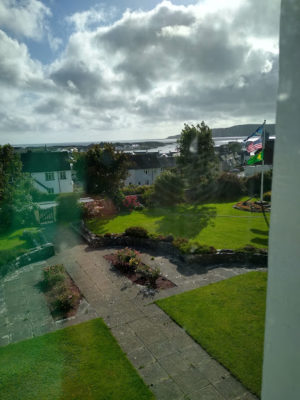
view from The Grange, the harbor, the American flag

A lovely antique piano so vintage that the Hasties can’t find anyone to tune it sits just inside the house where I saw it every time I entered and left the house. I played a piece of music entitled “Westering Home,” an old fashioned tune in three time written about Islay by the Scottish composer of the 1920s, Hugh Roberton. He also wrote the tune to “Mairi’s Wedding,” which my OK Chorale has sung and to “All in the April Evening,” whose ghastly text was popular in its day. Harold and the guests came to listen as I played. It has a sentimental magic and I felt its pull myself.

Westering home, and a song in the air,
Light in the eye and it’s goodbye to care.
Laughter o’ love, and a welcoming there,
Isle of my heart, my own one.

Tell me o’ lands o’ the Orient gay,
Speak o’ the riches and joys o’ Cathay;
Eh, but it’s grand to be wakin’ ilk day
To find yourself nearer to Islay.

Saturday morning I breakfasted with Ken and Derek, two brothers from Barrow–in-Furness in England although Derek now lives in Australia now which accounted for the Australian flag flying outside The Grange.

“Barrow-in-Furness,” I said. “That’s the home of the woman who wrote the war diaries for Mass Observation.”

Ken thought for a minute, “That’s right. Nella.”

It took both of us until the next day to remember Nella’s last name: Last. Ken said he quite liked his town being known for the “lady who wrote the war diaries.”

Rachel picked me up at 9:00 and for the next two days I felt repeatedly that Rachel and jet lag don’t mix. She radiates life and energy; I had to rally myself to keep up. We took off north toward Port Askaig, peeling off the main road to a narrow one in order to avoid Bowmore, the largest village on the island.

“We’ll take the high road,” she said.

“What’s the high road?” I asked, thinking I might get some geography surrounding the Loch Lomond song.

She looked at me as though she was afraid she had a nit-wit on her hands for the next two days. “It’s not the low road,” she said.

Oh.
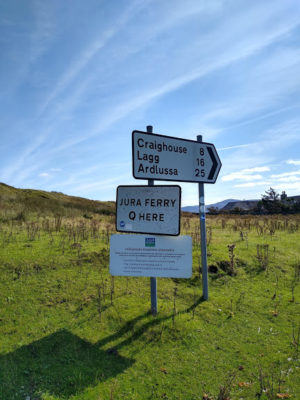
on the Jura ferry


At Port Askaig we drove onto a flat bed that turned out to be a small ferry like the Port Townsend-Whidbey Island ferry used to be. It pulled away and I got out of the car to enjoy what later was called the best day they had had all summer (a few said it was the summer): warm with a brilliant blue sky, sun and always wind. At the crossing’s end I walked onto the island of Jura.

Jura  (pronounced like it’s spelled but you have to be able to make one quick roll of the r;  by the way, Islay is pronounced “eye-la”) was my special request. George Orwell spent the last few years of his life on Jura, writing 1984. While I loathe that particular novel, I love just about everything else he wrote and have no end of admiration for him as a person. His old home, Barnhill, is still there but the main road stops before it gets there and a rugged vehicle is needed to go the final two hours of travel. The thing to do would be to go in with several days’ provision and stay.  That’s my plan for next time.

We parked in the only village on the island, Craigshouse, and had lunch at the Jura Hotel where Rachel’s friend Maggie joined us. Maggie’s parents had been neighbors of Orwell up at Barnhill and I could barely keep myself from leaping on her when she sat down.

Her father had helped George dig his garden and they’d stop for a “tot of rum.” He was quiet. He was ill—he had TB. His sister, Avril, was there looking after him. Maggie apologized that she had so little to tell me. It was before she was born and before Orwell became famous.

“Oh, Maggie,” I said. “You’re four degrees of separation between me and George Orwell and I’m delighted to have met you!”

Maggie gave me one of her free drams. When you live on Jura, you get three wee drams a month in the Jura Hotel. A wee dram is somewhere before one and two fingers. I had a dram of Jura Scotch called Sevenoak.

Rachel and I visited the distillery just across the road, then carried on up the island over the Three Arch bridge where I could see all three Paps of Jura. Mostly you see just the two and they look suspiciously like breasts. I found out later that was the whole point. Pap is old Norse for breast-shaped hills. I can’t imagine anything in America being called a pap; the Republicans would throw a sheet over it.

All three Paps of Jura

At Knockrome we plundered an old telephone kiosk that had been turned into a wee book shop. Further up the road was a post box that had discontinued service for two years because a starling had taken up residence in it.  When the bird died, a plaque commemorating Mrs. Starling’s residence was attached to the box.
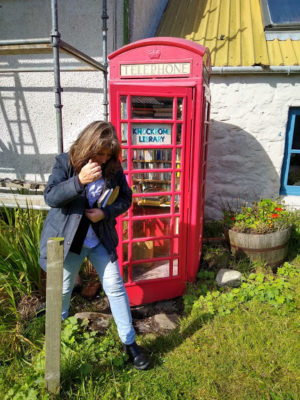
Rachel at Kiosk book shop at Knockrome
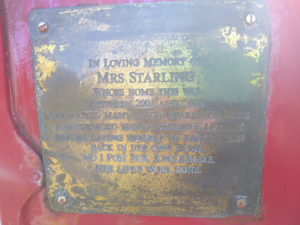
 

postal box plate in loving memory of Mrs. Starling whose home this was. . .

Back in Craigshouse we visited an old photo gallery of island life in a tiny room off the church. It smelled of a century’s worth of damp. The black and white photos were group according to activity: farming, school, church. One old woman with a forbidding face was captioned The Stramache and I learned a new word. A stramache is an uproar, a row. Apparently this Stramache was a terror.

Rachel suggested I nonchalantly drop the line to Margaret and Harold that there had been a stramache on Jura and see if I could get them wound up. We practiced my nonchalance but I couldn’t quite pull it off on the Hasties. I tried it the next morning at breakfast. Harold got that gleam of mischief in his eye and looked as though he wasn’t quite sure whether or not to believe me

“Did they call out the coast guard?” Harold is in the coast guard so he’s seen a fair number of stramaches.

I grinned. “No, I was just trying out my new word.”

We came off Jura mid-afternoon and went to Finlaggan, the ancient seat of the Lord of the Isles. I tried to read some Scottish history before this trip and got hopelessly confused having very few reference points in the long history of the Celts and the Scottish tribes .  The natives of the islands were the Celts who are best understood as a language group that included parts of Ireland and Scotland plus Wales, Cornwall, Brittany and even down into areas of Spain. The ancient seat in this case, would be a Celtic one.  The word Lord is better understood as King as that is essentially who occupied the ancient seat.

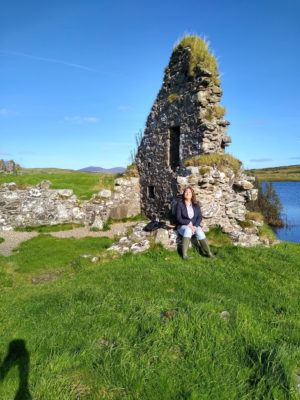
Finlaggan is now a ruin on a small island. At the visitor’s center I met Catherine, the docent. I sussed right away that this was not a woman one asked stupid questions of.  I’d be afraid she would demand why I hadn’t read the material.
Rachel at Finlaggan

We wanted to walk out to the ruin but the past week there had been so much rain that even the boardwalk was underwater, up to two feet in places. The efficient Catherine, however, had laid in a supply of wellies and people were sharing them. When they became free, Rachel and I set out down the path and waded out to the ruin.  Rachel made me a gin and tonic out of Lussa Gin, which is distilled on Jura, and local tonic water that had quinine in it, which I don’t believe we can get any longer in our nanny state. We sat on the stones and talked as the wind played up the grass. The light and the wind felt magical and I thought, “the isle is full of noises.”

Finlaggan is a label that gets put on an affordable Scotch that I buy at Trader Joes. I learned from Rachel that all the distilleries take turns contributing to it. Over the years I have probably sampled Scotches from all eight distilleries; I just didn’t know it at the time.

Finlaggan marked the end of my first day on Islay. In the two days with Rachel, she would every so often go on a tear about Scotland, Gaelic, history, whisky, feminism. As an educator and business woman in whisky, she negotiates around entrenched male attitudes. I bet the men only mess with her once. She is passionate about her heritage. “Stop me if it’s too much,” she said. “My friends called me ‘Tartan Drawers.’” I went to bed early, the better to be ready for her in the morning.


FriendsSongsTeaching

May 3, 2019

Special Friends

Tags:

I got my naturalization papers last week. I made it past the health screening in spite of having a concussion.  After reading that you could be forgiven for thinking I still had one. Anyway, here’s what happened:

On Thursday in an accidental maneuver too complicated and boring to describe, I knocked heads with my dear friend Nina (rhymes with Dinah). The crack reverberated in my head more than it did in Nina’s and I was left with a crashing headache, which I ignored until I started feeling slightly woozy and other parts of my body started protesting. I had to cancel my students and lie down for the rest of the day.

The next morning I felt slightly better but still had vestiges of headache and wooziness. However I had a special appointment I could not miss. I was to be the Special Friend of my piano student, Sophie, at Special Friends Day at Perkins Elementary.  The students were to present their study of The Immigrant Experience at Ellis Island and there were to be *snacks.*

On the drive over, I imagined that I’d be sitting in a darkened and quiet auditorium next to Sophie until she got up to do her part. It’s been a while since I’ve been in a grade school. The place was noisier than a cocktail party and excited kids careered from room to room as though looking for where they last set their drinks. I took a deep breath. It was important I not wimp out just because I had a headache, felt nauseated and was allergic to this kind of atmosphere.

“You can do this,” I said.

A smiling adult approached me. “Are you a Special Friend?”

How could that not make someone feel better?

Sophie started us in the Snacks Room where heritage foods from all over the world were laid out, complete with ingredients labels for sensitivities to things other than noise. At the end of line I was offered the choice of bottled water or lemonade.

“No coffee?” I asked.

The Special Parent sagged. “I wish,” she said.

A bell rang and we were herded into the next room. Sophie and I quizzed each other. I asked Sophie a series of questions for immigrants to answer before they (we) could get off the boat. General questions about origins and health.

Then Sophie asked me questions on the actual citizenship exam. I could not have correctly answered half of the questions two years ago. I will say this for the current administration: many of us have learned more about government, politics, and espionage than we ever expected to or possibly wanted to.

From the screening and testing room, Sophie took me down a hallway that contained paper mosaics of the Statue of Liberty and Ellis Island.  Posted next to the lovely art were the immigrants’ identity papers. Sophie, for the purposes of the project, was part of the Miller family. Evidently the entire fourth and fifth grades had been organized into various families. Each family member had an identity card.

It was around this point that I got a lump in my throat. The presentation had been carefully put together and laid out. A lot of white paper, pens and colored construction paper was enough to evoke in me a thoughtfulness about how we all got here and how utterly heartbreaking it would be to lose what we have.

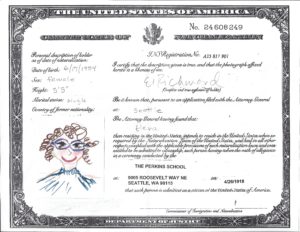
The last thing we did was to get our naturalization papers. Here’s mine:


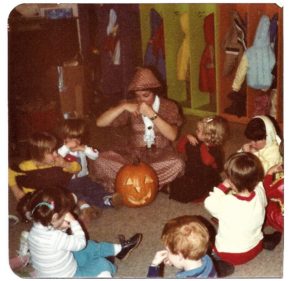
It had been a long time since I had been in Perkins School. Let’s see, umm, 35 years. I taught music in Perkins Pre-School for two years. I was the Music Lady. Every 45 minutes a new group would troop in to sing songs and play rhythm instruments and do interpretive dance.

In the Orange Group was a little girl named Jocelyn. She’s the daughter of my friend Nina on whom I cracked my head as related in the beginning of this post. That’s Jocelyn sitting next to me on the left. We all were sawing our fingers under our noses singing Vio-vio-violin. The little witch with blonde curls on the other side of me is trying to figure out which finger goes where on the nose. It’s good to have a special friend to help with things like.

BooksFriendsWriting

April 7, 2019

Writing My First Novel

I’ve just published my first novel. I began it in 1997.

I was part of a “spirituality group” that imploded from suppressed resentment, unbearable competitiveness and hurt feelings. One evening everyone popped off like a batch of homemade root beer in the basement, one at a time like a series of timed explosions. One woman turned to me and cried, “You’re just like my sister. Why can’t you leave things alone?” It could have been a Saturday Night Live sketch. All these people trying for months to be their version of spiritual and their humanness couldn’t take the pressure. It was the seed of my novel.

I got about 50 pages into a story of which this explosion was to be the climax and got stuck. I put it aside. Over the next ten years I got it out and tried to work with it. Nothing.

Then I wrote my memoir, 99 Girdles on the Wall. The memoir slipped onto the page like a pit from an over-ripe plum. When I had a better grasp of what I was doing, the writing flowed. I certainly knew my life better than anyone else. I had first lived it and then analyzed it in therapy, bringing me to about age 52.

In 2011 when the memoir was published I started my website, Local Dilettante Studio and this blog. I wrote a weekly post for six years before I lost steam. In all that writing, giving myself my own deadlines, my style improved. Plus I was living what was once my highest aspiration: to be a weekly columnist, writing whatever I wanted like George Orwell’s “As I Please.”

My blog posts had recurring characters, principally my long-suffering friends and neighbors who might be at home in a novel. The old idea from 1997 started to cough and clear its throat. My college roommate, Putzer, The Attorney encouraged and occasionally prodded me to start up and then to keep going. She offered to read everything I wanted to send her: notes, character sketches, outlines, drafts. I sent her everything (for years) and she always came back with “Carry on.”

I couldn’t write at home. There were too many distractions. So, once a quarter I went for a week-long retreat on Whidbey Island where I wrote six hours a day. Slowly the book took shape.

Writing a novel became a process of problem solving. I needed characters. I thought of some characters. I sent the character sketches to my neighbor Gwen who knows something about just about everything; she dressed them and gave them cars. It took me the longest time to internalize the fact that my characters weren’t going to do anything unless I made them do it. It wasn’t like a memoir where something had already happened and I just needed to remember it, elaborate on it, or as my Aunt Frances would say, lie about it. I could have them do anything as long as I could make it credible.

I needed a setting. To reduce complications over locale and logistics in the story, I set the novel in my neighborhood and had my own house and garden in mind for the March home.

I needed a structure. I had an idea of several plot lines that I wanted to inter-twine with each other. I read novels and plays, trying to pay attention to the structure of plots. Nothing. Well, nothing that opened the computer and made an outline for me.

I hired an editor (Jennifer D. Munro) who helped me develop my plot ideas and gave me some help with structure. She introduced me to my next problem: Point of View. She analyzed what I had written and demonstrated how I was in and out of every character’s head, including the dog and the cat and without any focus.

I read some tomes about POV. I read short stories, paying attention to point-of-view. I tried my story in first person, didn’t like it.  Finally I chose four characters who would tell the story. Well, four characters and a snake; that is to say the Ouroboros who (loosely) became the narrator when the spirituality group met.

When I decided on who would be telling the story, it finally flowed. The writing went faster and I didn’t have any major roadblocks, just small solvable problems. The last thing I did was read it aloud slowly. This helped me catch awkward sentences and words that were repeated too often. Once I declared it finished, I sent it back to Jennifer who copy-edited it.

If you are writing your first book, don’t skip the copy-edit and don’t confuse it with proof-reading. I had half a dozen proof readers: friends, English majors, retired editors and two people who were prototypes for two of my characters who I mostly wanted to okay things so there wouldn’t be some nasty law suit in my future. The copy-edit is different: little elves standardize things like the spaces between the dots in the ellipses and make sure all the single digit numbers are spelled out. Otherwise your finished book will be like you in the first shirt dress you made in the 1960s, all pressed and fine, and your slip showing.

After the final proof and the copy-edit, you Don’t Touch It. You send it to your next handler. In my case that was my book designer, the inestimable Vlad Verano. He worked his magic with the interiors and the cover design. It was anti-climactic to upload onto the Ingram website but it was a relief for it to out of my hands. There was another round of proofs, both of the print copy and the e-pub. Then there was the excitement of having 100 books delivered to my door, which I chronicled in The Drang Before the Sturm.

The book launch, a huge success, is over. Now I am hustling to line up at least one reading a month because this is how one sells a book, whether it’s traditionally or self-published. The early reviews tell me it’s funny (as planned) and there’s a nice build-up of suspense (one of the problems I learned to solve.) I hope you read it and if you like it, put a review somewhere and tell a friend. Thank you!


Choir SingingHolidaysSongs

March 19, 2019

How Like a Winter

Tags: ,

How like a winter has this quarter been, like a winter.* It’s been unseasonably cold and has gone on for too long. Taxes loomed over everything, as always until one gets them done, making January even more dreary than it already is. God bless the Capricorns, they can’t help it.

I wasn’t especially excited about our OK Chorale/All Present St Patrick’s Day concert at the end of this quarter. The OK Chorale struggled with a lot of new music, which always comes together in the end except for the times when it doesn’t. On the All Present side of things, we had whittled down our Irish songs until there weren’t that many left. The list was further eroded by the fact that the Ukuleles could only play two of them, one of which I nixed, “When Irish Eyes are Smiling,” because I’m sick of it. I christened “Bill Bailey” an Irish song and added it to “Harrigan.” Then there were two.

Ginger, one of our All Present regulars and a fellow piano teacher, lobbied hard to put “When Irish Eyes are Smiling” back in. Both she and her husband have the Irish in them and she felt there wasn’t enough of it in the program. Particularly “When Irish etc”. She pointed out that everyone knew it; couldn’t we just tack it on to the last sing-a-long song? So I had an extra song sheet printed especially and everyone in the audience got a song packet and a sheet just so we could sing about Irish eyes.

I was planning to smile a lot and get through the concert. Instead it was a roaring success and I got teary during all the sentimental songs. “When Irish Eyes are Smiling” rose through the hall, getting louder and more relaxed and rowdy every time we came round to the chorus. You could almost imagine everyone was in their cups it was so fulsome. I sat playing the accompaniment with tears pooling in my eyes.

What was making me emotional was not so much the song, which I loathe, but the fact that everyone was singing together. It’s like when we sing “Joy to the World” at Christmas. Everyone knows it, everyone sings it and something happens that threads us back into the past and connects us to humanity.  Even if it isn’t part of our culture, as with the Filipina in All Present, people are singing together.  It strips away our pretensions and worries. It links us to each other if not in memory or culture, in the heartbeat of rhythm and the voice of melody.

The audience rocked out to “Hey Good Lookin’.” For my money, this song should be sung at every sing-a-long, everywhere, all the time. I have an evangelical fervor about it because I am a recent convert. When the Ukulele band introduced it I called it “that sexual harassment song.” It was pointed out to me that it’s a unisex song. If I thought a man was asking a woman what she’s got cooking and that meant a woman’s place was in the kitchen, barefoot and pregnant, that was my problem. Anyone could be in that kitchen. And the song wasn’t about cooking in the kitchen at all. Madame Metaphor had missed it completely. In any case, it is the rowdiest, catchiest, most fun-loving, toe tapping song imaginable for group singing.

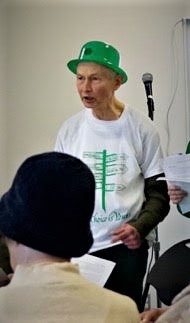
The highlight of the whole concert for me was when Ben sang. Ben is a slight, thin man who is currently living with Parkinsons. He asked The Other Susan to stand with him when he sang. He stood unsteadily and his hands shook as they held his music.  Then he sang. What comes out of Ben when he sings is vibrant and strong, a high ethereal tenor. He sang the verses of “Wimoweh.” Then he smiled his wonderful smile, full of sweetness, relief that he had gotten through it and surprise that the ovation was so stunning.

After the concert he told me, “I’ve waited 50 years to do that.”

“Oh, Benny!” I said and hugged him.

Apparently Ben has lived with his wondrous instrument and for reasons I can’t fathom, has never been given the opportunity to use it. He’s auditioned for choirs and he has asked to sing in churches. Nothing. I don’t understand this. Maybe someone had parents who bribed directors into letting their little Brittney Spears Wanna Be get in and there wasn’t room for someone with real talent. There seems to be a lot of that going around. Or I could put it down to the snobbery of some churches. It’s inexcusable.

I was proud to put Ben on the promotional posters as the featured soloist at our little concert.  I am already thinking about what he might do next. One day Parkinsons will take his voice. I want to give him lots of chances to share it before that happens.

Ben


* one of the Chorale songs was a setting of Shakespeare sonnet # 97 “How like a winter has my absence been.”

BooksFriendsTravel

February 6, 2019

The Drang Before the Sturm

I never visited my friend Louise when she lived two miles from my house. She was my singing student before we became friends. Then she moved to Oregon City and I spent five hours travel time to visit her there.

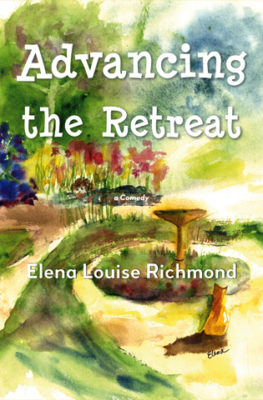
I’ll get to that in a minute. First there were the books. Or rather, The Books. A shipment of three boxes containing 100 copies of my first novel, Advancing the Retreat. I ordered them as soon as they were available from the distributor and wouldn’t you know it they were scheduled for delivery just about time the train left Seattle for Oregon City.

I already had Erina, the energetic neighbor girl, feeding the cat in the evening because Bill who usually takes the evening shift was also going to be out of town but it was his birthday and he was going skiing. I told Erina about the books.

“Do you want me to pull them inside for you?”

“Oh that’d be great.  .  . Do you want to write that down?”

“Oh no, I’m fine.”

I looked at her skeptically then alerted Gwen who was feeding the cat in the mornings. Gwen told me I could arrange for UPS to notify her when the boxes were delivered to my door.

This necessitated my creating an account at UPS, which took actual life blood out of me. I saw no way to alert a third party upon delivery. I haven’t enough life blood to spare to learn how to do such things by phone or –God help me—wrist watch. I considered taking my laptop with me just to get the UPS notice but the great attraction of being on the train was to be away from electronic leashes. I dithered over whether to pay $15 and have the boxes delivered the following Monday when I would be home. I abandoned that idea but managed to instruct them to deliver the three boxes to the side of the house. There was no way to specify which side of the house so I was able to worry about that for a while. This is my first novel, you understand.

I told Gwen she was not to leave the neighborhood on Friday during the hours of one and four or until the boxes came. She saluted. I asked my friend Tim if he would stroll up here at 5:00 and check everyone’s work.

Then I told myself, “STOP!”

Friday morning, UPS notified me that due to weather conditions in the Midwest, my delivery was postponed til Monday. Big sigh. New blood pumping in. I texted Erina, emailed Tim and told Gwen she could stand down.

I was off to Oregon City with a light heart. I was pitifully excited about going someplace I had never been before, even if it was only a suburb of Portland. And I love the train. I love the station and walking down the track, feeling like I’m in a Hitchcock movie, hoping the similarity ends there. I love watching the world go by at a pace faster than a stagecoach but slower than a plane, more spacious than a car and with room to move around. The people one meets. The sway of the cars on the track. The ability to pee when one needs to.

It was a semi pleasant ride but not so lovely as in my anticipation because I had forgotten the value of booking business class. In coach I was crammed next to a big, cheerful, galumpy  woman who was going to visit her twin for their birthday. She needed me to plug in her phone because she was diabetic and couldn’t reach the plug in. I learned a great deal about her in such non-sequiturial ways. We became BFFs when a seat went spare behind us and the attendant offered it to either of us. My seat mate left me to expand into two seats. After that I was quite cheery with her off and on through the slat between my two seats. I caught hold of her sweet vibrations of excitement about seeing her twin.

There was another passenger on the train who made an impression on me when we stood in line for the bistro car. He also seemed to be bubbling over with some wonderful anticipation. He was going to Portland and he hadn’t been there in a long, long time.

“Why’s that?”

“It’s kind of embarrassing.”

I braced myself for a family-from-hell story.

“I been in prison for the past 26 years.”

Twenty six years and he looked to be about 50. I was curious as hell what he’d been in for, but 26 years? I didn’t want to bring it up.

“When did you get out?”

“At 10:10 this morning.” He emanated joy.

I teared up. “Congratulations!” I thought what an amazing morning he must have had, just moving around in the world. “I am so happy for you!”

He grinned. “It’s kind of embarrassing,” he repeated.

“Hey,” I said. “We all have embarrassments. The trick is to know who it’s OK to tell.”

I bought a bag of 4 potato chips for $2.25 and my new acquaintance ordered a sandwich. I started to leave then turned back and whispered in his ear, “Do you need any money?”

“No ma’am,” he said. “But thank you.”

“You made my day,” I said. “I am so happy for you.”

At Louise’s new house I had two cats at my disposal: Stop That Sammy and Get Off the Table Davy. Sammy was a remarkably friendly tabby, going right away for a complete face inspection. Davy, a little more cautious, is a tuxedo cat with bedroom eyes. I encouraged them to sleep with me but I mostly got nocturnal visitations from Sammy who squirmed on the bed and batted my belongings around on the night stand.

After a relaxing weekend, I scored a bit of a coup on the train home. I wanted to upgrade to business class but the car was full. Oregon City being an early stop in the run I got a single window seat-with-table facing north in the lounge car. The staff told me I could stay there the whole trip, which I did. I read, wrote, knitted and chatted; and arrived home to the beginnings of a snow storm which developed blizzard qualities before it finished.

In the midst of the storm, my 100 books were delivered and I was able to collect them at my front door. If you want a copy from my delivery, you’ll have to come to a reading:

Friday, Feb 15, 7:00 PM– Ballard Writer’s Collective Annual Event, Sunset Hill Community Center.

Tuesday, Mar 12,  7:00 PM– Book Launch, Phinney Books

Thursday, April 11, 7:00 PM– “It’s About Time,” Ballard Library

Meanwhile please consider buying a copy from your local bookseller. I think you’ll enjoy the read.


FriendsSingingSongs

January 31, 2019

Verdi Poisoning

My friend Karla is from Holland, land of liquorice. Black liquorice. If you consider red vines to be liquorice you can stop reading right now even though this post isn’t about liquorice at all.

Karla told me they have a saying in Holland “liquorice poisoning.” That’s when you spend all evening (or days) with your hand going back and forth from the candy bowl. It’s akin to Death by Chocolate.  Then she went and introduced me to Salmiak Rocks, a slightly salty/sweet Dutch liquorice. I currently have liquorice poisoning but that’s only by the by.

I also have Verdi Poisoning. Verdi’s Il Trovatore has just finished up a run at Seattle Opera. While I gather it is one his most loved operas, I don’t remember ever seeing it and I wasn’t familiar with many of the well beloved and famous songs. At Seattle Opera I saw it twice. In between I ordered the score. While I was waiting for the score, I sat at the piano and sang every aria from Il Trovatore I could find in the house. I found myself saying “Strrrrrride la VAMPa” for no apparent reason other than that I live alone and talk to myself a lot.

It began with my neighbor across the street, Bill, asking me if I wanted to go to the dress rehearsal of Il Trovatore. His parents are huge opera goers; part of their subscription includes dress rehearsal seats, which Bill and his sister usually avail themselves of. Bill’s sister being otherwise engaged, he asked me.

I had never been to a dress. We had excellent seats smack in the center of the first tier. But I was otherwise not impressed. The singers were marking, not really giving it their all, which we had been warned about but I didn’t expect this to detract from my enjoyment. It did.

I was disappointed in the soprano (Leonora) anyway. I require an exceptional soprano. This one had one of those voices whose beauty had been trained out of her. And the mezzo (Azucena) wobbled. To my ears she needed more frontal focus to disperse some of that breath that was hanging around in her throat. Ironically, the only voice I really loved was that of the tenor who sang Manrico and he had a cold.

In Il Trovatore, most of the action has already taken place and is relayed in the arias and choruses. It’s a grotesque and repulsive story that involves a baby being thrown into a fire. In this production we learn this not just through the music and super-titles but with the help of a shadow play behind a curtain. When you’re sitting in the center of the house, it’s right in your face: a woman tied to a stake, struggling to free herself from the fire and the mezzo tosses in (what she think is) her baby. It was horrifying. I couldn’t stop commenting on it on the way home. Bill kept saying, “All operas have horrible plots.” I kept saying, “But it was a baby.”

Though it had been a sleepy performance (except for the baby), I could not get the music out of my head. That was when I started looking through my books and CDs to find arias to play. I scrolled YouTube. I stalked Il Trovatore.

Then I walked around Green Lake with my friend Nancy who had just seen the production with The Other Cast. She and Scott had loved it so much they were talking about going to see it again. The music was already zinging in my head. They had seen and heard something apparently stunning. I wanted to hear the other cast.

We found a time we could all go together. Nancy and Scott went SRO and I went with that golden ticket, the Senior Rush. You show up before curtain and present your rush ticket, whereupon they find you a spare seat and no matter where it is in the house, it costs $45.

I almost always manage to get in a box. A Box! At Aida, I had Box #1, practically hanging out over the stage. I could have thrown up from excitement, right onto the first violins. I sat next to the guy who had turned the ticket in and who obviously was unhappy his chosen partner wasn’t there with him. I told him how delighted I was to have the seat because I was a singing teacher and those of us who actually teach singing can’t always afford to hear singing.

“You teach?” he perked up. “Where?”

“Oh I have a private studio.”

“Oh.” He turned away in disappointment. Not only was his chosen partner not there, the singing teacher he had to sit next to wasn’t even a professor at Julliard.

At this performance of Il Trovatore, I again got a great box seat and a congenial seatmate as well. The guy on my other side was a jaw-clicker but he smelled good and my pleasure was not impinged upon.

I was forward in my seat most of the evening. I will confess that much as I adore opera (and Shakespeare,) I do tend to take a little snooze at some point. On this particular evening I didn’t. The soprano was everything I could have hoped for. I could have died and floated away on her voice on “Tacea la notte placida.”  It was the same wonderful tenor, now a week past his cold! The mezzo had a nice frontal edge and a range and flexibility that was electrifying.

I looked down at my lap when the baby was thrown into the fire.

It was a transcendent experience. Nancy and I compared notes all the next week.

“That fast one that comes after the slow one, what is it? It runs through my head all the time.” (We determined it was “Di tale amor”—it comes after “Tacea la notte placida.”

“I am listening to Joan Sutherland sing it right now.”

“I’ve found “Il Balen” in my arias for baritones and was just playing it.”

“I found Leotyne Price singing “D’amor sull’ali rosee.” I’m getting that CD.” 

“Stride la vampa.”

“Ah, ‘Stride la vampa!’”

“Do you think you might want to see it again.”

“Maybe. Would you go?”

We didn’t, but we both thought about it: that’s Verdi Poisoning.


BooksFriends

January 6, 2019

My New Cookbook

At Christmas I told my friend Mary-Ellis that I had gotten rid of all my cookbooks and was devoting the rest of my life to Joshua McFadden’s new one.  She wanted to hear more about that and here is my answer to her:

I have not been a good cook since the 1970s. When I was first out of college, I exulted in being in the kitchen without anyone yelling at me.  As I recall I had several specialties: cinnamon rolls, cardamom bread, pea soup and cornbread, quiche, which at the time was quite nouvelle in the United States. We were all trying to be vegetarian at the time on account of Frances Moore Lappe.  And we did the best we could with Adele Davis even though her recipes were awful and Euell Gibbons even though we lived in the city.

I remember a later golden period where I made orange cake. It was like a vanilla cake only with orange juice and orange peel with creamsicle orange butter cream frosting. And ooh, ooh: the orange bread recipe from the Nantucket Diet Murders, one of the first of the mystery genre that has recipes stirred into the narrative. It’s the only one I ever read, not having a taste for them, really, but I think I made that orange bread several times a year for a long time.

Somewhere in there I learned to make chicken soup, roast a turkey and make gravy. I started making my mother’s celery almondine, which probably sounds awful to you but it is delicious and I still make it several times a year. My finest culinary accomplishments came about when there seemed to be nothing in house to eat. I could open the refrigerator and cupboards, muse for a bit and put together a meal. That was fun.

Then I started having digestive problems and “joint issues,” which I immediately diagnosed as diet-related. I had taken over this practice from my mother. (“Your problem is you don’t get enough broccoli”)I didn’t need her to blame my diet, I did it myself. I commenced upon a series of experimental diets which did absolutely nothing for me and which I don’t want to re-live here. In any case, most American women reading this know exactly what I’m talking about.

When I first started eschewing –as opposed to chewing—gluten, I made awful mock graham crackers and swore I liked them. In the 90s, gluten free eating was a desolate business. There were no tasty substitutes or decent recipes. After expensive experiments with xantham gum and rice flour, I stopped trying. In the end, I gave up bread and cake and pretty much everything I loved to eat.

Then there was Abascal Diet craze, which I faithfully followed for three years. Here’s the diet: shop for vegetables, chop vegetables, roast vegetables with a little olive oil, salt and pepper. Eat. Repeat. There’s no time for anything else.

This is what was going on with me when everyone else was watching cooking shows and raving about Elizabeth David and MFK Fischer and Julia Child and Craig Claiborne and Irma S Rombauer and Julee Rosso and Ina Garten and I can’t think of any more without resorting to research. The point is that everyone was cooking and everyone had their favorite book and show and everyone was developing fusion tastes except me. I was chewing weeds and tree bark and herb tea bags.

I have two friends who are ingenious cooks and who somehow have made it their practice to feed me. Former professionals, they have both taken on the challenge of cooking within my diet restrictions, which fortunately now are few.

Four times a year, once a season, Tim invites me and a mutual friend, Julie to a soiree at his apartment. He spends the entire day cleaning his place (because he is the child of 1950s’ parents) and cooking. The meal always consists of some surprise cocktail, a plate of three different hors d’oeurves and preliminary conversation. We move to the table for the entrée, two sides and a livelier, if not heated conversation about books, movies, politics, religion, our childhoods, the book I’m writing, Julie’s Mexican family and whatever Neil de Grasse Tyson said recently. Then dessert.

Every few months I go down to Burien to have lunch with my friends Susan and Mike. Susan’s kitchen could be in a cooking show. Her cookbooks could stock an entire bookstore. She says she likes just looking through them. When her grandchildren were babies, she read to them from the cookbooks in a soothing voice.

Susan’s lunches start with a display of appetizers, artistically presented. I sit at the bar and chomp away on homemade and fresh everything while Susan puts the finishing touches on the main meal and the three of us talk.

The meal is always splendid. There’s dessert and usually some chocolate for Afters. Then we play poker or Scrabble or the Great Dalmuti or a card game, which I believe is called “Oh, Hell,” or “Go to Hell.”

My point in going into all this is that Susan and Tim have inspired me to believe that I can re-learn to cook. Or up my game, anyway.  I was itching with this aspiration when I happened upon a cookbook in the Peak Picks section of the library. Six Seasons, a New Way with Vegetables by Joshua McFadden.  Part of the attraction besides all the lovely photographs were the chapters on the late winter vegetables that come in my Imperfect Produce box and I’m not sure what to do with them except roast à la Abascal. I checked out the book. Three recipes in I ordered my own copy.

Part of my difficulty, I have learned, is that today’s cuisine does not lend itself to the mindset from the Betty Crocker kitchen of my childhood. Recipes in old cookbooks tend to have a list of six ingredients and three sentences of instruction. They are begging for improvisation. That is how I learned to cook: by trying whatever is available. Today’s recipes are like chemical experiments and you have to approximate exactness.

In the past if it called for parsnips, I might substitute carrots and potatoes. If it called for lemon zest, I might use Rose’s lime juice. A yellow onion would substitute for shallots, chives or leeks. If I don’t happen to have marjoram or oregano, I’d use thyme. If I didn’t have parsley, I’d leave it out. I almost never had parsley. And don’t get me started on vinegars. Apple cider vinegar was all anybody needed. I would try a recipe according to these slovenly standards and end up with some shlock and think, well, that recipe’s no good.

So when I bought this cookbook I told myself I had to follow the recipes exactly. It takes some doing. Halfway down the list of ingredients will be some concoction I was supposed to have made ahead of time and those instructions are on page 30.  This might require me to wait another day to try the dish. More than once I have put off a recipe because I needed golden raisins and I only had currants in the house. But I have been amazed at how wonderful food can taste when prepared with enthusiasm for the details.

“Parsnip Soup with Pine Nut, Currant, and Celery Leaf Relish: Its flavor was just astonishing.

“Brussels Sprouts with Pickled Carrots, Walnuts, Cilantro and Citrus Vinaigrette:” Here are my notes from my first attempt: “Next time I wouldn’t use the burnt walnuts and I’d want the pickled carrots to be more pickly. Use the vinegars he says and let it pickle for more than two hours.” I made myself try the recipe again exactly as it’s written, even including the cilantro, which I didn’t think I liked. I ate it for two meals that day: a pound of Brussels Sprouts and all the trimmings. I thought nothing could taste so good as this.

One day I’ll have Tim and Julie and Susan and Mike over for dinner. And Mary-Ellis.


FamilyFriends

November 5, 2018

The State of Our Discourse

Nina (rhymes with Dinah) and I went out to dinner a few evenings ago. After the how-was-your-day conversation, Nina quoted a friend (who was quoting Woody Allen) saying that if this election turns out badly, she’ll be in the basement in a pool of blood. It’s come to that. There’s nothing to do but that .  .  .or vote. Nothing more to say. So this was the rest of the evening:

“God, this rain. What are all these cars doing backed up like this?”

“It’s Seattle drivers. The first rain and you’d think it was snow instead.”

“Is this where I’m supposed to turn?”

“No, I think it’s up there. No wait, that was it. Sorry. This is exactly we did last time we came here. Now we have to go under the freeway and make a U turn at Target.”

“Really? Was it Target?”

“I think so. But it wasn’t raining and there weren’t all these cars.”

Looking at our menus in the warm, inviting restaurant, we had the coupon conversation.

“Tell me how much you want to spend so I know what I can order,” I said.

“No matter what we order we can save $10,” Nina said

“But only if we each get a meal of $20 so we can get half off the second.”

“That isn’t the kind of coupon we have. We have the second meal free as long as we order two entrees.”

“Are you sure?”

“Yeah, and two drinks.”

“That part’s not a problem. Can I see the Scotch menu please?”

After the enjoyable meal came the check /tip conversation:

“OK, here’s the adjusted one. It looks like we just split it.”

“Can I have the other one for my tax deductions?”

“Not yet, I have to figure the tip without the discount. Are you paying with your card or cash?”

“I’ll give you cash.”

“Oh, good, then I’ll have some cash.”

And scene.

The next day my friend Nancy and I saw Seattle Shakespeare Theater perform Arms and the Man. We always park halfway up Queen Anne Hill so we can get a bit of a walk.

“It feels like Sunday,” I said.

“This is the first Saturday performance we’ve seen this season.”

“Haven’t we always gone on Sunday?”

“No we always go on Saturday. This is the first Saturday performance we’ve seen this season because we changed our seats for Richard III and went on a Sunday.”

“Isn’t this the first season we’ve had Saturday seats?”

“We always go on Saturday.”

(We don’t, you know. We’ve always had Sunday season tickets but we changed to Saturday this year. I just didn’t remember that in time to back up my confusion.)

Then Nancy reminded me of our trek to see Richard III at Seattle Rep theater.

“Where are you going, Nancy?” I had asked. I stopped at the Cornish Theater. “It’s here at Intiman.”

“No it isn’t. It never is. It’s either at the Center House or Seattle Rep.”

“I’ve never been in Seattle Rep with you. That’s Bagley Wright up there.”

“That’s not Bagley Wright, that’s Seattle Rep. And we always go there.”

(For those of you not from Seattle, Cornish Theater used to be called Intiman and to some of us it always will be even though it’s now named after a doyenne of the arts in Seattle, Nellie Cornish and I should celebrate that. I do, actually, I just can’t ever remember that the theater is no longer Intiman. Up the street from Cornish/Intiman Theater, the Seattle Repertory Theater has a main stage, Bagley Wright and a smaller stage, Leo K Theater. I’ve always thought of the whole boiling as Bagley Wright. Period.)

Arms and the Man was fabulous, especially S.F. Kamara as Capt Bluntschli.  Even so at the first interval, Nancy said, “I want to get some tea. I’m starting to fall asleep.”

“Me too.”

I wonder if Susan Sonntag ever talked like this?

I’m listening to my conversations with my friends even as they are becoming  spoken words and I see an image: My two great aunts tottering and doddering in downtown Olympia, their shoulders pressed together as though they are holding each other up.  And yet if we were twenty-somethings having these conversations while texting each other, we’d be .  .  . hmmm. I was going to say “young and lively and cute,” but actually I think we’d be supremely annoying.

Or as Nancy, always the Libra, said, “Aren’t we all just human?”

I think the larger point with which I started this post was that there’s nothing much to say anymore. Just make sure you VOTE.


BooksCharles DickensFriends

October 22, 2018

Library Hours

Tags: , ,

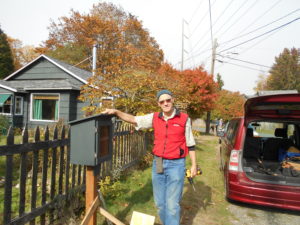
My new Little Free Library is open for business! I’ve wanted one of these charming things forever and I finally sprung for one. I got the least expensive preassembled one I could find. I painted it the same color as my house and did as much of the hardware as I could figure out. I put in a request for a village volunteer to help me plant (read: do it for me) the library in the ground.

In case you (cousins in England) don’t know what I’m talking about, Little Free Libraries are all over Seattle, practically one in every block. Tiny houses, larger than a birdhouse, smaller than a doll house, they offer books to a community of dog walkers.

Actually anyone can take a book and add a book.  Lots of people walk in Seattle. They walk their dogs, walk to the bus, walk to the store. My neighbor Gwen, who already wants to know how many books she is allowed to put in the Little Free Library, walks every morning just to walk. So do I. I’ve been walking in the cemetery behind my house because I love it in the morning mist with the falling leaves. Just to be clear, though, there aren’t any Little Free Libraries in the graveyard.

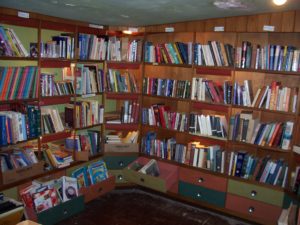
One of my reasons for wanting a Little Free Library is my book room.  A small room in the cabin behind my house has welcomed all the books that I years ago dragged up by the car load from my parents’ house in Olympia. When I purge the book collections in my house, I add to the book room. People used to give me books by the sacksful:

“Do you want these for your yard sale?”

“Oh sure, just think of me as the Crown Hill Good Will northern division.”

I had unloaded hundreds of books at my annual yard sale but I’ve retired from that career. The last sale was three years ago after which I took a deep breath and packed everything up while trying to not look at it or think about it. In three carloads, I took it to Good Will. But I could not bear to get rid of the books. After all there were some I hadn’t read. There were others I had read but might want to read again. They are books. Books, books, I love my books!

Book Room

One of the beauties of a yard sale is that people carry junk off your property.  Thinking in those terms resulted in a guy from Books for Prisoners collecting all the paperback mysteries. I still have shelves and shelves of fiction, history, biography, humor, poetry, essays, a 12 volume Groves music dictionary (anyone?), a set of Will and Ariel Durant’s Story of Civilization and a nearly complete set of Dickens from three summers ago when I read all the novels.

I enjoyed my summer of Dickens but none of the novels made the cut of books I want to re-read. Except maybe A Tale of Two Cities, which I’ve already read five times principally for the build-up to the scene at the end where Mme Defarge makes her murderous way through the streets for her final battle with Miss Pross.

But I digress. A delightful village volunteer, Jack, came over one Friday morning and dug the hole for the post, while I pulled what I call weeds and Tim (fellow gardener) calls ground cover in the winter garden. Jack set up a support to hold the post level. He mixed the cement and tamped it in. Then he came back a few hours later to affix the little library atop the post. I learned a lot, like I really need to get an electric screwdriver.

In progress

Vibrating with anticipation, I had already picked out the first books to go in the little library. I thought I’d be putting them in on Friday afternoon but Jack said to wait until Sunday. To appease my excitement, I put a sign in the little window saying “Books Coming Soon.” My maiden stack of books sat by the front door like Christmas presents waiting to be opened. Sunday morning I put them under my arm and marched out to the parking strip. I opened the door and to my great consternation found that someone had gotten there first. Someone had already donated two books. It took me all morning to stop feeling slightly cheated.

I understand that’s hardly in the spirit of the Little Free Library, whose registration plaques (I’ve ordered mine) say “Take a book. Share a book.”But do these people understand I have hundreds of books to get rid of? It’s been 24 hours and they are all still there!

CatsFriendsGardenPolitics

September 29, 2018

Dear Diary

Tags: ,

I am making this a news free weekend because I am exhausted after the heart wrenching testimony on Thursday of Dr. Christine Blasey Ford and the ensuing pissing match between Lindsey Graham Cracker and Brat Kavanaugh to see which could spew their putrid stream of testosterone the farthest in service to their own egos.

So.  .  . well, I went to an orientation meeting to become a volunteer for The PNA Village. The PNA (Phinney Neighborhood Association) began life as a community center for an area of town called Phinney Ridge. It has expanded into a Seattle octopus of good will and services that encompasses other neighborhoods, kind of a community center on steroids but in a bighearted way, not like the toxic steroidic display of the senators on Thursday.  The Greenwood Senior Center where I hold “All Present,” my song circle for people with dementia is now part of the PNA. My neighborhood of Crown Hill is touched by one of the tentacles (again in a good way, a protective way not the insidious way this administration is poisoning the country) of the PNA.

The Village is a program happening all over the country that helps people age in their homes. Earlier this year I had to make a decision about whether to sell my house (and free up some equity) or try to remain in my home without pots of money to actually keep it standing. In my research for this decision, I learned about a lot of programs and services that I was now eligible for because I am aging. I’m on the young side of aging but it is inexorably happening. It helps to identify facts, look ahead and just get on with things. Some people might want to identify the fact that women are human beings but I’m not thinking about that this weekend.

The Village, among other lovely services, deploys volunteers to do things for people. All kinds of things. One morning, five able-bodied and energetic young women came over and worked in the yard for an hour in a half, doing things I and my gardening buddy Tim couldn’t have done in months of work.  Another time someone grounded four electrical outlets for me. I’ve gotten wood chopped and trees pruned.  One volunteer who has come twice, brings his adorable little miniature-pinscher-chihuahua-ish dog named Smalls.

After five volunteer visits I was so grateful, I wanted to volunteer as well. I can’t do any of the physical things that have been done for me, but I can do other things: visit, play piano duets, play Scrabble, sing songs, take walks. But the salient thing here is the gratitude. In my earlier life as the self-erasing daughter of alcoholic and mentally ill parents, I often felt taken for granted, used really. As many women have felt when their feelings are dismissed and they aren’t entitled to throw a tantrum in front of the entire nation when they don’t get what they want. For me to actually choose to do something that in my earlier life I would have resented is a measure of how grateful I am.

So I went to the orientation. I already had an exhausting seven hour meeting on Thursday along with much of the rest of the country but I really want to be involved in the Village. I rode my bike to the meeting, got through it and came home.

Oxi-Fresh arrived to clean the carpets. While a cheerful guy named John attacked all the cat vomit stains, I worked in the garden. Tim and I are creating a little cat cemetery under the lilacs where there are already five cat graves: two of mine, two of neighbor cats and the bones of The Unknown Cat. We’ve got a little wall and a little entrance and five indicators of where the bodies are buried. We’re priming the area with succulents. Photos in the future.

OK, a paragraph without mentioning anything political. Not that I don’t think of politicians when I think of graves. Some of those guys on Thursday looked like they had crawled out of graves to come sit on the judiciary committee.

I talked to my friend and former college roommate, Mary-Ellis on the phone. She expected I would be all wound up from the hearing on Thursday. I told her I had been but that this was a news free weekend. Uh- huh.

Mary-Ellis said she hadn’t seen a blog post from me in a while. Once when I published a diatribe about rape culture, she commented mildly that she missed those “slice of life pieces you do so well.” Today I told her I would try to write something if for no other reason than I usually find it therapeutic. It’s been a challenge to not make any comment on politics or the lack of respect women get in this country. I think I’ve done pretty well all things considered.