
Ah, HumanityFamily

October 23, 2014

Remembering My Mother, Part One: The Mail

Tags:

When I was working on my memoir 99 Girdles on the Wall, my editor blue-penciled several chapters about the end of my mother’s life.  He said they sounded crazed and angry. Crazed was the word my analyst used to describe me during that time as well.  The legitimacy of anger and crazy feelings aside, I went back to have a look at my words to see if I could make them more entertaining.  I don’t like to waste a good story:

The Mail.

The entrance to my mother’s house in the last years of her life involved tunneling through boxes of unsorted mail, towers of envelopes leaning precariously off end tables, and stacks of letters creating a nest for her on the long sofa where she sat for hours watching religious television and drinking coffee. She lived for the mail.  She read every word of every letter of every lobbyist that ever set up shop this side of legality.  She believed everything they said.  She believed them when they sent screeds on stapled sheets of paper saying they couldn’t afford envelopes.  She believed them when they told her that she was losing her civil rights at the hand of the Democrats who were secret Communists.  She believed them when they said Hillary Clinton, personally, was siphoning off her social security.  She believed them when they told her that if Puerto Rico was allowed to become a state, the English language itself was in jeopardy.

Some of the political solicitations came dressed up like urgent telegrams. (I had to admire the savviness of this lure.  People my mother’s age associated telegrams with urgent news.) Some called themselves “legal documents” and were stamped “Time Sensitive” and “Do not Tamper.”  Some had important sounding returnees like “Public Advocate of the United States.”   They issued meaningless membership numbers and asked for membership dues with warnings about what would happen to America if their organization failed in its mission due to –at this point in the letter they were on a first name basis—Mary’s lack of support.  They sent membership cards and cheap promotional items: umbrellas, key chains, pens, T-shirts, personalized pads of paper.

They asked for “pledges” of $7 (a study probably found the elderly more likely to send $7 than some other amount because a lot of these borderline criminal organizations asked for $7 pledges.) My mother sent her $7 pledges. Two weeks later, the telegrams reminded her of her pledges and asked her for more.  Since she had short term memory loss and the word pledge meant something to her, she sent more checks for $7.  Two weeks later, Pete and Repeat went back to the lake. Except this wasn’t a kid’s joke. My mother was giving away $1500 a month, over half her monthly income, to unethical scum, many of which used the same mailbox number in Fredericksburg, Virginia.

The religious ones were just as bad: “The Atheists are on the march. Help me reduce my debt so I can fight them.”  Envelopes came with Bible verses on the outside and tales of the imminent apocalypse on the inside.  These appealed to my mother because she believed in The Rapture. She and my father had an on-going fight about The Rapture, a word that does not appear anywhere in the Bible.  My father said it was a made up event, worthy of Hallmark. My mother insisted it was a Biblical concept exactly as annexed to the Bible by John Nelson Darby in the 1800s.  The pertinent thing about The Rapture in my family was its source of conflict.  It was weekly entertainment for a while.

My mother believed that Jesus was coming soon, though she was always canny enough to not give a date. She intoned the line from Revelations about “wars and rumors of wars,” and stuff about weather patterns changing.  She commented regularly that the clouds looked different.  She had never seen clouds like these in her life.  Somewhere was a cloud focus group assembled just for her.

All the solicitors: religious, political, medical, charity—sent pages of hyperactive, alarmist verbiage, every second paragraph in caps and every third paragraph in italics, and the summary in red, italic caps.   She thought the letter writers were her friends and she looked forward to hearing from them.

Then there were the sweepstakes. Once she responded to their mailings the organizations tagged her as a viable address. Then they accessed her phone number.  One day I came in the front door and intercepted her on the telephone.

“Elena,” she said excitedly, “I’ve won a million dollars!”

I grabbed the phone away from her and yelled into the mouthpiece:

“Put this number on your Do Not Call list!”

“But, ma’am–”

Put this number on your Do Not Call list!”

I hung up.

“Why did you do that?” My mother looked hurt.

“Because you didn’t win anything.”

“How do you know?”

“Because no one ever wins anything!”

Another time, my brother intercepted her in the parking lot of the Tumwater Safeway with $700 in cash, ready to hand over to someone who needed it to process her million dollar win.

She gave out her banking information to strangers who lured her with fictitious wins. I had her bank account changed so many times the bank said that if it happened again, they would drop her as a customer.   My brother Alex and I hoped that would happen.  Six months after my father’s death, more of my mother’s synapses must have started firing because the sweepstakes activity stopped being a problem.

Every time I visited, I sneaked as many boxes of mail out of the front room as I could manage. When my mother went to the bathroom, I got at least two out to the car, leaving another sitting on the front porch waiting to be transported.  If she happened to see me with a box, I got very good at whisking them quickly away, calling over my shoulder something like,

“Oh this is that stuff we went through last time, remember?” Or “These are some of my books, good grief, don’t be such a snoop.”

My sporadic visits didn’t make enough of a dent in the mail. One Sunday while my mother was at church, a few of us from Seattle descended on her house and sucked out every piece of mail we could find.  We piled the boxes into my neighbor Gwen’s VW bus, floor to ceiling and filled the trunk and back seat of another car.  Then I slapped the vehicles on their rumps and sent them back to Seattle while I stayed behind to take my mother to her church’s harvest festival where she had to make nice with me because the priest would be watching.

She was furious but she didn’t say anything except, “You went into my bedroom!” She was angry with me for the SWAT raid until the day she died.   She complained to her friends, her priest and to my brother. “Elena took everything away from me.”  That was her line.

The mail continued to be a problem. I arranged a change of address.  All her nasty mail started being forwarded to my house.  I spent hours going through it, partly to make sure there wasn’t anything important, partly out of fascination, and partly to document the solicitors.  The final tally of criminal organizations my mother had been sending money to came to over 450.

I contacted all of them at least once. I ticked off the number of times I mailed or called to have her name removed.  It was fatiguing. When I was up late, feverishly and determinedly trying to gain control over the mail, I started writing letters that said things like, “Yo, man o’ God.  Take my mother’s name off your fucking mailing list.”

I learned that often you had to send a stop mail request to an address that was hidden in the fine print and pale type on the back of a page of the mailing.   I also learned that some of that mail was not going to stop no matter what I did.  Eight years later, I am still getting mail addressed to my mother.

The business with the mail was a species of the lifelong competition between my mother and me. I was going to win this one though I didn’t know what exactly I thought I would win.  Did I think that if I got every single solicitor to stop sending their mailings, I would gain control over my mother’s finances and through some intricate alchemy of money and value, I would finally have a mother?  I wasn’t thinking at all.  I was obsessed.

My mother reversed her mail.   She waylaid the mailman at the neighbor’s house one day and filled out a change of address card.  Soon she was hearing from all her friends again.  On alternate days she felt she was drowning in mail.  She asked me to make it stop.  I told her it was her own fault.  I had helped her once and she had taken it all back.   She received this in silence.

A few weeks later, she asked me again.

“Why don’t you ask Phyllis Schlafly to come help you?” I asked. “After all, you are sending her money.   You think she’s your friend.  Maybe she’ll help out.”

The third time it came up, I said, “OK, look. I will help you with your mail.  But that means it has to all come back to my house.”

“OK,” she said.

I made her sign a statement saying: “I want Elena to help me get the mail under control.”

I filled out a change of address card and signed it with a POA I had forced her to give me.   Before long, this came in the mail from the U.S. Postal Service:

“Dear Ms Richmond:

We have instructions from Mary K Richmond to deliver mail to the old address on the change of address card. Without legal documentation proving you have permission to forward Mary’s mail to you, we are unable to comply.  It is a felony to fraudulently submit a change of address without the legal right to make decisions for that person. . . etc.”

Taped to the letter was a note in my mother’s familiar handwriting, full of underlines and explanation points saying she wanted all her mail delivered to the Olympia address. The main reason I saw red was because I knew I had walked into this one with my eyes open. I knew I should have made her sign the change of address card but I wanted to use my new POA.   It was all part of the competition with my mother.

I was still steamed when I dialed her number. “Do you see what you did?  Do you know what a felony is?  People go to jail!”

“Elena, did you take those plastic forks I had on the dining room table?”

“DID YOU HEAR ME?”

“Yes, I heard you. Did you take those forks?”

By the time she died, she had managed to amass as much mail as we had once sucked out of her house and I had to start all over again.

Stay tuned for “The Attorney.”


Ah, HumanityCatsFriends

October 10, 2014

Skunkless in Seattle

Tags: , ,

There is nothing as sweet as the calm after the source of anxiety has vacated the premises. In reference to my current situation, I believe the skunks have moved on. It was news to me that skunks could live in residential areas of a city when I first smelled them last spring. I came home from OK Chorale rehearsal to the unmistakable odor of skunk hanging around my front gate. I say unmistakable because I have no patience with people who say that skunk smells like pot. It doesn’t.

My only previous experience of skunks was when I was a child growing up in Olympia. My parents had just purchased their first new car, a Rambler three-on-a-tree. We left home early for Wednesday night prayer meeting at Tumwater Evangelical Free Church in order to take a little celebratory spin in the country. Sitting in the back seat and all of eight years old, I’m not clear about exactly what happened. There was an animal in the road and the car swerved. The new car smell was replaced by an ascending odor accompanied by my mother screaming hysterically. We trooped into church reeking of skunk and with an obvious prayer request.

The skunk odor around my gate last spring was mild. It was mild a few weeks ago when I started noticing it again. Then came the evening when I stepped out of the sun-room to get the cats in for the night and the odor was so powerful that if it was pot, there was an entire Grateful Dead audience in the cemetery storage lot on the other side of my fence. If that wasn’t cause enough for anxiety, there was Freud, my orange and white cat who still smells like Kitten, sitting atop the fence and far too interested in something in the lot below. Fortunately he stilled smelled like Kitten when I finally got him in a few hours later.

I assumed that the skunks had taken up residence in the cemetery. The next day I went up to talk to the caretaker. Skunks were news to him. He hadn’t seen any evidence of skunks. Rats, raccoons, opossums. No skunks. But then skunks are nocturnal and he tried to not be in the cemetery at night. Whether this was out of superstition or because like any of us, he preferred to not have to work overtime, he was a dead-end of information.

The next evening, George, another orange cat in the neighborhood got spooked and ran up to the top of a telephone pole where he nestled comfortably amongst the open wires. Julie, his person, knocked frantically on my door to ask if she could get some cat treats from me. I came out with little green fishes for George and some Paul Newmans for Chester, Julie and Cory’s little chihuahua-ish dog. George and Chester regularly take their passeggiatta down my street. George likes to climb a neighbor’s old dead tree and have a little cat meditation. While he’s doing that I sometimes chat with Julie and Cory and feed Chester.

Anyway the upshot of George’s race to the top is that a bunch of us sat out under the telephone pole until well after dark, at which time City Light showed up to cheerfully effect the rescue. The guy rode up in the little elevator and pried George away from the electric wires. Just as the box began to descend, George took a flying leap out of the man’s arms and attached three of his paws to the telephone pole. Gasps all around. The prying process was repeated and George was finally restored to safety.

It’s what Julie told me during our vigil that is pertinent to my skunk story. She told me that she had smelled skunk in the neighborhood.

“It smells like pot,” she said.

She also filled me in on a house across the alley from me, which belonged to a family of hoarders. I knew the couple vaguely. I knew they owned several beat up cars. I even let them park one of them on my parking strip for a period of months. I knew their yard was unkempt. I knew they owned a vicious dog that sometimes got loose, crapped in my yard and aggressed toward me when I tried to shoo it out. I occasionally ran into them at the grocery check-out. They were odd. They seemed wary of me in the way that kids who have just spilled their milk are wary of grown-ups.

Apparently they had moved and someone had bought the house for re-development. I don’t know how the couple decided what to take and what to leave behind but when the excavators arrive and started pulling the place down, it was still full of stuff, some of it in packed boxes taped up and ready to move.

I started thinking backwards. The skunks had not always been here. I’ve lived in my house for 17 years without ever suspecting there could be skunks in the city. So the skunks arrived, this couple moved. Was that the order? Maybe the couple moved and then the skunks arrived. Either way I suspect the skunks found shelter and a feast of garbage and dog food; they were in clover, so to speak, all summer.

Then the excavators arrived and paradise was invaded. The skunks started moving north in the direction of the cemetery and my house. The day the wrecking ball came I strolled over to talk to the guys. In answer to my query, one of them said he had smelled skunk.

“Naw, it was pot,” the other one said.

The noise of the house being pulled down has made my cats jumpy. I suspect it has dislocated quite a bit of urban wildlife. Significantly, the Grateful Dead concert appears to have moved on. But I am still sniffing the air obsessively when I gather the cats in at night.


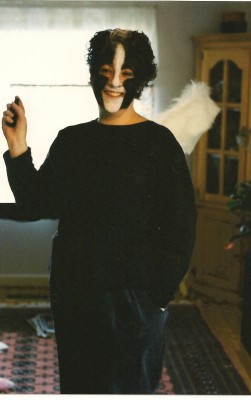
Halloween, 1995

Halloween, 1995


BooksCharles Dickens

October 3, 2014

Bleak House

Tags: , , , ,

It’s difficult to choose a “favorite” Dickens novel. What I can say is that I’ve read Bleak House three times. It begins with the fog surrounding the Chancery law courts:

“Fog everywhere. Fog up the river, where it flows among green aits and meadows; fog down the river, where it rolls defiled among tiers of shipping. . .Fog on the Essex marshes, fog on the Kentish heights. Fog creeping into cabooses of collier brings; fog lying out on the yards, and hovering in the rigging of great ships. . .”

and with a lawsuit over a will –Jarndyce and Jarndyce– that has been going on for generations:

“This scarecrow of a suit has, in course of time, become so complicated, that no man alive knows what it means. . . Scores of persons have deliriously found themselves made parties in Jarndyce and Jarndyce, without knowing why or how; whole families have inherited legendary hatreds with the suit. The little plaintiff or defendant who was promised a rocking-horse when Jarndyce and Jarndyce should be settled has grown up, possessed himself of a real horse, and trotted away into the other world.”

The fog and the lawsuit surround the characters and provide a structure for all that takes place:

Esther Summerson is plucked from her aunt’s house to be a companion for Miss Ada Clare at Bleak House. Esther’s mother, ill after the birth, was told her baby died. Esther’s father, James Hawdon– a sea captain allegedly lost at sea—is actually alive. The two were never married and it’s a huge disgrace for Esther to have been born at all as her caregiver continually impresses upon her. The mother, the father, and the now grown Esther are adrift in England, unaware the other others are alive.

Esther’s mother went on to marry an aristocratic old fossil named Sir Leicester Dedlock (don’t you just love the name Dedlock? Gee, I wonder what kind of mind he has) and has been depressed ever since, ensconced in Lincolnshire in a house called Chesney Wold, which sounds as damp and gloomy as it is. Sir Leicester’s affairs are assiduously and jealously looked after by the misanthropic solicitor Tulkinghorn. Under the guise of professional concern for Dedlock family, Tulkinghorn nurses a sadistic fascination with Lady Dedlock. The scenes between them are creepy.

James Hawdon now addicted to opium, supports his habit by law writing, i.e. copying legal papers. Hawdon copies an avadavat that finds its way to Chesney Wold via Tulkinghorn. Lady Dedlock recognizes her lover’s distinctive handwriting and faints. Tulkinghorn is immediately suspicious and sets out to find the law writer with the distinctive handwriting. He finds James Hawdon who now goes by the name of Nemo (Latin for “no one”) in his lodgings above Krook’s rag and bottle shop. There’s a bit of a problem, though, in that Nemo is dead from an overdose of opium. Mr. Krook who has shown Tulkinghorn to his lodger’s room, secretly pockets the rent he feels is owed him as well as a bundle of letters tied with a pink ribbon.

Someone else is curious if not suspicious: “a man by the name of Guppy,” the legal clerk of the law office that looks after Jarndyce vs Jarndyce. Mr. Guppy is curious about Esther Summerson, thinking she might be a suitable mate for him. Because of his infatuation, information about Esther sticks to him like lint. Thus he comes across the information that her correct last name is Hawdon. He sniffs out that there might be some connection between Esther and Lady Dedlock. Stumbling about in the dark with these fluffs of intuition he asks Lady Dedlock if she might be interested in a packet of letters found in the lodgings of the law writer’s room.

Lady Dedlock launches her own surreptitious investigation. Jo, a small homeless boy who was befriended by Nemo and who gives evidence at his inquest, is an unwitting conduit of information between all interested parties and is rewarded for it by dying of smallpox. Lady Dedlock disguises herself as her French maid and seeks out Jo to serve as a guide to her dead lover’s former insalubrious lodgings and to his pauper’s grave.

At this point we are about a tenth of the way through the book; I’ll spoil the plot for you in a minute. I have omitted about 15 secondary characters, all of them worth the reading of the book. To quote from Mary Gaitskill’s introduction to the Modern Library Classic edition, “Dickens is excessive like Nature; like living things his creatures must twist and turn, expand out or tunnel in until they have utterly fulfilled what they are.” Each time I have read Bleak House I’ve gotten attached to a new secondary. This time it was the Smallweed family.

The Smallweeds are a family of small time crooks related to Krook of the rag and bottle shop who famously dies by spontaneous combustion, a bit of gratis trivia that ought to come in handy at some time in your life. When Krook dies, the Smallweeds take over his business and become protective of the bundle of letters tied with the pink ribbon that a lot of people seem willing to pay a lot of money for.

The patriarch of the Smallweed family is a “baleful old malignant” with almost no muscle tone and who continually bleats, “Shake me up!” whenever he has slid “down in his chair since his last adjustment, and is now a bundle of clothes, with a voice in it. . .” Someone is usually available to pull him up and plump him like a pillow so he can more comfortably renew his spews of venom.

Mr. Smallweed is belligerent with everyone. To his wife he “discharges the cushion at her, crushes her against the side of the chair, and falls back into his own, overpowered. His appearance after visiting Mrs. Smallweed with one of these admonitions is particularly impressive and not wholly prepossessing. . . because the exertion generally twists his black cap over one eye and gives him an air of goblin rakishness. . . All this is so common in the Smallweed family circle that it produces no impression. The old gentleman is merely shaken, and has his internal feathers beaten up, the cushion is restored to its usual place beside him; and the old lady. . . is planted on her chair again, ready to be bowled down like a ninepin.”

Now I’ll spoil part of the plot: Late in the game, Lady Dedlock realizes that Esther Summerson is her daughter. They meet once in a heart-rending scene in which Lady Dedlock tells Esther they can never meet again or acknowledge one another. Lady Dedlock is not a particularly admirable character but she is compelling because she is a woman depressed from the constrictions of society without the recourse of reading Betty Friedan. She doesn’t love Sir Leicester but I think she is fond of him. She is not prepared to risk the security of her position with the announcement that she has a love child.

Tulkinghorn picks up the scent. By paying off, brutalizing and threatening quite a number of people, Tulkinghorn puts together the story of Lady Dedlock’s life, and her connection to Nemo and Esther Summerson. He threatens Lady Dedlock –and takes quite a sadistic pleasure in it—with the information. Should it ever come out that Esther Summerson is Lady Dedlock’s child it would ruin the great Dedlock family of Chesney Wold. This is his stated position but clearly Tulkinghorn is also interested in imposing his power on other people for no other reason than because he can.

So it’s not surprising that one day his clerk finds him shot to death in his lodgings. At this point the story becomes a murder mystery. Enter Inspector Bucket of The Detective who is the first detective in English fiction. He’s a decent man, full of good-will, who just happens to take note of absolutely everything.

He solves the murder. I won’t spoil that part of the plot. Nor will I say what happens to Lady Dedlock and Esther. If you don’t want to read the book I highly recommend the PBS production with Gillian Anderson as Lady Dedlock , Charles Dance as Tulkinghorn and Alun Armstrong as Inspector Bucket of The Detective.

Ah, HumanityCats

September 28, 2014

Journal of My Plague Year –Part Two

Tags: , , ,

At the end of Part One, I was crying on my kitchen floor, wearing a respirator mask and talking to an opossum with eyes as big as silver dollars who was under the house along with a family of dead rats:

March 28
A beautiful, warm day but all that means to me is that the stench of putrefaction will be ever more powerful. I cancel my students and spend the day in the garden.

Pete spends the morning setting traps and sealing the house. He tells me there is no evidence of an opossum and no possible way for it to get in unless I ushered it in the front door, but he’ll trap for it anyway. He is re-assuring, answering all my questions patiently even when I ask the same ones over and over at regular intervals. He pulls several bags of insulation and a rat body out of the vent under the kitchen but the stench remains.

Cook fish.

March 31
Though I didn’t think it possible, the stench in the kitchen is worse. Another rat must have come home to die in the arms of its loved ones.

Wills’ piano lesson. Someone drops him and his mother off and speeds away. For the first time in eight years Esther is without a car and comes into the house.

Wills says, “You’ll have to blow out those candles because my mom is allergic to the smell.”

I start to sweat. Noticeably.

Esther says, “Never mind, I can wait in your sun-room.”

“You can’t,” I blurt out. “There’s. . . well, you see, I’ve had a teeny problem with a rat and there’s trap out there.”

“Oh that won’t bother me. He won’t come out while I’m there.”

“Okay, look, you can’t go back there. There are dead rats under the sink and it vents to the sun-room and the place stinks and you can’t go back there.” I burst into tears.

Pop corn and cook fish.

April 3
Pete checks the traps. The only animal—dead or alive—under the house is a small mouse who licked the bait off all the traps until the last one sprung.

“Here’s your opossum,” Pete says.

I’m confused. The dirt-dobber described something with eyes as big as silver dollars that hissed at him. Pete says the guy probably got claustrophobic and imagined the rest.

Pete grows a halo and stigmata appear on his hands.

April 4
Playboy and company show up three hours late. They mercilessly tease the fellow who looked at a mouse and saw an opossum with eyes as big as silver dollars. I give him a soda, thank him, and think the rest of them are better specimans for Becky of Neanderthals than those of us born at Maynard Hospital in the 1950s.

The guys resume work digging a tunnel to the kitchen.

In the middle of piano lesson with Sarah I hear the Playboy say, “What another one?” Sarah struggles to the end of “Frogs on Logs” and blood drains out of my face.

The guys pull six corpses out from under the kitchen sink bringing the total to eight and not counting the skeletons.

I leave For OK Chorale rehearsal. When I come home, I put my key in the lock and hallucinate that a six-foot rat is inside, lounging on the sofa with the TV remote and refrigerator left-overs, and entertaining an opossum with eyes the size of silver dollars. Inside it’s just Edith, fit to be tied that I won’t let her into the sun-room and feeling defrauded of the most engrossing fun she could have had in years.

April 9
The house feels like a mouth whose teeth haven’t been brushed in a month. Hire Lynette to help me clean. Turns out she can’t work with me. I “interfere with her energy.” I set a cassette to record “Car Talk” and spend the morning in the garden while Lynette pushes a rag around, smearing the dirt and insulation dust. She vacuums the entire house on the wrong vacuum setting with a bag that needed to be emptied and seems quite put out when I point out that the vacuum hasn’t picked anything up. She piles all the dirty rags in a heap on the oak table, forgets to do the bathroom, and leaves with Christian rock blaring out of the radio. Reminds me of a character in a book who turned out to be a psychopath.

Call Sunshine Carpet Cleaning. A female voice answers with a menu of options. I choose to schedule an appointment. All operators are busy and I’m put on hold. After several minutes, a male voice tells me to leave a message for Dirk, which I do.

Sarah’s mother calls to say that Sarah doesn’t want to take lessons any longer.

April 13
Drive to Bellevue to teach a class. Pop in my cassette of “Car Talk.” In the middle of a caller’s story about a car trip after her husband’s vasectomy, the tape vreeps into Christian rock. My hands lock onto the steering wheel and I almost crash into the bridge divider.

April 20
Hire Sharon to help me clean. She spends three hours on the kitchen and bathroom and gets all traces of insulation dust, dirt, and grime removed. Not wanting to interfere with her energy I spend the afternoon cleaning the sun-room and leveling the pile of bricks that the rats have used as a walk-up to the broken window. Neighborhood cats come expectantly with their lawn chairs and leave in disappointment.

April 21
One of Hitler’s youths shows up to clean the carpet. It’s not just the blue eyes, the blond hair and the German accent. It’s the lectures I have to endure about how I abuse my carpet. Dirk from Sunshine Carpet Cleaning is a one-man operation in a battered station wagon with ancient rug cleaning equipment. There are no employees, no secretary, no dispatcher, just a very complicated intake system. He energetically cleans the carpets and I cower in the garden.

May 1
I finally feel like I have my home back. The house smells sweet and clean.

May 15
There’s a skunk smell somewhere in the yard. There can’t be skunks in the city.

Ah, HumanityCatsWriting

September 24, 2014

Journal of My Plague Year–Part One

Tags: , ,

Feb 5
I hear scratching and scurrying sounds in the ceiling above my bed. It must be birds on the roof.

Feb 10
I find a pile of sunflower seed shells dribbling from a bag of bird seed in the sun room. Outside the door is a fat squirrel innocently nibbling under the outdoor bird feeder. He’s the prime suspect.

I get a notice from the Post Office saying my mailbox is in an impossible place and causing intractable and unreasonable hardship to the mail carriers. Since my mail box is three feet from the road on a fence post, I don’t understand this.

I call my branch office, which can only be reached by calling national headquarters in Washington D.C., which connects me with my branch a mile from my home. A pleasant tenor voice tells me that because of the way my car is parked, the carriers have to put their carts in reverse and this is illegal. My options are to move my mailbox or park a block from my home, ceding the entire parking strip to the mail carriers who aren’t allowed to back up.

He tells me that my mail will be held for me until I move my box and that I have to give back all of last week’s mail. But this is a joke. I think.

Feb 24
Becky calls to talk about how homesick she is for New Orleans. She proceeds to denigrate everyone who has had the misfortune to be born in the Pacific Northwest and who hasn’t the wherewithal to either rise above their miserable lot or move. I ask how her psycho-therapy clients respond to that paradigm. No comment.

Feb 27
Neighborhood cats bring over lawns chairs and Mai Tais and spend the day lounging outside the sun-room door. Occasionally one gets up to paw and sniff around a pile of bricks. Edith spends hours crouched by a crack in the wall.

Chris and Wills come with their mother to help move the mailbox. They fight over who gets the post-hole digger and for how long. I time them—five minutes a turn. We move the mailbox just in time for today’s mail, which the mail carrier can now deliver not only without going into reverse but without even leaning over onto one buttock.

March 8
Early morning I watch a large rat strut across the sun-room floor as though his name was on the mortgage. I open the door. He pauses insolently. I make a loud thump and he scurries off but I haven’t the presence of mind to mark where he goes.

I immediately depart for the hardware store, still in bedroom slippers, to get rat poison. I understand that the poison makes them thirsty so they wander to the edge of one’s property and fall face down in a puddle of water in the neighbor’s yard. I have never seen this phenomenon but I don’t question it. Put bedroom slippers in garbage.

Mail not delivered today.

Becky calls. All Seattlites are Introverts, something that ranks a little above slug. We are social Neanderthals who don’t know how to have fun or make friends. She is going to write a scholarly book on the subject. I suggest that she doesn’t find me unfriendly and that it hurts my feelings to hear my home, family and friends being criticized so viciously. This surprises her.

March 14
No more scurrying sounds. No more sightings. However sunflower seeds now being extracted from fresh hole in bird seed bag, which I had moved to what I thought was an inaccessible place.

Yesterday’s mail comes today with little handwritten notes on four envelopes saying that mail was undeliverable because mail box was blocked by a car. It would have taken less time to walk around the alleged car than it did to scribble the notes.

To Die Fledermaus with Eleanor. Opera is charming but as Eleanor says, a little Strauss goes a long way. We go in my car and I forget to give her back her handicapped parking sign.

March 15
I fuss about the parking sign. Eleanor says not to worry. Her car is inoperable and she’s stuck at home for at least a day. Library lot is full and I am salivating to get the Anne Perry on hold for me. Pull into the handicapped spot, put out the sign, and limp theatrically into library.

John across the street and I agree to split the cost of a load of compost. We decide to have it delivered in front of my fence, well off the parking strip that is reserved in its entirety for the mail carrier.

March 20
Smell emanating from kitchen drain. Scrub out the sink. Pour vinegar and baking soda down the drain. Scrub out garbage cans. Scrub cupboard below the sink. Dust with soda, sprinkle with bay rum. Odor is noticeably stronger.

Becky calls with fresh tirade brought on by having arranged to meet someone for coffee and the two of them sat in two different Starbucks waiting for the other to show up. This somehow reflects upon the social skills of anyone born in the Pacific Northwest. I say I won’t listen to any more criticism but would talk about ways to help her feel more at home here. Long pause. She appreciates hearing “where I am.”

I am certain the rat I apprehended in the sun-room has died under the kitchen sink. There’s a clearance of only eight inches under that part of the house. I make a few tentative swipes with stick through the sun-room air vent but lose heart.

Ask Eleanor to come over with moral support and a hoe. Burn incense and essential oils all over the house.

March 25
The stench is staggering. I find a listing in the yellow pages with “RAT ODOR?” in caps. The voice on the end of the line is reassuring. Within the hour, Pete from Excel pest Control shows up to inspects the house, the sun-room, and the yard. He tells me that rats seldom work alone. They have families.

“Well I’ve only seen the one,” I say confidently.

Judging by the number of tracks, Pete estimates there are at least two families under the house. I feel blood drain from my face. He watches me and doesn’t say any more. I tell him about the scratching sounds above my bed. He goes to inspect the attic. I am sitting down, taking deep breaths through my nose when he comes back with a report that there are several more families in the attic. This information does not register at all.

“How did you come to have this job?” I ask chattily.

He answers all my questions matter-of-factly while my mind whites out, comes back, and whites out again.

“I’m sure there’s just the one rat,” I repeat.

He looks at me for a long time.

We walk outside and the fresh air clears my mind. We settle on a time for him to set traps and to seal the house. He sprays some vicious pine-smelling stuff into the vent under the sink. I spend the rest of the morning trying to find someone to remove all the contaminated insulation and to dig out a crawl space under the sink.

March 26
Wait all day for the compost to be delivered. At ten o’clock in the evening John calls to say the garden company wrote down the wrong address and couldn’t deliver but will come first thing in the morning.

Cook Chinese herbs while wearing a respirator mask.

March 27
Ten cubic feet of compost is delivered at 5:30 in the morning and wakes up the entire neighborhood. Next door neighbor calls to say she is having major surgery that morning—just wanted me to know. I run over to see her off.

Becky leaves a message. She is calling to say goodbye to our “friendship” and comments that I, in typical Seattle introverted Neanderthal fashion, am not picking up the phone so she has to get her closure by leaving a message. I intercept the call but she tells me she doesn’t see any point in talking and hangs up. I crawl into my cave, make grunting sounds and suck on my greasy hair.

Edith is beside herself wanting to go into the sun-room.

Contractor and a couple of workers show up two hours late and start on the insulation. Contractor is wearing a cap with a Playboy bunny logo and I look at it while he goes over the contract.

He says, “Now if there’s anything you want us to do or not do, just say so.”

I consider asking him to not wear that cap while on my property but decide against it.

My first student arrives. The guys have begun to explore the areas under the kitchen. They decide they need trench digging shovels. The Playboy goes off to Army/Navy. I ask the dirt-dobbers to please not make any loud announcements once I start teaching. They both smell as bad as the dead rats but I am very, very nice to them and give them sodas and ice tea.

Late afternoon I hear a shout and a lot of thumping. The guys pack up hurriedly. Evidently there is an ancient rat civilization complete with burial grounds under my kitchen sink, but they had only managed to pull out one skeleton. The Playboy tells me gravely that there is a live opossum with eyes as big as silver dollars under the house and he can’t let his men finish the work until all live animals are gone.

I burst into tears. That night I sit on the kitchen floor with a respirator mask on and talk to the opossum. I thank him for choosing my home and ask him to please go away now. I burn sage all through the house and don’t sleep very well.

END OF PART ONE

Ah, HumanityAstrologyCatsFriends

September 21, 2014

Noises Off

Tags: , , ,

You know sometimes you hear a noise in your house that you can’t identify? But one cat opens an eye and another one yawns. The third lifts his head up, but none of them summon a sense of danger or even curiosity. And so everyone relaxes. An hour later you find the shower curtain has crashed into the tub where you have an inch of bleach water, bringing with it the black skirt you had drip drying on the rod. And you think, “oh that must have been that noise.” And you’re so relieved that you’ve located the sound that you don’t think to castigate yourself for leaving your (favorite) black skirt so close to its mortal enemy til much later in the day.

There was a noise like that a few weeks ago, I’m sure of it. Now that the season is turning and the windows aren’t open as much, there have been a collection of such noises. I haven’t gotten them all catalogued yet but I did think I had identified one such noise last week.  As it turns out, it’s still a cold case.

The story begins with a different kind of house noise: the one I’ve been hearing for a few months. It’s a ticking sound in the ceiling above my bed. Sometimes it wakes me up at night. I know the sound of wasps in the wall and it wasn’t like that. I know the sounds of rats in the walls and it wasn’t like that either. So for a long time I told myself it was nothing. Crows maybe, picking at whatever they could find on the roof.

But the other night when it was chilly and we had our first rain in weeks, the ticking activity accelerated to the point that I knew Something Was Going On that couldn’t be ignored any longer. In the morning I did an inspection tour on the north side of the house and sure enough, there was a swarm of wasp activity at an air vent. Inside the house I slid open the door to the attic crawl space, which happened to be conveniently located three feet from the air vent that was providing the wasps their summer rental. A wasp came ambling toward me and I slammed the door shut.

“My god, they’re in the house!”

My voice was about two octaves higher than usual when I talked to Eden Pest Control but they re-assured me that what I was describing was not unusual. The only unusual thing was the amount of money it would cost to have them come out to neutralize the situation. They came within two hours. These guys are great, by the way. I think that a calm, matter-of-factly demeanor must be part of their job description. Enjoying the rescue and the sense of being a savior doesn’t hurt. I know two people in pest control who are Sagittarians.

After checking the outside, my savior inspected the attic. He shone his flashlight inside, then crawled in and had a good look. He emerged looking calm and reassuring while I sat on the stairs making hash of the inside of my lip.

“What I am going to do is spray the outside of the hive with a transference product. It’ll get passed around the hive until they all die. I’ll be back in two weeks to follow-up and when I do, it would be a good idea to remove the rat you’ve got up here.”

I felt the blood drain right down to my toe-nails and I started babbling.

“There’s a rat? There can’t be a rat. How did a rat get up here? I haven’t smelled anything. It must be from a long time back.” Like that mattered.

“It doesn’t look all that old.”

“My god. I set that trap fifteen years ago.”

“It’s a good thing you did.”

Aw geeze. There’s been a dead rat practically above my bed and I don’t want to finish this sentence.

But this is where I linked up one of those unexplained noises. Somewhere in the recesses of the last month there was an odd thump, I’m sure of it. It was the trap springing while my cats yawned. Or rather, the cats that bothered to wake up yawned. It turns out that was wishful thinking and that uncredited noise now exits the story.

What happened next is that I got to obsessing about the rat. I wasn’t going to wait two weeks to have it removed and I most assuredly was not going to crawl in and get it myself. I’ve removed dead rats from behind refrigerators and stoves and have scooped up body parts in the yard with a shovel but the truth is that I am rather phobic about rats and I did not want to go after one in a dark enclosed space and then have that memory to torment me. I don’t know why I feel I need to justify myself. No one would want to do it, not even a Sagittarian.

I asked my neighbor to do it. Not my neighbor Gwen who knows something about just about everything and who actually is a Sagittarian–I need her for too many of her specialized skills as it is—but my lovely, lovely neighbor, Bill whose little cat I adore. He didn’t look especially pleased to be asked, but he was very nice about it. I sat at the top of the stairs, looking like I do when the phlebotomist draws blood– that is to say, gazing in the distance– while Bill Went In. He reported that the rat was very light, suggesting that it had been up there longer than just a few weeks. A fresh helping of horror cascaded down my spine. How long have I been sleeping with a rat corpse above me while my useless cats hogged the bed?

I revisited the origins of my rat phobia by re-reading a piece I wrote in 1999 called “My Journal of a Plague Year” and decided it was time to buff it up and publish. It was written on a typewriter so I have to re-type it into the computer. Stay tuned.


BooksCharles DickensLiterature

September 6, 2014

The Pickwick Papers

Tags: , , ,

I had an odd relation to this novel. In the beginning I liked it more than I did when I’ve tried to read it before. Then I thought it stupid. Then the character Sam Weller appeared and I kept reading just to see what he would say next. Then the narrative got tiresome. I took a break and read a spy novel. The most I can say about the last 200 pages is that I touched every one of them once. And I read all the footnotes. In some cases they were more interesting than the text.

The Pickwick Papers is the book that made Dickens’ name. Serialized over the course of 18 months, it was wildly popular. But the 19th century was a different time. Today the characters come across like a bunch of arrested twelve year old boys in gaiters and waistcoats. If they had actually been twelve year old boys in gaiters and waistcoats, they might have been endearing, and certainly would have been funnier. Mr. Pickwick is a man in his 60s who forms a little club of his friends—all of independent means—to travel around southeast England, have adventures, and record them. Guileless, they get into various scrapes usually on account of their naïveté about women and the ways of the world.

The scrape that carries the plot along is the one which also gives the world Sam Weller. Here is an early conversation with a hotel guest while cleaning boots in the yard of the hostelry where he is employed:

Pretty busy, eh?” said the little man

“Oh werry well, Sir,” replied Sam. “We shan’t be bankrupts and we shan’t make our fort’ns. We eat our biled muttons without capers and don’t care for horse-radish ven ve can get beef.”

“Ah,” said the little man. “You’re a wag, a’nt you?”

“My eldest brother was troubled with that complaint,” Sam said. “It may be catching—I used to sleep with him.”

“This is a curious house of yours,” said the little man, looking round him.

“If you’d a sent word you was a-coming, we’d a ha’ it repaired.”

When Mr. Pickwick meets the young cockney man, he is impressed and amused, and wants Sam as his valet. Mr. Pickwick and his friends can’t say anything without making a formal discursive of at least three paragraphs accompanied by hand gestures. But here is the hiring of Sam Weller:

“I have half made up my mind to engage you myself.”

“Have you, though?” said Sam.

Mr. Pickwick nodded in the affirmative.

“Wages?” inquired Sam.

“Twelve pounds a year,” replied Mr. Pickwick

“Clothes?”

“Two suits.”

“Work?”

“To attend upon me, and travel about with me and these gentlemen here.”

In discussing Sam’s lodging with his landlady, Mr. Pickwick begins by telling her he has something important to discuss with her, sends her little boy out of the room and begins thus: “Do you think it’s a much greater expense to keep two people as to keep one?” After a series of ambiguous exchanges Mrs. Bardell decides Mr. Pickwick has proposed marriage and she accepts. Mr. Pickwick is oblivious to what has happened until 300 pages later when Mrs. Bardell sues him for breach of promise.

Another couple hundred pages later is the trial in which the court finds for the plaintiff. Rather than pay the damages, which though hefty, Mr. Pickwick can easily afford, he goes to debtors’ prison. He refuses to let Sam stay with him in prison. So Sam borrows money from his own father (who is himself an entertaining character) on condition that he sue to get it back the next day. By such a contrivance Sam lands himself in prison in order to keep an eye on Mr. Pickwick.

In the debtors’ prison Mr. Pickwick does something that gives English majors something to write about: he matures. He sees the real suffering about him—people who are truly destitute, not dandies like himself whose noses are out of joint because they never bothered to grow up and understand anything about women. It’s not quite enough to make him pay up, but it’s a start.

The slimy attorneys –Dickens had a lifelong antipathy for lawyers– who handled the Bardell/Pickwick case turn around and sue Mrs. Bardell for court costs and she, too, ends up in the debtors’ prison. Mrs. Bardell agrees to drop her breach of promise suit if Mr. Pickwick will pay her court costs—a much smaller sum than the breach of promise—and they all walk out the door of the prison.

A man who appreciates Sam Weller deserves a second consideration and in the end I liked Mr. Pickwick, but I kept reading the book so as to not miss a single scene that Sam appeared in. “Wellerism” is actually a word. Rather than give a tedious explanation, here are some of my favorite examples and you can deduce your own definition:

*“Then the next question is, what the devil do you want with me, as the man said, wen he see the ghost?”

*“Wery glad to see you, indeed, and hope our acquaintance may be a long ‘un, as the gen’l’m’n said to the fi’ pun’ note.”

*“Avay vith melincholly, as the little boy said ven his schoolmissus died.”

*“Wotever is, is right, as the young nobleman sweetly remarked wen they put him down in the pension list ‘cos his mother’s uncle’s vife’s grandfather vunce lit the king’s pipe vith a portable tinder-box.”

*“Anything for a quiet life, as the man said wen he took the sitivation at the lighthouse.”

Here are a few other bon mots I enjoyed in The Pickwick Papers:

*“Hocus the brandy and water”—put laudanum in it

*“British Hollands”—Dutch Gin.

*“There are very few moments in a man’s existence, when he experiences so much ludicrous distress, or meets with so little charitable commiseration, as when he is in pursuit of his own hat.”

*“It wasn’t the wine,” murmured Mr. Snodgrass in a broken voice. “It was the salmon.”

*“Dumb as a drum with a hole in it, sir.”


Alzheimer's diseaseChoir SingingSongsTeaching

August 28, 2014

All Present with The OK Chorale

Tags: , , , ,

When I tried to picture the logistics of the recent Summer Musicale featuring both The OK Chorale and All Present my mind tended to shut down. Working with either group can feel like trying to juggle Jell-O cubes. For this event we sang at the Community Hall at the Phinney Neighborhood Center.  It has great acoustics but a small stage made smaller by the presence of the upright piano, which I wanted to use. Both groups couldn’t be up there at the same time and I needed a certain amount of room to maneuver without falling off the stage.

My non-negotiables for this event were that 1) Once All Present was up on the stage, they had to stay for the duration and 2) The Chorale needed to sing on-stage since the whole point of using a hall with a stage is to be on it, not to be on the floor with the lumpen proletariat.

I decided to have the Chorale sing first. It’s always a smaller group in the summer but they had worked hard and they sounded like 40 voices instead of 20. The altos were smallest in number but they held their own with the basses, the strongest section. The sopranos positively wafted and –if you’re a choir director you’ll appreciate this—I always get reliable tenors. They deserved the stage. They sang “Java Jive” (flourishing coffee pots and mugs), “Isn’t it Romantic,” and “Under the Boardwalk” (with sun-glasses on).

Then there was a deployment of Chorale members to sit on the edge of the stage (the “danglers”), or to stand behind All Present, once we got them up there. Another group was to sing on the floor amongst the audience. All Present slowly, inexorably moved onstage with walkers before them and caregivers in tow. Susan and Mike, my lovely assistants, and several of the Chorale tenors and basses helped maneuver twelve dressed-up and excited elderly people with short term memory loss into place on the stage. Several of them grabbed my arm to tell me they didn’t have their music.

“I’ve got the song sheets,” I said over and over, sometimes to the same person. “We’ll pass them out in a sec.”

The two groups sang “It Had to be You” with harmonies both planned and spontaneous. Several of the All Present men had been professional singers and Barber Shop singers in their earlier days, and they either remember the harmonies or have never forgotten how to make harmony. After our first number it was brought to my attention that Violet and Vivian and Bill couldn’t be seen by their families and friends because Jim and Dennis, both quite large men, were sitting in the front row.

There was very little room to maneuver on stage. A discussion ensued in which advice was poured on me. One idea was to have a few people of All Present sit on the edge of the stage with some of the Chorale “danglers.” Jim, who is over six feet tall with a large frame, volunteered enthusiastically. He shuffled to the edge of the stage, clearly preparing to lower himself to the floor and swing his legs over the edge. There was a gasp from the audience followed by the silence of suspense. I looked across the hall and caught the expression on his wife’s face and knew this was an accident about to happen. The silence was filled by a rush of “No” coming from the social worker and director of the Greenwood Senior Center. I put my hand on Jim’s back and turned him around to the stage door. He and Dennis were helped around to the front where they could hitch themselves up on stage and let their legs dangle.

Then we had to get the back row up to the front row. Bill and Vivian are mobile but Violet needs her walker, which was god knows where. I helped her to her feet and then got behind her. With my arms under her arms, sweating and thinking about my own back, I inched her into a chair in the front. Why hadn’t I asked someone else to do this?

She beamed into my face. “This is so much fun!” she said.

I went to the microphone. “When we were trying to plan the logistics of this event, someone memorably asked me if it couldn’t just arrange itself organically,” I said to the audience.

“Kind of like a slow growth,” piped up Susan from the front row. Susan was, by special request, our guest soloist.

Finally we were ready to continue. The two groups sang “Pick-a-little, Talk-a-little/Goodnight Ladies” and “Lida Rose/Dream of Now” from The Music Man. Then we commissioned the audience to join us for “Goodnight, Irene.” Susan came on stage to sing the verse she had taught us last quarter when we sang “Goodnight, Irene” in our tribute to Pete Seeger:

Sometimes Irene wears pajamas.
Some Irene wears a gown,
But when they’re both in the laundry,
Irene is the talk of the town.

The audience of fifty had been given song sheets. The entire hall sang “Oh, Susanna,” “Home on the Range,” “Sloop John B,” and “Swing Low, Sweet Chariot.”

By chance I had discovered that “How Much Is that Doggy in the Window?” and “Where, oh Where has my Little Dog Gone” can be sung at the same time. Here I am, trying to organize this duet with the audience and the group on stage while the tenors and basses in back had lost their stage presence and were acting like they were lounging around their own living rooms:

“The folks on stage are Group One,” I announced to the audience.

I faced the stage. “Forget what we did in rehearsal –you are group one–and hey! will you stop talking back there?”

Back to the audience. “The first two rows are part of Group One and the rest of the hall is Group Two,” I said waving my arms unnecessarily and thinking, “god, I hope this works.”

Gail, alto, moved in between rows and faced the audience. She led Group Two as we started to sing.  Gail teaches kindergarten. She could see what needed to happen.

It worked beautifully. We got through the “Two Doggy Songs,” and finished the show with “White Cliffs of Dover” and “As Time Goes By.”

I don’t get nervous over OK Chorale events but I had never been been in charge of putting the two groups together. When it was all over I was so wound up I could not relax.  I had one finger too much Scotch that evening.  During the night I woke up six or seven times trying to catch Jim as he pitched over the edge of the stage.

The next day I joined everyone to do it all over again on the Edmonds ferry.  Dennis and Jim, both former Barbershop singers,  stood with the Chorale during “Java Jive” without quite knowing why except that it felt familiar. They had brought their harmonicas and spontaneously led some of the singing.  One of the Chorale had recently had a death in her family.  Another had family hurt by the recent California earthquake.  There we were, a jumble of people with joys and sorrows, singing the old songs that everyone knows.


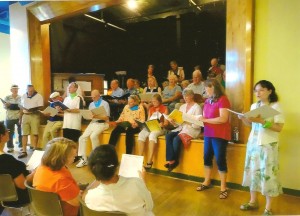
All Present with the OK Chorale--before the big shift.  Photo by Kay Groves

All Present with the OK Chorale–before the big shift. Photo by Kay Groves


FriendsTravel

August 22, 2014

Walla Walla Summer, 2014

Tags: , , , ,

For my annual pilgrimage to Walla Walla, I decided to fly instead of drive. I hadn’t flown since 2009 so I was rusty on the procedure. I scored an expedited pass so I didn’t have to take off my shoes, but the water bottle I meant to leave in the car was still in my bag and that held up the line. I had too many carry-ons with me so I crammed one bag into the other. The flight is only long enough to get in the air, get the drinks cart up and down the aisle, collect one’s things and get off the plane. The drinks cart passed my row several times with no joy when we began the descent.

“Did they just ignore us?” I asked my seat mate, a winemaker whose arms were covered with interesting tattoos and on whose earlobes were a couple of earrings that looked like heavy bolts. His carry-on was a little cooler and I was dying to know what was in it.

“I think they did,” he said.

“Just us?”

“Yep.”

We both shrugged, collected our belongings and de-planed.

Putzer the Attorney was home recovering from knee surgery and though I had the option of waiting for James to leave work to come collect me, I had the unaccountable desire to take a taxi. A taxi in Walla Walla. It must stem from having been a student here, back in the days when I had never been in a taxi and it felt like a dangerously adult thing to do. Also the airport being about 5 miles away, it seemed silly to not take a taxi for the $3 it was going to cost.

It cost $16. Plus the driver had BO and talked too much. Now I’ve had the experience I won’t need to do it again.

The plane had been two hours late leaving Seattle. Door to door from my house to Putzer’s: if I had driven, it would have taken me an extra fifteen minutes and I would have felt no less drained.  I felt keenly the snub my row received from the airlines, which shall go nameless because a friend works for them.

My first morning I went for a walk while it was still only 70 degrees and the sun was hidden by clouds. I walked the few blocks to Mountain View Cemetery where reside quite a number of my family on my father’s side. I found my grandparents’ graves at the corner of Cypress and Pine. I’d like to have a go at their headstones with a wire brush and some Mr Clean; the dates are almost unreadable. Louise Knott Richmond died in December of 1918 from the Spanish flu. That burial must have been bleak. The lovely old trees in the cemetery wouldn’t have been there then. Mountain View was most likely out of town in 1918 and Louise and Charles are on its very edge. Closer to the center of things is the Knott family plot. There lie the greats and the grands. There’s a story in there somewhere as to why Charles and Louise are buried so far from the rest of the family. I think my great grand-father wasn’t all that enamored of his son-in-law (One of those damn wheat farmers from Prescott.)

After paying my respects and trodding on the graves, I started back. I was at a bus-stop when the trolley came by and since the fare was free and I was still feeling indignant about the expense of the taxi, I, on impulse, hopped aboard. I got off at 2nd and Poplar and walked to Main Street where I bought an iced-coffee at Olive’s, which I still think of as Merchant’s (that’s inside information) and went in search of Putzer’s office. I had two reasons for dropping in. One was to see a painting of mine, which had been hanging in my living room for a year with a sold sign on it and which now hangs in Putzer’s office. The other reason was to ask the office assistant to call Putzer at home and tell her I was at large in downtown Walla Walla and would be back as soon as I caught the trolley again.

At the bus-stop was a sign saying the trolley followed the same route it took from 1906-1919. I tried to imagine 2nd Ave in 1906, the year my great-grandfather and his two youngest daughters, made the trip back to Cornwall. Maybe the trolley down 2nd Ave was the beginning of that long trip across the U.S. and the Atlantic Ocean to England. Or in 1918, the year Louise died. My father was eight years old. Did he take the trolley down to Main Street to a candy shop? I could smell cooking at Bright’s Candies when I came out of Olive’s with my coffee, but unfortunately they weren’t yet open.

Late morning, Anitra from Putzer’s book group came by for coffee bringing with her clusters of white grapes from her garden. Sharp and sweet, I think I ate most of them over the course of the weekend. I like grapes with pits because they take longer to eat.

In any case Anitra was named after the Peer Gynt character by parents who named another daughter– who grew up to become a buffalo rancher– Thaïs. I say this by way of suggesting that this was an interesting woman. She had been married to a history professor at Whitman and she finished her English degree during her tenure as a faculty wife. Over tea and grapes, the three of us thoroughly dissected the Whitman English department of the 1970s.

When I try to remember what else happened on Friday it all dissipates into the heat of a Walla Walla August.

On Saturday Putzer, Jim and I went for coffee at the Walla Walla Roastery out by the airport. It’s important to say “out by the airport,” partly because the Walla Walla Regional Airport needs all the attention it can get and partly because there are so many good things “out by the airport.” There’s Klicker’s, the produce farm that’s been family owned and operated for nearly one hundred years. There’s the community college, which has a now-famous school of viticulture.

And there are the tasting rooms. I don’t know if it’s true any longer but the word among the wine cognoscenti used to be that the tasting rooms “out by the airport” were run by the least pretentious and most generous vintners. Their rooms weren’t as classy looking on the outside as the ones along the highway or on Main St in Walla Walla, but they had heart. That’s just a little freebie for you. I don’t drink wine.

We split up: I to the Saturday Farmer’s Market, Jim to run errands and Putzer to go home and ice her knee. At the market, the sun was too hot and the music too loud. To get there we had passed the edges of the college and I felt nostalgic for it. I walked back to campus and sat among the trees at Lakem Duckem. I thought about Putzer and Jim living in Walla Walla for over 35 years. Their associations with the town are of people and relationships and daily life. Mine is of memories and a nostalgia for what never was.

In talking about it later, Jim said that all of us have memories and nostalgia for what never was. I realized that my Walla Walla associations are with people and relationships, too. I have friends of forty years who unlike my family in the cemetery are not a memory and a nostalgia.

The rest of the visit dissipates into the heat of a Walla Walla August. The plane home was on time and I scored three servings of cranberry juice.

Lakem Duckem

Lakem Duckem

BooksCharles DickensEnglandLiterature

August 13, 2014

A Tale of Two Cities

Tags: , , , , , , , , , , , , ,

I almost wet myself the first time I read the denouement of Madame Defarge in A Tale of Two Cities and I still love the pacing and tension between the comic and the terrifying in that scene. This book is an old favorite, and one nurtured by a beloved high school English teacher. I can still hear Mrs. LaBelle talking about Jerry Cruncher, the honest tradesman and Jarvis Lorry, the man of business; about the mender of roads in the blue cap who becomes the sawyer in the red cap; 105 North Tower, and the evocative and cryptic “Recalled to life.”

A Tale of Two Cities is a book about death, redemption and retribution with images of such flowing like the blood and the wine from the beatific to the crass. When it opens, it is 1775; Jarvis Lorry, solicitor of Tellson’s Bank and Lucie Manette are on their way from London to Paris to collect Lucie’s father who had been released (recalled to life) from the Bastille where he had been imprisoned for 15 years, long after everyone thought he was dead. He is in safekeeping in the home (and wine shop) of his former servant Ernest Defarge and his wife Therese who, for the moment, merely knits and “sees nothing.” As events unfold, Madame Defarge knits and “sees nothing” often enough as to be unnerving.

Back in London we make the acquaintance of Sydney Carton, lazy, alcoholic reprobate and Charles Darnay, man of such honor and goodness that his teeth gleam. They bear a physical resemblance to each other and both are in love with Lucie, the Dickensian angel du jour. Lucie marries Darnay and becomes the unattainable Beatrice, Laura, and Stella to Sydney Carton.

Fifteen years later, the Revolution is about to explode in France. Charles Darnay receives word that an old family retainer has been thrown in prison by the revolutionaries because of his association with Charles’ family, the aristocratic Evrémondes. Without checking the web cam for Paris, Charles leaves for France and is arrested as an enemy of the Revolution. Jarvis Lorry, Dr. Manette, Lucy and her little girl set out after him. With them are Jerry Cruncher, Lorry’s gopher; and Miss Pross who has been Lucie’s nurse, governess and companion all her motherless life.

Miss Pross and Jerry Cruncher are minor characters but they have more life to them than Lucie and Charles, and I get a kick out of them.  Jerry Cruncher, the honest tradesman, sits outside Tellson’s Bank with rust on his fingers, awaiting orders from Jarvis Lorry. The message with which he is entrusted–“Recalled to life”– worries him because it suggests– to him, if not the reader– a curtailment of some mysterious activity of his. At home he keeps a steady surveillance on his wife to see she isn’t “flopping” against him.

As slowly as these hints are doled out, they are elucidated: Jerry is a “resurrection man,” a grave robber. That’s why his fingers are stained with rust and why he doesn’t much care for the idea of anyone being recalled to life. On one of his Boys’ Nights Out Jerry and his associates dig up a coffin that’s full of rocks; he blames his wife. (“What do you mean by flopping yourself down and praying agin me?”) Only late in the story do we learn that the body supposed to be in the coffin was that of a double agent who is still very much alive.

Miss Pross and Jerry both come to France with the retinue that is determined to free Charles Darnay. There’s a menacing scene when Madame Defarge and her BFF, The Vengeance, pay them a visit, ostensibly to ascertain where the Manettes live in order to spare them in the coming Revolution. But by this time we know what it means that Madame Defarge knits and “sees nothing.” She is creating The Register, a list of names coded into her knitting.

Miss Pross, however, is not impressed. She, with her “rooted conviction that she was more than a match for any foreigner, was not to be shaken by distress and danger, appeared with folded arms, and observed in English to The Vengeance, who her eyes first encountered, “Well, I am sure, Boldface! I hope you are pretty well!” She also bestowed a British cough on Madame Defarge. . .”

Not only does Dr. Manette, with his clout as a former prisoner of the Bastille, fail to get Charles freed from prison, his whole family is knitted into The Register as enemies of the Republic who are to be arrested and eventually guillotined.

This is Sydney Carton’s hour. The nonredeemable lout’s eyes have been raised to visions of goodness merely by brushing up against Lucie Manette in her London drawing room. He hatches a plan to impersonate Charles Darnay and go to the guillotine in his place. While he is exchanging clothes with Darnay in the prison cell, Jarvis Lorry bustles Dr. Manette, Lucie and her daughter out of their Paris lodgings and into a coach that only needs a drugged Charles Darnay to be slopped inside before they can rattle up to the coast and board a ship for England.

It’s at this point that Madame Defarge decides it’s time to dispose of the entire Manette family herself. Her husband has a regrettable tendency towards kindness and he is too fond of Dr. Manette. Madame takes a pistol and a knife and sets off. “There were many women upon whom the time laid a dreadfully disfiguring hand, but there was not one among them more to be dreaded than this ruthless woman now taking her way along the streets. Of a strong and fearless character, of shrewd sense and readiness. . .  She was absolutely without pity. . .”

Jerry Cruncher and Miss Pross are to follow the Manettes in a separate coach. They have seen the Manettes and Charles Darnay off and were “concluding their arrangements to follow the coach even as Madame Defarge, taking her way through the streets, now drew nearer and nearer.” Jerry and Miss Pross get into a discussion about whether it might not be better to take their departure from a different street seeings as how one coach has already left the area. Two might look suspicious.

“And still Madame Defarge, pursuing her way along the streets, came nearer and nearer.”

Jerry has an explosion of conscience and guilt and starts to unburden himself about moonlighting in graveyards. He goes on incoherently about his wife’s predilection for “flopping.”

“Whatever housekeeping arrangement that may be,” said Miss Pross. . . “I have no doubt it is best that Mrs. Cruncher should have it entirely under her own supervision.”

Jerry fervently hopes she is flopping for him right now.

“And still Madame Defarge, pursuing her way along the streets, came nearer and nearer.”

Miss Pross tacks back to her idea of leaving in a coach from a different street.

“Madame Defarge was drawing very near indeed.”

Miss Pross takes a final tour through the empty rooms, and then leans over a basin to splash cold water on her face. As she comes up from one such splash, she sees Madame Defarge standing in the doorway.

“The wife of Evrémonde; where is she?”

Miss Pross with great presence of mind runs to shut the doors of all the empty rooms in order to obscure the fact that the birds had flown. She plants herself firmly in front of Lucie’s door.

“Years had not tamed the wildness nor softened the grimness of her appearance; but she too was a determined woman in her different way, and she measured Madame Defarge with her eyes, every inch. . .

Madame Defarge looked at her scornfully, but still with something of Miss Pross’ own perception that they two were at bay. . .

‘On my way yonder,’ said Madame Defarge. . . ‘where they reserve my chair and my knitting for me. I am come to make my compliments to her in passing.’

‘I know your intentions are evil,’ said Miss Pross.  .  .

Each spoke in her own language; neither understood the others’ words; both were very watchful, and intent to deduce from look and manner, what the intelligible words meant.”

Every critics in history may agree that Dickens needs an editor, but I already feel I have travestied his writing by cutting out numerous paragraphs to suggest the suspense this scene carries. I love the build-up.

Anyway, the two women struggle. Miss Pross gets Madame Defarge in a lock. The pistol goes off. Madame Defarge takes the bullet. Miss Pross and Jerry Cruncher get away.

Sydney Carton achieves his redemption if redemption is something one can be said to achieve. He goes to the guillotine in place of Charles Darnay. Charles Darnay gets through all the roadblocks on Sydney Carton’s travelling papers.

A Tale of Two Cities begins and ends with two of the most famous passages in English literature.

The Beginning:
It was the best of times, it was the worst of times, it was the age of wisdom, it was the age of foolishness, it was the epoch of belief, it was the epoch of incredulity, it was the season of Light, it was the season of Darkness, it was the spring of hope, it was the winter of despair. We had everything before us, we had nothing before us, we were all going direct to Heaven, we were all going direct the other way— in short, the period was so far like the present period, that some of its noisiest authorities insisted on its being received, for good or for evil, in the superlative degree of comparison only.

The End, spoken by Sydney Carton at the end of an operatic speech at the mouth of the guillotine:

“It is a far, far better thing that I do, than I have ever done; it is a far, far better rest that I go to than I have ever known.”

This book is only corny because it’s so well known. It’s well known because it’s been so loved. I can’t get through it without sobbing.